
You are using an out of date browser. It may not display this or other websites correctly.
You should upgrade or use an alternative browser.
You should upgrade or use an alternative browser.
Tab and Slot / Certiflat Weld Table
- Thread starter houdni
- Start date
jeepinerdeep
Well-known member
I got ship notification today. Week or so ago I ordered 2 fab wings to hang off the edge of a traditional plate table I'm building. Thought it would neat. Hoping for best of both worlds.
stretchkelvinski
New member
I built one of these a couple of months ago, about the time this thread started. I didn't find a lot of info on them when I built mine. Thought I would share my pics on here for anyone interested. 
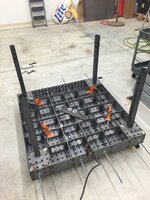

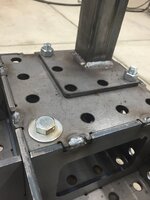

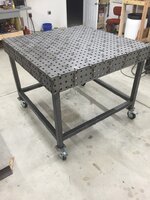
Here's one (well two...) I designed for our shop. Each face of the table is two 7/16" plates layered together. The sides are plug welded from the inside, and the top is held on by bolts so it can be replaced once it gets worn out.
When I saw this thread I had to laugh at how similar in concept they are.
View media item 55714
When I saw this thread I had to laugh at how similar in concept they are.
View media item 55714
Here's one (well two...) I designed for our shop. Each face of the table is two 7/16" plates layered together. The sides are plug welded from the inside, and the top is held on by bolts so it can be replaced once it gets worn out.
When I saw this thread I had to laugh at how similar in concept they are.
Nice looking tables. Was there a special reason you sandwiched two 7/16 plates rather going with one thick plate?
4 FN 27
ALLIANCE MEMBER
I have built an number of Weld tables over the years but nothing like this. Pretty cool. I think I'll make an attempt at building one with a thicker top so I can have in Blanchard ground after all the welding is complete.
I like the idea of the replaceable top.
Years ago I build a couple Chassis Tables. 6 x 18 feet with 3/8 holes on 3 inch centers. Built a few car on them myself and they are floating between local chassis shops today as far as I know.
Worked great for making sure everything is where it should be.


I like the idea of the replaceable top.
Years ago I build a couple Chassis Tables. 6 x 18 feet with 3/8 holes on 3 inch centers. Built a few car on them myself and they are floating between local chassis shops today as far as I know.
Worked great for making sure everything is where it should be.
Last edited:
Nice looking tables. Was there a special reason you sandwiched two 7/16 plates rather going with one thick plate?
Having a replaceable top was one of the factors as houdni mentioned. The original plan was to use standard carbon steel for the core and sides, and then to use A400 on the top for better durability. We decided to make the whole thing out of standard carbon steel to see how well it held up, so far so good.
Also, there are several side benefits to this approach... the kerf on a laser cut plate is less noticeable on thinner material, allowing tighter tolerances to be designed into the final product. I was able to incorporate tab and slot reinforcement plates into the core structure while having a clean and flat outer work surface. Finally, two pieces of 7/16" plate is cheaper than one piece of 7/8" plate.


txvwnut
Well-known member
Nice! 
motofool33
Well-known member
Nice Project, i tried to get these guys to make me a folding table so better storage but they didn't like the designs and wouldn't ever sell me one.
cvairwerks
Well-known member
Motofool33: You could make the legs fit a permanent socket and have a knock down base using taper drifts and slots. Not foldable, but take down within a minute or less...
motofool33
Well-known member
Motofool33: You could make the legs fit a permanent socket and have a knock down base using taper drifts and slots. Not foldable, but take down within a minute or less...
while im not sure what all of your statement meant, my thoughts were a Hinge Point and grab one side with forklift and unbolt the stabilizing points and allow it to be stored in the vertical position against the wall.
cvairwerks
Well-known member
I'll try to word it in a more descriptive way. Think of how a Morse taper on a drill press is knocked apart, Use the same sort of setup, straight rather than a taper, but the wedge is to lock the joint instead, like a mortise and tenon joint in woodworking.
motofool33
Well-known member
I'll try to word it in a more descriptive way. Think of how a Morse taper on a drill press is knocked apart, Use the same sort of setup, straight rather than a taper, but the wedge is to lock the joint instead, like a mortise and tenon joint in woodworking.
sounds like a good idea there.
cvairwerks
Well-known member
Motofool: Check out post # 1 and 2 on this thread. It'll show you what I was thinking.
garagejournal.com/forum/showthread.php?t=330151
garagejournal.com/forum/showthread.php?t=330151
motofool33
Well-known member
Motofool: Check out post # 1 and 2 on this thread. It'll show you what I was thinking.
garagejournal.com/forum/showthread.php?t=330151
awesome. Ive got a mill now just need to learn how to lay that out.
sorry folks...i broke down....and decided to upgrade....the certiflat table is a very good introduction table as well as value of what these tables are capable of....
if you do decide to get these table....youll have to figure out how to lift them up....this one is 1200 lbs....just something to consider...
this is one of their newer table...the buildpro max...that is why there is no big gaps between plates...

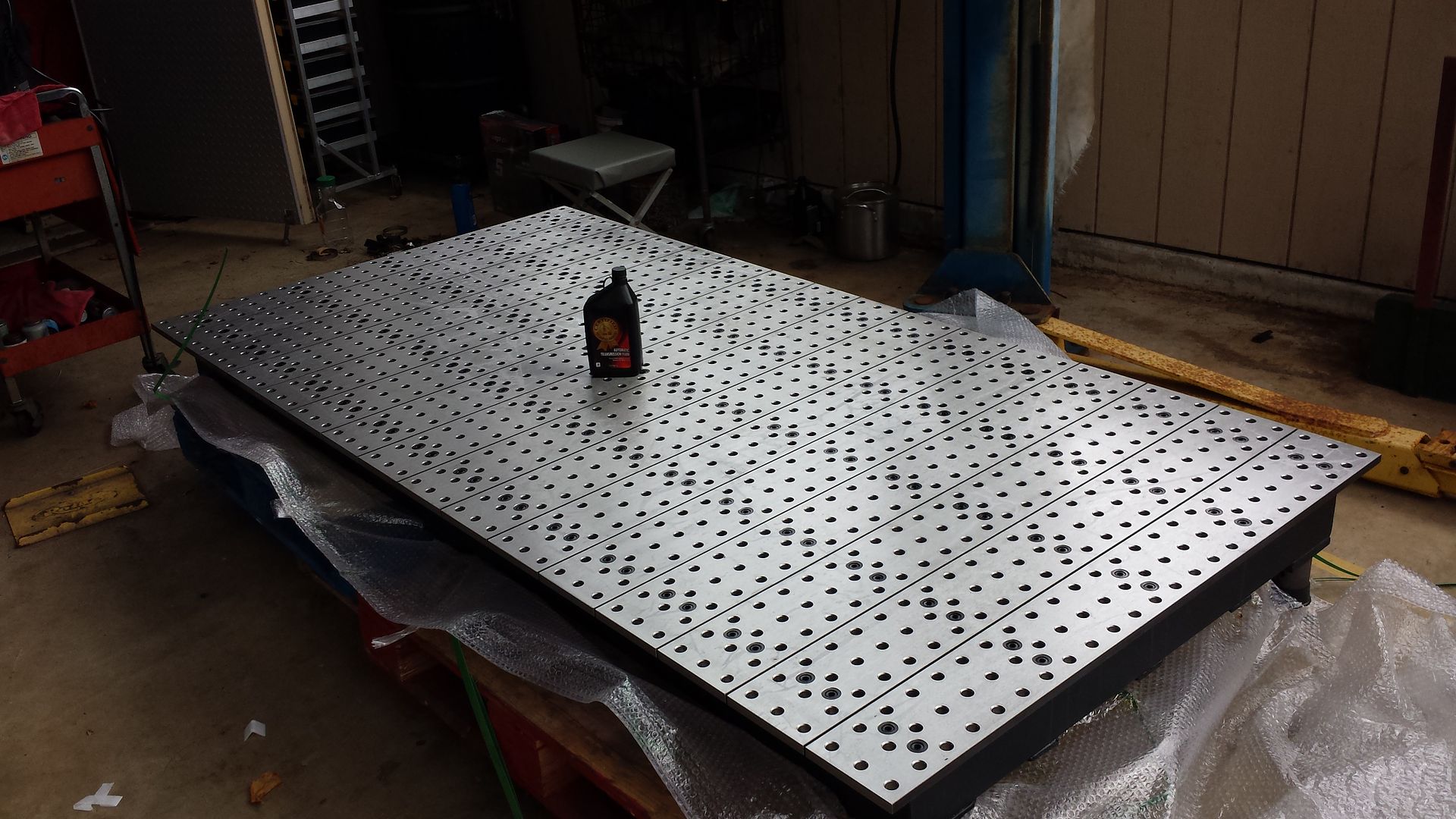

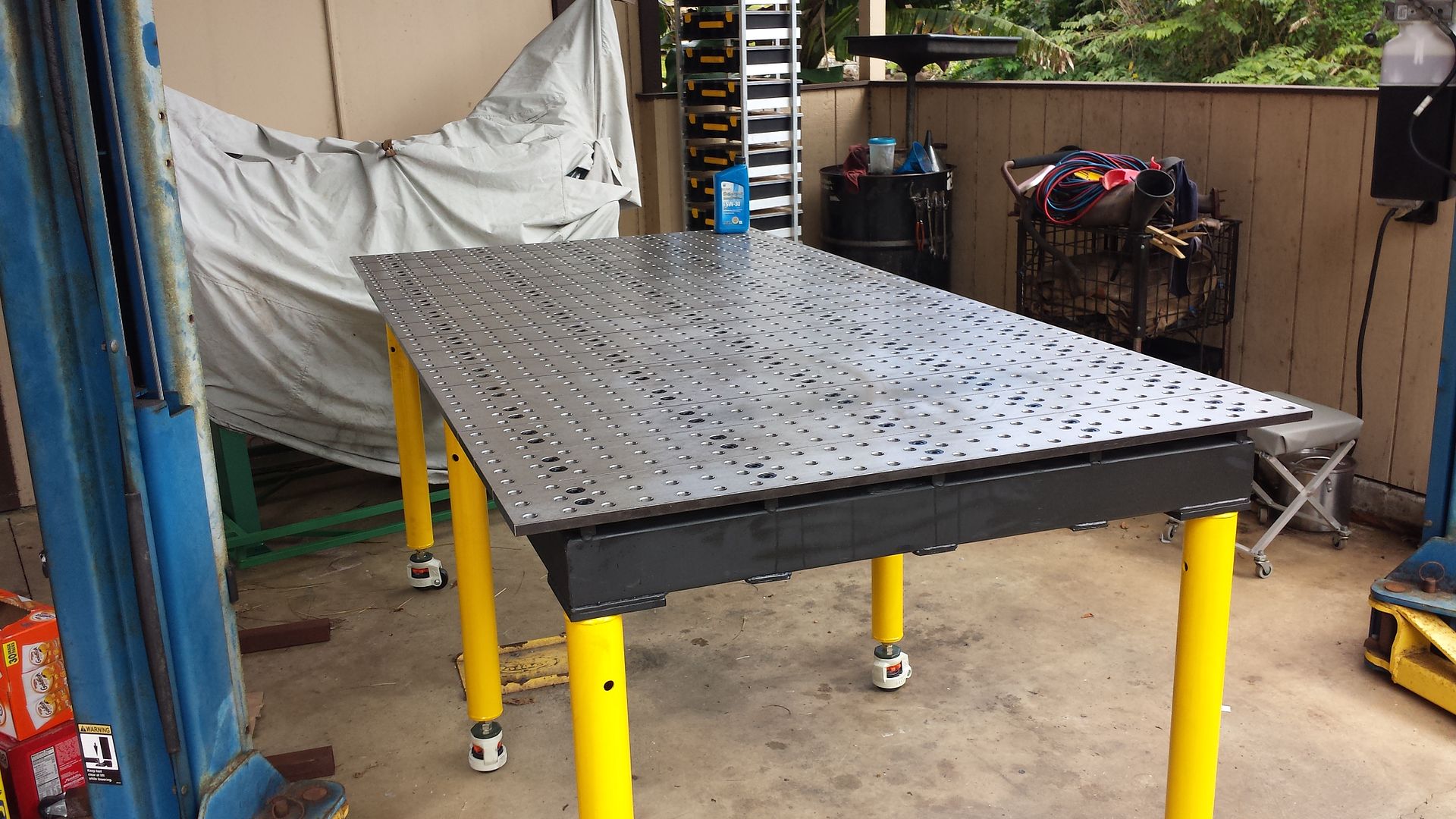
if you do decide to get these table....youll have to figure out how to lift them up....this one is 1200 lbs....just something to consider...
this is one of their newer table...the buildpro max...that is why there is no big gaps between plates...
drc42
Active member
I was about to just buy some steel and weld together a simple table of my own when I discovered these. I ended up going for the 2' x 4' "pro series" (not the full/thick "fab block" design but plenty good for my needs).
Pretty happy with how it went together. Of course I have yet to use it for any welding projects (other than welding the table itself together of course).
I put together a little youtube video of the assembly for anybody interested.
I was about to just buy some steel and weld together a simple table of my own when I discovered these. I ended up going for the 2' x 4' "pro series" (not the full/thick "fab block" design but plenty good for my needs).
Pretty happy with how it went together. Of course I have yet to use it for any welding projects (other than welding the table itself together of course).
I put together a little youtube video of the assembly for anybody interested.
<iframe width="560" height="315" src="https://www.youtube.com/embed/a4mRp6AdsG8" frameborder="0" allowfullscreen></iframe>
Pretty happy with how it went together. Of course I have yet to use it for any welding projects (other than welding the table itself together of course).
I put together a little youtube video of the assembly for anybody interested.
I was about to just buy some steel and weld together a simple table of my own when I discovered these. I ended up going for the 2' x 4' "pro series" (not the full/thick "fab block" design but plenty good for my needs).
Pretty happy with how it went together. Of course I have yet to use it for any welding projects (other than welding the table itself together of course).
I put together a little youtube video of the assembly for anybody interested.
<iframe width="560" height="315" src="https://www.youtube.com/embed/a4mRp6AdsG8" frameborder="0" allowfullscreen></iframe>
Bigblue&Goldie
Well-known member
I ended up buying one of the 2'x3' table kits and welded it up on Saturday. I had 4 big C-clamps for the corners and I went to HF and got 6 small bar clamps for $3/each to hold the rest of the frame work while welding. I didnt bother trying to get it as flat as possible, but it still turned out pretty decent. Overall, they are a great deal that produces a very nice end product. I would definitely recommend them to others.
CGT80
Well-known member
I have two 30x30 fab blocks and two 30" wings and I built a frame to hold them with adjustable legs. It goes from around 28" to 44" tall by turning nuts in the top of the legs with a 7/16" socket, through the holes in the top of the table. This allows me to also level the table since the garage floor is so uneven.
The casters are quality units from Mc Master Carr and were not cheap at $35 each, but they work great and the table is surprisingly sturdy even when the legs are extended. The thing can hardly be budged to even cause movement when pushing on it. It probably weighs 600 pounds.
It's been a while, but I think there might have been one area where a 15 thousandths feeler would pass under a 4' level. I had to shim the parts to get them that close and I used a few different squares to compare since it is nearly impossible to find a dead nuts on square unless you pay big bucks for a large machinist square. With the top that flat, I won't be able to blame it when something doesn't turn out right.
Later, I added pairs of triangles in double width and 3 different sizes including the 14" tall units. They can be clamped to the table and then projects can be run vertically at 90 degrees to the table and clamped to the triangle. One set is assembled and I still need to do the other two sets.
While I was disappointed in trying to get the tables flat and square all around they were the best solution for a small space and low to mid range budget. I have no regrets and am thrilled to have such a great setup now.
View media item 72994
View media item 72910View media item 72909View media item 72911
The casters are quality units from Mc Master Carr and were not cheap at $35 each, but they work great and the table is surprisingly sturdy even when the legs are extended. The thing can hardly be budged to even cause movement when pushing on it. It probably weighs 600 pounds.
It's been a while, but I think there might have been one area where a 15 thousandths feeler would pass under a 4' level. I had to shim the parts to get them that close and I used a few different squares to compare since it is nearly impossible to find a dead nuts on square unless you pay big bucks for a large machinist square. With the top that flat, I won't be able to blame it when something doesn't turn out right.
Later, I added pairs of triangles in double width and 3 different sizes including the 14" tall units. They can be clamped to the table and then projects can be run vertically at 90 degrees to the table and clamped to the triangle. One set is assembled and I still need to do the other two sets.
While I was disappointed in trying to get the tables flat and square all around they were the best solution for a small space and low to mid range budget. I have no regrets and am thrilled to have such a great setup now.
View media item 72994
View media item 72910View media item 72909View media item 72911
drc42
Active member
CGT80, that is one slick setup! Nice job!
loveall13
Well-known member
sorry folks...i broke down....and decided to upgrade....the certiflat table is a very good introduction table as well as value of what these tables are capable of....
if you do decide to get these table....youll have to figure out how to lift them up....this one is 1200 lbs....just something to consider...
this is one of their newer table...the buildpro max...that is why there is no big gaps between plates...
I've got a 4'x8' Build Pro Max coming to my high school welding shop in the next couple of weeks! Which fixturing kit did you get? I'm looking at the 172 piece.
i started piecing when i had my certiflat table...ive been buying a little at a time so it doesnt hit me too hard in the wallet....
on the side note....ive noticed the certiflat table have gotten some bigger sizes...not to mention you can now buy them in different thickness... before the fab blocks were only in 1/4".
on the side note....ive noticed the certiflat table have gotten some bigger sizes...not to mention you can now buy them in different thickness... before the fab blocks were only in 1/4".
Jawn
Well-known member
I have two 30x30 fab blocks and two 30" wings and I built a frame to hold them with adjustable legs. It goes from around 28" to 44" tall by turning nuts in the top of the legs with a 7/16" socket, through the holes in the top of the table. This allows me to also level the table since the garage floor is so uneven.
The casters are quality units from Mc Master Carr and were not cheap at $35 each, but they work great and the table is surprisingly sturdy even when the legs are extended. The thing can hardly be budged to even cause movement when pushing on it. It probably weighs 600 pounds.
It's been a while, but I think there might have been one area where a 15 thousandths feeler would pass under a 4' level. I had to shim the parts to get them that close and I used a few different squares to compare since it is nearly impossible to find a dead nuts on square unless you pay big bucks for a large machinist square. With the top that flat, I won't be able to blame it when something doesn't turn out right.
Later, I added pairs of triangles in double width and 3 different sizes including the 14" tall units. They can be clamped to the table and then projects can be run vertically at 90 degrees to the table and clamped to the triangle. One set is assembled and I still need to do the other two sets.
While I was disappointed in trying to get the tables flat and square all around they were the best solution for a small space and low to mid range budget. I have no regrets and am thrilled to have such a great setup now.
I love the adjustable legs. I was thinking of doing something similar for my table. How wobbly is it without tightening those T-handles on the sides of the legs? What size (and thickness) tubing for both inner and outer leg?
mowkep
Well-known member
Too funny. Our shop makes a similar sort of table of out magnesium for a customer. I pre-mill all of the parts and pre-assemble it. We then send it to our welder who is a magician. Needless to say they warp/shrink/twist like crazy and have to be straightened. There is an 1/8 that gets milled off the top so it has to be flat within reason. That being said, the welder welds these tables on two oversized aluminum saw horses. LOL
Last edited:
sberry
Banned
Yup, most of the worlds work is done that way.That being said, the welder welds these tables on two oversized aluminum saw horses. LOL
CGT80
Well-known member
I love the adjustable legs. I was thinking of doing something similar for my table. How wobbly is it without tightening those T-handles on the sides of the legs? What size (and thickness) tubing for both inner and outer leg?
I used 2" by 3/16" weathering steel tube for the outer leg. I bought extra when I did a job and this is a drop from that job, used for fit up. I'm no machinist.
The ID of the outer is 1-5/8" and the inner tube is 1-1/2" by 1/8" wall. That left an 1/8" so I plasma cut some shims from 16ga steel and welded them inside the outer legs by drilling 3/8" holes and doing rosette welds and I'm pretty sure I did two sides of the tube.
Right now the table is almost all the way down and there is a little movement when I unscrew one handle. When it is very high and the handles have not been tightened, it moves a little but not bad. When tightened at full height, it is surprisingly sturdy. With proper telescopic tube it might be better and I was limited on extra length on the legs as it was a balancing act to give it as much range in height as possible while fitting the acme thread and nuts inside and keeping it under the surface of the top plate.
View media item 73268
View media item 73269
Jawn
Well-known member
I used 2" by 3/16" weathering steel tube for the outer leg. I bought extra when I did a job and this is a drop from that job, used for fit up. I'm no machinist.
The ID of the outer is 1-5/8" and the inner tube is 1-1/2" by 1/8" wall. That left an 1/8" so I plasma cut some shims from 16ga steel and welded them inside the outer legs by drilling 3/8" holes and doing rosette welds and I'm pretty sure I did two sides of the tube.
Right now the table is almost all the way down and there is a little movement when I unscrew one handle. When it is very high and the handles have not been tightened, it moves a little but not bad. When tightened at full height, it is surprisingly sturdy. With proper telescopic tube it might be better and I was limited on extra length on the legs as it was a balancing act to give it as much range in height as possible while fitting the acme thread and nuts inside and keeping it under the surface of the top plate.
Thanks!
I have some 2" and 1.75", both appear to be 1/8" wall... left from someone else's project where they were intended to telescope for something else, but I think I'll do something like what you've done.