To avoid these ads, REGISTER NOW!

To restore or not to restore?

Jaxwagen

Member
Joined
Dec 28, 2016
Messages
19
Location
PGH
I have recently inherited a bunch of old hand tools. The only ones I have been able to identify are some Vlchek wrenches. My question is, are these the types of wrenches you want to restore, or is the type of rust/patina you want to leave alone? I also don't want to ruin what little is left of the makers marks. I don't see myself really using these as I have their more modern equivalents, but I also don't want to throw them out. Any input or maybe identifications? Thanks

 
To avoid these ads, REGISTER NOW!

Rileysan

Well-known member
Joined
Sep 11, 2015
Messages
4,298
Location
Milwaukie, Oregon
I have recently inherited a bunch of old hand tools. The only ones I have been able to identify are some Vlchek wrenches. My question is, are these the types of wrenches you want to restore, or is the type of rust/patina you want to leave alone? I also don't want to ruin what little is left of the makers marks. I don't see myself really using these as I have their more modern equivalents, but I also don't want to throw them out. Any input or maybe identifications? Thanks


There's very little value in these regardless of what you do. I'd leave them alone
 

EOC_Jason

Well-known member
Joined
Jun 25, 2012
Messages
11,388
Location
Bentonville, AR
If they aren't worth big money and you want to keep, I might go over with a brass brush to clean off any excessive rust, then oil or paste wax as someone else said and use them.
 

JMLangford

Well-known member
Joined
Jun 25, 2014
Messages
1,122
Location
Upstate SC
I've got a question as far as collectors and collecting goes.......

If the tools are rusty (I don't consider rust a patina! :headshake) but can be cleaned up to nice and shiny.....does that kill the "collectior" value ???

what say ye?


.
 

EOC_Jason

Well-known member
Joined
Jun 25, 2012
Messages
11,388
Location
Bentonville, AR
Me personally....

Patina = Good
Rust = Bad

I clean off rust, even if it means having to clean the whole tool to get the color even. If there is rust then it will continue to rust and deteriorate the tool...
 

jd_1138

Well-known member
Joined
May 8, 2013
Messages
17,059
Location
NE Ohio
Be careful, as some old tools contain dangerous chemicals that can be released while restoring them. Is it lead? Or something else?
 

kwoswalt99

Well-known member
Joined
Oct 24, 2015
Messages
701
Location
Detroit
Be careful, as some old tools contain dangerous chemicals that can be released while restoring them. Is it lead? Or something else?

You're thinking of cadmium plating.

Be-Cu non-sparking tools too.
 
Last edited:

notlob

Well-known member
Joined
Aug 19, 2013
Messages
1,384
Location
norcal
Be careful, as some old tools contain dangerous chemicals that can be released while restoring them. Is it lead? Or something else?

You are likely talking about cadmium plating, which, especially during WWII, was used instead of chrome plating as a corrosion-resistant finish for tools (chrome was a strategic material reserved for the war effort). Cadmium finished tools are very common, and typically have a non-glossy whitish-silver appearance, which tends to become mottled with age.

You also might be referring to beryllium, which was, and in a few instances still is, alloyed with copper in tools designed to not create sparks when used. These tools are generally used in explosive and other hazardous environments such as mining, refineries, and grain silos. These tools are fairly uncommon, appear to be made of brass or bronze, and are typically marked Be-Cu (for beryllium-copper). Ampco and Berylco are the most common brands.

Cadmium and beryllium are both toxic, so you should not grind, sand, or wire wheel these tools.
 
Last edited:

jd_1138

Well-known member
Joined
May 8, 2013
Messages
17,059
Location
NE Ohio
Yeah that's what I was thinking of. Just wanted to give the OP a heads up if he's new to the classic tool hobby.
 

pendragon1998

Well-known member
Joined
Mar 24, 2012
Messages
3,733
Location
NE Georgia
Rare tools, I would say leave intact for collectors common antique tools, I have no problem personally with a restoration if you plan on using them.

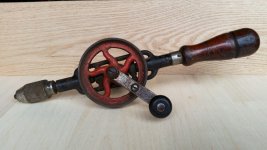
Here's a hand drill I recently sold after doing a full restoration. It's common enough that I wasn't committing a crime against posterity.

attachment.php


attachment.php
 

Attachments

  • 14844434277610.jpg
    14844434277610.jpg
    135.9 KB · Views: 395
  • 14844434827691.jpg
    14844434827691.jpg
    74.5 KB · Views: 395
To avoid these ads, REGISTER NOW!

6PTsocket

Well-known member
Joined
Mar 12, 2014
Messages
4,593
Rare tools, I would say leave intact for collectors common antique tools, I have no problem personally with a restoration if you plan on using them.

Here's a hand drill I recently sold after doing a full restoration. It's common enough that I wasn't committing a crime against posterity.

attachment.php


attachment.php
That looks really nice.
You are likely talking about cadmium plating, which, especially during WWII, was used instead of chrome plating as a corrosion-resistant finish for tools (chrome was a strategic material reserved for the war effort). Cadmium finished tools are very common, and typically have a non-glossy whitish-silver appearance, which tends to become mottled with age.

You also might be referring to beryllium, which was, and in a few instances still is, alloyed with copper in tools designed to not create sparks when used. These tools are generally used in explosive and other hazardous environments such as mining, refineries, and grain silos. These tools are fairly uncommon, appear to be made of brass or bronze, and are typically marked Be-Cu (for beryllium-copper). Ampco and Berylco are the most common brands.

Cadmium and beryllium are both toxic, so you should not grind, sand, or wire wheel these tools.

Yeah that's what I was thinking of. Just wanted to give the OP a heads up if he's new to the classic tool hobby.


Sent from my SM-G900V using Tapatalk
 

woody 73

Well-known member
Joined
Apr 14, 2009
Messages
11,546
Location
The Great State Up North
As a collector I look for condition, condition, condition first and patina is important. I tend to pass up rusty tools unless...they are rare and do not come to market very often.

With rust (I have had my share) I clean them up because leaving the rust on will only speed up the process of killing the tool.

With a full restore (they do look great) but the value is most times just not there. A collector wants it to look like the day it was made with the box it came in.

Sometimes the very box is worth more then the item!

Sometimes a coat of paint will hide things like cracked metal, hide rust pit marks, hide abuse marks etc.

Just my two cents as a vintage tool collector.
 

Rileysan

Well-known member
Joined
Sep 11, 2015
Messages
4,298
Location
Milwaukie, Oregon
I learned long ago that anytime you clean or restore old stuff the value plummets.
I've seen so many idiots kill value by doing it.
Well intentioned but totally misguided.
Ask appraisers. They will tell you the same.

You will have a hard time convincing me or most other hand tool collector of this. There are very few rare hand tools out there and even fewer that would be considered "damaged goods" because you cleaned them.

Brian
 

vettex2

Banned
Joined
Jul 30, 2012
Messages
1,146
Location
Northern Ca.
You will have a hard time convincing me or most other hand tool collector of this. There are very few rare hand tools out there and even fewer that would be considered "damaged goods" because you cleaned them.

Brian
Frankly, I don't have to convince you. Nor do I care to.:lol::lol:
 
Last edited:

four.cycle

Well-known member
Joined
Oct 19, 2015
Messages
28,953
Location
Tacoma, Washington
There are valid arguments pro and con on "restoration".
Those old open-ends are a dime a dozen because there are so many of them out there. I would do as has been suggested and just wipe them down with oil (or wax) to prevent any further deterioration. The big combination wrench is rusty, and (as mentioned) if the rust is not removed, it will just continue to get worse.

Are you buying or selling or collecting? All depends upon what your goal is.
If you're selling, leave it the hell alone. As the owner of all kinds of old oddball items, I want them exactly like they are. I wouldn't think about trying to remove the dent from the fuel tank on my 1913 Aladdin model B kerosene lantern or "fixing" any number of other things around here - it would destroy any "value" (be that monetary or intrinsic) the piece might have.

Some will disagree. There are two camps on this. I've done stuff like what Pendragon did with that drill, but it was for my own use on an item I intended to use, not hang on the wall or set on a shelf to look at.

There was an episode on Antiques Roadshow years ago in which a lady brought an old side table in for an appraisal. The original finished had been removed and replaced with modern stain and polyurethane. The two hosts marveled at the lady's table, and told her it was worth a lot of money. Then they added had she not refinished it, it would have been worth about 50 times as much. Something worth considering - a collector is a collector, whether it's side tables or wrenches.

So no, this gem will not see a buffing wheel:
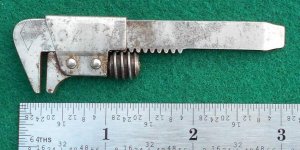
Gormully & Jeffery Mfg. Co. 3-inch bicycle wrench 01.jpg
 

Rileysan

Well-known member
Joined
Sep 11, 2015
Messages
4,298
Location
Milwaukie, Oregon
There are valid arguments pro and con on "restoration".
Those old open-ends are a dime a dozen because there are so many of them out there. I would do as has been suggested and just wipe them down with oil (or wax) to prevent any further deterioration. The big combination wrench is rusty, and (as mentioned) if the rust is not removed, it will just continue to get worse.

Are you buying or selling or collecting? All depends upon what your goal is.
If you're selling, leave it the hell alone. As the owner of all kinds of old oddball items, I want them exactly like they are. I wouldn't think about trying to remove the dent from the fuel tank on my 1913 Aladdin model B kerosene lantern or "fixing" any number of other things around here - it would destroy any "value" (be that monetary or intrinsic) the piece might have.

Some will disagree. There are two camps on this. I've done stuff like what Pendragon did with that drill, but it was for my own use on an item I intended to use, not hang on the wall or set on a shelf to look at.

There was an episode on Antiques Roadshow years ago in which a lady brought an old side table in for an appraisal. The original finished had been removed and replaced with modern stain and polyurethane. The two hosts marveled at the lady's table, and told her it was worth a lot of money. Then they added had she not refinished it, it would have been worth about 50 times as much. Something worth considering - a collector is a collector, whether it's side tables or wrenches.

So no, this gem will not see a buffing wheel:

Gormully & Jeffery Mfg. Co. 3-inch bicycle wrench 01.jpg

I have seen the episode you speak of. The lessons learned regarding 17th & 18th century hand-made furniture do not correlate to mass-produced hand tools of the 20th century.

I also have 35 years of stamp collecting experience to draw from. Common stamps from the 19th century, no matter how old they are, are still common (one 2 cent stamp from the 1890s had more than 15,000,000,000 printed). In those cases, only in a million will fetch a premium because there is something exceptional about it.

Back to the hand tools question. Unless it's a rare item, do whatever you want to them. The patina on these tools has zero impact on their current or future value.
 
Last edited:

EOC_Jason

Well-known member
Joined
Jun 25, 2012
Messages
11,388
Location
Bentonville, AR
I guess if you don't want to use them, and you don't want to risk cleaning them... You could just pack them in cosmoline and forget about them for a few decades... lol.
 

DuroChrome

Well-known member
Joined
Apr 24, 2015
Messages
323
Location
Oregon
Maybe put them in evaporust and then clean them up with a brass brush or plastic 'tuffy' scrubber. If it was a complete set of ancient rare tools in an original case I might leave it alone but if you want to trick out the ones you have go for it. I have an old Plomb toolbox that has some surface rust and missing paint on the outside...but the original logo is in pretty good shape on the inside. I'm not going to 'restore' it because then it won't be original. It's only original once.
 

RStewart

Well-known member
Joined
Jul 10, 2013
Messages
1,767
Location
a little north of boston
There are valid arguments pro and con on "restoration".
Those old open-ends are a dime a dozen because there are so many of them out there. I would do as has been suggested and just wipe them down with oil (or wax) to prevent any further deterioration. The big combination wrench is rusty, and (as mentioned) if the rust is not removed, it will just continue to get worse.

Are you buying or selling or collecting? All depends upon what your goal is.
If you're selling, leave it the hell alone. As the owner of all kinds of old oddball items, I want them exactly like they are. I wouldn't think about trying to remove the dent from the fuel tank on my 1913 Aladdin model B kerosene lantern or "fixing" any number of other things around here - it would destroy any "value" (be that monetary or intrinsic) the piece might have.

Some will disagree. There are two camps on this. I've done stuff like what Pendragon did with that drill, but it was for my own use on an item I intended to use, not hang on the wall or set on a shelf to look at.

There was an episode on Antiques Roadshow years ago in which a lady brought an old side table in for an appraisal. The original finished had been removed and replaced with modern stain and polyurethane. The two hosts marveled at the lady's table, and told her it was worth a lot of money. Then they added had she not refinished it, it would have been worth about 50 times as much. Something worth considering - a collector is a collector, whether it's side tables or wrenches.

So no, this gem will not see a buffing wheel:

Gormully & Jeffery Mfg. Co. 3-inch bicycle wrench 01.jpg
Is that wrench a Mossberg?
 

leg17

Well-known member
Joined
Aug 11, 2011
Messages
1,374
Location
Kentucky
Cleaning is good. But cleaning means cleaning, ie. dirt, grime, etc.
"Restoring" .... it all depends.
Keeping a tool in usable condition is not the same as trying to make a tool in like new condition. It all depends.
 
Last edited:

2oolhound

Well-known member
Joined
Dec 18, 2010
Messages
5,918
Location
BC Canada
Since you want to keep them but not use them (for good viable reasons) you might try turning them into drawer handles. Small on top and big on bottom where the heavier drawers are. I've done this and you get to enjoy them every time you open a drawer. They're always on display.
 
To avoid these ads, REGISTER NOW!
Top Bottom