To avoid these ads, REGISTER NOW!

how to determine crappy power from poco?

99driver

Well-known member
Joined
Mar 7, 2015
Messages
46
Location
Ontario, Canada
I built a new house about 3 years ago. I wired the whole thing myself so I'm fairly sure it was done properly. I'm not counting out my own stupidity but I tend to do quality work.

I've noticed flickering lights. I believe it may happen when high draw items such as A/C turn on.

I have a 200 amp supply.

Recently I had a home theater receiver and sub woofer amplifier stop working at the same time. They just didn't work one day when I turned them on.

We're at the very end of the transmission line and the neighborhood was originally built in the early 50s.

I've read that end of line houses can suffer from low voltage due to under sized transformers.

I tried calling the poco and they said they would look into it. They sent someone to our house when only my wife was home. He was there for 3 minutes and said the power was fine.

I'm thinking that i get occasional voltage drops. Is there something I can use that will track the real time voltage at my house over a week?

Is there something else I should be looking into?
 
To avoid these ads, REGISTER NOW!

LXCam

ALLIANCE MEMBER
Joined
Apr 23, 2013
Messages
19,136
Location
AZ
You need to log the power quality for several days. For your application something as simple as an Amprobe DMII would provide enough data to provide some insight. There are several companies that rent these types of meters you could use or try a contractor. All though depending on what kind of report I need to format when it's complete, I normally charged between 350-500 for a 48-72 hour period when I was contracting.
 

Tool_Master

Well-known member
Joined
Jan 16, 2016
Messages
189
Location
Southern California
LXCam is correct, it sounds like this is a Power Quality issue. I would call POCO and tell them to install a PQ meter. I've seen failing transformers that cause lots of flicker.


Sent from my iPhone using Tapatalk
 

Git

Well-known member
Joined
May 18, 2008
Messages
6,894
Location
S Cal
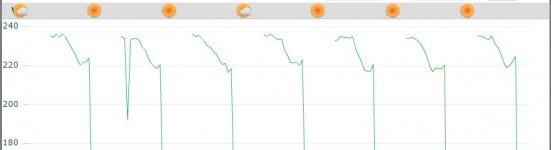
When I first had my solar PV system installed last year, within the first couple of days, the system shut down and threw an error code that the 'ac voltage was too low'. The installers came out, checked everything over and could not find anything wrong with the system (it could have been improper wire size running from the meter)

I ended up calling the inverter manufacturer for more info and they told me that the inverter actually graphs the incoming ac voltage from the grid. Every afternoon (this was during the summer) the 240 volts would slowly drop down to around 215 volts (measured line to line) and if it got under 210 volts it would trip and go off line.

This had been going on for at least 3 weeks and when I realized what was happening I called up the power company and they had it fixed within a couple of days - the problem was at the local substation for our area.

(I should add that I had to argue with the power company about it. When I first called they tried to blow me off and tell me it's just everyone turning on the air conditioners in the afternoon and people coming home from work which was increasing the demand, but I got it escalated finally to the right person) A cap on one of my air conditioners blew about 2 weeks prior to me finding out we had a problem...

You could just check the voltage and the two legs where they come into your panel with a voltmeter, but you may have to do it several times a day. A logger as mentioned would be ideal.

I still have one of the graphs - you can see how the voltage started off just below 240 and as the day wore on it would gradually decline - the vertical drop is the system going offline for the night
 

Attachments

  • SNAG-205.jpg
    SNAG-205.jpg
    26.4 KB · Views: 180
Last edited:

rsanter

Well-known member
Joined
Dec 22, 2007
Messages
18,514
Location
visalia ca
Yes houses that are at the end of the line can be subject to, issues. The issue is based on what is going on at all the other houses. Sometimes you can have decent powers and other times it *****.
You need to use a power quality analyzer that will log data over time. I work for a power company and we have them that can be borrowed to be installed and left on site for up to two weeks.
I have this problem at the facility I work at, we have awful power quality. In some cases I have had to install power conditioners on critical electronic equipment. AV equipment often uses power conditioners and we have them on all the AV equipment at my work. In factories I often have used them to power automation controls to prevent false positives/negatives.

I may have a couple spare power conditioners floating around at my shop still

Bob
 

ard

Well-known member
Joined
Feb 16, 2015
Messages
4,391
Location
Sierra Foothills... California
LXCam is correct, it sounds like this is a Power Quality issue. I would call POCO and tell them to install a PQ meter. I've seen failing transformers that cause lots of flicker.


Sent from my iPhone using Tapatalk

I had an issue with dimming lights when I was using large draw items in the shop. Called the poco and after some back and forth, escalation, etc (importantly, I had some numbers to prove it was under voltage) they sent a tech. He was able to diagnose it as a failing transformer, neutral would float up when one leg was pulling current. Using a hand held ir meter he could see issues around one tap of the transformer.

Funny it was new year eve day when they came out- and rolled a second crew for the transformer. I apologized to them about ruining their NYE. Guy laughed, said 'we get 2.5 times normal- and if it goes past 5PM another 8 hours guaranteed, so don't worry'. They were done at 5:20.
 

theoldwizard1

Well-known member
Joined
Feb 22, 2011
Messages
43,173
Location
SE MI
We're at the very end of the transmission line and the neighborhood was originally built in the early 50s.

I've read that end of line houses can suffer from low voltage due to under sized transformers.
It will affect you neighbors on that same transformer.

I tried calling the poco and they said they would look into it. They sent someone to our house when only my wife was home. He was there for 3 minutes and said the power was fine.

I'm thinking that i get occasional voltage drops. Is there something I can use that will track the real time voltage at my house over a week?

Is there something else I should be looking into?

Call the POCO again. Request that they install a voltage monitor at your home for a week. If they refuse, ask to speak to a supervisor. If the supervisor refuses, send a letter to you public utilities commission. You need to document EVERYTHING in detail. Who you talked to and on what day what you requested and what was their response. You need to be accurate because the PUC probably has your phone conversation stored in a computer some where.

My Dad had the same problem. The utility came out a couple of times and said everything was fine. Last time they were there, he flushed the toilet and the water pump came on and all the lights dimmed ! He got a new transformer a short ways up the road within a few weeks.
 

machsnell

Well-known member
Joined
Jun 12, 2010
Messages
942
Location
Northern Virginia
Wow this is interesting. My lights in my living room dim (i assume) when my heat pump turns on. Is this not normal? There is not an unusual amount of draw on the house at all.

Sent from my SM-G930V using Tapatalk
 
OP
9

99driver

Well-known member
Joined
Mar 7, 2015
Messages
46
Location
Ontario, Canada
I guess I'll have to try and contact the POCO again. They make it totally impossible to talk to anyone. I'd rather not shell out money if I can get them to come and monitor the power.

One Question. If I am seeing a voltage sag, does the whole line see the sag equally or does the voltage keep getting lower and lower as you get further from the transformer?
 

ard

Well-known member
Joined
Feb 16, 2015
Messages
4,391
Location
Sierra Foothills... California
I guess I'll have to try and contact the POCO again. They make it totally impossible to talk to anyone. I'd rather not shell out money if I can get them to come and monitor the power.

One Question. If I am seeing a voltage sag, does the whole line see the sag equally or does the voltage keep getting lower and lower as you get further from the transformer?

Do you have a voltmeter?

Take a piece of paper and make a table. Date, Time, voltage reading, notes

In 'notes' jot down 'using table saw' or 'when well pump kicks on' or 'nothing'.

DOCUMENT over the course of many days, and you have evidence that is hard for them to brush off.

If you can monitor voltage at the panel, great- or on a branch circuit close to the panel with nothing else on it.


As to this specific question you pose above, it is a bit more complex- depends on the cause of the 'sag'. Any line will show voltage drop- so even in a 'good' install, you can get drop as you move down. It isnt great, and should be a few percent. If the POCO is having a delivery issue I would NOT expect it to somehow drop MORE than the normal drop due to the design of the service.

Finally 'what the neighbors are on' and 'too many homes on one transformer'..all that are non-issues. The issue is "You as the POCO are responsible for meeting power quality specs and you are not, based on the data I have collected"
 

Bigbandguy

Well-known member
Joined
Oct 18, 2014
Messages
1,169
Location
North Carolina
I had a similar issue on a rehab I was working on years ago. Turned out that someone had cut the line from the disconnect at the meter just a tad short (as in barely reaching the terminal screw). I discovered that all but one strand of the wire had pulled loose. Upon installation of a probably improper but very heavy duty pigtail the problem went away. Suggest checking the rarely looked at connections.. you might find a surprise.
 

boomer12831

Well-known member
Joined
Jan 6, 2013
Messages
526
Location
northern New York
This is a very common call for a Power co. Usually it is a loose or corroded connection on the pole, mast on the house, meter can, or panel box. Does your service run through any trees? It could have rubbed on a branch and one or both of the legs could be worn. It could also be a neutral problem. Try turning on all of your kitchen lights and then plug in a hair dryer in one of the kitchen outlets and see if it dims down. You can also try this in the bathroom. If your service is underground, it could be either a loose or corroded connection in the handhole or padmount or the service going bad. Call in a trouble call to the power co. and they should send a troubleman out to look into this. If they do not find a problem then insist that they put a power quality monitor on your meter and this will tell if the problem is on your side or their side. They are usually very good about getting to the bottom of the problem. Let me know how you make out.
 

HunterDan

Well-known member
Joined
Apr 21, 2011
Messages
185
Location
Maryland
This is a very common call for a Power co. Usually it is a loose or corroded connection on the pole, mast on the house, meter can, or panel box. Does your service run through any trees? It could have rubbed on a branch and one or both of the legs could be worn. It could also be a neutral problem. Try turning on all of your kitchen lights and then plug in a hair dryer in one of the kitchen outlets and see if it dims down. You can also try this in the bathroom. If your service is underground, it could be either a loose or corroded connection in the handhole or padmount or the service going bad. Call in a trouble call to the power co. and they should send a troubleman out to look into this. If they do not find a problem then insist that they put a power quality monitor on your meter and this will tell if the problem is on your side or their side. They are usually very good about getting to the bottom of the problem. Let me know how you make out.


X2, I'm a troubleman for our local utility, And run these types of calls daily. As stated above, a majority of the time it is a bad clamp or sleeve at the pole, house, or connection in the meter box. If your service is underground, the urd cable could be on its way to faulting.

Most utilities have a load tester that a troubleman can use to help narrow down the problem fairly quickly. If it's flickering, that's usually a neutral problem. If some parts of your house work, your 240 appliances act wierd, etc, it's usually a problem on one of the hot legs.


Any other questions feel free to ask!
 

FMC1959

Well-known member
Joined
Feb 9, 2014
Messages
2,319
Location
Montreal, Canada / Upstate NY
This could be similar to your problem, and as in Canada from one province to another, my guess in the US, the electrical utility from state to state may be governed differently, which can affect how they will react to problems.

Years (many) ago I had purchased a Radial Arm saw from Sears, and it included a service guy to come to my place and set it up. I had installed a 12 gauge 20 amp line for the saw. After setting various adjustments the tech mad a very simple test. He put both leads from his ohm meter into the other receptacle the saw was plugged into, set on voltage. It flickered in the 119 to 122 range. He started the saw and it dropped below 100, somewhere in the low 90's.

He said this was not good and long term the saw motor would burn out prematurely, and the main culprit is being too far from the transformer. He said to call the EU and they would fix this. I called and they said they would come and check, and then fixed it (adding another transformer? Not sure) Anyway, when I tried after the fix, the voltage drop would be near 109 to 113. The tech said it should not go below 100.

If you have any large motor items, 15 amp induction stuff on 120v, you can try this test. (Air compressor, table saw...etc).

If this is your case and the EU doesn't want to budge, give them some story about a service tech having checked your fridge or other high amp items in your house having problems due to the voltage drop, and they won't warranty the appliances, saws or whatever because of it. The service tech said this usually makes them do something about it.
 
OP
9

99driver

Well-known member
Joined
Mar 7, 2015
Messages
46
Location
Ontario, Canada
Partial Update.

I talked to the poco yesterday. They stated that because they had come and checked the connections previously that it was obviously a problem in my house. They also said they wouldn't ever put a logger on the line to check the quality. Putting a logger on the line was something that was reserved for 3 phase industrial.

Their solution was that I was to call an electrician to check my panel and then if there isn't a problem then they will reimburse me for the cost of the electrician and do some more checking.

Onward and upwards. I don't want to replace my AV Equipment until I know my power isn't going to fry it again. It obviously isn't good for any of my electric equipment but at least it still works.
 
To avoid these ads, REGISTER NOW!

wyliesdiesels

Well-known member
Joined
Aug 14, 2012
Messages
20,016
Location
Modesto, CA
Partial Update.

I talked to the poco yesterday. They stated that because they had come and checked the connections previously that it was obviously a problem in my house. They also said they wouldn't ever put a logger on the line to check the quality. Putting a logger on the line was something that was reserved for 3 phase industrial.

Their solution was that I was to call an electrician to check my panel and then if there isn't a problem then they will reimburse me for the cost of the electrician and do some more checking.

Onward and upwards. I don't want to replace my AV Equipment until I know my power isn't going to fry it again. It obviously isn't good for any of my electric equipment but at least it still works.

Buy a power conditioner with AVR(automatic voltage regulation) and then plug the new AV equipment into that.

Then hire electrician to put power quality meter on service.

Then when results are in and service is bad, u can rub it in their face.

Sounds like PoCo is arrogant.

PoCos around here are very helpful and I have had to call them out for this exact issue before and the troubleshooters have found the issue everytime on their end and fixed it.

How far away is the transformer and how many houses does it feed?
 
Last edited:

HunterDan

Well-known member
Joined
Apr 21, 2011
Messages
185
Location
Maryland
Yea that sounds like an arrogant company. If a customer has a few calls like that at their house, our company sends a voltage quality tech out to install a voltage recorder
 

boomer12831

Well-known member
Joined
Jan 6, 2013
Messages
526
Location
northern New York
As you stated in your first post, the guy was only there 3 minutes. It would take 20 - 30 minutes to take your ladder of the truck and check or change the connections on the house. Another 20 - 30 minutes to set your truck up and check or change the connections on the pole. If your transformer is not on the pole where your service comes from, you would have to check all the poles between where your service comes from and the transformer pole. You would spend anywhere from 1/2 to 1 hr there to do a thorough job troubleshooting this. The goal of a troubleman is for a customer to be satisfied and never have to call the power co again
 

Git

Well-known member
Joined
May 18, 2008
Messages
6,894
Location
S Cal
When I was having the problem with my solar inverter - I wasn't sure how accurate the readings were. So one day I was working out on the garage, I set a timer for every 30 minutes and I would just walk outside to the main panel and use my digital voltmeter (one lead on one leg the other lead on the other leg) and checked the voltage, writing it down in a chart I made.

It was pretty easy to verify that the inverter readings were accurate and when I talked to the power company the second time and I knew the problem was on their end (after they blew me off the first time) I made it clear that if the problem wasn't fixed within a week, I was going to make a complaint to the Public Utilities Commission. (I made sure I was talking with a supervisor at the power company and got their name)
 

Worsedog

Well-known member
Joined
Mar 2, 2008
Messages
1,511
Location
Central FL
I had an issue with the lights getting brighter intermittently at my house. Doing a little research, I found info about the cheesy neutral causing similar problems. I went through all the neutral connections that I could put my hands on and the issue continued.

I called the power company and the lineman recrimped the neutrals from the house to the transformer. After a few days it was evident that was not the problem. I called back and was told the problem was in the house as their side was good.

I called back the power company and told them I had an electrician check everything and no problem was found. They still insisted that there was no problem with the power.

I have a Fluke multimeter that has a peak hold function. I left that with the probes in a outlet for a day. When I got home from work it had recorded a 170v peak on a standard outlet. I called the poco back and stretched my peak hold to a recording multimeter and told them what I had recorded and if they didn't see fit to sort my problem promptly I would be sending them the bill to replace my appliances and electronics.

The next day the was a PQ recorder hooked up at the meter base. After a week it was gone and the very next day they replaced a failing transformer.

Be polite, but be firm and persistent. It's that whole squeaky wheel thing.
 

kwschumm

Well-known member
Joined
Feb 13, 2016
Messages
1,220
Location
Olympia, WA
If your poco won't help, and you really want to get to the bottom of the problem, you might call some test equipment places to rent a power quality logger. Dranetz used to make a good one but I haven't used one for a very long time.

A paper graph of power problems over a 24 hour interval should convince them. They may still say it's in the house but if you connect it to the main terminals in the panel it would show otherwise.
 
Last edited:

SiGmA_X

Well-known member
Joined
Aug 13, 2005
Messages
1,111
Location
Portland, OR
It will affect you neighbors on that same transformer.


Call the POCO again. Request that they install a voltage monitor at your home for a week. If they refuse, ask to speak to a supervisor. If the supervisor refuses, send a letter to you public utilities commission. You need to document EVERYTHING in detail. Who you talked to and on what day what you requested and what was their response. You need to be accurate because the PUC probably has your phone conversation stored in a computer some where.

My Dad had the same problem. The utility came out a couple of times and said everything was fine. Last time they were there, he flushed the toilet and the water pump came on and all the lights dimmed ! He got a new transformer a short ways up the road within a few weeks.
Sounds like what my folks had happen, too. First few times, POCO found no faults. Another time, they replaced the line to the house - POCO had done a bad job placing the new pole in the last 5yrs or so, and the line rubs on a lot more stuff than it should... Brilliant job, guys, brilliant. Finally, the POCO installed a monitoring meter. Shortly there after, my folks transformer was replaced. I think this was around the time when my dad mentioned that he just replaced many hundreds of dollars of electronics (see below) and if it damaged their appliances, he would make sure the POCO paid for all damages.

This took a long time, my post makes it sound fast.

Odd thing was, the other house on the transformer never had any issues - my folks had a router, modem, and the power conditioner for their TV/AV die over the course of a year or so. The conditioner was just under 5 when it died (Monster covered it which was great) and the modem/router were under 2yrs. It's entirely possible that the residence of the other house didn't notice, they're rather old and just a bit senile... And they well may not have sensitive electronics.

From talking to one of the linesmen at my parents place, it sounds like most smart meters do a good job logging and reporting voltage. Perhaps it just the model they're starting to move to up there (remote location in N.WA) vs across the board. Does this sound accurate to others? I haven't actually googled it, I probably should.
 

wyliesdiesels

Well-known member
Joined
Aug 14, 2012
Messages
20,016
Location
Modesto, CA
I had an issue with the lights getting brighter intermittently at my house. Doing a little research, I found info about the cheesy neutral causing similar problems. I went through all the neutral connections that I could put my hands on and the issue continued.

I called the power company and the lineman recrimped the neutrals from the house to the transformer. After a few days it was evident that was not the problem. I called back and was told the problem was in the house as their side was good.

I called back the power company and told them I had an electrician check everything and no problem was found. They still insisted that there was no problem with the power.

I have a Fluke multimeter that has a peak hold function. I left that with the probes in a outlet for a day. When I got home from work it had recorded a 170v peak on a standard outlet. I called the poco back and stretched my peak hold to a recording multimeter and told them what I had recorded and if they didn't see fit to sort my problem promptly I would be sending them the bill to replace my appliances and electronics.

The next day the was a PQ recorder hooked up at the meter base. After a week it was gone and the very next day they replaced a failing transformer.

Be polite, but be firm and persistent. It's that whole squeaky wheel thing.

Thats the tell tale sign of a bad neutral on a MWBC- either on the branch circuit or the main service drop at the pole or panel.
 

Norcal

Well-known member
Joined
Mar 16, 2008
Messages
13,755
A complaint to the State Public Utilities Commission or whatever the regulating body for the PoCo is called in your State is called, might be worth a try. Could put a fire under their azz.
 

HunterDan

Well-known member
Joined
Apr 21, 2011
Messages
185
Location
Maryland
From talking to one of the linesmen at my parents place, it sounds like most smart meters do a good job logging and reporting voltage. Perhaps it just the model they're starting to move to up there (remote location in N.WA) vs across the board. Does this sound accurate to others? I haven't actually googled it, I probably should.


The smart meters our company use don't record/log voltage, there's a seperate piece of equipment that they will install on a meter that's having issues. Our meters just know when they have voltage. If you lose power, the company sees that in their control center. They also know if they are getting hot, and will send a high temperature alarm, and the company will send one of us out immediately to determine the problem. (Loose connection, broken meter block, etc)
 

myredracer

Well-known member
Joined
Nov 1, 2015
Messages
557
Location
Langley, BC
What is there for incoming service wire to the house panel? An overhead line from the poco transformer on the street or maybe a long private property run from a pole on your property line to the house? Copper or aluminum? Light flicker when a motor in an appliance like a fridge, washer, well pump, etc. starts can be due to incoming service wires that ought to be a larger size. We have a long underground run from the street to our main panel and sometimes have noticeable flicker even though I upsized the copper conductors to minimize flicker.

What have you got for neighbors? All ordinary residences or someone with a big shop or? How bad is the flicker?

Have you possibly got a testing co. locally that you could rent a recording voltmeter from? Or maybe an electric contractor might have one that you could rent or borrow or at least tell you where to find one? There are a few vintage recording voltmeters on ebay under $100. Without a paper (or some other form) record, I wouldn't think the poco will listen to you.

Info. on the voltage tolerance boundary ANSI standard C84.1 that pocos must comply with in North America from PG&E is here: http://www.pge.com/includes/docs/pdfs/mybusiness/customerservice/energystatus/powerquality/voltage_tolerance.pdf This info. from Entergy (Mississippi) talks about a number of voltage parameters including flicker (customer caused), swell, sag, etc. http://www.entergy-mississippi.com/Global/your_business/installation_standards/2008/power_quality_standards.pdf If you were to read the terms of service from your poco, you may find it is difficult to show that they are liable for power issues you are experiencing.
 

wyliesdiesels

Well-known member
Joined
Aug 14, 2012
Messages
20,016
Location
Modesto, CA
......Info. on the voltage tolerance boundary ANSI standard C84.1 that pocos must comply with in North America from PG&E is here: http://www.pge.com/includes/docs/pd...ergystatus/powerquality/voltage_tolerance.pdf .....

PG&E shouldve read 90.5(C)

One error i will point out in that document is that PG&E says "The National Electrical code allows up to a 5% drop. There can be a <3% drop in a feeder and an additional <3% drop in individual branch circuits."

The above quote is incorrect in that the NEC only RECOMMENDS that the feeders be sized to prevent a VD exceeding 3% at the furthest outlet of power, heating, and lighting loads. And that a maximum total VD on both feeders and branch circuits to the farthest outlet of power not exceeding 5% will provide reasonable efficient operation.

See:
210.19(A)(1) FPN #4 (which lists the other FPN as being 215.2(A)(3) which is a typo)
215.2(A)(4) FPN #2
310.15(A)(1) FPN #1

heres a Mike Holt Article on this subject

http://ecmweb.com/code-basics/dont-let-voltage-drop-get-your-system-down
 

myredracer

Well-known member
Joined
Nov 1, 2015
Messages
557
Location
Langley, BC
The above quote is incorrect in that the NEC only RECOMMENDS that the feeders be sized to prevent a VD exceeding 3% at the furthest outlet of power, heating, and lighting loads. And that a maximum total VD on both feeders and branch circuits to the farthest outlet of power not exceeding 5% will provide reasonable efficient operation.
[/url]

I wonder why the NEC doesn't limit voltage drop?

The 2015 CEC changed the rule(s) on voltage drop as per this CSA Impact Assessment: http://www.safetyauthority.ca/sites/default/files/csa-fia3660-voltagedropcalc.pdf. The CEC has required a max. voltage drop of 3 & 5% for some time but has now added a limitation on the length of #14, 12 & 10 circuits that if followed will be deemed to meet voltage drop requirements.

We run into low voltage in the US a lot when we go to RV Parks (campgrounds) and sometimes get voltage down near 105 and occasionally less. So annoying! :mad: Ended up buying an autotransformer (aka "autoformer" in the RV world) to deal with it.
 

torqueman2002

Well-known member
Joined
Jun 3, 2009
Messages
6,141
Location
SE Michigan
Chart recorder, something like this old-school one, but for power.
potentiometric-strip-chart-recorder.jpg
 
Last edited:

bjcouche

Well-known member
Joined
Sep 11, 2010
Messages
509
Location
Ohio
A lot of good advice and experience with bad power on this thread.
I'd want to find out just how much the voltage is rising or sagging before I came down on the power company too hard. Then again I'm an EE not Joe homeowner.
Anyhow, some voltage sag IS normal when large appliances start. Especially an air conditioner compressor. I would expect the entire house lights to dim slightly when a large whole house air compressor kicked on. The key word here is SLIGHTLY. When a 2-3 ton air conditioning compressor turns on, it has huge starting current possibly as much as 100A (and still be on a 30A breaker) but only for a very brief instant, less than 1 second. My house does exactly that. I see the lights dim and hear the compressor start simultaneously. A small amount of voltage dip causes a much larger noticeable change in light bulb output. I have a 200A service for reference, but I am near the end of a line, and I have my own pad mount transformer with no neighbors tapping off of it. If I were home I could tell you the KVA imprinted on the side. I can drop a 40A 240V resistive load on my service and I can't perceive any light flicker, but it sure is obvious when that compressor kicks in.
I certainly don't want to tell you that you don't have a problem, but you don't necessarily have one. I'd still want some hard measurements to prove it either way. You could start with a peak (min / max) hold voltmeter. Connect the voltmeter to the 240V mains in your panel and then turn on your air conditioner and observe the minimum voltage. Then if you have any other large 240V loads, try getting them to start, like an electric water heater, resistance heat if you have an electric furnace, well pump if you have a well, 5hp air compressor if you have one. Hey, you weren't running your 300A welder when the lights were flickering were you? Just kidding, this is a garage forum though.... If you can't find an electric load in your panel that causes a big dip in your voltage then maybe the cause is is upstream from your house.
Maybe with the min hold meter set up, when you go to work, turn all the breakers in the house off EXCEPT leave the fridge on so your food doesn't go bad. If your house isn't drawing any power except your fridge, and the min / max hold meter shows a large dip in voltage then the problem is likely upstream.
Next I would want to chart the voltage over several days. The voltage chart that GIT posted showing a rising and falling voltage is a normal daily cycle. In HIS case though it was rising and falling excessively. The voltage will gradually rise and fall during the day based on how much customers are using and how much the power company "tweaks" the voltage. The power company will automatically trim the voltage up and down during the day to compensate for voltage drop based on expected customer usage. Sometimes this is in steps, and you can see this when you chart record the voltage over several days.
A power quality analyzer is really the best tool for the job here. It will chart the voltage over several days, and it will also catch and record any fast acting spikes and dips that a slow 1 sample per second recorder might miss. I used to rent them on occasion for work 8 years ago and remember them to be out of the reach cost wise of any homeowner, even to rent.
Another thought might to shop around for a very good quality UPS. I saw another poster recommended one that I checked out. It could trim the voltage up and down, but only in large steps. Adding a UPS to your AV equipment would be good protection, but shop hard for a UPS. Some of them have USB or serial connections for connection to your computer. Some of those UPS's have software on the computer that can LOG the voltage, so you can see the voltage over days or weeks. It might also show you when the UPS had to trim the voltage up, down, or revert to battery. A log file from a UPS might be helpful to the power company.... A good ups would be a good investment and might be able to prove whether you have a power problem or not.
Brian
 

ard

Well-known member
Joined
Feb 16, 2015
Messages
4,391
Location
Sierra Foothills... California
A lot of good advice and experience with bad power on this thread.
I'd want to find out just how much the voltage is rising or sagging before I came down on the power company too hard. Then again I'm an EE not Joe homeowner.
Anyhow, some voltage sag IS normal when large appliances start. Especially an air conditioner compressor. I would expect the entire house lights to dim slightly when a large whole house air compressor kicked on. The key word here is SLIGHTLY. When a 2-3 ton air conditioning compressor turns on, it has huge starting current possibly as much as 100A (and still be on a 30A breaker) but only for a very brief instant, less than 1 second. My house does exactly that. I see the lights dim and hear the compressor start simultaneously. A small amount of voltage dip causes a much larger noticeable change in light bulb output. I have a 200A service for reference, but I am near the end of a line, and I have my own pad mount transformer with no neighbors tapping off of it. If I were home I could tell you the KVA imprinted on the side. I can drop a 40A 240V resistive load on my service and I can't perceive any light flicker, but it sure is obvious when that compressor kicks in.
I certainly don't want to tell you that you don't have a problem, but you don't necessarily have one. I'd still want some hard measurements to prove it either way. You could start with a peak (min / max) hold voltmeter. Connect the voltmeter to the 240V mains in your panel and then turn on your air conditioner and observe the minimum voltage. Then if you have any other large 240V loads, try getting them to start, like an electric water heater, resistance heat if you have an electric furnace, well pump if you have a well, 5hp air compressor if you have one. Hey, you weren't running your 300A welder when the lights were flickering were you? Just kidding, this is a garage forum though.... If you can't find an electric load in your panel that causes a big dip in your voltage then maybe the cause is is upstream from your house.
Maybe with the min hold meter set up, when you go to work, turn all the breakers in the house off EXCEPT leave the fridge on so your food doesn't go bad. If your house isn't drawing any power except your fridge, and the min / max hold meter shows a large dip in voltage then the problem is likely upstream.
Next I would want to chart the voltage over several days. The voltage chart that GIT posted showing a rising and falling voltage is a normal daily cycle. In HIS case though it was rising and falling excessively. The voltage will gradually rise and fall during the day based on how much customers are using and how much the power company "tweaks" the voltage. The power company will automatically trim the voltage up and down during the day to compensate for voltage drop based on expected customer usage. Sometimes this is in steps, and you can see this when you chart record the voltage over several days.
A power quality analyzer is really the best tool for the job here. It will chart the voltage over several days, and it will also catch and record any fast acting spikes and dips that a slow 1 sample per second recorder might miss. I used to rent them on occasion for work 8 years ago and remember them to be out of the reach cost wise of any homeowner, even to rent.
Another thought might to shop around for a very good quality UPS. I saw another poster recommended one that I checked out. It could trim the voltage up and down, but only in large steps. Adding a UPS to your AV equipment would be good protection, but shop hard for a UPS. Some of them have USB or serial connections for connection to your computer. Some of those UPS's have software on the computer that can LOG the voltage, so you can see the voltage over days or weeks. It might also show you when the UPS had to trim the voltage up, down, or revert to battery. A log file from a UPS might be helpful to the power company.... A good ups would be a good investment and might be able to prove whether you have a power problem or not.
Brian

Well.

Why not just take readings when voltages appear to be 'off', log the readings and date time, and use that to confront the poco?

The 'best tool for this job' is not a phd dissertation on the power coming into OPs house- it is the simplest item that gets enough info to get the poco to investigate.

IMO
 
OP
9

99driver

Well-known member
Joined
Mar 7, 2015
Messages
46
Location
Ontario, Canada
I got an accurate meter with a Min/Max function and plugged it in for 6 days.
I got a min of 118.6 and a max of 125.6.

According to the Terms of Service they guarantee voltage 120v +/- 5%. I'm close on the high side but the low is fine.

Is there anything that I can do to arm myself before I try back at them? I have flickering lights and blown up av equipment, but the supply voltage is within the limits. Is it possible it was a one time thing with the A/V stuff and I should just live with the lights?

Should I try again on a hot week in the summer when there is more tax on the grid?
 

wyliesdiesels

Well-known member
Joined
Aug 14, 2012
Messages
20,016
Location
Modesto, CA
When did the problem occur?

Summertime?

If so then yes i would wait til everyone kicks on the AC. Otherwise u wont get an accurate idea of what the power is at during peak load.

Did u get some AVRs or UPSs with AVR?
 

ard

Well-known member
Joined
Feb 16, 2015
Messages
4,391
Location
Sierra Foothills... California
I got an accurate meter with a Min/Max function and plugged it in for 6 days.
I got a min of 118.6 and a max of 125.6.

According to the Terms of Service they guarantee voltage 120v +/- 5%. I'm close on the high side but the low is fine.

Is there anything that I can do to arm myself before I try back at them? I have flickering lights and blown up av equipment, but the supply voltage is within the limits. Is it possible it was a one time thing with the A/V stuff and I should just live with the lights?

Should I try again on a hot week in the summer when there is more tax on the grid?

Do YOU have any large loads you can kick on, see if it pulls the supply down?

I had a 5HP 220V table saw that would cause the transformer to fluctuate- they cam out and confirmed a bad leg, replace the trans. It was fine with stead state low level use...


Also, I assume these reading were from close to the main? Next try hooking it up out at the far end of your AV circuit or lighting circuit. Perhaps it isnt the poco?....
 

nehog

Well-known member
Joined
Jan 2, 2010
Messages
7,935
Location
Jaffrey, NH
I have a small power line monitor that works just fine on 120 volt circuits. Haven't used it in years, I could even be convinced to sell it...
 
To avoid these ads, REGISTER NOW!
Top Bottom