To avoid these ads, REGISTER NOW!

Will this foundation set up work / helical piles questions

grail21

Well-known member
Joined
Oct 15, 2007
Messages
53
Location
North Shore, MA
Upfront disclaimer – I’ll be working with the requisite professionals to actually get this done, but I’d like to be better informed before I start making plans or asking said professionals to do something that could technically be done but maybe not the best way to go about it.

In the process of planning my garage (28x24, 2-story) it came to light that the place I’m going to build has pretty soft soil. Had Techno Metal Post (helical pile company) come out to do a test of the bearing capacity and they had to go down 17’ before they hit solid bearing capacity. Not great, but it could have been a lot worse. Helical piles seem to be the best way to go, so I’m planning on moving forward with that. The upside is that I don’t have to do any massive excavating or footer / 4’ frostwall, they will install pretty quick and for my 28’x24’ abundantly rock solid.

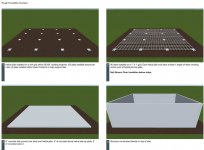
My plan for the foundation is linked below.

As you can see, once the piles, rebar and concrete are installed, the building would be built directly on the 6” slab. I’m obviously completely unfamiliar with the idea of building something this way – here in the Northeast, all my experience has been with a footer / 4’ frostwall design. But since all the weight of the building would be handled by the helical piles, is there any reason that this wouldn’t work? Is my lack of knowledge in this type of building process making me delusional? Am I opening myself up to future headaches / failure / problems by building this way?

As a side question – anyone care to comment on if it’s better / most cost effective to go with a precast concrete slab vs a poured slab?

Many thanks in advance for your insight.
 

Attachments

  • RoughFoundationOverview_SM.jpg
    RoughFoundationOverview_SM.jpg
    142.2 KB · Views: 133
To avoid these ads, REGISTER NOW!

dave*99

Well-known member
Joined
May 5, 2009
Messages
4,264
Location
Coastal NJ
Have you considered wood piles? I don't know if they are applicable to your project or locale, I do know they are often much less expensive than helical piles.
 

Radix2

Well-known member
Joined
May 28, 2014
Messages
1,853
Location
the thumb!, MI
I can't see the value of piles in the center of the floor. No way the ground is so soft it can't support a slab.

You also still need to account for frost heave under your slab, so some kind of insulation like a FPSF or insulated frost wall to keep the freeze from getting under the building.

What is the soil there that is so soft? Is this on a riverbank? Water involved?
 

kd3pc

Well-known member
Joined
Aug 10, 2013
Messages
3,630
Location
Northern Neck
IIRC correctly, there may be a requirement to NOT build as close to the edge of the slab as you might with the slab on grade, or where the footers are. Engineer will specify that.

Floating slabs are common, not sure why that wouldn't be an option unless you have some tough usage in mind.

Similarly, 2x construction will be fine, using poles, attached to the slab, not so much....see some of the more recent posts on attaching load bearing posts to concrete slab.

I would speak with the engineer about added steel for a lift or other load specific tool and it's placement on the slab.

Cost benefit of prestressed vs poured would depend on the engineering needed and intended use. Might be able to save some piles if a suspended prestressed system would work. I used to see this a lot in commercial construction, but it has it's own issues.

Wood piles are likely not an option as driving and joining them, if needed is troublesome and no matter how well treated today, they are subject rot. We did some DC metro piles and a 12x12 treated 22' pole just slid right down to grade...no need to drive. Engineering was on site the next day.

Best of luck.
 

ixlr8

Well-known member
Joined
Sep 15, 2009
Messages
435
Location
Mid-Coast Maine---> Eastern Shore Virginia
I looked into doing helical piles for a porch I am planning to build. Check out the warranty on those piles. The company I contacted only had a 7 year warranty on their piles... not long enough for me to build anything on!!
 

CTyankee

Well-known member
Joined
Jan 13, 2013
Messages
3,795
Location
CT
We've done 2 houses using them..Both homes were built in a flood zone so they had to be raised up on concrete piers. A grade beam was poured over a pattern of piles(around the perimeter and a row through the middle) and then piers were stacked on the beam.

The piles were only placed where the actual structure needed support. One home had a slab poured for an under house garage, no piles were specified for the actual floor space.

Suppose you could do the same and just add a knee wall atop a grade beam and build from there, then pour a floor. :dunno: I'm no engineer though. Good luck.

Curious how the helical company priced out the job...By the pile? It was a few years ago, but IIRC ours priced out at about 1000 per pile(16ft I think)
 
To avoid these ads, REGISTER NOW!

ms fowler

Well-known member
Joined
Jun 27, 2012
Messages
450
Location
Littlestown, PA _ 6 miles south of Gettysburg
Helical piles are great--if properly designed and installed ( like almost everything) Engineer i worked for a few years ago loved them. We used them on a hospital addition. I had to run a load test on them all thru the night. they easily passed. They are a good, and inexpensive solution.
 
OP
G

grail21

Well-known member
Joined
Oct 15, 2007
Messages
53
Location
North Shore, MA
Wow – thanks for all the responses, super helpful all around.

To answer some of the questions / comments:

Dave*99 – I think we’d have a hard time getting wood piles 17’ down. Plus first 4’ of top soil (fill we brought in when we built the house) is a bit on the rocky side – when we did the test pile, it took some maneuvering with the machine before we got to the soil underneath. Plus, while I know coatings have come a long way, I’d be worried about rot long term.

Radix2: The soil is actually really soft, we have some wetlands at the back of our property (only 50’ away) and it’s incredibly mushy. The top fill we brought in is firm enough, but what's underneath is not. No question in my mind that the weight of a 6" slab would compress it over time. My best guess is this was the result of poor grading, bad soil and lack of maintenance since the original house was built in the 50s (we tore that down and did a lot of regrading). I had always been worried about resting the slab directly on the ground, so for an extra 3-4K, I’d rather be safe than sorry. This is our forever home, we don’t plan on moving so it’s a long term investment for me. As for insulation under the slab – totally agree, the plan is to use rigid foam underneath the slab – seems to be a cost effective way to go.

Kd3pc – Great info – I hadn’t thought about the closeness of the piles to the edge of the slab – thanks for that tidbit. As you say, the engineer will specify that. As for the type of building I’m putting up – I’ve been all over the map with options – metal frame, pole, traditional stick built. At this point I’m thinking traditional stick built is the way I’m going to go. It might be a little bit more expensive, but it will be easier for me to finish the inside myself. Since my building is not that large, the savings (while not inconsequential) are not as dramatic as if I was building an 80’X100’ structure. Pre-stressed slabs was something I just started thinking about from a cost/ease of installation/strength perspective. I honestly haven’t looked into it that much yet, but I think I will.

Ixlr8 – very good point. Techno Metal Post has a very positive reputation, but your post made me realize I don’t know exactly how long their warranty is.

CTyankee – Yes, they price them by the pile depending on length and diameter of the pile. For what I’m looking at it’s around $750 per pile.

Ms fowler – thanks for sharing the positive experience. I’ve heard nothing but good things about them so far – if they’re good enough for giant commercial buildings in more questionable soil than what I’ve got, they should work perfectly for my small building.

Brownbag: That’s where I had initially started, but between the soil and other building constraints I think it makes long term sense for me to go in another direction.

Thanks again for all the great comments. I hope others continue to share. It was difficult for me to find relevant info as I searched around the web. Hopefully this can serve as a resource for others in the future facing similar situations. If nothing less, I love continuing to learn more.
 

ms fowler

Well-known member
Joined
Jun 27, 2012
Messages
450
Location
Littlestown, PA _ 6 miles south of Gettysburg
We also used them for a new school that had variable subsoil conditions---Original ground on most of the building and 4' to 12' feet of fill over a portion. The helical piles were designed to prevent differential settlement problems.
Note that both of the projects that I worked with were long-term, major capital projects. I think that is as good a recommendation as you can get.
 

LX-Markham

Well-known member
Joined
Apr 27, 2013
Messages
2,929
Location
Markham, Ont.
I can't see the value of piles in the center of the floor. No way the ground is so soft it can't support a slab.
We have built on MANY sites where the ground is not capable of supporting a slab-on-grade. Not uncommon at all.

This looks like a standard structural slab on piles construction. Helical screw piles are perfect for this application.
 

WNYflyer

Well-known member
Joined
Sep 13, 2009
Messages
2,119
Location
Lockport, NY
Not that familiar with helical piles but we use that basic type of construction all the time in industrial facilities. Due to the required capacities instead of helical piles we are use steel H-piles, pipe piles, wood piles,etc. So many of the facilities back in the day filled in riverfront and lakefront property to create more space and the fill is typically considered very poor to build on by today's standards at least for the weight we typically need to support.

Basically a pile supported concrete mat/slab foundation. As already mentioned you need to be careful how close the piles are to the edge of the slab and you need to worry about the the slab thickness at the piles to keep them from punching up through. But that is what the engineer figures out.
 
To avoid these ads, REGISTER NOW!
Top Bottom