To avoid these ads, REGISTER NOW!

Between 705 & 1200 SQ/FT Another Garage Build, 26 x 30 w/ future studio apartment above

Workspaces between 705 and 1200 squarefeet.

kasander

Well-known member
Joined
Jun 7, 2016
Messages
424
Location
Wilmington, NC
Hello all, I've been lurking here for a few months reading everyone's build threads and am finally ready to kick off my own build. I am building a 26x30 garage with a stick built roof to maximize space upstairs for a future studio apartment. I welcome any feedback from you experienced guys along the journey.

Here is a summary of my requirements that drove this design:

26' depth because the garage at my last house was 24' and I needed a little more room to park my boat trailer straight.
30' width to have 2 garage doors and additional workspace and room for stairs
I want stick built roof to maximize square footage upstairs, hence the functional dormers front and rear.
Separate entry for upstairs for possibility of future rental as AirBnB or to a college student.
10' garage ceiling (possible future lift and storage of 9.5-10' SUP boards)
Monolithic slab (No block work, concrete work done in one shot)
No support columns in garage (Hence the W12x50 beam)
Not so massive that it looks out of place behind my 1 story ranch with 3:12 roof pitch. (I might have missed this design criteria...)

Here are a few renderings:

Front view:
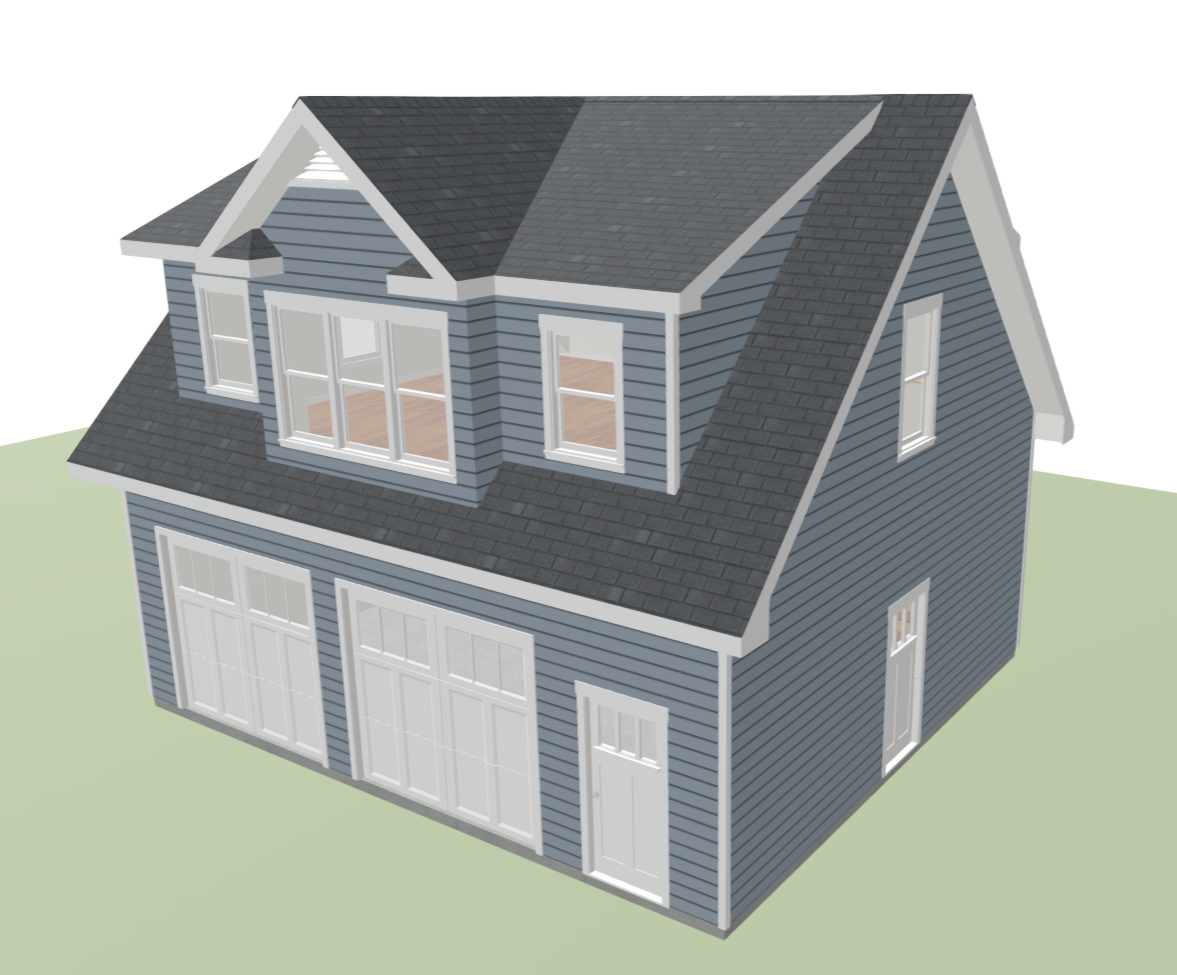
rendering_front.png

Back view:
rendering_back.png


3D representation:
https://sketchfab.com/models/a82560ab1552418881e952f4649cc013#

Architectural plans:
http://www.pelicanpointroad.com/garage/garage_arch_plans.pdf

Thanks to Cory at 2x4 Designs in Wilmington for the architectural work!

Engineering plans:
http://www.pelicanpointroad.com/garage/garage_eng_plans.pdf

Thanks for Doug Jones Engineering for the engineering plans!

I have changed the slab to be 8" above grade to eliminate the need for pressure treated sheathing. The other deviation from the plans I was thinking was to use full 10' studs. This will make the garage ceiling height 10' 5.5" (1.5" bottom plate + 1.5" bottom plate +120" stud + 1.5" top plate + 1.5" top plate -.5" drywall). It seems studs are available as either 117" or 120". At 117" the wall would be 122.5" which would leave 2.5" gap with 10' drywall sheets. Might as well make is a 5.5" gap and get the extra height. (I am thinking of maybe putting in a lift at some point years down the road).

I will be attempting to do most of the work myself, so will welcome any tips along the way.

I have staked the location in the backyard and am meeting with the concrete contractor tomorrow to review. They are planning to start work on footings and slab prep next week.

This leads to my first questions:

Is there anything I need to think about before the concrete is poured?

I have permit and termite treatment covered. I am also leaning towards flat, level slab as I will not be bringing wet vehicles in often. I have asked it to be slick (not just smooth) finish. I know it will be slippery when wet, but I hope to insulate and install HVAC eventually. Slick should be easier to keep clean.

Engineering plans specify 4" thickness, 3000psi concrete, but I may ask for 5" and 3500psi based on all the conflicting information I have found online...

I am thinking the only thing I need to add is a water supply and drain line stubbed up through the slab. I will tie this into my house water and sewer lines later. I am thinking I will have a separate power feed for the garage which will come through the wall, so I don't need anything there. I may run a piece of conduit up through the slab for ethernet or coax cable from the house.

I also thought about running a pipe through the slab and out the back for future air compressor outside. I will eventually put a lean-to shed off the back to store lawn and garden type stuff and was thinking about putting a compressor there as well. I was wondering if running air line under the foundation would just fill up with water and be a bad idea?

Anyway, I'll stop for now, but thanks in advance for any advice and tips!

Keith
 
To avoid these ads, REGISTER NOW!

The Tool Tyrant

ALLIANCE MEMBER
Joined
Dec 19, 2011
Messages
2,182
Location
Bonita, Ca. (San Diego)
Keith, 4'X10' struct I ply is readily avaliable, so why not use 116.25" studs + 4.5" (three plates) = 120.75". This way you can use the 4'X10' sheathing on the exterior (this gives you the required perimeter nailing without additional blocking) and then, on the interior, two and a half sheets of drywall (4'+4'+2'+ 5/8" ceiling). Then whatever additional height you need for the lifts, make up in the height of your stem walls.
I have read many folks with lifts recommend 12' ceiling height, so you may want to ask about that first though.

Regarding placing your compressor outside, I would definitely plan for it. Have your concrete contractor pour it at the same time as the slab and save yourself some money.

Some thing that I would also consider is adding a half bath in the lower righthand corner, where the man door is. Leave the man door to access the bathroom from outside, along with a inside door.
 
Last edited:
OP
K

kasander

Well-known member
Joined
Jun 7, 2016
Messages
424
Location
Wilmington, NC
TF,

There will be no stem walls, slab will be flat. I have enquired to the engineer about why he specified 2 bottom plates and 2 top plates... For most of the rear wall the outer sheathing has to overlap the floor joists, so I will use 8' vertical sheet, then another 8' on top of that to overlap.

Also, the material supplier only supplies 117" or 120" studs, not 116.25."

I have read about the lift height issue, but this is something that I may or may not even end up doing. My concern about having the garage so much taller than the house is the reason for staying with 10' walls. Also, higher than 10' requires 2x6 wall studs. I currently have 2x6 framing only around the stairs and on the front wall.
 

The Tool Tyrant

ALLIANCE MEMBER
Joined
Dec 19, 2011
Messages
2,182
Location
Bonita, Ca. (San Diego)
My bad...just looked at the section and now see the detail on the shear panel.

As far as stud length... Many studs are cut onsite, that's what Skilsaws are for!

I prefer to have stem walls just to get the walls up off the slab. Keeps the drywall from getting wet in case of who knows what. I don't know if you're aware, but you can still pour the slab monolithic, even with stem walls.
 
OP
K

kasander

Well-known member
Joined
Jun 7, 2016
Messages
424
Location
Wilmington, NC
TF, yeah, I will check to see how much it adds to cost to pour with stem walls. I like the idea, just trying to keep things simple and lower cost.

Also, would rather not have to cut all the studs.

I may not put drywall in the garage anyway, or may just but a 1x4 as baseboard and cover the gap...
 
OP
K

kasander

Well-known member
Joined
Jun 7, 2016
Messages
424
Location
Wilmington, NC
Got a response back from the engineer. Double bottom plates are required to resist uplift due to wind loads (I am on the NC coast...) The overlap on the outer sheathing is also required to resist uplift.
 

camarosrus69

Well-known member
Joined
Aug 7, 2013
Messages
243
Location
South central Kansas
Looks like a nice design. Is that a sketchup model? A couple comments that may not apply where you live. Some municipalities need to approve plans like yours since you are considering using the upper level as living space. They get a lot more picky when lives are involved. Fire codes, sewer and other issues are more strict. Also some planning departments may take issue with size, considering your existing structure. You may already know this, and just haven't mentioned it yet, since we're only 7 posts into what I expect to be a good thread. I only mention this so you don't get bit in the *** down the road if you find out what you want to do, and what they want you to do, are two very different scenarios. Good luck, and post lots of pictures.
 
Last edited:

SiGmA_X

Well-known member
Joined
Aug 13, 2005
Messages
1,111
Location
Portland, OR
I would do a 12ft ceiling if you think you may have a lift in the future. You'll thank yourself later. Stem walls are great for cleaning the garage out, too. I would really look into it. Cutting the studs shouldn't be a big deal, make a jig on your (contractors?) chop saw and go to town.
 

The Tool Tyrant

ALLIANCE MEMBER
Joined
Dec 19, 2011
Messages
2,182
Location
Bonita, Ca. (San Diego)
Hey Keith, I just noticed...where is the upstairs bathroom? :headscrat

Regarding the 'lean to' for the compressor, you'll be ahead if you just include it now as it will be much easier to incorporate into the finish now rather than adding it later. Be sure to include sufficient ventilation. Even if you don't put a compressor in it, it will make a great storage shed.

I can understand the reasoning now for the engineering being as you're in hurricane country!
 
Last edited:
OP
K

kasander

Well-known member
Joined
Jun 7, 2016
Messages
424
Location
Wilmington, NC
camaro, not sure what software the architect used. Plans have been approved by the county, so I am good there. Lean-to was not in the plans so I will add it later. Should be easy enough to take a piece of siding off to attach a ledge for a shed roof. My lot is over 0.5 acre so the 800 sq ft garage is not overly big for the space.

sigma, I am already concerned about the overall height of the building with, so I don't want to go 12'. I did meet with the concrete guy today and he said only $300 more for stem walls, so I think I will add 6" stem walls (as long as the engineer says its ok). I don't like wasting material, so would rather use the full length studs. If I use the 117" studs, ceiling will be around 10'8".

Concrete guy said 3500 psi concrete vs. 3000 psi quoted is no extra cost. Looks like most lifts only require 4" thick, so I guess I will just stick with that. He also included saw cut joints in the quote (no keys). He said they never put keys in garages, only commercial jobs.

TF, I haven't decided on a floor plan for upstairs yet, why do you ask? I guess I should run that by the engineer, but the floor trusses will only span 13' so should support a full tub of water...

Hopefully topsoil will be cleared and footings dug on Monday! Here is a picture of my backyard with the garage area staked in the back left.

backyard.JPG


I was asking some electrical friends about what I should do about service and they recommended getting separate service for the garage. I'm wondering if the power company will eat the cost of running service to the garage or if I have to pay for that? I don't think running from my existing 1968 panel is an option without an upgrade...

panel.JPG


So, for compressor, should I run a pipe under the footer or just go through the wall later?
 

SiGmA_X

Well-known member
Joined
Aug 13, 2005
Messages
1,111
Location
Portland, OR
camaro, not sure what software the architect used. Plans have been approved by the county, so I am good there. Lean-to was not in the plans so I will add it later. Should be easy enough to take a piece of siding off to attach a ledge for a shed roof. My lot is over 0.5 acre so the 800 sq ft garage is not overly big for the space.

sigma, I am already concerned about the overall height of the building with, so I don't want to go 12'. I did meet with the concrete guy today and he said only $300 more for stem walls, so I think I will add 6" stem walls (as long as the engineer says its ok). I don't like wasting material, so would rather use the full length studs. If I use the 117" studs, ceiling will be around 10'8".

Concrete guy said 3500 psi concrete vs. 3000 psi quoted is no extra cost. Looks like most lifts only require 4" thick, so I guess I will just stick with that. He also included saw cut joints in the quote (no keys). He said they never put keys in garages, only commercial jobs.

TF, I haven't decided on a floor plan for upstairs yet, why do you ask? I guess I should run that by the engineer, but the floor trusses will only span 13' so should support a full tub of water...

Hopefully topsoil will be cleared and footings dug on Monday! Here is a picture of my backyard with the garage area staked in the back left.

I was asking some electrical friends about what I should do about service and they recommended getting separate service for the garage. I'm wondering if the power company will eat the cost of running service to the garage or if I have to pay for that? I don't think running from my existing 1968 panel is an option without an upgrade...

So, for compressor, should I run a pipe under the footer or just go through the wall later?
Fair enough re the height but you will be cutting a lot of drywall vs using full sections if you run the taller studs. I wonder what the cost savings/expense would be....

Electrical, you may be able to upgrade your meter to a 320amp and split service before your house and shop. I don't know enough about it to weigh in, but I am pretty sure you'll pay out of pocket to drop a second service at the house, plus an extra monthly base fee - at least in my neck of the woods. Ask on the electrical sub forum, there are a bunch of pros over there.
 

The Tool Tyrant

ALLIANCE MEMBER
Joined
Dec 19, 2011
Messages
2,182
Location
Bonita, Ca. (San Diego)
TF, I haven't decided on a floor plan for upstairs yet, why do you ask? I guess I should run that by the engineer, but the floor trusses will only span 13' so should support a full tub of water...

1) Here in California, your 'approved' plans must show everything...no surprises. I don't understand how you can get away from including the bathroom on the plans and yet can't build the air compressor lean-to because it's not shown on the plan. :headscrat

2) You need to consider where your drain lines will need to go as you may need to change one of your 2x4 walls to 2x6 or double 2x4 to accommodate the plumbing.
3) As I've mentioned...if you're planning on a compressor area, then you must plan on working in the garage...right? Adding a half bath should be a no-brainer as it appears by looking at your plot plan, that is a good distance to your house.
4) IF you decide to add the garage bathroom, you want to consider both bath locations to maximize your plumbing.


So, for compressor, should I run a pipe under the footer or just go through the wall later?

I would just go through the wall. Running a line under the footing is just asking for a mess. Remember that it would be the lowest point in your air system, so moisture will collect there and it would be very difficult to remove.
 

Mr. Welsh

Well-known member
Joined
May 21, 2007
Messages
1,425
Seems like the lack of prep on the 2nd phase of this thing will kill you down the road. No electrical, plumbing, or HVAC prep for the future use of the second story as a living space?

Otherwise the plans look great. Architecturally this building is very pleasing to the eye.

I see you mentioned boat storage...I assume you are familiar with how much fun it is to take an 8.5' wide trailer through a 9' wide door? Personally, if that were something I planned to do frequently, I would go with one 18' wide door or two 10' wide doors.
 
Last edited:
OP
K

kasander

Well-known member
Joined
Jun 7, 2016
Messages
424
Location
Wilmington, NC
Regarding the air lines, yeah, I will just run them through the wall.

I will call the power company tomorrow and see what they say about new service vs. splitting house service.

I'm not too concerned about the drywall issue, it may be years before I put any up.

Regarding finishing the upstairs, this will also come years down the road. (I am verifying that trusses will support the extra load of a tub) I will draw up my floor plans and submit for another building permit at that point.

I am only putting a sink in the garage, it's only 50 yards to walk to the house. The back right corner around the stairs is framed 2x6 so maybe I can utilize that for plumbing. Or I might just run them through the interior of the garage in a corner later. I am planning to have my supply and drain come under the footing in the back right under the stairway landing. I still need to consult with a plumber on that...

Concrete guys showing up tomorrow to do some digging. I have drawn up where to put J-bolts so they don't come up where I need to put studs. The garage doors have 3 Jack posts and 3 King posts each side, then 5/8" rod from founation through top plate.
Speaking of, for a 9' door (8' 11 1/2" actual opening), the stem wall opening should be 9'2 1/2" right? Then the 2x6 trim will sit next to the stem wall. And door openings should be 41" for a 36" door? Again, 2x trim will bring it down to 37"

Thanks for the advice so far guys!
 
OP
K

kasander

Well-known member
Joined
Jun 7, 2016
Messages
424
Location
Wilmington, NC
One more question, should the stem walls be 3.5" (or 5.5" for 2x6 plates) thick to accept bottom plates, or should they be wider in case they aren't square?
 

DarrenF

Well-known member
Joined
Mar 11, 2008
Messages
291
Location
Thunder Bay, Ontario
subscribed, love the plans, thank you for including them. We are planning an attached garage/master suite addition on our house and your plan looks like it was made for us.
 

The Tool Tyrant

ALLIANCE MEMBER
Joined
Dec 19, 2011
Messages
2,182
Location
Bonita, Ca. (San Diego)
Yes, you want the stem walls at the garage door opening to be 3" wider than the finish opening to allow the 2x jambs to go down to the slab.

Exterior 'pre-hung' doors with 5/4 jambs require 3" over call-out, so your rough opening for a 36" door would be 39". Interior 'pre-hung' 3/4 jambs require 2" over call-out. this is pretty much standard unless you are using 'rabbited' jambs, then exterior r/o's are 2" over.
Bottom line is you need actual overall jamb width + 1/2".
 
OP
K

kasander

Well-known member
Joined
Jun 7, 2016
Messages
424
Location
Wilmington, NC
TF, so for the exterior door, I don't need a 2x6 all the way to the floor to attach the prehung door? Both exterior doors will be on the 2x6 walls, so I am guessing 5/4 jambs are what I need.

Mr Welsh, I am utilizing 14" floor trusses which have a rectangular section open for HVAC duct. I just have to figure out how to get it past the 12" tall steel beam. May go under it on the end wall... Electrical and plumbing shouldn't be an issue with the open trusses.
 
To avoid these ads, REGISTER NOW!

ncboat

Well-known member
Joined
Aug 20, 2015
Messages
166
Location
Wilmington North Carolina
I see you are in coast Carolina and suspect maybe close to Wilmington where I am. I would love to pick your brain on who you have used locally or decided not to. I am about 90 days away from being able to start my 34x36 detached shop. I too have decided on 10' high for much the same reason as you. I think I am going to use zip 4x10 sheathing (vertical) blue board for the sill, and Hardie plank although if I can find Louisiana pacific multi lap it is easier. On the doors I am going with 10 wide for Trailer clearance.
 
OP
K

kasander

Well-known member
Joined
Jun 7, 2016
Messages
424
Location
Wilmington, NC
ncboat, yes I am in Wilmington. 2x4 Designs for the architectural drawings, Doug Jones Engineering for the structural drawings, and I am going to attempt to do as much as possible myself. American Patio is doing the concrete work. I couldn't use 4x10 vertical sheathing due to my large shed dormer on the back. Floor joists have to be overlapped for uplift resistance. I will probably go Hardiplank siding as well.
 

ncboat

Well-known member
Joined
Aug 20, 2015
Messages
166
Location
Wilmington North Carolina
KasanDer, I am going to follow with great interest. I talked to American and had some good references for them. Did you just go into 2x4 and tell the what you wanted and then take that to Jones?
 
Last edited:
OP
K

kasander

Well-known member
Joined
Jun 7, 2016
Messages
424
Location
Wilmington, NC
Yes, I sketched up the design I wanted and Cory at 2x4 made plans, then I took them to Jones to engineer the stick built roof and dormers.
 

The Tool Tyrant

ALLIANCE MEMBER
Joined
Dec 19, 2011
Messages
2,182
Location
Bonita, Ca. (San Diego)
TF, so for the exterior door, I don't need a 2x6 all the way to the floor to attach the prehung door? Both exterior doors will be on the 2x6 walls, so I am guessing 5/4 jambs are what I need.

If you're using standard 5/4 jambs, your header length should be 42". With a 2x6 trimmer under each side, that brings your R/O down to 39".
Door = 36"
Two 5/4 jambs= 2.5
Total = 38.5"

The trimmers must fit tightly under the header as they are supporting the header.
 
OP
K

kasander

Well-known member
Joined
Jun 7, 2016
Messages
424
Location
Wilmington, NC
TF, my question is should the 2x6 trimmers sit on the stem wall or on the slab floor? Stem wall opening should be 39" or 42"?
 

clutch assisted

New member
Joined
Feb 25, 2017
Messages
2
Location
Quakertown, Pa.
Looking forward to trying to learn from this garage build. I would like to build a detached garage similar in size, without the living space on top. Thanks for posting everything.
 

The Tool Tyrant

ALLIANCE MEMBER
Joined
Dec 19, 2011
Messages
2,182
Location
Bonita, Ca. (San Diego)
TF, my question is should the 2x6 trimmers sit on the stem wall or on the slab floor? Stem wall opening should be 39" or 42"?

Keith, if the jamb has standard 'streamline' casing, which is approx. 1-5/8" wide, you can get by with 42" between the stem walls which will allow the casing to to fit between the stem walls. If you happen go want to use wider casing...like 2-1/2" +/- you should add 3-1/8" to the header length and then use double trimmers at both sides, which will require you then to have 45-1/8" between the stem walls.
If you don't leave sufficient room between the stem walls, you'll end up having to rip down the casing at the stem walls. :mad:

NOTE: the king studs should be ON the stem walls and the trimmers on the slab.
Wrap a piece of Sisalkraft flashing behind and below the trimmers so they aren't in direct contact with the concrete.
 

GLTHFJ60

Well-known member
Joined
Oct 31, 2013
Messages
821
Location
Durham, NC
Looking forward to this build!!

If you don't mind me asking, what did the architectural and design work cost from 2x4 Designs?
 
OP
K

kasander

Well-known member
Joined
Jun 7, 2016
Messages
424
Location
Wilmington, NC
TF, Ok, just want to confirm:

39" rough opening for door casing
2x6 trimmer resting on slab (with flashing between)
42" stem wall opening
Jack and king studs rest on bottom plate on stem wall
45" header

GLTHFJ60 - Design work was $825. I did much of the design myself, just had 2x4 pretty it up.

Footings were dug yesterday, will snap pictures today. I will start on the plumbing rough in tonight after work.
 
OP
K

kasander

Well-known member
Joined
Jun 7, 2016
Messages
424
Location
Wilmington, NC
A few pics from day 1:

roof2.JPG

footers1.JPG

footers2.JPG


I hope to get plumbing done this weekend and call concrete guys back to finish forming the stem walls, laying rebar, etc next week.

I measured the diagonals on the forms and it is about 5/8" out of square. I will check squareness to my house this weekend, but is this something I should be concerned about?
 

GLTHFJ60

Well-known member
Joined
Oct 31, 2013
Messages
821
Location
Durham, NC
I don't think that 5/8" out of square over a span of more than 30' is a point of concern. I'd be more concerned about the door and window openings being square, but even those are shimmed into place.
 
OP
K

kasander

Well-known member
Joined
Jun 7, 2016
Messages
424
Location
Wilmington, NC
Ok, I having been going back and forth on plumbing options. How about some input? I am trying to lay out the drains for future finishing of the upstairs into a studio apartment. The problem is that I haven't decided on a floorplan (bathroom and kitchen location).

Here is what I am planning as far as fixtures:

Downstairs:
Slop sink (Either close to entry door or under stairs)
Washing machine (Under stairs)
Outdoor shower (On right side of garage near back)
Upstairs:
Bathroom (Tub and sink)
Kitchen (Sink, maybe a dishwasher, icemaker in fridge)

Here is the site plan, so I will eventually need to run the drain to the street, or at least to the front right corner of the house to tie into the house drain.

site_plan.png


The plumber suggested putting the bathroom in the front right corner, but I just can't see how that would work with the windows on the front of the upstairs.

garage_front_iso.png


Here are a couple of floor plans I sketched up...

I am leaning towards this one:

floorplan_1.png


I am thinking my rough in plumbing could be like this with a 3" drain for the upstairs bathroom and 2" drain for slop sink. Then the question would be can I drain the upstairs sink into the same 2" drain for the garage sink?

I can make the wall between the stairs and the garage 2x6 so the 3" pipe will fit inside the wall up to the floor trusses. If I need a 3" drain for the upstairs sink + downstairs sink I guess I can make that wall 2x6 as well...

plumbing_rough.png


Here are a couple others I had looked at previously but didn't think they would work very well.

floorplan_2.png

floorplan_3.png


The main problem is that I guess I need to keep the garage sink and the upstairs bathroom relatively close and I am pretty locked down on the location of the garage sink. I either want it by the entry door, or possibly under the upper flight of stairs. I also may put in a washer later which would be in the garage under the upper flight of stairs.

I think I have convinced myself that Option 1 is best for floorplan, the only thing I don't like is that I was thinking of having a half wall upstairs between the upper flight of stairs and the living area just to keep things more open. Putting the bathroom next to the stairs will eliminate that...

What do the experts think?
 
OP
K

kasander

Well-known member
Joined
Jun 7, 2016
Messages
424
Location
Wilmington, NC
Ok, I think I have a plan to keep my options open, just need some verification by the plumbing experts. See the sketch below. I will have a 3" main drain that will come up near the back wall inside the wall between the stairs and the garage to service the future upstairs bathroom. I will run the main diagonally towards the front right where it will pass under the other wall between the stairs and garage where I will stub up a 2" pipe for potential washing machine and/or garage sink. It will continue straight through the exterior wall where I will stub up another 2" pipe for another potential sink location and also potential drain for upstairs kitchen sink. What do you guys think? And where would I need cleanouts for this setup?

plumbing_sketch.png


Here is a 3D view of just the piping, the main line is about 20' long.

plumbing_3d.png


I just have to be pretty darn accurate on where I stub up these pipes to get them contained within the walls...
 

The Tool Tyrant

ALLIANCE MEMBER
Joined
Dec 19, 2011
Messages
2,182
Location
Bonita, Ca. (San Diego)
TF, Ok, just want to confirm:

39" rough opening for door casing
2x6 trimmer resting on slab (with flashing between)
42" stem wall opening
Jack and king studs rest on bottom plate on stem wall
45" header

First, lets clarify terminology...A Trimmer (out west) and Jack Stud (back east) are the same thing.

A 'Standard' 3'-0" exterior door with 5/4" jambs requires a 39" opening.
With 'Streamline' (1-5/8") casing you need a MINIMUM of 1-1/2" (one- 2x) past the jamb on both sides (which would be the trimmers) in order NOT to have to notch the casing (as it would run into the stem wall)...IF your jamb has wider casing, you may need to add another trimmer to each side which would mean that you would also need to add to the header length to makeup for the added trimmers.

I suggest verifying the R/O required for your particular door, as I stated previously, your material supplier may only stock 'Rabbeted' jambs, which would require a 1" narrower R/O.

Bottom line, the STEM WALL OPENING MUST MATCH THE HEADER LENGTH. Only the king studs sit on the stem walls. Trimmers must go down to the slab.

Lastly...Measure the height from the slab to the top of the stem wall and add that measurement to the length of the top cripples (the short 2x's above the header)
 
Last edited:

diiulio

Well-known member
Joined
Nov 14, 2008
Messages
136
Location
Saratoga Springs, NY
TF-
Why do the trimmers go down to the slab? If they are transferring the load down from the header shouldn't they go to the stem wall? The stem wall is tied to foundation. If they go to the slab they are transferring the load to the slab which is independent of stem wall and foundation.

I am asking because I will be soon doing this and would like clarification.
Jason
 

The Tool Tyrant

ALLIANCE MEMBER
Joined
Dec 19, 2011
Messages
2,182
Location
Bonita, Ca. (San Diego)
I measured the diagonals on the forms and it is about 5/8" out of square. I will check squareness to my house this weekend, but is this something I should be concerned about?

A good job starts at the foundation. I, personally would not accept 5/8" out of square. I as a (past) framer would ALWAYS check a slab for square before starting layout and if the slab was out of square, I would have to compensate on my layout (ie, one corner might be in 3/4" and the diagonal corner hanging off the slab 3/4") If the framing isn't square, it will be a problem to the end...drywall, cabinets etc. Start with a square slab and you'll be miles ahead.
I would insist he gets it to within a 1/4" MAX. Be sure the forms are STRAIGHT also. :thumbup:
 
OP
K

kasander

Well-known member
Joined
Jun 7, 2016
Messages
424
Location
Wilmington, NC
TF, I was thinking of having the jack stud on the stem wall would be better, then what I am calling a trimmer could be raised off the slab 1/4" to prevent moisture getting into it(In addition to putting flashing between the concrete and stud). I thought I would have the "trimmer" go down to slab just so I have wood to attach the door frame to. What do you think? I don't think me having 2 extra studs around the door frame will be an issue.

dii, transfering the load through the stem wall or slab is no difference, the pour is monolithic and the same footer is under the stem wall and door opening area.
 

The Tool Tyrant

ALLIANCE MEMBER
Joined
Dec 19, 2011
Messages
2,182
Location
Bonita, Ca. (San Diego)
TF-
Why do the trimmers go down to the slab? If they are transferring the load down from the header shouldn't they go to the stem wall? The stem wall is tied to foundation. If they go to the slab they are transferring the load to the slab which is independent of stem wall and foundation.

I am asking because I will be soon doing this and would like clarification.
Jason

As far as load transfer, the footing is continuous under the slab so the load is still being supported by the footing...it's not like the 4" slab is just sitting on grade. ;)

The reason the trimmers need to go to the slab is if you take a look at how a door jamb is built, the casing extends outward past the jamb and is nailed into to trimmer to assist in attaching the jamb to the wall. If the trimmers were allowed to bear on the stem wall, the casing would need to be ripped down from the top of the stem wall to the threshold. :shocking:
If you were dead set on the trimmers bearing on the stem wall, then you would need to add and additional 2x (we'll call it a filler so as not to be confusing) to go down to the concrete, but make sure to add an additional 3" to the header length to compensate. :thumbup:
 
OP
K

kasander

Well-known member
Joined
Jun 7, 2016
Messages
424
Location
Wilmington, NC
TF, 10-4, I will go with my original plan:

39" rough opening for door casing
2x6 trimmer resting on slab (with flashing between) (We can call this a filler)
42" stem wall opening
Jack and king studs rest on bottom plate on stem wall
45" header
 
To avoid these ads, REGISTER NOW!
Top Bottom