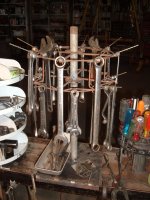
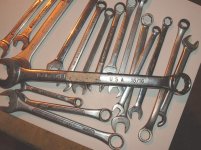
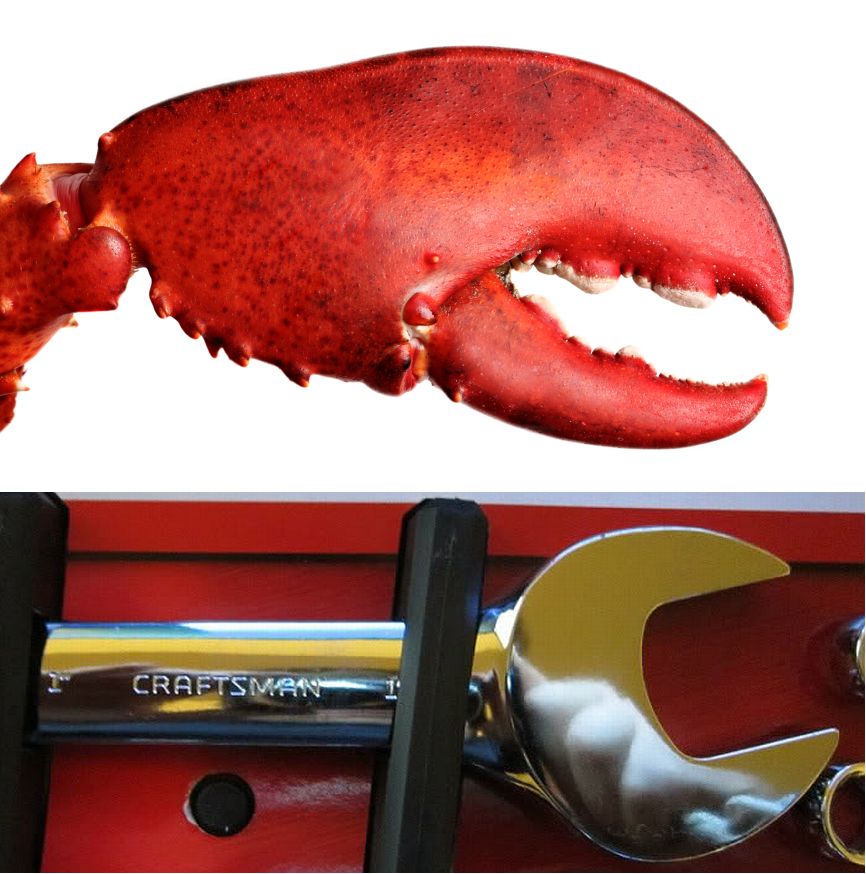
I agree, the argument is almost always that lobster claws use inferior metallurgy. If true, fine. However, all things being equal you don't have to be a structural engineer to understand that more material is likely stronger in this instance.
While technically correct, 'inferior' metallurgy suggests that there is something wrong with the tools. This is not necessarily the case. There are many types of steel alloy, each exhibiting different qualities. The manufacturer may choose to spec the wrench in many different ways. It may be spec'd by strength, size, weight, finish, price, you name it. In most cases it is going to be some combination of all the above. Unfortunately the tools don't come with labels letting us know just what went into their design. I think this is one of the areas Sears went wrong. Why did they give up the 'good' 'better' 'best' rankings for their tools? That was perhaps our best indication of what went into the tools. I'm no expert but I imagine Sears spec'd the three tools along these lines:
Each shall have a
minimum strength of 'x' (as measured in use) and be made of a steel alloy.
'Good' tools shall have a lower price and less perfect finish.
'Better' tools shall feel nice in the hand and have a fine finish.
'Best' tools shall be smaller and lighter weight while maintaining the nicest finish.
As I understand it, the metallurgy of the 'Best' tools didn't necessarily make them stronger than the 'Better' tools, it did however make them stronger per ounce. This meant the heads could be smaller, the handles longer (more leverage), etc.
In this case everyone knew what they were getting, and what they were giving up, for the difference in price. The important thing in my mind is that none was a poor tool. Who among us wouldn't cringe at the sight of a mechanic kicking a Snap-On wrench across an old asphalt driveway, yet we've all known a guy who would. What need does this guy have for a nice finish? Smaller size or lighter weight maybe, but not a nice finish. Ignoring the questionable production practices of lessor companies, 'Good' wrenches are good wrenches and if the trade offs of weight and finish, budget and application, don't compel you to spend more, buy the wrench that 'fits'.
---
As a side note, I have noticed that when the professionals move in a new direction, the tools or materials they leave behind do tend to suffer. As an example, my dad and I have been framing a new shop building. We are framing by hand rather than with a nail gun. The loose nails we buy today would have been roundly rejected by my grandfather 50 years ago. They are short, soft, and their heads pop off way too easy. As a result I have been haunting Habitat for Humanity's Restore locations for old USA and Canadian nails. One of the boxes I picked up had the nails laid in rows so you could just pick them up and drop them into your bag without aligning them first. A real time saver. If there were demand for good loose nails today, they would be made, but there is not. All the production guys have gone pneumatic. Same goes for the tools that fall out of favor. There is not necessarily going to be a quality entry level option.