To avoid these ads, REGISTER NOW!

Lobster Claw is it always BAD?

[memphis]

Well-known member
Joined
Sep 30, 2016
Messages
129
I bought several Gray wrenches (specificially 6pt) and see guys throwing around the term lobster claw, I don't have to use wrenches much and have a full set of MasterCraft Maximum wrenches that are around 10 years old so it's the good old stock (in 12pt)

The Mastercraft are made in Taiwan and the Gray are made in Canada. I have zero doubts in my mind that the Mastercraft will spread before the Gray will, the throat on the Gray 10mm is roughly 5mm or 3/16" deeper.

I don't have a full set of Gray, I only bought a few specifically for bleeder screws where this wrench should not hinder me due to increased bulk. I realize Gray is more industrial vs. automotive which may account for the increase in size.

edit: I also like how the open end is thicker, as it may provide advantageous having more surface area on the object or bleeder in my case

It definitely feels nicer in my hand, thoughts?
 

Attachments

  • IMG_1429.JPG
    IMG_1429.JPG
    135 KB · Views: 442
  • IMG_1430.JPG
    IMG_1430.JPG
    110.5 KB · Views: 503
  • IMG_1431.JPG
    IMG_1431.JPG
    100 KB · Views: 378
  • IMG_1432.JPG
    IMG_1432.JPG
    61.7 KB · Views: 349
Last edited:
To avoid these ads, REGISTER NOW!

smuro04

Well-known member
Joined
Feb 23, 2017
Messages
143
That's a pretty beefy wrench!

I would say for a primary set of wrenches, you don't want anything with a lobster claw for obvious reasons (clearance, etc.).

However, for your intended purpose as a specific use for bleeders, a nice bulky open end and a 6 point box end, those wrenches should serve you just fine, if not, better than a standard wrench would.
 

bwringer

Well-known member
Joined
Jan 1, 2013
Messages
10,298
Location
Indianapolis
Nice comparison pics! Some people think a wrench is a wrench... it never is.

The extra throat depth does absolutely no good in any situation. Not sure why you see this as an advantage? The tips project further past the fastener. How does this help anything?

The thickness of the wrench could be a strength advantage, or it could be compensating for an inferior alloy. In this case, I'm sure it's there for strength. When I see thick slabs of metal in a cheapie Chinesium set, I assume the opposite.

I work on a lot of motorcycles, and there are in fact a lot of situations where the lobster claw and thicker material causes clearance problems.

If they work for you and the things you work on, great. For the vehicles I usually work on, I'm reaching for the wrench least likely to cause clearance problems, unless I have some particular reason for needing the 6 point on the Gray.
 

Gmonkee

Well-known member
Joined
May 9, 2010
Messages
2,829
After I post this everyone after me will declare wider hipped wrenches are poor alloy and don't fit anywhere at all. Thus useless completely and totally.

Except that is not true. I have and use wrenches daily wider than the OP's pictures. They are more resistant to spreading and feel solid on a fastener. Thinner has to be harder to not spring but not so hard that they are brittle.
Wider hips give a little flex without spreading as easy. A more resistant alloy can be used.

Of the 'regular' hipped style I have found Euro wrenches and Proto to carry the balance best.
not too springy and not eggshell brittle. You can feel it in a hard pull and appreciate the confidence it gives.

But, where I can the wide hips go in and do the job with no issues. If those cannot its the socket set. In late model auto work this works great for me. Other specialists will know another solution.
 

Ign

Well-known member
Joined
Jul 7, 2006
Messages
12,769
Location
Butte Peak ND
I agree, the argument is almost always that lobster claws use inferior metallurgy. If true, fine. However, all things being equal you don't have to be a structural engineer to understand that more material is likely stronger in this instance.
 

neophyte

Well-known member
Joined
Apr 23, 2012
Messages
9,705
Location
Pennsylvannia
Hex fasteners and square fasteners need wrenches with different jaw lengths or broaching depths to fully grip the flats on the fasteners.

Some open end wrench designs have jaw lengths that are obviously designed for hex fasteners, and if you try to use then on a square head nut or bolt, the jaws don't fully engage the flats on the bolt. If the bolt is corroded or very highly torqued the one jaw tip on the wrench recieves a huge amount of pressure.

Wrenches with longer jaws spread the pressure from a square nut over a longer surface.

Some "lobster claw" wrenches may have been designed for use on both square and hex fasteners, since square fasteners are still used. Other lobster claw wrenches may use an older jaw geometry from when square head fasteners were more common.
 

WittHay

Well-known member
Joined
Jan 6, 2016
Messages
2,157
Location
Surrey, BC Canada
I remember people saying those older Mastercraft Maximum wrenches were just like Snap-on or Snap-on copies.

My reasoning for the thicker Gray wrenches is that in industry is that you run into a lot of different fittings, soft brass, tough steel, oddball square nuts, rusted fasteners, jam nuts that you need strong open ends.

I use Proto ASD and sometimes i wish i had stronger open ends like Gray's
 

Strouty

Well-known member
Joined
Mar 21, 2010
Messages
38,215
Location
Southern Maine
I would not say that lobster claw is bad, but the larger ones can be tougher. I honestly think there are times when lobster claw is really good, but I much prefer the tail with melted butter.

As for wrenches, lobster claw not only looks dumb, but it ignores the fact that most bolts have things around them and you need clearance. If all bolts were out in the open you could probably use a gator grip socket for every bolt and it would truly be a magical tool.
 

Schurkey

Well-known member
Joined
Oct 27, 2011
Messages
2,369
Location
The Seasonally Frozen Wastelands
Do I not understand the meaning of "Lobster Claw"?

I thought a "Lobster Claw" wrench was one that was poorly aligned when the stamping machine came down and punched-out the U-shape on the open end--so that one side of the opening was excessively beefy, and the other side was excessively wimpy.

Put another way, the open-end opening for the fastener is not centered on the wrench blank.

I first heard the term "lobster claw" on this site, describing the Chinese Craftsman open-ends, and the offset stamping on the blank was what I saw in the store.


I can see that in some applications, having a "heavy-duty" open-end would be an advantage. In my case, I will do all I can to never use the open end on anything that requires torque to break free; I'll use a box or a socket if I can. Open ends to me are for fasteners that have already been loosened, and merely need to be spun the rest of the way off (or on.) Therefore, I treasure access over strength for my open ends.
 

WWheeler

Well-known member
Joined
Jun 23, 2015
Messages
4,105
Location
Middleofnowhere USA
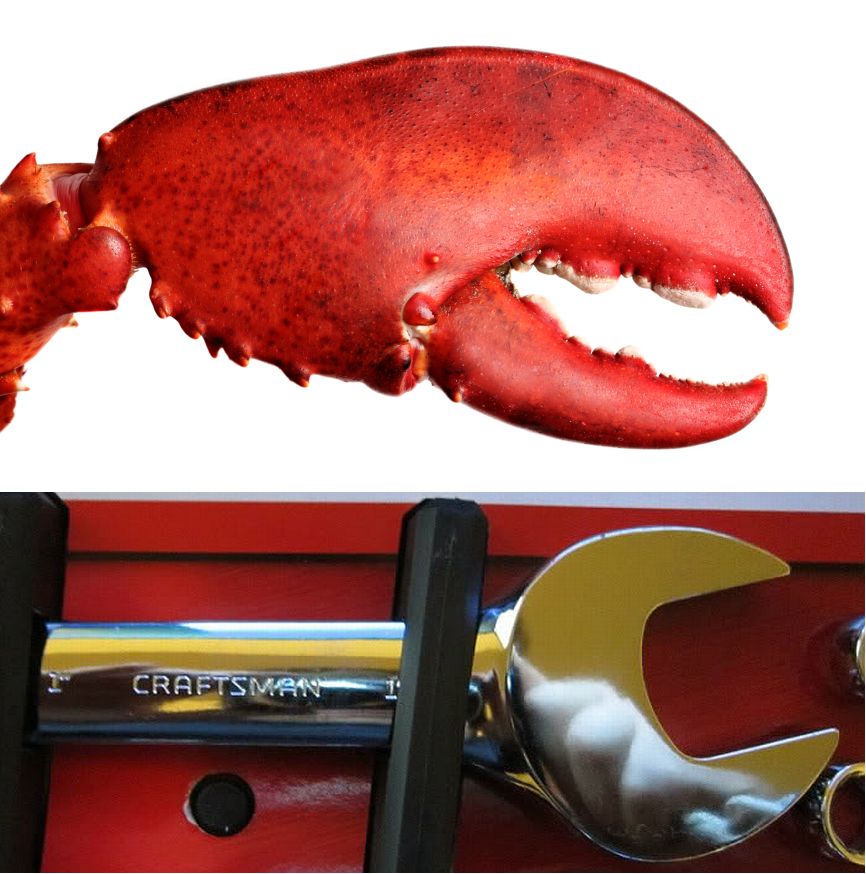
The new China-made Craftsman full polish wrenches are what come to mind when I hear "Lobster Claw'. There's just no other better way to describe how ridiculous they look. Every time I see them they remind me of Mr Crabs or Larry the Lobster on Spongebob.

r1wjdy.jpg
 

Gmonkee

Well-known member
Joined
May 9, 2010
Messages
2,829
There lies the fault. Some think they look dumb or ridiculous.
But the design is almost two centuries old and alloys of modern versions are equal to any other modern wrench. A failed idea would never last that long.

What you think about appearance does not affect if they work well or not. Mine work just fine. And I don't care what they look like beyond that. Neither does the bolt.

When you find something visually ugly you also see the faults and trust your expert judgement whether or not you actually used them.
These are not the worn out carbon steel relics great grand dad left on the bench, those are done.

These can work and do if someone picks them up and tries.
 

pi_guy

Well-known member
Joined
Jul 27, 2014
Messages
2,819
Location
N/A
I would not say that lobster claw is bad, but the larger ones can be tougher. I honestly think there are times when lobster claw is really good, but I much prefer the tail with melted butter.

I prefer deep fried lobster with drawn butter.
Available at Jake's on April 1 for the season......
 

T45

Well-known member
Joined
Nov 20, 2014
Messages
3,253
OP, those aren't lobster claw...just deep broach

lobster claw is excess widthd across the face of the jaw...[see post #10]

Just my $0.02

On very thin wrenches engineers use "lobster claw" profile for more stregth--eg, when using 50% of so of normal jaw thickness, you make jaws wider to keep it from bending or deforming.

On a cheap wrench which is not a thin wrench, the shape is simply used because lack of hardness would allow the wrench to deform and create warranty liabilies for the selller.

So lobster claw implies (1) low hardness metal; and (2) poor fitment in tight spaces.

(2) is ok if used on a thin wrench, because it fits in other tight spaces, and also is likely to be properly hardened as the design is intentional and not a cust cutting move.

A cheap lobster claw has no useful benefits for the design compromise, so it's usually avoided.
 
OP
M

[memphis]

Well-known member
Joined
Sep 30, 2016
Messages
129
I remember people saying those older Mastercraft Maximum wrenches were just like Snap-on or Snap-on copies.

My reasoning for the thicker Gray wrenches is that in industry is that you run into a lot of different fittings, soft brass, tough steel, oddball square nuts, rusted fasteners, jam nuts that you need strong open ends.

I use Proto ASD and sometimes i wish i had stronger open ends like Gray's

I've had a bunch of people tell me the old maximum line is the same as Snap-On. I don't believe that to be the case, but I am quite sure Gray used to make the old version of Snap Ons Flare Wrenches that were made in Canada. I have a friend with an old set and the size and quality feel and look identical. New snap On is very thin and low profile, much like the new Mastercraft Flare Wrenches
 

WWheeler

Well-known member
Joined
Jun 23, 2015
Messages
4,105
Location
Middleofnowhere USA
OP, those aren't lobster claw...just deep broach

lobster claw is excess widthd across the face of the jaw...[see post #10]

Just my $0.02

On very thin wrenches engineers use "lobster claw" profile for more stregth--eg, when using 50% of so of normal jaw thickness, you make jaws wider to keep it from bending or deforming.

On a cheap wrench which is not a thin wrench, the shape is simply used because lack of hardness would allow the wrench to deform and create warranty liabilies for the selller.

So lobster claw implies (1) low hardness metal; and (2) poor fitment in tight spaces.

(2) is ok if used on a thin wrench, because it fits in other tight spaces, and also is likely to be properly hardened as the design is intentional and not a cust cutting move.

A cheap lobster claw has no useful benefits for the design compromise, so it's usually avoided.

This is the best 'Lobster Claw' explanation I've seen.

That's exactly the problem with those Chinese-made Craftsman full polish wrenches (not to be confused with USA-made Craftsman Pro full polish wrenches). The heads are so ridiculously big and fat in every dimension that they won't fit onto many fasteners that you've never had trouble getting a wrench on before.
 

kelwar

Well-known member
Joined
Oct 14, 2010
Messages
64
I have heard that the old mastercraft professional / maximum series was made by snap on also but unless your going way back (then I can't say, might be possible as snapon used to make some tecomaster tools) they are not and spread easier. They do feel fairly similar to the snap on's though. More on topic the gray wrenches are good quality but like others have already stated are made for more industrial work where there is less concern about space. I wouldn't say in the case of the grays it is bad but it all depends where you are trying to use the wrench.
 

Abeo

Well-known member
Joined
Oct 22, 2009
Messages
784
Location
Calgary, Ab
I have heard that the old mastercraft professional / maximum series was made by snap on

This makes me feel better about my circa 2004 set...

I do have wrench envy for doing brake bleeders based on the first post
 
To avoid these ads, REGISTER NOW!

Kev442

Well-known member
Joined
Jan 15, 2009
Messages
5,386
Location
Wi
Those Cman wrenches are why I have not been in a Sears tool section in 10 years. Tekton, HF, Akar, all cheap wrenches that avoid the lobster claw.
 

rsanter

Well-known member
Joined
Dec 22, 2007
Messages
18,521
Location
visalia ca
That's the way the old engineers wrenches were. Large beefy open end heads.

The down size is when working in tighter spaces. Other than that doesn't matter

Bob
 
OP
M

[memphis]

Well-known member
Joined
Sep 30, 2016
Messages
129
i laugh when i come across these.

OK those are definitely lobster claw :lol_hitti
I had several techs complaining about the size of the Gray and I thought it can't be THAT bad. Half the guys are Princess Auto technicians anyway and won't pay for quality unless it's free or stolen (re: cheap) :lol:
 

mrvm

Well-known member
Joined
Feb 12, 2014
Messages
3,845
Location
PA
Great lobster claw pics......If I had any lobster claws, they would be easy to spot in the tool drawer for one-way rentals to tool borrowers.
 

Gmonkee

Well-known member
Joined
May 9, 2010
Messages
2,829
Memphis. The small shop I work at has mostly cheaper import tools, and a shitload of them.
Some Euro and a few bits of ancient truck brands too. Its a soup of styles and truly a worldwide mix.

The tools only have to fit well and not break. We use them all without any shame to get us paid.

The lesser brands can start and finish jobs as well as costly brands in capable hands. No amount of money spent will make incapable hands a great mechanic.

If some of those guys simply changed how they use the tools a little bit they would be fine. The rest need to find tools that fit how they work.

I prefer older style tools and figured out how to make them make me money. Its not science, just understanding how something works best.
 

bwringer

Well-known member
Joined
Jan 1, 2013
Messages
10,298
Location
Indianapolis
Hex fasteners and square fasteners need wrenches with different jaw lengths or broaching depths to fully grip the flats on the fasteners.

Some open end wrench designs have jaw lengths that are obviously designed for hex fasteners, and if you try to use then on a square head nut or bolt, the jaws don't fully engage the flats on the bolt. If the bolt is corroded or very highly torqued the one jaw tip on the wrench recieves a huge amount of pressure.

Wrenches with longer jaws spread the pressure from a square nut over a longer surface.

Some "lobster claw" wrenches may have been designed for use on both square and hex fasteners, since square fasteners are still used. Other lobster claw wrenches may use an older jaw geometry from when square head fasteners were more common.


Excellent points I hadn't considered before. :headscrat

In industrial use, you're much more likely to encounter square fasteners and fittings made of softer material, so a thicker, deeper open end would have real advantages.
 

sberry

Banned
Joined
Jun 18, 2005
Messages
35,747
Location
Brethren, Michigan
Memphis. The small shop I work at has mostly cheaper import tools, and a shitload of them.
Some Euro and a few bits of ancient truck brands too. Its a soup of styles and truly a worldwide mix.

The tools only have to fit well and not break. We use them all without any shame to get us paid.

The lesser brands can start and finish jobs as well as costly brands in capable hands. No amount of money spent will make incapable hands a great mechanic.

If some of those guys simply changed how they use the tools a little bit they would be fine. The rest need to find tools that fit how they work.

I prefer older style tools and figured out how to make them make me money. Its not science, just understanding how something works best.
This is how we look at it. I survive a good share on common combo, a collection, some imports mixed in too. Many have special features, fine old Cman, handful of Snap flanks, dbe, offsets etc, lots of duplication for super convenience.
 

Attachments

  • wrenchs 1.JPG
    wrenchs 1.JPG
    40.4 KB · Views: 43
  • wrenchstyle.jpg
    wrenchstyle.jpg
    143.9 KB · Views: 44
  • wrenches 2.JPG
    wrenches 2.JPG
    45.3 KB · Views: 39
  • wrenches 5.JPG
    wrenches 5.JPG
    60.5 KB · Views: 39
Last edited:

sberry

Banned
Joined
Jun 18, 2005
Messages
35,747
Location
Brethren, Michigan
As easy as it can get. The Sears lobsters and heavy box are very tough, beat them bad and never broke one.
 

Attachments

  • box top 3.1.jpg
    box top 3.1.jpg
    144.9 KB · Views: 49
  • vise wrenches.jpg
    vise wrenches.jpg
    122.2 KB · Views: 47
Last edited:

7th Kahuna

Well-known member
Joined
Aug 4, 2012
Messages
1,704
Location
Los Angeles, CA
I agree, the argument is almost always that lobster claws use inferior metallurgy. If true, fine. However, all things being equal you don't have to be a structural engineer to understand that more material is likely stronger in this instance.

While technically correct, 'inferior' metallurgy suggests that there is something wrong with the tools. This is not necessarily the case. There are many types of steel alloy, each exhibiting different qualities. The manufacturer may choose to spec the wrench in many different ways. It may be spec'd by strength, size, weight, finish, price, you name it. In most cases it is going to be some combination of all the above. Unfortunately the tools don't come with labels letting us know just what went into their design. I think this is one of the areas Sears went wrong. Why did they give up the 'good' 'better' 'best' rankings for their tools? That was perhaps our best indication of what went into the tools. I'm no expert but I imagine Sears spec'd the three tools along these lines:

Each shall have a minimum strength of 'x' (as measured in use) and be made of a steel alloy.
'Good' tools shall have a lower price and less perfect finish.
'Better' tools shall feel nice in the hand and have a fine finish.
'Best' tools shall be smaller and lighter weight while maintaining the nicest finish.

As I understand it, the metallurgy of the 'Best' tools didn't necessarily make them stronger than the 'Better' tools, it did however make them stronger per ounce. This meant the heads could be smaller, the handles longer (more leverage), etc.

In this case everyone knew what they were getting, and what they were giving up, for the difference in price. The important thing in my mind is that none was a poor tool. Who among us wouldn't cringe at the sight of a mechanic kicking a Snap-On wrench across an old asphalt driveway, yet we've all known a guy who would. What need does this guy have for a nice finish? Smaller size or lighter weight maybe, but not a nice finish. Ignoring the questionable production practices of lessor companies, 'Good' wrenches are good wrenches and if the trade offs of weight and finish, budget and application, don't compel you to spend more, buy the wrench that 'fits'.

---​

As a side note, I have noticed that when the professionals move in a new direction, the tools or materials they leave behind do tend to suffer. As an example, my dad and I have been framing a new shop building. We are framing by hand rather than with a nail gun. The loose nails we buy today would have been roundly rejected by my grandfather 50 years ago. They are short, soft, and their heads pop off way too easy. As a result I have been haunting Habitat for Humanity's Restore locations for old USA and Canadian nails. One of the boxes I picked up had the nails laid in rows so you could just pick them up and drop them into your bag without aligning them first. A real time saver. If there were demand for good loose nails today, they would be made, but there is not. All the production guys have gone pneumatic. Same goes for the tools that fall out of favor. There is not necessarily going to be a quality entry level option.
 
Last edited:

WittHay

Well-known member
Joined
Jan 6, 2016
Messages
2,157
Location
Surrey, BC Canada
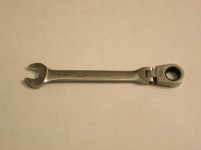
New Gray lobster claw Flex-Head Ratcheting Wrench. Stronger design than the GearWrench
 

Attachments

  • IMG_0999.jpg
    IMG_0999.jpg
    164.4 KB · Views: 49
  • IMG_1000.jpg
    IMG_1000.jpg
    168.5 KB · Views: 44

WWheeler

Well-known member
Joined
Jun 23, 2015
Messages
4,105
Location
Middleofnowhere USA
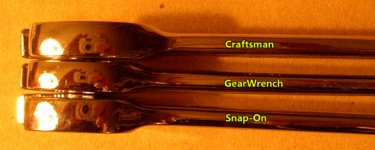
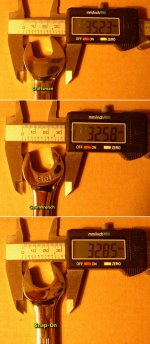
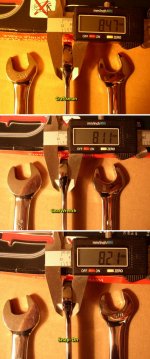
5/8" wrench comparison
Craftsman China 45979 A-AE
GearWrench China 81658
Snap-On USA SOEX20

2wdtvr8.jpg


9a95qw.jpg


2s166w5.jpg


f0rotg.jpg
 

Attachments

  • Craftsman_GearWrench_Snap-On(1).JPG
    Craftsman_GearWrench_Snap-On(1).JPG
    76.2 KB · Views: 20
  • Craftsman_GearWrench_Snap-On(2).JPG
    Craftsman_GearWrench_Snap-On(2).JPG
    42.2 KB · Views: 18
  • Craftsman_GearWrench_Snap-On(3).jpg
    Craftsman_GearWrench_Snap-On(3).jpg
    130.4 KB · Views: 18
  • Craftsman_GearWrench_Snap-On(4).jpg
    Craftsman_GearWrench_Snap-On(4).jpg
    123.2 KB · Views: 26
Last edited:

WWheeler

Well-known member
Joined
Jun 23, 2015
Messages
4,105
Location
Middleofnowhere USA
Just to bring this back up, but I was wondering if anyone else besides me was surprised the Snap-On open ends are actually slightly larger than the GearWrench in both aspects?

One thing I wasn't able to measure, at least not by myself and get a picture of it, was the distance from the tips of the open end to the back of the 'claw' so to speak, which is most pronounced on the Craftsman and largely what gives it that lobster claw look. I'm not sure that actually affects usage though as much as the thickness and outer diameter which I was able to measure up.
 
To avoid these ads, REGISTER NOW!
Top Bottom