To avoid these ads, REGISTER NOW!

VISE REPAIR 101 all vise repairs, lubricants, sources for parts and the tricks to fix

G-ManBart

Well-known member
Joined
Jan 24, 2015
Messages
2,059
Location
Michigan
Almost all manufacturers' vises were grey cast iron back then.


Schiller Park models and earlier were grey cast iron except for the hydraulic vises.

Wrong.

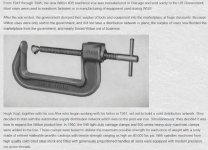
Even this ad from a 1947 Popular Mechanics magazine for the Wilton baby family says they were made from a malleable alloy that was 53K PSI tensile strength.

The chances that they used lesser materials for their bigger vises is pretty much zero. The fact they specify it as 53K PSI strength, and the newest models are quoted as being 60K PSI says your constant comments that Wilton used grey iron for decades isn't remotely close to the truth.

 
Last edited:
To avoid these ads, REGISTER NOW!

sparklemotion

Member
Joined
Feb 8, 2017
Messages
19
Wrong.
Even this ad from a 1947 Popular Mechanics magazine for the Wilton baby family says they were made from a malleable alloy that was 53K PSI tensile strength.

The chances that they used lesser materials for their bigger vises is pretty much zero. The fact they specify it as 53K PSI strength, and the newest models are quoted as being 60K PSI says your constant comments that Wilton used grey iron for decades isn't remotely close to the truth.

Malleable Iron is different than Ductile Iron. It's reasonable to assume that the "malleable alloy" of the 40s is different than the "ductile alloy" of the 70s.

So, on the surface, it seems that this isn't accurate, at least as far as 1940s era Wilton's is concerned:

I keep saying they're made of ductile iron because that's what they're made of.

That still leaves the question of the post 1957 vise at issue.

Diving a little deeper, I notice that the 1947 ad actually says that "head and nut are made from malleable alloy--53,000 lbs. tensile strength."* Similarly, the 1974/75 brochure says "Stressed Parts of Ductile Alloy areas of greatest stress have been 'beefed up' with ductile alloy -- for the strength of steel -- 50% stronger than gray iron vises."

Both of which imply to me that neither vise was 100% "better" material, meaning that they could have been mostly grey iron until some point in the more recent past. I obviously don't have evidence for that (or I'd show it).

*incidentally, this jives with what Wikipedia has to say about malleable iron being good for "small castings." Both from a "head and nut" only perspective, AND as a data point that maybe design decisions were made for the baby bullet that wouldn't scale to the big boys.
 
Last edited:

87GNat

Member
Joined
May 2, 2006
Messages
11
Location
Central CT
I moved into a new house and the previous owner left two vises for me, one was mounted to a workbench and the second was rusted frozen in the corner.

The first is a Parker 88 that is missing the pipe jaws, overall its in nice shape with good jaws.

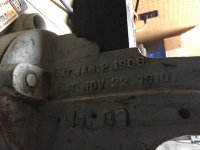
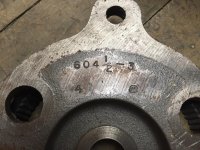
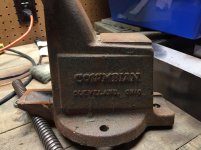
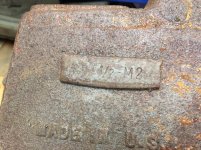
The second is a Columbian 604-1/2M2, this one was frozen. I let it sit in some marvel mystery oil for a few months and I was finally able to open it up.

I cleaned them both quick with a wire wheel and then I blasted them in my sandblast cabinet. I'll post the after pics in the next few posts
 

Attachments

  • IMG_5077.jpg
    IMG_5077.jpg
    131.4 KB · Views: 29
  • IMG_5078.jpg
    IMG_5078.jpg
    142.6 KB · Views: 29
  • IMG_5097.jpg
    IMG_5097.jpg
    147.3 KB · Views: 25
  • IMG_5087.jpg
    IMG_5087.jpg
    148.1 KB · Views: 21
  • IMG_5086.jpg
    IMG_5086.jpg
    146.6 KB · Views: 18
Last edited:

87GNat

Member
Joined
May 2, 2006
Messages
11
Location
Central CT
Columbian 604-1/2M2

As I mentioned this one was frozen, probably long before I moved into the house. I forgot to take a pic before I opened it so the first photo is half cleaned with a wire wheel the other half as is.

The jaws are in nice shape and were fairly easy to removed with a punch.

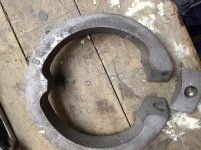
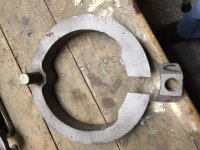
This vise is missing the swivel lock parts. I know I read somewhere that you can get them on ebay but with so many vise threads, I can't remember where I read it.
 

Attachments

  • IMG_5091.jpg
    IMG_5091.jpg
    146.7 KB · Views: 15
  • IMG_5090.jpg
    IMG_5090.jpg
    148.4 KB · Views: 16
  • IMG_5088.jpg
    IMG_5088.jpg
    143.6 KB · Views: 17
  • IMG_5082.jpg
    IMG_5082.jpg
    143.2 KB · Views: 18
  • IMG_5080.jpg
    IMG_5080.jpg
    153 KB · Views: 17
  • IMG_5079.jpg
    IMG_5079.jpg
    142.8 KB · Views: 23
Last edited:

kwhunter

Well-known member
Joined
Oct 9, 2016
Messages
61
Location
@home
I know what is the "nut", not sure what is the "head"... as per the leaflet, head and nut are made of malleable alloy but how about the body? grey iron probably, to keep costs low.
Fairly easy to identify by any experienced metallurgist.

Wrong.

Even this ad from a 1947 Popular Mechanics magazine for the Wilton baby family says they were made from a malleable alloy that was 53K PSI tensile strength.

The chances that they used lesser materials for their bigger vises is pretty much zero. The fact they specify it as 53K PSI strength, and the newest models are quoted as being 60K PSI says your constant comments that Wilton used grey iron for decades isn't remotely close to the truth.


ALLFAST

Well-known member
Joined
Feb 20, 2017
Messages
1,233
Location
Northern California
Hello Everyone,

Does anyone have a BROKEN ROCK ISLAND SWIVEL BASE for which they are willing to part ways? It would preferably be a 5 or 6 inch model as I need to have a decent mounting ear to fit and weld onto my broken old base.

My goal is two fold:

• I will soon be liberating my old broken ear base (a previous owner carefully stitch welded it to the vise body) from my 577 and I would like to have a similar material to experiment on before I start carving away on my irreplaceable old base. With an old base I can try some different RexCut abrasives (grits and profiles) to see which will work the best for the actual "surgery."

• I want to get a little practice with some NiRod X55 on the broken base before I dive into my actual vise body (filling numerous ugly little divots and padding up the jaw bodies for milling and fitting new jaw inserts) and fit a new mounting ear to my old base.

I was extremely fortunate to source a good used base for my 577 and recently learned that Packard V8 is still in need of a base for his own 577. I'm most confident that I will be able to restore my old base to a very respectable condition and will be giving it to him for his project.

I'd be willing to pay shipping my way and any cost for the donor part.

Thank You !
 

G-ManBart

Well-known member
Joined
Jan 24, 2015
Messages
2,059
Location
Michigan
Malleable Iron is different than Ductile Iron. It's reasonable to assume that the "malleable alloy" of the 40s is different than the "ductile alloy" of the 70s.

So, on the surface, it seems that this isn't accurate, at least as far as 1940s era Wilton's is concerned:


That still leaves the question of the post 1957 vise at issue.

Diving a little deeper, I notice that the 1947 ad actually says that "head and nut are made from malleable alloy--53,000 lbs. tensile strength."* Similarly, the 1974/75 brochure says "Stressed Parts of Ductile Alloy areas of greatest stress have been 'beefed up' with ductile alloy -- for the strength of steel -- 50% stronger than gray iron vises."

Both of which imply to me that neither vise was 100% "better" material, meaning that they could have been mostly grey iron until some point in the more recent past. I obviously don't have evidence for that (or I'd show it).

*incidentally, this jives with what Wikipedia has to say about malleable iron being good for "small castings." Both from a "head and nut" only perspective, AND as a data point that maybe design decisions were made for the baby bullet that wouldn't scale to the big boys.

There's some history here that sort of makes the context hard to follow. I was talking about a 1960 or newer vise, not a 1940s model, when kwoswolt99 decided he wanted to try pointlessly correcting me again. :roll eyes:

The ad was simply point out that Wilton documented using materials much better than grey iron decades earlier than some folks seem to believe...if nothing more than for some parts.

As far as stressed versus non-stressed area, and what the "head" is, it's open to conjecture. I can only imagine either the head is the dynamic jaw where the spindle seats, or the tail cap assembly where the nut seats.

The entire body of a vise is stressed, and trying to make a composite body where some parts are grey iron, and others some sort of malleable iron, or ductile iron is unlikely.

When you compress something in the vise, it puts a load on the body of the vise because that's what supports the static jaw, so that part is very definitely stressed.

Non-stressed, would definitely be a swivel base, and likely the slide since it doesn't take any significant load...it's just a guide. The rest of the dynamic jaw is stressed, and all of the static jaw is stressed, both in compression, and shear since the static jaw wants to move back and up under load.

In theory they could have made the dynamic jaw out of some sort of ductile/malleable alloy, the slide out of nearly anything, the tail cap assembly out of an alloy, and the main body out of a less expensive material, including grey iron and probably gotten away with it since the main body has the most mass.

My point many posts ago was that trying to weld a new jaw support onto the main body of a vise isn't likely to succeed....it's some sort of cast iron, malleable iron, ductile iron, etc and welding steel to that would result in a very weak structure no matter how skilled the welder.
 
Last edited:
OP
D

drivesitfar

Well-known member
Joined
Oct 23, 2013
Messages
36,040
Location
Pacific Northwest
AllFast: when you make posts like that if you might have any pictures of your own or some you can borrow from somebody else to post it sometimes helps. also looks like you are preparing to post a bunch of pictures of your restoration of your Rock Island 577 and i for one am going to get the popcorn and enjoy the view from my chair. good luck and sorry i can't help with the missing parts.

METAL TYPES: regarding the types of metal used on vises instead of posting typed old facts and theories is there anybody that has the talent/skills or ability to run tests to determine which vises were made of what material and when?

ALL: speaking of better materials i just picked up an old USA made version of the CHINESE WONDER VISE from another GJ member i know. it's missing a few parts so thought i'd post here first since this thread is a lot more active than the vise parts thread and see if any of you might have a broken one and want to sell or donate parts to copy to make mine a working vise again and i will set it up on a bench if i do get it working like it did almost 100 years ago.

it's missing a swivel base and the parts, a top pipe jaw and the 2 inner pipe jaws. otherwise this little 3.5 inch wide jaw vise is just needing to be stripped and have some BLO put on it.

anybody own one of these that is broken that can sell me the parts or maybe one that is 100% complete where you can show me and maybe send me measurements i can have one of the machinists i know make some?

thanks in advance
 

Attachments

  • WP_20170323_009[26516].jpg
    WP_20170323_009[26516].jpg
    153.6 KB · Views: 26
  • WP_20170323_004[26512].jpg
    WP_20170323_004[26512].jpg
    145.9 KB · Views: 30
  • WP_20170323_006[26514].jpg
    WP_20170323_006[26514].jpg
    150.5 KB · Views: 36
  • WP_20170323_005[26513].jpg
    WP_20170323_005[26513].jpg
    140.4 KB · Views: 31
  • WP_20170323_008[26515].jpg
    WP_20170323_008[26515].jpg
    151.3 KB · Views: 42
To avoid these ads, REGISTER NOW!

Outlawmws

Well-known member
Joined
Aug 9, 2011
Messages
39,297
Location
The Badlands
Dang Drives, that IS a score! three jaw inserts, and your fully operational except for the swivel base. (So stand mount it...)
 
OP
D

drivesitfar

Well-known member
Joined
Oct 23, 2013
Messages
36,040
Location
Pacific Northwest
Provi: that burgundy one on Portland's craigslist has been for sale for maybe 4 years now, but thanks for reminding me. his is missing pipe jaws, but maybe he has a good base and the top pipe jaw i could copy or use if he isn't still asking a couple benjamins for it

Outlaw: you have an amazing knack for stating what i'm thinking. it's not like i'm in a hurry so maybe i'll wait until i find all the parts, but thanks for the post. have you seen one of these in person yet? it's about a 1/3 the size of the Chinese Wonder Vises and built like a little tank.

ALL: thanks all for making this one of the best threads to talk about fixing vises on the internet. also for any of you that have spiffed up your vise there is always room for more before and after pictures (lots of room so take lots of pictures) and lots of conversation about how these old vises work and come apart and go together.

cheers
 

bareass172

Well-known member
Joined
Aug 5, 2012
Messages
817
Location
N'awlins
Drives - I wanted to add something for your #5 post on lubricants. I got into the habit of using moly pastes in splined gears on motorcycles. Moly pastes are 60+ % moly content which sets them apart from moly grease which is usually only ~3-5%.
http://na.henkel-adhesives.com/product-search-1554.htm?nodeid=8797877698561
Now, I still use the paste on some applications as a lubricant, and I believe it would be a good application on screws that are relatively protected from dirt/debris, but moly paste (much like anti-seize) somehow seems to get on everything and leaves you wondering how it got where it is.

Anyways, using the moly so much I looked into what makes it so effective in splined gears and learned that in high moly content pastes the moly actually forms a barrier that protects the metal against wear. In essence, the moly takes the damage and abuse and protects the metal splines in the process. When I started rebuilding machines a few years ago I often found myself thinking that moly would be a great protector for any similar metal on metal wear like acme threads, rack/pinion type setups like my lathe carriage moves on, and other similar jobs - but I knew that I could not use the paste because it would attract "crud" and that grit would destroy parts. A friend of mine who works in industry brought me a can of this stuff they use at his facility and I fell in love - it's dry moly in a spray can. The one I use is from CRC:
http://www.crcindustries.com/products/dry-moly-lube-11-wt-oz-03084.html
CRC makes 2 other versions also, one is just a fast drying version. Loctite also makes one:
http://www.na.henkel-adhesives.com/product-search-1554.htm?nodeid=8797876944897
I'm guessing other companies do too - but the CRC is what I use.

Anyway, I can clean my part, spray this on, it dries in a couple of minutes and then it is completely dry and won't rub off. You can handle parts and nothing rubs off on your hands, etc. After the part is dry I can then assemble my item and, if necessary, use additional lube on top of it. The moly is definitely a lube, but in this dry form I consider it more of a protector against metal to metal wear. So on exposed screws like my lathe lead screw or the the big screw on the clamp for my band saw I'll keep them with just the dry moly so they don't collect dirt, but on an application like a vise that requires "wet" lube I still use standard lube on top of the moly.

It's really pretty great stuff and I recommend anyone who does a lot of work like this try a can. I think you, like me, will find a lot more uses once you see how it works. I actually use it as a coating for old machine hardware now also. If I get a machine and the hardware is rusty but I don't want to replace it, I'll clean the rust using my method of choice, and then coat all the hardware in this dry moly. It sets up like a coating and will help ward off rust, but unlike paint it won't flake off when I put a tool on the fastener to install it. So I'm clear, this stuff is NOT paint, but it does a pretty decent job at preventing rust if you clear the old rust first and then coat properly.

Anyways - just sharing and hopefully providing good info to help everyone in their endeavors. ;)
 
OP
D

drivesitfar

Well-known member
Joined
Oct 23, 2013
Messages
36,040
Location
Pacific Northwest
BA: you've always had interesting posts and this one is another good one. i'll put the links for Molly paste and spray on post #5 cause i think we all would like more choices.

quick question have you tried to paint over the top of the spray or do you have to remove it before painting?

also since you have a cool little garage with a ton of good organizing items along with all your projects might i suggest you maybe start a garage thread and just post what you want to about your garage and projects so more of the members can see what you do?

then put the garage gallery thread link in your signature. i still haven't set up my garage like i want to, but i think you were the first one to show me and maybe us the PVC tool and parts holders that i thought were great.

take care and thanks for the post!! :bowdown:
 
OP
D

drivesitfar

Well-known member
Joined
Oct 23, 2013
Messages
36,040
Location
Pacific Northwest
ALL: here's a few images of Moly Lube and Spray i found with my GOOGLE FU and these were at Zoro, but it looks like they are at a lot of retailers so pick your favorite and maybe buy some.

anybody that buys some and uses it or maybe there are already users please comment on how you like it if you would cause lubrication is a key part to a vise working properly.

cheers
 

Attachments

  • Z20totfo5oy.JPG
    Z20totfo5oy.JPG
    19.2 KB · Views: 19
  • Z1tBKyhcpIx_.JPG
    Z1tBKyhcpIx_.JPG
    52.3 KB · Views: 16
  • Z-1sr-fo5oy.JPG
    Z-1sr-fo5oy.JPG
    49.3 KB · Views: 17

vintage nut

Well-known member
Joined
Mar 17, 2015
Messages
1,272
Location
west coast of canada
I've been meaning to try moly paste for a while.. I've been using insted-a-led and am very happy with it though.
A couple other things that'd be worth considering. Mobil makes a moly grease for the mining industry that is 5% instead of the regular 3%
Open gear grease would have potential for this application as well.
Next time I strip my vises down for cleaning (usually every 4-6 months) I'll give one of them a shot.

Sent from my MotoG3 using Tapatalk
 

Outlawmws

Well-known member
Joined
Aug 9, 2011
Messages
39,297
Location
The Badlands
The attraction to the CRC moly spray is that is dries so won't pickup grit as easy. The pastes and greases will.

I used to have some spray graphite that dried to a dry graphite film that I loved using in a lot of places. Interestingly, it could be quickly buffed and looked like blueing on a smooth metal surface. While not highly durable, it was easy to reapply an rebuff. (by hand and a rag...)

I bought a case of the stuff but at about can three I discovered they had lost pressure and the company had disappeared...

I'm going to give this CRC moly stuff a go. It is apparently at all major Autoparts chains.
 

bareass172

Well-known member
Joined
Aug 5, 2012
Messages
817
Location
N'awlins
@ Drives: Thanks for the kind words! I've never tried painting over it, but I would strongly assume that you cannot paint over it. I honestly never looked into the garage thing you're talking about - do I just make a thread somewhere or is it something in my forum control panel? Not trying to sound ignorant, this place just has so much going on I usually spend most of my time in 2 or so sections and even then I don't have the time to read it all! ;)
You mentioned PVC holders, are those the ones I have my zip ties in? I guess I think of most of my garage inventions as simple compared to some of the really neat ideas I see here from others.
I've been using moly paste for a lot of years servicing bikes with shaft drives, but this dry stuff is relatively new to me so if anyone else has experience I'm all ears as well. I will say though, I love it on everything I've tried it on so far. I recently rebuilt my 70's era Craftsman "Commercial" lathe and I even used it to coat all the Zamak gears to provide extra protection.

@vintage: Just consider what I mentioned about the difference between moly paste and grease. Grease with moly is not uncommon, in fact moly is in many, many motor oils also, but getting it in the concentration of the paste (60ish %) makes the difference. I would consider moly grease (3-5% moly) no different or better than regular wheel bearing grease. The paste has a consistency closer to anti-seize. On motorcycles the grease isn't thick enough and it flings off, one more reason the paste is a necessity. I've had to rebuild wheel/drive assemblies with new parts because certified mechanics at certified dealers used the grease instead, justifying it because it's more readily available. :eyecrazy:

@Outlaw: I'd be curious to know how that works for you in that application. I've never thought of that, so I've never tried it. I'm not sure what the costs are at auto stores, but I know that MSC Direct (formerly Enco) sells it as well.

I will also mention that, since this was a required maintenance item for bikes, you can also buy it from Honda directly. They called it Moly 60 and they have since replaced that with Honda Moly 77. I started buying it from Loctite before they changed, so I have no experience with the 77. I've also never used the loctite version of the dry lube, so I can't comment there. Part of the convenience of the dry lube (for me) is that spray which gets into all the little cracks and crevices.
I'll also tell everyone in advance, moly is very hard to get off your skin once it's there, so consider gloves if that kinda thing bothers you. :lol:

Glad to contribute!
 
OP
D

drivesitfar

Well-known member
Joined
Oct 23, 2013
Messages
36,040
Location
Pacific Northwest
BA: another great post and thanks for sharing your thoughts. also maybe i should get the spray and spray it on me since it's been raining up here in Seattle about 9 of 10 days lately and a lot. seriously good tip about the gloves and maybe long sleeves too when spraying it on your tools and vise.

BA & ALL: as far as starting a thread in GARAGE GALLERY if you go in that section and just click on the tab at the top that says START A THREAD all you need to do is pick a title and start filling up the posts. the more pictures and information you post and questions if you have any the more eyes you'll get on your thread and maybe more member's posts too. here's a few of the garage gallery threads i've enjoyed the content and the members hosting the threads seem to answer all mine and others questions and post lots of pictures. read a few of the threads before you start yours and some of the threads are great and only started with a shed or a condo's carport so it's not the size of the garage it's always the host and the content. HAVE FUN and put the link to your garage gallery thread in your sig line along with your other links and see how it goes. simple projects are great with pictures and a few words cause there are only so many YOUTUBE videos we can watch without some interaction between people. GJ is my version of FACEBOOK and my wife keeps showing me what the kids are doing on FACEBOOK when she sees something interesting.

Denwood's thread started with him raising his 15x25 100+ year old garage so he could put a lift in it and there are many other projects and high tech stuff since then and here's the link: http://www.garagejournal.com/forum/showthread.php?t=263351

1/2 Cup's thread i haven't read from the beginning yet, but there is always a lot of information and activity on it

http://www.garagejournal.com/forum/showthread.php?t=225061

OldIronFarmer's thread started with an idea to get floor space and he really does have some interesting stuff and stories that will keep anybody smiling

http://www.garagejournal.com/forum/showthread.php?t=334140

DonLong's thread is just pure EYE CANDY and information cause the man is blessed with a great personality, skills and some funds to do as he pleases.

http://www.garagejournal.com/forum/showthread.php?t=153099

sorry to divert from VISE TALK for a moment, but i get asked this a lot and a lot of you deserve to have a thread where you can post up your projects and just some of the skills you possess that you wouldn't mind passing on to others like some of the guys have done graciously here on this Vise Repair 101 thread.

have fun and there are many many other great threads on GJ's garage gallery and other areas and if you read something good maybe a thanks, Well done or a thumbs up is just a nice way of telling the posters that their post had some value.

cheers and saw this picture posted that really does ring home with me and maybe a few of you too. i'll get back to ORGANIZING.
 

Attachments

  • How I spend my time.jpg
    How I spend my time.jpg
    24.5 KB · Views: 29

sparklemotion

Member
Joined
Feb 8, 2017
Messages
19
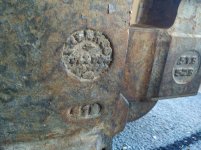
The pictures below are of a Prentiss 518 that I picked up from a metalsmith who was downsizing. It was in his possession for at least 25 years, and he claims that it was as crusty when he got it as it is now.

It works great, AFAICT (I haven't put any really force on it yet since I don't have a mount, but I have reasons to trust the dude who sold it to me). Anyways, I'd like to pretty it up some and ideally make it my go-to big-girl vise. The first order of business is wire brushing (any reason to go with brass instead of steel?) to get the flakes off, then probably an evaporust or electrolysis bath for the rest of the rust.

I'm considering boiled linseed oil for the finish, but there are things I'd rather not use my oven for, so it will probably be paint on all the non-friction surfaces, some sort of oil everywhere else.

My big question though is the static jaw. Is there any reason why I should risk trying to get the jaw off and welding/brazing the "ledge" to rebuild those pits? If I went that route, I'd probably also plan on milling/heat treating new jaws, which I don't wanna do (I'd rather not buy replacements either).

So, I'm really leaving towards to just cleaning the non-structural stuff up and putting her back to work. What say you, vise wizards?
 

Attachments

  • IMG_20170318_162605.jpg
    IMG_20170318_162605.jpg
    140.6 KB · Views: 34
  • IMG_20170318_162620.jpg
    IMG_20170318_162620.jpg
    141 KB · Views: 37
  • IMG_20170318_162652.jpg
    IMG_20170318_162652.jpg
    148.6 KB · Views: 37
  • IMG_20170318_162901.jpg
    IMG_20170318_162901.jpg
    146.4 KB · Views: 33
  • IMG_20170318_162920.jpg
    IMG_20170318_162920.jpg
    145.2 KB · Views: 32
  • IMG_20170318_163021.jpg
    IMG_20170318_163021.jpg
    144.5 KB · Views: 30
OP
D

drivesitfar

Well-known member
Joined
Oct 23, 2013
Messages
36,040
Location
Pacific Northwest
SM: how wide are the jaws on your PRENTISS? while you static jaw is pretty beat up if it works it's really your call. some have taken the old jaws off of better looking vises than yours and even bought new jaws cause they wanted the new look and sharp teeth.

i might wipe it down with simple green and get all the grease and crud off of it before electrolysis and then wire wheel or sandblast or clean it up before putting BLO or paint on it.

you certainly can wire wheel it first and you might not need to use electrolysis, but since you mentioned an E tank i probably wouldn't wire wheel first unless really dirty and it doesn't look that bad.

good luck and welcome to the forum
 

sparklemotion

Member
Joined
Feb 8, 2017
Messages
19
I keep forgetting to get an actual measurement -- I'm pretty sure they are about 6" (though sources say the 518/528 is a 7").

The way I see it, the jaw inserts are actually not that bad, compared to the static jaw itself. So, shiny new-to-this-vise inserts won't do much without backfilling the missing iron. But I'm not an amazing welder so I could see myself making things worse off, structurally, with a shoddy repair job that would really just be for looks.

If I were just planning on flipping this then I'd be willing to give it a shot.
 
OP
D

drivesitfar

Well-known member
Joined
Oct 23, 2013
Messages
36,040
Location
Pacific Northwest
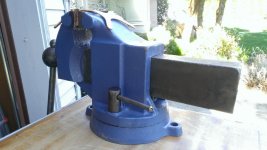
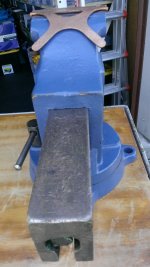
SM: might i suggest doing the best that you can with the skills you posess without taking the jaws off and then using a pair of copper jaws like i do on my big vises. here's a picture i had handy of my Rock Island 577 with a pair of 6 inch Wilton copper jaws i bought off of Ebay about 5 years ago.

in this thread there are several examples of members making their own copper, aluminum or brass jaws and for a lot cheaper than you can buy a pair for.

good luck and when you have time throw a tape on your Prentiss so you and we will know how big your old vise is. ok?
 

Attachments

  • WP_20150215_007.jpg
    WP_20150215_007.jpg
    144.4 KB · Views: 36
  • WP_20150215_006.jpg
    WP_20150215_006.jpg
    143.5 KB · Views: 29
  • WP_20150215_004.jpg
    WP_20150215_004.jpg
    149.2 KB · Views: 30

bareass172

Well-known member
Joined
Aug 5, 2012
Messages
817
Location
N'awlins
@Drives: Thank you for telling me about that. I love the idea, and the ability to show off my space. Mostly, I like being able to share without having to go snap a pic every time I want to show something. Now I have a project... Take pictures, organize my own thread, etc... ;)
 

sparklemotion

Member
Joined
Feb 8, 2017
Messages
19
good luck and when you have time throw a tape on your Prentiss so you and we will know how big your old vise is. ok?

After a seeing enough things that are supposedly six inches, a girl tends to hone her estimation skills.

6" bang on for the Prentiss 518/528 jaws.

Had a little head-slapping moment when you mentioned the copper jaws. 90% of what I do is some kind of manipulation of copper sheet and I've made (fugly) jaw covers for every vise I've got in use -- no reason not to do the same (and actually care about aesthetics) this time.
 

Attachments

  • IMG_20170324_191733.jpg
    IMG_20170324_191733.jpg
    139.3 KB · Views: 35

ganymede

Well-known member
Joined
Nov 29, 2012
Messages
2,332
Location
New England
I keep forgetting to get an actual measurement -- I'm pretty sure they are about 6" (though sources say the 518/528 is a 7").

The way I see it, the jaw inserts are actually not that bad, compared to the static jaw itself. So, shiny new-to-this-vise inserts won't do much without backfilling the missing iron. But I'm not an amazing welder so I could see myself making things worse off, structurally, with a shoddy repair job that would really just be for looks.

If I were just planning on flipping this then I'd be willing to give it a shot.

It all depends on what kind of work you'll be doing with the vise and how much support is left behind the jaw pads. If you're fabricating parts to restore WW2 tanks then you don't want most of the load being on the screws that hold the jaw pad on. At the very least the screws would bend or break, worse, a big chunk breaks off of the body where the screw goes in.
If you're just using the vise to work on 1/72nd scale trains then it doesn't matter.
For wire brushing you can get away with using steel but use a softer brush, one of the ones for a hand held electric drill not those really aggressive types for an angle grinder.
 
To avoid these ads, REGISTER NOW!
Top Bottom