To avoid these ads, REGISTER NOW!

J.H. Williams Wrench--Interesting

Sawdustmaker

Well-known member
Joined
Jan 15, 2017
Messages
928
Location
Placentia, Orange Co., California
Attached are pics of a J.H. Williams & Co., Brooklyn, NY that I have.
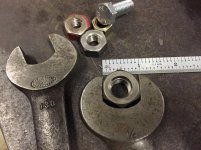
According to Vintage-Alloy web page this wrench was made sometime between 1884 and 1914. Probably belonged to my grandfather(for 20 years, 1899-1919, he was a switchman on the MKT and Frisco railroads in TX) and ended up in the bottom of my dad's old (homemade) toolbox. Anyway the company is well known and this one is stamped with the number 26, which is the style of the wrench. What is unusual is the size of the wrench, One one end it is stamped 3/8, but is actually 3/4 (see pic). The other end is similar being stamped with 1/4, but is actually 1/2. Manufacturing glitch? Anyone seen this before?
 

Attachments

  • IMG_1670.jpg
    IMG_1670.jpg
    145 KB · Views: 37
  • IMG_1669.jpg
    IMG_1669.jpg
    142.1 KB · Views: 30
  • IMG_1667.jpg
    IMG_1667.jpg
    140.8 KB · Views: 34
To avoid these ads, REGISTER NOW!

Private Lugnutz

Well-known member
Joined
Mar 30, 2012
Messages
30,575
Location
The Authentic Jersey Shore
The sizes are bolt diameter sizes, not milled openings. Common in that era.

EDIT: Also, the 26 is not the style of the wrench, it's a size designator. A #26 DOE engineers wrench should have milled openings 1/2" x 11/16" for U.S.S. bolts 1/4" x 3/8" (not the size of the head, but the actual diameter of the bolt). Williams system was eventually adopted by many Mfgrs, became known as an Industry Standard Number, and could be seen on wrenches well into the late 1940's.
 
Last edited:

Oregon rock crusher

Well-known member
Joined
Jun 28, 2016
Messages
1,908
Location
West of Salem
Just like lugz says old wrenches were often marked only with the bolt size and not the across the flats measurement. That said most of them marked with 3/8 would be sized at 11/16" across the flats which was the USS standard. Not sure why yours would be 3/4" atf unless it fit a square nut of the time or was modified a hair. Here is a pic of a Williams wrench marked 1/2 which is 7/8" across the flats and fits the USS stnd heavy hex nut. Ed.
 

Attachments

  • Williams old wrench markings.jpg
    Williams old wrench markings.jpg
    145.6 KB · Views: 28
OP
S

Sawdustmaker

Well-known member
Joined
Jan 15, 2017
Messages
928
Location
Placentia, Orange Co., California
Thanks O.R.C and Lugz.
Not being a machinist or mechanic I was not aware of that standard of measurement. I will definitely recheck the measurement of the distance across the flats with my caliper. This was my first encounter with this. Knowledge acquired!
I do know the difference between across the points and across the flats.
 

Private Lugnutz

Well-known member
Joined
Mar 30, 2012
Messages
30,575
Location
The Authentic Jersey Shore
This was my first encounter with this.
Oh, it's definitely a head scratcher the first time. Sometimes you will see a wrench with "U.S.S." or "S.A.E." after the fractional size marking, or even a hex symbol (literally, a six-sided hex outline), or a hex symbol followed by "C.S." - for the Hex Cap Screw size the wrench fits, which offers more of a clue as to what's going on with the difference between the marking and the milled opening.
 
To avoid these ads, REGISTER NOW!

leg17

Well-known member
Joined
Aug 11, 2011
Messages
1,373
Location
Kentucky
Sawdustmaker; According to Vintage-Alloy web page this wrench was made sometime between 1884 and 1914. [/QUOTE said:
Actually made after 1914 up till about 1924.
 

bill300d

Well-known member
Joined
Jul 25, 2010
Messages
237
Location
lehigh valley, pa
Measure as far in the opening as you can. Those old carbon steel wrenches have a tendancy to have spread jaws from use and abuse.
 

6PTsocket

Well-known member
Joined
Mar 12, 2014
Messages
4,593
Just like lugz says old wrenches were often marked only with the bolt size and not the across the flats measurement. That said most of them marked with 3/8 would be sized at 11/16" across the flats which was the USS standard. Not sure why yours would be 3/4" atf unless it fit a square nut of the time or was modified a hair. Here is a pic of a Williams wrench marked 1/2 which is 7/8" across the flats and fits the USS stnd heavy hex nut. Ed.
The British Whitwirth wrench system is also sized to the bolt , rather than the head. Ask anyone who has worked on an old British sports car. I first ran into it with British turn buckles on a Canadian built sailboat. This is waaay after we stopped sizing US wrenches that way. They match no US size. I just ended up grinding a little off the closest US wrench. At least we now have all settled on metric.


Sent from my SM-G900V using Tapatalk
 
OP
S

Sawdustmaker

Well-known member
Joined
Jan 15, 2017
Messages
928
Location
Placentia, Orange Co., California
Measure as far in the opening as you can. Those old carbon steel wrenches have a tendancy to have spread jaws from use and abuse.

Hit both openings on the wrench today. Larger opening (3/4) was 1/32 over 11/16. Smaller opening (1/4) was 1/32 over 1/2. Not bad for a wrench of that age. It was 1914 to 1924 date of manufacture. Misread the Vintage Alloy article. Learn something new everyday.:thumbup:
 

wasabiboys

Well-known member
Joined
Oct 16, 2010
Messages
76
The British Whitwirth wrench system is also sized to the bolt , rather than the head. Ask anyone who has worked on an old British sports car. I first ran into it with British turn buckles on a Canadian built sailboat. This is waaay after we stopped sizing US wrenches that way. They match no US size. I just ended up grinding a little off the closest US wrench. At least we now have all settled on metric.


Sent from my SM-G900V using Tapatalk

Nailed it. I got some old snap on box wrenches in british standard sizes. Used on my old triumph bike
 
To avoid these ads, REGISTER NOW!
Top Bottom