I am wiring a drill press with 240v single phase input to a vdf but I want to pull 120v for a work light. Will I need a 4 wire(two hots, neutral and ground) circuit from the breaker or can I use a 3 wire(two hots and a ground)?

You are using an out of date browser. It may not display this or other websites correctly.
You should upgrade or use an alternative browser.
You should upgrade or use an alternative browser.
Am I over thinking this... or under thinking it?
- Thread starter nine4gmc
- Start date
wyliesdiesels
Well-known member
Im not sure i understand your first sentence.
Is the drill press single phase?
And yes, if you need 120v, you will need 4-wire, as 240v is just 2 hot legs and ground. it is dangerous and against code to use the EGC as a neutral.
Is the drill press single phase?
And yes, if you need 120v, you will need 4-wire, as 240v is just 2 hot legs and ground. it is dangerous and against code to use the EGC as a neutral.
Furd50
Well-known member
You will need two "hots" plus equipment ground for the drill press motor and a neutral plus a tap from one of the hots for the light, making a total of four conductors. Ideally you would add a fuse from the one hot to the light.
You will need two "hots" plus equipment ground for the drill press motor and a neutral plus a tap from one of the hots for the light, making a total of four conductors. Ideally you would add a fuse from the one hot to the light.
That's what I was thinking originally but started over thinking it when I saw there was already a 3 wire outlet near there. I'll just run the 4 wire as initially intended. Also thanks for the fuse suggestion, I have a panel mount fuse I'll add for it.
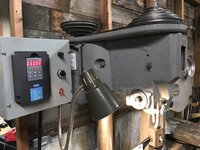
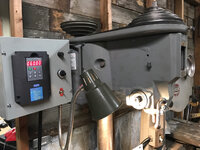
The drill press has a 3ph motor and a vfd with single phase 240v in. I am mounting the vfd in an enclosure and will have a main power switch in there, a 120v power indicator lamp and connections for the externally mounted 120v work lamp.
sberry
Banned
Also to make sure its fused at 20A or less.
They do make 230v bulbs....https://www.1000bulbs.com/product/54043/IN-0040A19220.html
lg
no neat sig line
lg
no neat sig line
slodat
ALLIANCE MEMBER
I would use a control transformer..
Sent from my iPhone using Tapatalk
Sent from my iPhone using Tapatalk
falcody
New member
The vfd doesn't have a 120v tap?
wyliesdiesels
Well-known member
The vfd doesn't have a 120v tap?
Ive never seen that on a VFD...
falcody
New member
The seimens vfd units we used were completely computerized. we used them for speed control. You could program it to do anything with voltages on different taps.These units were 3ph to 3ph ac drives tho...
sberry
Banned
You kind of hit it in the title. Overthinking. string a cord with a light on it from an outlet. Is it really worth it? Hang a fixture if needed. I can do **** like that,,,, but dont. I hook up a power strip and plug in a light.
When I was a kid I wired all kinds of stuff hard and all kinds of goobers and gadgets. Today will find something easy with a plug on it.
When I was a kid I wired all kinds of stuff hard and all kinds of goobers and gadgets. Today will find something easy with a plug on it.
Last edited:
sberry
Banned
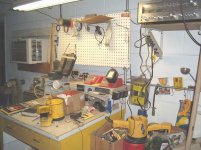
Over some time most of this has become obsolete, been remodeled or moved. Still got a couple illegal wires here and there should be fixed or removed from that **** I wired in. A simple strip would have taken care of it in the first place and cost 1/2 the parts.
Attachments
Last edited:
You kind of hit it in the title. Overthinking. string a cord with a light on it from an outlet. Is it really worth it? Hang a fixture if needed. I can do **** like that,,,, but dont. I hook up a power strip and plug in a light.
When I was a kid I wired all kinds of stuff hard and all kinds of goobers and gadgets. Today will find something easy with a plug on it.
+10 ^^^^^^^^^ no need for transformers or 230 bulbs. Use what's already there for the light and power the drill with the VFD with the VFD control panel. Overthinking that's an understatement

Last edited:
sberry
Banned
I used to be guilty of over complicating every design. I added every valve and fitting I could find or was invented. I added every future proof thing I could think of, used about 1 or 2 and dozens set idle till they became obsolete. During more recent remodels I have removed as many features as I have added, found out most of them were really brain farts and could have been easier added as needed.
Last air upgrade I did reduced about 60 ft of pipe, dozen fittings and several couplers, 3 jumper hoses and improved performance greatly.
Last air upgrade I did reduced about 60 ft of pipe, dozen fittings and several couplers, 3 jumper hoses and improved performance greatly.
Last edited:
Unfortunately there are no outlets near where I'm putting the drill press, there is one 1 three wire 240v outlet run to the middle of the building but no outlets beyond there. Since I will be running the outlet anyway, I want to be able to run the light off one leg to keep from running a separate 120v to that area just for a light.
sberry
Banned
Run a new 120v outlet. Sounds like it could be used.
sberry
Banned
The 3 wire outlet is not legal for this anyway, yes,,,, run another wire, its that difficult and a guy should learn to run a simple circuit if he doesn't know how anyway. Tailor it, there is a chance this could be tapped elsewhere too? Yes another breaker, this is a super simple safe practical solution.
wyliesdiesels
Well-known member
so now I should run a 240v outlet AND a 120v outlet to that area? another breaker, more wire when I can just tap one leg of the 240v?
U dont have a neutral so how would u complete the 120v circuit?
I plan on leaving the 3 wire where it was, it's not hurting anything there. Initially I thought I could just extend that outlet 15' but since I need four wires, I plan to run a new 4 wire outlet from the breaker all the way to the drill press.
You're saying I should run what, 5 wires(if I can use the neutral from the 240v) or 6 wires(four for 240v and two for 120v) plus another breaker?
It's physically not hard, and I don't have a problem doing it if that is what is required but if I can legally and safely get away with just 4 wires(two hots, neutral and ground), I don't see any reason to run another entire outlet there just for the 20w CFL bulb.
You're saying I should run what, 5 wires(if I can use the neutral from the 240v) or 6 wires(four for 240v and two for 120v) plus another breaker?
It's physically not hard, and I don't have a problem doing it if that is what is required but if I can legally and safely get away with just 4 wires(two hots, neutral and ground), I don't see any reason to run another entire outlet there just for the 20w CFL bulb.
wyliesdiesels
Well-known member
Who said anything about 5 or 6 wires??
If u will be running new 4-wire beanch circuit then youre good.
Make sure to fuse the light with the proper rated in-line fuse...
If u will be running new 4-wire beanch circuit then youre good.
Make sure to fuse the light with the proper rated in-line fuse...

sberry
Banned
It doesn't get any easier to wire than that garage.
tjdux
Well-known member
What about a 220v to 12v transformer and some low voltage leds
Sent from my SM-G900V using Tapatalk
Sent from my SM-G900V using Tapatalk
What about a 220v to 12v transformer and some low voltage leds
Sent from my SM-G900V using Tapatalk
A 220V transformer will overdrive 12V lamps when supplied with North American 240V power.
Looks like the machine light is a re-purposed sewing machine model.
You are correct sir, I do upholstery and it was convenient.

You are correct sir, I do upholstery and it was convenient.
Have 1 or 2 in my stash, which is why I knew, prefer Moffatt ones & bought a few Moffatt's off eBay a few years ago, but nothing wrong with those sewing machine lamps.
http://www.moffattproducts.com/
tjdux
Well-known member
Not sure why american power matters but any decent or even medicore quality transformer for electronics should come with a voltage adjustment and work totally fine.A 220V transformer will overdrive 12V lamps when supplied with North American 240V power.
And that shouldn't matter for a 12v RV lamp or any LED. Besides most leds can handle a decent voltage range.
Sent from my SM-G900V using Tapatalk
sberry
Banned
I think Norcal may have been making the point that it could be helpful to know what voltage the system in the country runs on.
tjdux
Well-known member
Sorry to hijack OPs post further but for anyone following along inwill try to explain. Im no expert or engineer but here goes. I would like to hear norcals explanation too.I think Norcal may have been making the point that it could be helpful to know what voltage the system in the country runs on.
Transformer is a transformer... should always be same output no matter input as long as the transformer is rated to handle the input it's given.
OP is in usa (same as me) and its 2 line 120v each line running 60 hertz. For a DC transformer hertz doesnt matter. But even with AC only thing hertz effects os ac motor speed.
European wiring is generally 1 line 240 volts and hertz varies from country to country... none of that matters to a transformer...
And i know little about 12v incandescent lights but LEDs have a working voltage range generally. So a 12v LED will work anywhere from 8 to 14 volts on average.
Sent from my SM-G900V using Tapatalk
sberry
Banned
This may be so but the US used 120/240 for most residential.
wyliesdiesels
Well-known member
What about a 220v to 12v transformer and some low voltage leds
US is 120v/240v nominal. 110v/220v hasnt been available for decades...
A 220V transformer will overdrive 12V lamps when supplied with North American 240V power.

Not sure why american power matters but any decent or even medicore quality transformer for electronics should come with a voltage adjustment and work totally fine.
And that shouldn't matter for a 12v RV lamp or any LED. Besides most leds can handle a decent voltage range.
I think the issue here is that many people refer to american power as being 110v/220v nominal however that is old info and currently incorrect.
Seeing as we occasionally have international folks on here, it is best to list the correct voltage which is the reason Norcal replied to your comment about using a 220v transformer.
His reply(copied above) was correct because feeding a 220v rated transformer with 240v will increase the secondary/output voltage above what is needed and possibly fry whatever is plugged into it....
I have seen many transformers that do not have multi-tap primaries or secondaries so assuming that the OP would have a multi-tap transformer is a bad idea....
Why not just say 240v? is it that hard to state the correct US voltage? People that make generalizations only confuse others....
wyliesdiesels
Well-known member
Sorry to hijack OPs post further but for anyone following along i will try to explain. Im no expert or engineer but here goes. I would like to hear norcals explanation too.
Transformer is a transformer... should always be same output no matter input as long as the transformer is rated to handle the input it's given.
Thats where you fell off the apple cart.
If you input 240v into a transformer rated 220v primary/12v secondary you will NOT get 12v on the secondary. The voltage will be increased proportionately to the increased input voltage....
The only type of transformer that will give you the same rated output voltage no matter if u increase or decrease the input voltage(within a certain range of course) is an autotransformer...
In our current example, 240v is 1.09 * 220 so 12v * 1.09 = 13.1v. Which obviously isnt much of an increase but increases should always be considered....
OP is in usa (same as me) and its 2 line 120v each line running 60 hertz. For a DC transformer hertz doesnt matter. But even with AC only thing hertz effects os ac motor speed.
European wiring is generally 1 line 240 volts and hertz varies from country to country... none of that matters to a transformer...
And i know little about 12v incandescent lights but LEDs have a working voltage range generally. So a 12v LED will work anywhere from 8 to 14 volts on average.
Sent from my SM-G900V using Tapatalk
In your original comment you stated 220v, and thats why Norcal responded the way he did. If you had simply said 240v transformer then we wouldnt be having this conversation....
tjdux
Well-known member
Yeah you guys are correct that i wrote 220 instead of 240. That was my mistake. Mostly I was suggesting a simple transformer/LED circuit that really has a lot of room when it comes to the details. Its not like a powering a microprocessor.Thats where you fell off the apple cart.
If you input 240v into a transformer rated 220v primary/12v secondary you will NOT get 12v on the secondary. The voltage will be increased proportionately to the increased input voltage....
The only type of transformer that will give you the same rated output voltage no matter if u increase or decrease the input voltage(within a certain range of course) is an autotransformer...
In our current example, 240v is 1.09 * 220 so 12v * 1.09 = 13.1v. Which obviously isnt much of an increase but increases should always be considered....
In your original comment you stated 220v, and thats why Norcal responded the way he did. If you had simply said 240v transformer then we wouldnt be having this conversation....
All the 12v transformers I use have voltage adjustment controls built right in and work over a range of input voltages from 110 to 240, much like a desktop computer power supply.
Sure the output will vary with the input but as you pointed out a 1 volt differential from 220 to 240. Most any diy LED setup can handle that variance.
Sent from my SM-G900V using Tapatalk