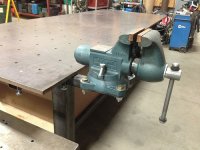
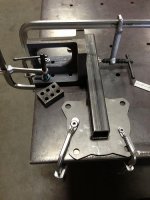
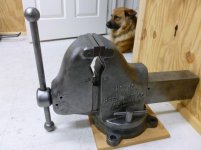
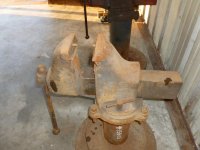
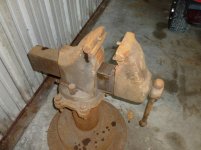
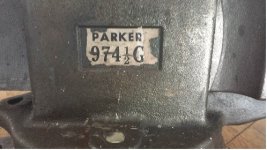
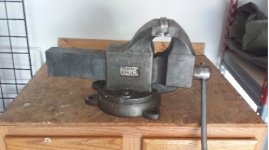
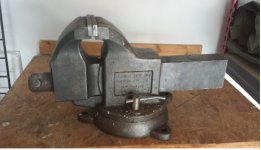
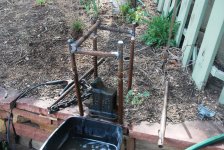
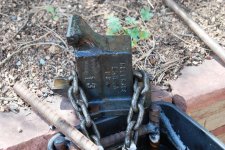
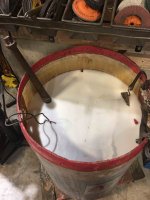
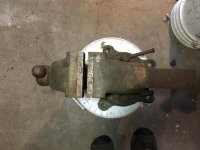
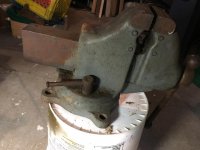
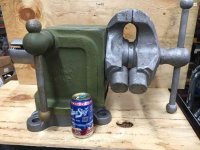
Jim and Carla, actually the handle and channel looks to be a fairly easy job to remake especially if you have a milling machine. This one I replaced the pin with a home made one because it was to sloppy. I forged a head on a 3/32 pin and re drilled the hole a little bigger and added a small C-Clip. But looking at the handle you can see that 3/32 channel could be made and with a welder a short hand made handle could be welded and formed to the original shape like these pic's I added. The handle is made to snap in place when pulled up,
Carla, I need to figure out how to cast bronze. I am clueless to where to start. Plastic Injection molds are no problem but clueless on Casting Bronze. Can you recommend a book on this subject. I would like to read about the different ways to cast. I would love to build a mold for casting the inner rings for the Wilton swivel bases, Wilton's break real easy and I get calls every week with people saying theirs has broken. I can see where a better cast material and thicker sections would help in keeping these from breaking. I have a foundry very close to me but want to know a little about this process before talking with them.
Hi, Kevin,
Yes, I'd quite agree, the little cam lever part for the detent pin on a Prentiss vise could be readily re-made, whether by making a pattern for casting, or by machining from the solid.
If I had to make a one-off, I think I'd mill it in steel, to a rectangle with the clearance cut for the pin, and the cam surface suitably radiused. Then I'd grab it in a 4-jaw, and turn the 'handle' shape, after which I'd bring the lower end of the handle to a full red and bend it to match the original configuration. Its readily do-able, but involves a good bit more working time than does the older style 'button' handle.
Re bronze casting......I'm the wrong person to ask. I'm not a foundry person, and I have a lot of respect for the specialised skill set involved in best quality foundry work. I've made up patterns, one time and another, and have had them cast by the folks who know the fine points of getting sound castings. There is quite a bit to know about sprues, risers, and gating, to be certain of a casting free from porosity, and true to pattern.
(yes, I've done a little bit of casting, but only on a 'playing in the sand-box' level, doing small ornamental brass castings for amusement....a very different level, that, from those who do best quality industrial foundry work in the various bronzes)
Re your Wliton vise swivel binders.......i'd think that one of the high-strength bronzes should be quite adequate for the purpose, so if your local foundry does only non-ferrous, no problem, tho the metal is 'not cheap'. Since one side of the part is flat, you could readily make up an aluminium pattern with your CNC mill, suitably dimensioned for shrink, of course, which the foundry workers could screw down to a match-plate.
For low-volume production, I'd think it cost-effective to cast them solid, then do the square holes by drilling, and following the drill with a square broach.
Any ordinary light press will drive a 3/8 or 1/2" broach in a bronze, no problem, but one must take care to keep the broach in alignment with the work.
Alternatively, you could have core-prints on your pattern, and make up a suitable core-box for moulding little square-tipped cores.....but I think you'd get a better casting by running it solid.
cheers
Carla