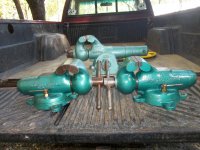
FACT: Per Wilton’s website, the bullet vise was designed and the company was founded in the same year: 1941.
“The legend of Wilton begins in 1941, when Hugh W. Vogl, a Czech immigrant, founded the vise manufacturing company…”
“Throughout all the changes, over 73 years, the original bullet vise designed in 1941 by Hugh Vogl is still the largest selling industrial vise in the marketplace.”
FACT: The Wilton bullet patent (D131,498), applied for on August 1, 1941, and granted on March 3, 1942, was a Design Patent, not a Utility Patent. If someone commented on this already, I did not see it. It is significant. Under 350 US Code 171, it protects only the appearance, shape, and ornamental features of Vogl’s vise, not the construction, function, or use. The patent was less than 100 words and included no internal mechanical drawings. That’s the reason it was granted so quickly! And yes, 7 months is EXTREMELY quick. Utility patents in this same period – and I have studied MANY of them – typically took at least 3 years, some as long as 4 or 5 years.
FACT: Per Wilton’s website, Wilton had no commercial customers until after the war was over.
“From 1941 through 1945, the new Wilton 40S machinist vise was manufactured in Chicago and sold solely to the US Government.”
“Because Wilton vises were only sold to the government, and did not have a distribution network in place, the surplus of vises now flooded the marketplace from the government, and nearly forced Wilton out of business.”
Note: see my post upthread regarding January 1942 reference to commercial plants making equipment for the military and the war. My hunch is Wilton is referring to these as US Government contracts, or the vises may have been sold to the US Government and provided as GFE, as I noted.
FACT: There are no Wilton vises in the bluebolt database with a date stamp earlier than 1-945.
FACT: VE Day is 8 May 1945. VJ Day is 15 August 1945.
CONCLUSIONS:
The design patent indicates to me that Vogl was in a hurry. It’s very unusual that Vogl never applied for a utility patent at the same time, but a primary reason for applying for a design patent was the shorter lag time in getting some degree of protection before or as entering the manufacturing sector.
I would assume he had a working prototype when he applied, probably built in a small shop. I don’t think he would’ve gone into any production, even limited production, and certainly not for any government contracts, which would’ve exposed his product to industry, before applying for the patent, but that’s just conjecture. He may have had a lead on a contract and a lead on some crude limited production facility (on the corner of the street that gave the company on its name), but it certainly would’ve taken some time to get that going. If it started in 1941, I don’t see how it could’ve been early 1941, and there is no proof that it was any earlier than the patent. Incorporation details would be nice, but they are not instrumental to any conclusions above.
Whether one reads the “1-945” date stamp as January 1945, or a range (January to September 1945), the database makes it clear that Wilton was not date stamping vises until very late in the war. Why start date stamping in early 1945, before the end of the war? Perhaps they were already preparing for openly commercial business. In 1945, the Allied Forces were chasing the Nazis across Europe, victory was imminent, and the WPB was slowly relaxing restrictions on material and commercial sales restrictions on chucking equipment, vises, and hand tools. Limitation Order L-216 was fully revoked in May 1945.