
You are using an out of date browser. It may not display this or other websites correctly.
You should upgrade or use an alternative browser.
You should upgrade or use an alternative browser.
Prentiss vise; you have to be kidding me!
- Thread starter 1982fxr
- Start date
Musicinabottle
Banned
- Joined
- Jul 24, 2016
- Messages
- 3,371
This is such typical **** anymore. People just put arbitrary figures on their stuff thinking they're going to RETIRE! So much of this is spurned by sites like Ebay and the internet in general. Used to be the paper or yard sales and you could find good deals all the time. Not no more! People just up and say.... "I want $10,000 for that". I always ask...... WHY?
meatsis
Well-known member
Ha! How many of these have you seen in person? Probably none. I wouldn't be surprised it if sells for almost double what its at now. What blows my mind is how much money people waste on the those Wilton bullets.
****** Hell, I got one of those Prentiss vises that is 4x bigger than that for $75. People must be out of there mind..

lg
no neat sig line
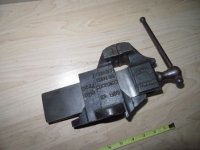
I own a couple dozen vises. I've seen hundreds of others in person, and likely thousands on the internet. That is the first nickel plated vise I've ever seen or even heard of. Plus it has a swivel jaw and what appears to be a small removable anvil.
If I were a jeweler, and especially if I worked in a location where customers could see my workbench, I'd likely happily pay that and more for that vise.
If I were a jeweler, and especially if I worked in a location where customers could see my workbench, I'd likely happily pay that and more for that vise.
TinkTinkForge
Well-known member
I've seen one other one and a Stephens one. Hell the regular Prentiss vise that size go for 300$
Sent from my iPhone using Tapatalk
Sent from my iPhone using Tapatalk
Rileysan
Well-known member
This is such typical **** anymore. People just put arbitrary figures on their stuff thinking they're going to RETIRE! So much of this is spurned by sites like Ebay and the internet in general. Used to be the paper or yard sales and you could find good deals all the time. Not no more! People just up and say.... "I want $10,000 for that". I always ask...... WHY?
There is nothing arbitrary about the starting price ($145) as the seller clearly knows what it was worth. Outside of a lucky garage/yard/estate sale find, I would bet the farm you will never see one of those sold at auction for anything less than the opening bid. For that matter, I doubt you will find another one for sale.
Complain all you want about the effect eBay has had on estate sales, et al. eBay IS the market for all collectibles (stamps, coins, comics, books ... you name it).
A better question to ask is WHY someone questions what another is willing to pay for X? It's their money and their reasons for spending it is none of my business!
Brian
Bill C
Well-known member
I own a couple dozen vises. I've seen hundreds of others in person, and likely thousands on the internet. That is the first nickel plated vise I've ever seen or even heard of. Plus it has a swivel jaw and what appears to be a small removable anvil.
If I were a jeweler, and especially if I worked in a location where customers could see my workbench, I'd likely happily pay that and more for that vise.
What he said ^^^^
That vise is cool as hell. I am not a collector of vises, but can appreciate the uniqueness.
a better question to ask is why someone questions what another is willing to pay for x? It's their money and their reasons for spending it is none of my business!
Brian
bingo.
davethorik
Well-known member
Didn't prentiss make salesman sample vises that were even smaller than that? I'm willing to bet nickel plating isn't original. Usually the smallest and largest versions of anything are worth more than average sized. It does blow my mind how much some of y'all spend on vises, but it isn't my money.
ilovevocs
Well-known member
As far as "good finds" go these days I feel like the only place you can really score are garage / estate sales.
I quit going to equipment auctions a long time ago. Too many people willing to over pay just to win an auction.
Feel like eBay is much the same. They want it at a low price and loose their sensibilities after they start bidding.
Sent from my iPhone using Tapatalk Pro
I quit going to equipment auctions a long time ago. Too many people willing to over pay just to win an auction.
Feel like eBay is much the same. They want it at a low price and loose their sensibilities after they start bidding.
Sent from my iPhone using Tapatalk Pro
woody 73
Well-known member
Why should you guys be shocked, you vise worshippers helped to drive up the vise prices and now you guys are surprised at the prices people are asking; just google vise information and I bet somewhere the GJ will pop up.
Here's a smaller (?) nickel plated prentiss:
https://www.worthpoint.com/worthopedia/vintage-prentiss-jewelers-vise-swivel-291814351

https://www.worthpoint.com/worthopedia/vintage-prentiss-jewelers-vise-swivel-291814351
Last edited:
Here's another that is missing almost all of its plating; sold for $330
http://www.ebay.com/itm/Vintage-Prentiss-Gunsmith-Watchmakers-Vise-2-034-Jaws-/252925415368?hash=item3ae3878fc8%3Ag%3AdmAAAOSwaEhZD3qZ&nma=true&si=c%252FfE6MnYGo3L%252FYQmuepYCp6b4BU%253D&orig_cvip=true&rt=nc&_trksid=p2047675.l2557

here's an unplated prentiss of similar size, sold for $255:
http://www.ebay.com/itm/Vintage-small-Prentiss-209-bench-top-vise-jewelers-Bulldog-2-1-2-034-Jaws-/382113921983?hash=item58f7c3bbbf%3Ag%3AuhEAAOSwBt5ZMuDe&nma=true&si=c%252FfE6MnYGo3L%252FYQmuepYCp6b4BU%253D&orig_cvip=true&rt=nc&_trksid=p2047675.l2557

http://www.ebay.com/itm/Vintage-Prentiss-Gunsmith-Watchmakers-Vise-2-034-Jaws-/252925415368?hash=item3ae3878fc8%3Ag%3AdmAAAOSwaEhZD3qZ&nma=true&si=c%252FfE6MnYGo3L%252FYQmuepYCp6b4BU%253D&orig_cvip=true&rt=nc&_trksid=p2047675.l2557
here's an unplated prentiss of similar size, sold for $255:
http://www.ebay.com/itm/Vintage-small-Prentiss-209-bench-top-vise-jewelers-Bulldog-2-1-2-034-Jaws-/382113921983?hash=item58f7c3bbbf%3Ag%3AuhEAAOSwBt5ZMuDe&nma=true&si=c%252FfE6MnYGo3L%252FYQmuepYCp6b4BU%253D&orig_cvip=true&rt=nc&_trksid=p2047675.l2557
Attachments

Last edited:
Why should you guys be shocked, you vise worshippers helped to drive up the vise prices and now you guys are surprised at the prices people are asking; just google vise information and I bet somewhere the GJ will pop up.
I buy all of my vises for under $50, including a nice Wilton C1 and even nicer 4 1/2" Athol that were picked up at estate sales for $25 each, so I'm happy to contribute to viseflation.
BTW, google "old vise" and the 3rd entry is for GJ (first 2 are eBay), with over 18,000 search results.
EOC_Jason
Well-known member
Not sure if those are really jewelers or salesmen models. I can see with the little anvil area on the back how it would be useful for a jeweler...
Anything under 2" is somewhat less common for old vises and usually command a premium price.
As for Prentiss, they went out of business in the late 30's / early 40's... A lot of these vises you see are around 80 years old give or take...
Anything under 2" is somewhat less common for old vises and usually command a premium price.
As for Prentiss, they went out of business in the late 30's / early 40's... A lot of these vises you see are around 80 years old give or take...
crguy
Well-known member
This is such typical **** anymore. People just put arbitrary figures on their stuff thinking they're going to RETIRE! So much of this is spurned by sites like Ebay and the internet in general. Used to be the paper or yard sales and you could find good deals all the time. Not no more! People just up and say.... "I want $10,000 for that". I always ask...... WHY?
Just like I mentioned on a previous thread about Ebay. You always get guys running their mouth with no brains behind it, and no concept of how Ebay really works.

Roberts210
Well-known member
I think the problem is once "Collectors" have decided they gotta have one, to hell with what it costs. This takes the price out of the hands of guys who actually buy them to use as a tool. I'd be very surprised if any of the bidders on that auction are actually going to put this vise to use. They probably have shelves of vises in their man cave. Of course the joke is when they die, and their wives or young 'uns get rid of all their stuff, their precious vises might just become affordable again, as the heirs sell stuff off for pennies on the dollar!!
I don't know anything about jewelry work, what is the advantage of it being nickel plated?
Also it looks like the plating has come off on some working areas, so from a practical standpoint is there any advantage left in that vise?
Also it looks like the plating has come off on some working areas, so from a practical standpoint is there any advantage left in that vise?
Not sure if those are really jewelers or salesmen models. I can see with the little anvil area on the back how it would be useful for a jeweler...
Anything under 2" is somewhat less common for old vises and usually command a premium price.
As for Prentiss, they went out of business in the late 30's / early 40's... A lot of these vises you see are around 80 years old give or take...
I thought it was like 1959 ish...?
taumac
Well-known member
Why should you guys be shocked, you vise worshippers helped to drive up the vise prices and now you guys are surprised at the prices people are asking; just google vise information and I bet somewhere the GJ will pop up.
Exactly!!! I've seen that with a lot of things. From block grinders to vises.
EOC_Jason
Well-known member
I thought it was like 1959 ish...?
No... Prentiss went out of business waaay earlier than that... Actually, I believe they got bought by Parker...
The nickel plating probably provides a few purposes. First, you can't have a bare vise because it would rust. If it was painted then there is a chance some of that paint could rub off on jewelry maybe? Also the jaws would have to be oiled but then that oil would contaminate their work. Second, when jewelers are using a little torch, again the paint would probably start to burn or at least leave scorch marks on it. Finally, people come to a jewelry store for shiny things, and old stores usually you could see the jeweler working behind the counter so having that vise plated like that kept the shiny / clean appearance.
Its interesting to me the value that 'collectors' assign to items. Take an old car, it has some collector value, now take that same model car that has been in a movie and it's value can go up 2x to 10x. It's nothing special about the car, just it's history. These days it all seems about patina and it's only original once mentality. Thirty years ago it was not that way, restored was the game.
Find any object that is collectible and the collectors will assign values to random issues with the items. There is a very fine line between priceless and worthless.
It you want to watch this in action watch the movie 'The Wheeler Dealers' it's a decent movie about how one goes about adding value.
lg
no neat sig line
Find any object that is collectible and the collectors will assign values to random issues with the items. There is a very fine line between priceless and worthless.
It you want to watch this in action watch the movie 'The Wheeler Dealers' it's a decent movie about how one goes about adding value.
lg
no neat sig line
Last edited:
ybnormal70
Well-known member
I must say I am quite impressed with what my 2" Wilton Bullet vise is up to right now on eBay:
http://www.ebay.com/itm/Baby-Wilton...e=STRK:MEBIDX:IT&_trksid=p2055119.m1438.l2649
I have no idea where it will end but I know it is exciting watching the bids roll in. I also have over 70 people watching the auction and I'm sure a few of them are on this site.
Kevin
http://www.ebay.com/itm/Baby-Wilton...e=STRK:MEBIDX:IT&_trksid=p2055119.m1438.l2649
I have no idea where it will end but I know it is exciting watching the bids roll in. I also have over 70 people watching the auction and I'm sure a few of them are on this site.
Kevin
No... Prentiss went out of business waaay earlier than that... Actually, I believe they got bought by Parker...
The nickel plating probably provides a few purposes. First, you can't have a bare vise because it would rust. If it was painted then there is a chance some of that paint could rub off on jewelry maybe? Also the jaws would have to be oiled but then that oil would contaminate their work. Second, when jewelers are using a little torch, again the paint would probably start to burn or at least leave scorch marks on it. Finally, people come to a jewelry store for shiny things, and old stores usually you could see the jeweler working behind the counter so having that vise plated like that kept the shiny / clean appearance.
Thank you. Excellent post and info...
Maui
Well-known member
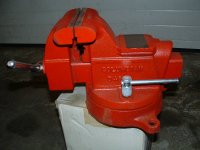
Here's another ridiculous price for a vise that I just ran across:
https://newlondon.craigslist.org/tls/6193279925.html
It's a crappy Columbian D46 with a 6" wide jaw. I've attached the only decent photo in the ad. He's asking $600. I think that ad might be up there for a while.
Maui
https://newlondon.craigslist.org/tls/6193279925.html
It's a crappy Columbian D46 with a 6" wide jaw. I've attached the only decent photo in the ad. He's asking $600. I think that ad might be up there for a while.
Maui
Attachments
EOC_Jason
Well-known member
That's the great thing about Craigslist, people can price things however they want for free...
When I see stupid stuff I just click the X to flag / hide it and move on with life...
When I see stupid stuff I just click the X to flag / hide it and move on with life...
No... Prentiss went out of business waaay earlier than that... Actually, I believe they got bought by Parker...
The nickel plating probably provides a few purposes. First, you can't have a bare vise because it would rust. If it was painted then there is a chance some of that paint could rub off on jewelry maybe? Also the jaws would have to be oiled but then that oil would contaminate their work. Second, when jewelers are using a little torch, again the paint would probably start to burn or at least leave scorch marks on it. Finally, people come to a jewelry store for shiny things, and old stores usually you could see the jeweler working behind the counter so having that vise plated like that kept the shiny / clean appearance.
I'd concur, generally, but I think there was another aspect to owning and using a vise of that grade on one's bench, both for traditional jewellers, and those who worked with small precision mechanisms requiring 'clockwork' techniques (dial indicators, etc.), one of personal satisfaction in having 'the best' of equipment for one's work, as well as, frankly, impressing one's clients with such attention to detail.
How many of you have noticed an automotive mechanic taking pride in a stack-up of highly polished Snap-On tool chests, with drawer after drawer of the highly polished wrenches, neatly arrayed in neatly arranged holders?
I have of those little Prentiss miniatures at my desk here, which I was given, back in the early '70's with an 1890's- 1900-ish? vintage oak jewellers' bench, after the bench itself had become somewhat deteriorated from long storage in a damp basement, and would have been thrown in the rubbish tip, otherwise.
Mine is the next fancier version, with the Prentiss swivel base, and was a 'work of art' when new, with the castings brought to an accurate, and very high grade of polish for plating......all the flats neatly reflective, all the radii matched for aesthetic symmetry. The 'moves freely but with no shake' fit-up of its workings demonstrates careful hand-fitting, and careful attention to detail in assembly is so evident a century or more later.
I can't even guess at the amount of time a worker at the Prentiss works had to put into that class of fitment. The the nickel is dulled, now, and has flaked off the iron in spots.....I really should feel motivated to polish it our a bit, I suppose, if only as a gesture of respect to the worker who did that now-incredible amount of hand-polishing and fitting, most probably a skilled European immigrant who was paid ever so little for his work.
I could not bring myself to discard the bench it was on, and passed the bench along to a woodworker who relished the challenge of restoring it......that bench was more a 'work of art' than the little vise, and would have been a wonderful workplace for its original owner.
Envision, if you will, a small size, but rather tall, of highly polished quarter-sawn oak roll-top desk, with a very large number of small drawers and pigeon-holes, the vise mounted on an oak 'riser' block, markings where a small lathe and its motor had been, and bracketting for a system of adjustable lamps. Many of the little drawers had been fitted-up with dividers and pigeon-holes for specific small tools and containers for teeny-tiny parts, and still had some tiny containers of watch screws, springs, and suchlike, marked for make/models of watches.
I've not the vaguest idea of the cost of such a workplace, when new, relative to the rate at which the original owner could bill his clientele for the work done there.......but it would have been a very serious investment, I should think, like today's stacks of Snap-On chests, maybe much more so.
Maybe more to the point, tho, would be that a simple artifact like that little vise is a wonderful piece of American industrial history, the fabulous obsession with design innovation and quality levels of the famous industrial production of the machinery trade in New England, in the 1800's, a field of endeavour then new to the world. This was the pioneering 'high tech' of its time, and may be seen in the 'fit and finish' applied to every sort of mechanism, from a tiny bench vise, to huge locomotives and steam engines, which, to their makers, not only had to run well, but display, in gleaming rubbed paint and nickel-plate finishes, the pride they took in their work.
Now.....all that said....I had a look at the ebay listing.......and am well and truly surprised.......its a wonderful piece of history, all right......but.... over $400, with shipment? Maniacal 'have to have it, no matter the cost' collectors, with more $$ than common sense???
(will we see a flood of so-called 'reproduction' Chinese counterfeit little vises on ebay next year?)
cheers
Carla
crguy
Well-known member
Followup: The little Prentiss went for $377. The same seller also just sold a Baby Wilton on a Powrarm Junior for $399.
Ha! How many of these have you seen in person? Probably none. I wouldn't be surprised it if sells for almost double what its at now. What blows my mind is how much money people waste on the those Wilton bullets.
Almost as much as some folks waste on countless massive vises they don't even use....but hey, it's their money, so why does anybody else care?
I thought it was like 1959 ish...?
I think Parker bought them in 1948 so they were a division of Parker for a while (ten years maybe?).
bubinga
Well-known member
Don't it look like he painted it, all kinds of Over spray?Here's another ridiculous price for a vise that I just ran across:
https://newlondon.craigslist.org/tls/6193279925.html
It's a crappy Columbian D46 with a 6" wide jaw. I've attached the only decent photo in the ad. He's asking $600. I think that ad might be up there for a while.
Maui
Maybe Not
bubinga
Well-known member
That's what I thought. Ok Thanks.It's been "touched up". Overspray on the side of the jaw inserts. Must not have had any tape so he just set something square on top of the anvil.
What's the deal with the Columbian on Amazon for $1,800.00
Are they really that good?
https://www.amazon.com/dp/B0008JF9UE/?tag=atomicindus08-20
SweetD
Well-known member
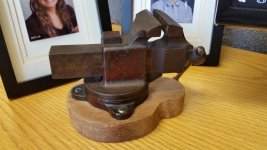
I have of those little Prentiss miniatures at my desk here...
I do as well. I bought mine from eBay several years ago (for less than half of the vise shown above) - always wanted a Prentiss Jeweler's Vise. Original patina, some of the original paint and scrolling is still (barely) visible. Mechanically perfect.
I just like looking at it, reminds me of simplicity and elegance in design.

davethorik
Well-known member
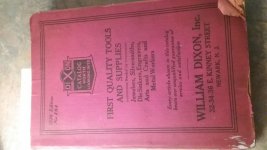
macgee
Well-known member
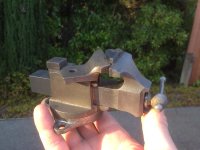
I have to totally agree with Carla. I have the same vise with the swivel base and they're really nice vises, mine had the nickel finish; was very lucky to find mine at a swap meet for an ungodly low amount that will not be mentioned here.
They are more than toy and quite useful, very well made with really good fit & finish. There was a lot of time put into these little vises and with being so small, it makes it harder to finish and to get it right than a bigger vise. Use can see that the serrations in the jaws were handmade.
For the price, I'm not complaining but I can see why they are commanding such high prices as there nothing like it at such a small scale available, the swivel jaw is the key. These vises as Carla said are perfect for holding small work like jewelry and other similar delicate odd size items. Add the quality, age and rarity to it.
A great detail to quality and fore thought was including the function of adjusting the backlash.

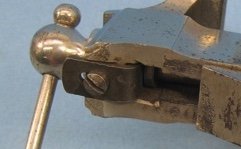
They are more than toy and quite useful, very well made with really good fit & finish. There was a lot of time put into these little vises and with being so small, it makes it harder to finish and to get it right than a bigger vise. Use can see that the serrations in the jaws were handmade.
For the price, I'm not complaining but I can see why they are commanding such high prices as there nothing like it at such a small scale available, the swivel jaw is the key. These vises as Carla said are perfect for holding small work like jewelry and other similar delicate odd size items. Add the quality, age and rarity to it.
A great detail to quality and fore thought was including the function of adjusting the backlash.
Last edited: