To avoid these ads, REGISTER NOW!

Rottler Boring Bar are they worth it?

mrpowderkeg

Well-known member
Joined
Dec 9, 2008
Messages
776
Location
Bismarck North Dakota
I have a problem, and maybe a solution. My problem here is that I need to travel at least 200 miles to a half decent machine shop for engines, I'd like to start to gather all the necessary equipment to do this work myself. I've been offered a Rottler boring bar, a Sioux hone (for rods) and a black and decker valve grinder. Can a person get a quality job from a boring bar? All the new stuff is huge machines that do most of the work, but I don't have the space for that. It would be great if I could do most of the block prep work myself, I have many core engines to practice on. I just don't know many people that have any experience with the old way of doing things, so I don't know how hard it is to accomplish boring and honing a block.
 
To avoid these ads, REGISTER NOW!

fatrhino

Well-known member
Joined
May 3, 2006
Messages
156
Location
Rochester
Interested in this as well. Hopefully someone with some experience will come by with some good information. Would love to be able to bore/hone my own blocks without too much trouble.
 

stock z/28

Well-known member
Joined
Dec 17, 2006
Messages
298
I have a problem, and maybe a solution. My problem here is that I need to travel at least 200 miles to a half decent machine shop for engines, I'd like to start to gather all the necessary equipment to do this work myself. I've been offered a Rottler boring bar, a Sioux hone (for rods) and a black and decker valve grinder. Can a person get a quality job from a boring bar? All the new stuff is huge machines that do most of the work, but I don't have the space for that. It would be great if I could do most of the block prep work myself, I have many core engines to practice on. I just don't know many people that have any experience with the old way of doing things, so I don't know how hard it is to accomplish boring and honing a block.

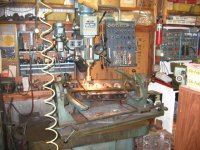
Are you sure thats not a Sunnen hone instead of Sioux?

Doing this kind of work can be very expensive. There are lots of specialty equipment needed. Its about an endless list. It is possible to "scrounge" enough equipment to do it, if you car persistent enough.


As far as quality goes, its like every thing else a skilled operator and good equipment can produce excellent work. Its hard to get good results with either a lack of skill or worn out equipment, but I think being skilled is the most important.


As far as accuracy goes, I can maintain a tolerance of approx. .0001"-.0005' if need be, on most bores. Flatness depends on material and size, usually around .001" or less on a typical block and/or head.

This could be a long discussion and Im kinda short on time but if you have any questions feel free to ask. I would be happy to help, if I can.

By the way usually Rottler makes excellent equipment and Sunnen is by far my favorite choice for auto/industrial honing equipment. Sioux is what most of my seat grinding equipment is, but Sioux closed its discontinued its automotive line a few years ago, and recently Sunnen did the same with the vast majority of their non-honing related auto equipment. B&D valve machines have been out of service for probably 20+ years?

It dosent take a lot of CNC style equipment to do basic auto machining but that is what a lot of shops are going to. Its a rapidly shrinking buisiness. Lots of shops closing. So there may be a lot of equipment available?
 
OP
M

mrpowderkeg

Well-known member
Joined
Dec 9, 2008
Messages
776
Location
Bismarck North Dakota
You are correct it's a sunnen hone, not souix. I have seen some valve grinding machines locally. I can get a machine to do the valves, but how are valve seats cut/ground? I have pleanty of core motors to practice on, I figure with an investment of about 5k I could start to dabble with doing some of my own work.
 

Toolhorder

Well-known member
Joined
Nov 9, 2009
Messages
5,711
Location
Montana
You are correct it's a sunnen hone, not souix. I have seen some valve grinding machines locally. I can get a machine to do the valves, but how are valve seats cut/ground? I have pleanty of core motors to practice on, I figure with an investment of about 5k I could start to dabble with doing some of my own work.

You don't need a fancy machine to do seats, we used to cut them by hand with seat cutters in my engine rebuilding class in college. For what you are doing it would work just fine. They come in different sizes or angles and you can cut the seat to whatever you need to make it right and be done with it. That's what I'm going to do if I do what you are thinking about doing. I haven't found a line bore machine but it seems like valve machines are a dime a dozen around here.
 

stock z/28

Well-known member
Joined
Dec 17, 2006
Messages
298
There several different ways to finish seats. There is kit that Neway sellys that is kind of cool.

There are very expensive guide and seat machines that used formed cutters.

And there are several different styles of seat grinders.

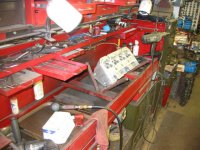
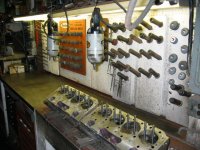
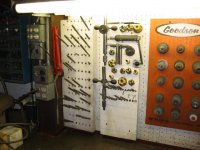
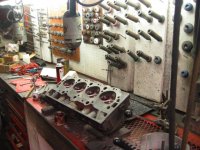
Heres some the cylinder stuff I used
 

Attachments

  • shop 010.jpg
    shop 010.jpg
    77 KB · Views: 70
  • shop 005.jpg
    shop 005.jpg
    87.9 KB · Views: 69
  • shop 006.jpg
    shop 006.jpg
    85.8 KB · Views: 64
  • shop 009.jpg
    shop 009.jpg
    82.3 KB · Views: 63
  • valve seat 001.jpg
    valve seat 001.jpg
    74.9 KB · Views: 62
  • valve seat 003.jpg
    valve seat 003.jpg
    60.4 KB · Views: 56
  • valve seat 002.jpg
    valve seat 002.jpg
    70.4 KB · Views: 57
Last edited:
To avoid these ads, REGISTER NOW!

Packard V8

Well-known member
Joined
Mar 16, 2009
Messages
7,380
Location
Spokane, WA
Yes, Rottler is worth the money.
No, it is not necessary to have the big CNC machines to produce good work. They are faster, not better.
Maybe you should tell us where you are located. For instance, I have a perfect older Kwik-Way boring bar and a Storm Vulcan cam grinder which could be for sale. I also know a couple of guys in the used machinery business. Tell 'm jack vines sent you.

Don Dennis
Automotive Machine Equipment
425-766-1619
[email protected].
 

rsanter

Well-known member
Joined
Dec 22, 2007
Messages
18,523
Location
visalia ca
I have the van-norman 777 boaring bar. it works well but is not as fast as some of the newer stuff. you need to be carefull with some of the used stuff as you really dont know what it has been through. when you buy a boaring bar you will need to test bore a old clock to verify function. a friend of mine has one he picked up and it bores a crooked hole. it was apparently dropped at one time and is tweaked. he bought it cheap as a 'parts machine' because he could tell it was in rough shape but thought he would see if and how well it worked

B&D valve grinders are great, I have had several. however they were discontinued in the late 70s and parts through B&D for them are getting thin.
you can still get some stuff for the seat grinders from non-B&D sources

bob
 

Dust

Well-known member
Joined
Nov 9, 2008
Messages
649
Location
Santa Ana, CA
We had both a Rottler and a Kwikway boring bar at my school when I took the engine building class. The Rottler was easier in that you didn't have to remove the block to do the other bank, but it was harder to set up, and it actually ruined a couple blocks, though it was probably due to operator error. I prefered the Kwikway, since it was simpler to use, and cut a bit more conservatively.

That said, you couldn't really go wrong with one provided you know what you're doing. The Sunnen CV-616 hone is *** on wheels, and the Neway valve seat cutters are awesome. They really cleaned up my 360 heads.

I really miss working in the machine shop. I'd go in on my days off just to get more work done.
 

Jerry Nu Hole

New member
Joined
Jul 11, 2010
Messages
1
Location
Arizona boycotters dont bother
I have a problem, and maybe a solution. My problem here is that I need to travel at least 200 miles to a half decent machine shop for engines, I'd like to start to gather all the necessary equipment to do this work myself. I've been offered a Rottler boring bar, a Sioux hone (for rods) and a black and decker valve grinder. Can a person get a quality job from a boring bar? All the new stuff is huge machines that do most of the work, but I don't have the space for that. It would be great if I could do most of the block prep work myself, I have many core engines to practice on. I just don't know many people that have any experience with the old way of doing things, so I don't know how hard it is to accomplish boring and honing a block.
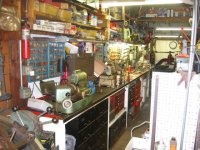
I have several rottler boring bars Model ca 2. been running one since 1970 in the field.
 

bluegrassbanjonut

New member
Joined
Jun 5, 2024
Messages
2
I bought a used Rottler boring bar back in 1975 or so. I suspect that the machine was made in the 1940s or 50s. It was at a Ford dealership. It was hardly used but abused with greaseball idiots putting vice grips on the knurled control knobs and flattening the knurls, putting dings in the bar itself, and generally maltreating the machine. I got it cheap for $200. It has a range of 2 1/8" to 4", although I can push it slightly over 4". I took it apart completely, hot tanked the castings, repainted it, re-knurled the control knobs, relieving the dings in the bar, and generally returning the machine to first class condition. It has served me well since that time, other than the motor packing it in at a later date. It always had a growl to it. I think that one of the idiots from that dealership probably jammed the machine and let the motor cook while it was stalled. An old guy who used to rewind motors showed me how to rewind the burned windings and coat them with GE Glyptol Varnish and bake the stator ring (there were only 2 stator windings that were burned). That eliminated the growl in the motor. I could work to tolerances of as little as 0.0002" with that machine. I even figured out how to remove parts from the machine so it wouldn't down feed and made a split brass collar that went around the bar, with allen screws that could control the downward movement of the bar so I could machine steps in the top of the bore for stepped sleeves. I would warn anyone who is contemplating doing boring work on engine blocks that you better measure the deck height from the main bearing bores and either have the deck(s) milled or compensate by putting long feeler gauges under one end of the bar to compensate for factory machining errors (about 0.006" is the maximum end to end deck height error that I would use the feeler gauge method on; the boring bar base is about half the length of the deck of a V-8 or 4 cylinder block, so I would use a feeler gauge that is half of the deck height error). Ford is the worst. I had a Ford 390 block that one end of the deck was 0.022" lower than the other end. I measure those deck heights on every block I've bored with a 12" caliper (I have 3 of them). I've also encountered Ford blocks with 0.004" waves in the deck so the boring bar would teeter-totter when I tried to bolt it down to the deck. What's the point of straightening and aligning the rods if the bores aren't perpendicular to the axis of the main bearings? The pistons won't run straight in the bores, which will wear them out quickly and possibly eat the pin fits in the pistons. I've run Kwik-Way boring bars in the past. Kwik-Way has a final belt drive to the boring tool which then doesn't leave any gear tooth chatter marks. I can see those chatter marks with my Rottler, but they are quite miniscule. Besides, I leave a half to 3/4 of a thousandth of an inch for final honing which I do with a Sunnen hone, which eliminates those chatter marks. The best blocks that I've encountered have been Japanese. If you don't want to hassle with what I've told you, then either get a boring rig that indexes off the main bearings (which will cost you $10,000 or more), or don't do boring jobs, and find someone who will follow what I said. Anyone doing this work better have a good set of both outside and inside micrometers, and a good dial bore gauge, plus a meticulous attitude and work habits. By the way, the Sunnen Honing Machine will not straighten a crooked bore. Only a boring bar will. I also constructed a boring table so I could do motorcycle, snowmobile, and Seadoo cylinders. The same principles apply to them as automotive blocks. Engines that I've done work on have set speed records and have won trophies. A full circle crankshaft that I made out of bars of steel propelled a logger sports chainsaw to 2nd place in the world champion tree falling. One doesn't accomplish this by being stupid. So pay attention to what I've said here. You can contact me if you wish. I'm not on the internet and am in a remote, rural location, so the only chance I have to use the internet is when I go to town and use the library's internet connection. Good luck.

Brian Bailey [email protected]
 

Packard V8

Well-known member
Joined
Mar 16, 2009
Messages
7,380
Location
Spokane, WA
All the above is spot-on. A block-mounted boring bar was the small shop standard for seventy years, but as so well-stated above, it's at the mercy of the OEM deck, which can be amazingly cattywhompas. The old US stuff was the worst; today's Asian economy car engines are machined more precisely than our blueprinted race engines of the 1960s.

Automotive machining can be about good-enough to get it running again for cheap or it can be about making it as good as it can be. As the truism still holds, "Speed costs money. How fast can you afford to go?"

Sixty years ago, I "rebuilt" my first engine in a dirt-floor garage with handful of tools and a set of feeler gauges. Later, I realized I'd put new rings and bearings in a worn-out engine; but it ran better. Because our standards were so low, and we could do the work ourselves, many old cars ran another few years.

Today, we remachine main bores, cylinder bores, block deck, crankshaft journals, rod bores, cam lobes, lifter surfaces, valve guides, faces, seats and hold every tolerance to the desired .0001". It's a way better engine, way more expensive.

jack vines
 
Last edited:
To avoid these ads, REGISTER NOW!
Top Bottom