A few of the plugs were gummed up with a light green dust and dirty terminals. I tried scrapping each terminal with a small flat head screwdriver and hosing it down with wd40 and carb cleaner. I didn't like the effect the carb cleaner did to it so I stopped using it. So besides pulling each terminal out of each plug and wire brushing it is there a better or easier way to rejuvenate them?


You are using an out of date browser. It may not display this or other websites correctly.
You should upgrade or use an alternative browser.
You should upgrade or use an alternative browser.
Best process for cleaning old electrical terminals/plugs
- Thread starter 4EyedTurd
- Start date
theoldwizard1
Well-known member
make a paste out of water and baking soda, apply with old toothbrush. rinse with distilled water, blow dry with compressed air
coat with terminal grease of your choice
I always heard that you soak them in vinegar, even if it means spraying multiple time over several days. Then rinse with baking soda and water and finally clean water.
If possible, open the connector and and treat the 2 piece separately.
The vinegar may remove some of the plating on the connectors so you MUST apply some type of protectant. Silicone dielectric grease is very good. Fluid film spray is also good.
Firebrick43
Well-known member
I always heard that you soak them in vinegar, even if it means spraying multiple time over several days. Then rinse with baking soda and water and finally clean water.
If possible, open the connector and and treat the 2 piece separately.
The vinegar may remove some of the plating on the connectors so you MUST apply some type of protectant. Silicone dielectric grease is very good. Fluid film spray is also good.
Great idea! Allow an acid to possibly creep up the wire where it can't be neutralized and cause a failure a year or two down the road.
Contact cleaner then if you have enough space a standard pink eraser does a decent job of cleaning terminals.
Lotek
Well-known member
Depending on the size of the terminals, you might be better off replacing the connectors. Electrical contact cleaner, reseating the connector a couple of times while wet, then spray in more cleaner and let dry, apply dielectric grease liberally, then reassemble and cross your fingers. If there is corrosion at the wire end of the terminal, you are done. Year, make, and model, connector pics would help.
Last edited:
the cleaner is called "De-Oxit". it's used on electrical components all the time. not cheap, but it works.
you can make your own, essentially it is naptha and oleic acid (olive oil), but I haven't tried it since I scored a case of the stuff with low propellant at an auction super cheap...
you can make your own, essentially it is naptha and oleic acid (olive oil), but I haven't tried it since I scored a case of the stuff with low propellant at an auction super cheap...
theoldwizard1
Well-known member
Personal experience on electrical connectors ?the cleaner is called "De-Oxit". it's used on electrical components all the time. not cheap, but it works.
I know it is good for volume/tuning controls on electronics, but I have always wondered how well it works on "green crusties" on electrical connectors.
theoldwizard1
Well-known member
If the vinegar wicks up the insulation, so will that baking soda/water solution, neutralizing it.Great idea! Allow an acid to possibly creep up the wire where it can't be neutralized and cause a failure a year or two down the road.
Easily & Safely Clean Electrical Connectors for Pennies
Using salt and vinegar to clean corroded wire
I don't think the salt really does anything when combined with the vinegar, but would make a good abrasive if you can rub it on the corrosion.
Green corrosion is one of several different types of copper oxidation. It is why copper roofs turn green. There is copper in bronze so it can happen to bronze. The proper term is "verdigirs".
Prevention is the best. In the early days of electronic fuel injection (I was there), all connectors were packed with silicon dielectric grease. Mechanics did not like it because it made the connectors hard to hold on to and some "bean counter" probably decided it was a way to save a few pennies.
Last edited:
dermal with a wire brush / wire wheel...... Cleaned my whole battery top fuse box on that ****** VW with that... replace any terminals if the corrosion extends into the wiring...
you can lightly use some electrical grease on the cleaned surface.
you can lightly use some electrical grease on the cleaned surface.
LS6 Tommy
Well-known member
Silicone dielectric grease is very good. Fluid film spray is also good.
Dielectric grease is never to be used on contacts, only connector weather seals. "Dielectric" means it doesn't conduct...
Tommy
Personal experience on electrical connectors ?
I know it is good for volume/tuning controls on electronics, but I have always wondered how well it works on "green crusties" on electrical connectors.
yes, it works good. I have used it on iphone charging cables and other usb cables and things that get corroded in my shop from sitting out or laying on the ground where I have a dirt floor. also spade terminals and things, but if they are big enough I will wire brush first and spray to de-oxidize it after.
dielectric grease is indeed non-conductive, but ideally a proper connector/connection is tight enough to break through the grease and make contact, leaving everything else is sealed. that is why it is used, other wise no connector would work with the grease on it, which clearly is not the case. so if there is a properly tensioned and formed connection, the dielectric grease shouldn't be a hindrance to conductivity.
Lotek
Well-known member
Dielectric grease is never to be used on contacts, only connector weather seals. "Dielectric" means it doesn't conduct...
Tommy
You can use it on connector contacts, the terminal should have enough tension to push it out of the way of the actual contact area, then the grease seals around it preventing further corrosion and fretting. If the terminal doesn't have enough tension for that, you need new terminals anyway. Normal and correct use of dielectric grease.
torqueman2002
Well-known member
If you are asking about typical electrical automotive connectors, I use the following.
Innovative Products 8040 3-Piece Diamond Grip Terminal Cleaner Set

Amazon has them for $30.78 w/ Prime.
Innovative Products 8040 3-Piece Diamond Grip Terminal Cleaner Set
Amazon has them for $30.78 w/ Prime.
Rag Roc
ALLIANCE MEMBER
Tarn X for cleaning jewelry.
Lotek
Well-known member
If you are asking about typical electrical automotive connectors, I use the following.
Innovative Products 8040 3-Piece Diamond Grip Terminal Cleaner Set
Amazon has them for $30.78 w/ Prime.
I wouldn't use something like that on most anything built in the last 20 years or so, tolerances are just too tight and terminals are just too small.. If the terminals are that bad, I'd replace them.
theoldwizard1
Well-known member
I am calling ******** on that statement !, Yes, it was over 35 years ago, but I actually worked for one of the Detroit 3 designing electronic fuel injection system. Back then, they all had silicon dielectric grease INSIDE the connector. The grease is a "back up" for when those "watertight" connectors are so watertight. You need a dielectric grease because some grease may contain "conductive" material that would cause a short or mess up a signal on a sensor.Dielectric grease is never to be used on contacts, only connector weather seals. "Dielectric" means it doesn't conduct...
Most automotive connectors are "pin and socket". Some may have split pins, some solid. The socket is actually smaller ID than the pins OD and has to expand a small amount to allow the pin to be inserted. This interference is good because the "wiping" action of the pin on the inside of the socket "cleans" the actual contact point.dielectric grease is indeed non-conductive, but ideally a proper connector/connection is tight enough to break through the grease and make contact, leaving everything else is sealed. that is why it is used, other wise no connector would work with the grease on it, which clearly is not the case. so if there is a properly tensioned and formed connection, the dielectric grease shouldn't be a hindrance to conductivity.
Some connectors do use flat "blades" instead of a pin. Now you only have 2 surfaces that can potentially make contact
Last edited:
theoldwizard1
Well-known member
I wouldn't use something like that on most anything built in the last 20 years or so, tolerances are just too tight and terminals are just too small.. If the terminals are that bad, I'd replace them.
Nothing automotive has a connector where the contact tolerance are that critical. The big issue now a days is large connectors with many contacts. If they are not lined up it is possible to mate the connector shell and bend a pin out of the way.
Last edited:
DC73
Well-known member
You can use it on connector contacts, the terminal should have enough tension to push it out of the way of the actual contact area, then the grease seals around it preventing further corrosion and fretting. If the terminal doesn't have enough tension for that, you need new terminals anyway. Normal and correct use of dielectric grease.
Agreed. I've always used dielectric grease on contacts, especially marine and auto. It also works great on spark plug boots to keep them from sticking to the insulator.
DC
Lotek
Well-known member
Nothing automotive has a connector where the contact tolerance arr that critical. The big issue now a days is large connectors with many contacts. If they are not lined up it is possible to mate the connector shell and bend a pin out of the way.
Almost everything nowadays has contact tolerances that are that critical, think micro .64 terminals, and even micro .50 terminals, that's .50mm, with terminal life measured in dozens of insertions, not hundreds or thousands. The pindrag test for the micro .64 is to turn the connector upside down and if the test lead falls out, replace the terminal.
MFolks
Well-known member
www.deoxit.com is the makers website.
theoldwizard1
Well-known member
Almost everything nowadays has contact tolerances that are that critical, think micro .64 terminals, and even micro .50 terminals, that's .50mm, with terminal life measured in dozens of insertions, not hundreds or thousands. The pindrag test for the micro .64 is to turn the connector upside down and if the test lead falls out, replace the terminal.
You are going to have to show me automotive terminals that use either of those size pins before I will believe you !
EDIT : Well a bit of research on my part and the smallest "pin" (actually a flat blade) I can find is on the Delphit GT 150 series connectors. They are 1.5 mm wide and the smallest wire they can mate to is 22 AWG. These are the "next generation" of Delphi/Packard weather pack connector.

Note that the "pin" is not solid. It is thin metal folded (you can see the seam right down the center). This allows the pin to flex a bit as it is inserted into the socket. The pin and the socket are both coated with tin for anti-corrosion AND as a "sacrificial" layer that is "wiped" as the pin is inserted in the socket.
This is not the best image of the socket.
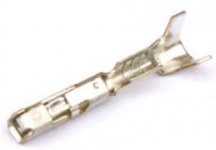
If you look carefully, you can see that there is a piece of metal on the very end that is folded INTO the socket. This is where the flex occurs on the female end.
No first hand personal experience with these, but they look quite well engineered !
Last edited:
jonhdw
Well-known member
Try Scotch Brite abrasive pads. They're like sponges but mildly abrasive.
easyrhino247365
New member
- Joined
- Feb 28, 2022
- Messages
- 1
All- this is an old thread but I’ll add my two cents worth; I’ve been working on cars as my only HOBBY for 40 years.
every old car I pick up has to be gone through electrically. From the factory- most modern cars have electric socket grease in the light sockets and some electrical fittings. It gets all over everything and the 1st thing old school mechanics did = wipe it off. Not knowing this dielectric = non electrical conductive “grease” prevented CORROSION.
WHEN OXYGEN IS REMOVED OR CONTACT IS ISOLATED FROM OXYGEN= CORROSION CANNOT HAPPEN.
In the military, HUMVEE batteries have a plastic cup (with a fitted lid) filled with grease around each battery terminal. These things sit for decades with ZERO battery MAINTENANCE and ZERO CORROSION at the terminals.
Clean and pack all terminals with dielectric grease= years of corrosion free service.
I have cleaned terminals with vinegar. It works BUT do not overdo it. If left in vinegar for 12-24 hours= it will remove the coating on the terminal. I’ve dipped terminals in Vinegar for 20-30 min then cleaned with tooth brush and blown out with air. You then use BAKING SODA=BASE to neutralize the Vinegar = MILD ACID.
Coat both sides of connection with DIELECTRIC GREASE, connect, disconnect, connect= good connection.
I’ve spent hours using fine sandpaper = it works but it is extremely time consuming considering how many connectors are present on a car and the FACT that on older cars you have to clean as many as possible to avoid electrical GREMLINS down the road.
Further, when I get a new to me OLD CAR and before I start any electrical diagnosis = try to figure out why something electrical will not work as designed- I go through the fuse box, verify fuses are “good” by pulling cleaning fuse blades or round ends with OOOO steel wool, adding dielectric grease to the female fuse holder/socket and reinstalling.
I also Inspect, clean and grease as many electrical connections as I can without major disassembly across the entire vehicle. IE I don’t remove door panels to access connections inside doors unless I have a power window that is not working = then I treat all connections Inside door as described above.
every old car I pick up has to be gone through electrically. From the factory- most modern cars have electric socket grease in the light sockets and some electrical fittings. It gets all over everything and the 1st thing old school mechanics did = wipe it off. Not knowing this dielectric = non electrical conductive “grease” prevented CORROSION.
WHEN OXYGEN IS REMOVED OR CONTACT IS ISOLATED FROM OXYGEN= CORROSION CANNOT HAPPEN.
In the military, HUMVEE batteries have a plastic cup (with a fitted lid) filled with grease around each battery terminal. These things sit for decades with ZERO battery MAINTENANCE and ZERO CORROSION at the terminals.
Clean and pack all terminals with dielectric grease= years of corrosion free service.
I have cleaned terminals with vinegar. It works BUT do not overdo it. If left in vinegar for 12-24 hours= it will remove the coating on the terminal. I’ve dipped terminals in Vinegar for 20-30 min then cleaned with tooth brush and blown out with air. You then use BAKING SODA=BASE to neutralize the Vinegar = MILD ACID.
Coat both sides of connection with DIELECTRIC GREASE, connect, disconnect, connect= good connection.
I’ve spent hours using fine sandpaper = it works but it is extremely time consuming considering how many connectors are present on a car and the FACT that on older cars you have to clean as many as possible to avoid electrical GREMLINS down the road.
Further, when I get a new to me OLD CAR and before I start any electrical diagnosis = try to figure out why something electrical will not work as designed- I go through the fuse box, verify fuses are “good” by pulling cleaning fuse blades or round ends with OOOO steel wool, adding dielectric grease to the female fuse holder/socket and reinstalling.
I also Inspect, clean and grease as many electrical connections as I can without major disassembly across the entire vehicle. IE I don’t remove door panels to access connections inside doors unless I have a power window that is not working = then I treat all connections Inside door as described above.
As mentioned at least once above you may be better off cutting the bad connector off and re-terminating it. You can clean the surface corrosion but there may be corrosion inside the terminals on the wired which even if soaked in a solvent to remove the internal corrosion, it would leave a loose connection from the removal of material.
Skiff Builder
Well-known member
I use one of these around the boats. Get's into small ,hard to access areas well. Believe they are fiberglass strands, that continually break their ends off and stay "sharp"A few of the plugs were gummed up with a light green dust and dirty terminals. I tried scrapping each terminal with a small flat head screwdriver and hosing it down with wd40 and carb cleaner. I didn't like the effect the carb cleaner did to it so I stopped using it. So besides pulling each terminal out of each plug and wire brushing it is there a better or easier way to rejuvenate them?
FredWanaker
Well-known member
need a lot more info on what these are. They could be anything from connectors in a car to 1920's connectors in a barn going to old fans, or connectors in an old tube radio. Photos would help. Each situation would have a different fix. OP needs to come back and provide more information.
Leaflessshadetree
Well-known member
It has been 4 1/2 years. I'm guessing that OP may have come across a variety of situations.
My experience is that if there is corrosion where the contacts mate there is also corrosion where the contact connects to the wire and some inside the wire as well, possibly even the next connection. No cleaner or method will make the "as good as new".
My preferred method is to replace (even if it is the entire wire).
In some cases I just need it to work "good enough" (for example connecting to a trailer I need at the moment). A quickwire brush or scrape with my pocket knife usually gets me going. (If it's my trailer or vehicle I replace the connector(s) first chance I get.
Deoxit works OK, same with contact cleaner.
Dielectric grease is usually a good thing as a second layer of protection is not a replacement for good seals.
Many years ago connections were completely unsealed and performed fine for many years. Modern systems often are lower power (voltage and current) sogood clean connections are more important.
Worse case is "partially sealed connections" where it's easy for water and corrosion to get in and impossible for it to get out.
My experience is that if there is corrosion where the contacts mate there is also corrosion where the contact connects to the wire and some inside the wire as well, possibly even the next connection. No cleaner or method will make the "as good as new".
My preferred method is to replace (even if it is the entire wire).
In some cases I just need it to work "good enough" (for example connecting to a trailer I need at the moment). A quickwire brush or scrape with my pocket knife usually gets me going. (If it's my trailer or vehicle I replace the connector(s) first chance I get.
Deoxit works OK, same with contact cleaner.
Dielectric grease is usually a good thing as a second layer of protection is not a replacement for good seals.
Many years ago connections were completely unsealed and performed fine for many years. Modern systems often are lower power (voltage and current) sogood clean connections are more important.
Worse case is "partially sealed connections" where it's easy for water and corrosion to get in and impossible for it to get out.