
You are using an out of date browser. It may not display this or other websites correctly.
You should upgrade or use an alternative browser.
You should upgrade or use an alternative browser.
Main feed line routing indie the box
- Thread starter 70pcuda
- Start date
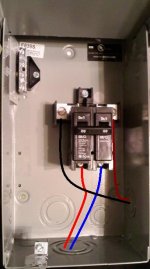
i would put the incomming feed through the left side.because of the short bend radius from the right side.also don't forget the ground.you also say 1/0.do you have a 150 plus feet run in or out?
Yes, 150 feet + out to the shop.
here is why people leave a loop: Imagine how screwed you would be if your wire ended up an inch short...
the slack is also a good idea incase something has to be reterminated later.
Tis makes sense, I'll try to leave a loop, but the outdoor box is kind of small and the 1/0 doesn't seem to bend very easy.
Thanks
Yes, 150 feet + out to the shop.
Tis makes sense, I'll try to leave a loop, but the outdoor box is kind of small and the 1/0 doesn't seem to bend very easy.
Thanks
insteat of coming up on an angle, come straight up and make two 90deg turns to get into the breaker.
Sokoloff
Well-known member
The loop in most installs is a drip loop, such that if a small amount of rainwater comes down the feed line, it will reach the bottom of the loop and drip off harmlessly from there, rather than being wicked into the connections, corroding them and causing a hazard.
In your case, feeding from the bottom, I'd have no issue not using the loop, but would prefer to use one, so that if the line ever needed re-terminated in the future, you'd have a little slack to play with.
In your case, feeding from the bottom, I'd have no issue not using the loop, but would prefer to use one, so that if the line ever needed re-terminated in the future, you'd have a little slack to play with.
The loop in most installs is a drip loop, such that if a small amount of rainwater comes down the feed line, it will reach the bottom of the loop and drip off harmlessly from there, rather than being wicked into the connections, corroding them and causing a hazard.
In your case, feeding from the bottom, I'd have no issue not using the loop, but would prefer to use one, so that if the line ever needed re-terminated in the future, you'd have a little slack to play with.
X2...
drip loop...
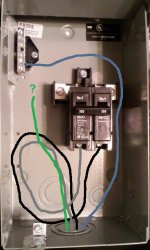
I agree, the loop sounds like a good idea if I have room. How about something like the new drawings below? Also, I have four wires going to the shop, 2 hots a neutral and a ground. do the neutral and ground both attach to the ground bar in the breaker panel?
Thanks
Thanks
Attachments

VHF
Well-known member
do the neutral and ground both attach to the ground bar in the breaker panel?
If this is a subpannel (fed off a breaker in your main panel) with a 4-wire feeder then the neutral and ground must be kept separate.
You may need to purchase a grounding buss bar to install below the existing neutral buss. (There are pre-drilled mouting holes in your panel.) The incoming ground wire in your feeder can connect to the ground lug at the bottom of the box or to the new grounding buss bar. The ground wire in your outgoing feed should connect to the grounding buss bar.
Out of curiosity, where is this box located? i.e. where the feeder enters your shop building?
What kind of earth ground do you have at your shop building? I.e. grounding rods and/or "UFER" ground attached to footing rebar?
Last edited:
This box is mounted on the side of my house next to the meter, and the feed to this 100 Amp breaker is directly from the meter (to the right of this box). Then the 4 wires (1/0-1/0-1/0-2) go out the bottom of this box under ground in counduit to the shop, which will have a 100 AMP panel. There will be a ground rod at the shop.
I was told I needed 4-wire to the shop, but I'm unclear on how I hook it up at the house. I guess I will need to call the electrician, but I hate to keep bugging him. I'd prefer to just get it all done, then have him come inspect my work. (I'm not doing the work in the meeter.)
Thanks
I was told I needed 4-wire to the shop, but I'm unclear on how I hook it up at the house. I guess I will need to call the electrician, but I hate to keep bugging him. I'd prefer to just get it all done, then have him come inspect my work. (I'm not doing the work in the meeter.)
Thanks
If this is a subpannel (fed off a breaker in your main panel) with a 4-wire feeder then the neutral and ground must be kept separate.
You may need to purchase a grounding buss bar to install below the existing neutral buss. (There are pre-drilled mouting holes in your panel.) The incoming ground wire in your feeder can connect to the ground lug at the bottom of the box or to the new grounding buss bar. The ground wire in your outgoing feed should connect to the grounding buss bar.
Out of curiosity, where is this box located? i.e. where the feeder enters your shop building?
What kind of earth ground do you have at your shop building? I.e. grounding rods and/or "UFER" ground attached to footing rebar?
VHF
Well-known member
OK, so it sounds like you are going to use a double-lug meter base to feed both your house as well this 100A disconnect feeding the detached shop building. Presumably, neutral and ground are tied together in your main house pannel.
So neutral and both hots will come from the meter to this disconnect. It seems then the question is where should the ground for the 100A disconnect panel originate? And should neutral and ground be bonded or kept separate in this disconnect panel?
Perhpas one of our NEC gurus can comment...
So neutral and both hots will come from the meter to this disconnect. It seems then the question is where should the ground for the 100A disconnect panel originate? And should neutral and ground be bonded or kept separate in this disconnect panel?
Perhpas one of our NEC gurus can comment...
torqueman2002
Well-known member
OK, so it sounds like you are going to use a double-lug meter base to feed both your house as well this 100A disconnect feeding the detached shop building. Presumably, neutral and ground are tied together in your main house pannel.
So neutral and both hots will come from the meter to this disconnect. It seems then the question is where should the ground for the 100A disconnect panel originate? And should neutral and ground be bonded or kept separate in this disconnect panel?
Perhpas one of our NEC gurus can comment...
You might also want to ask your question in the Electrical Code section here--> http://www.selfhelpforums.com/index.php?