twertsy
Well-known member
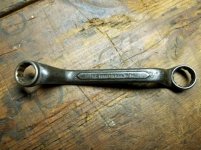
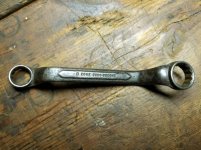
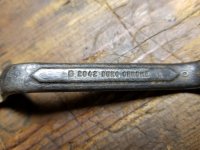
I also have to thank you Lugz as I been trying to find info on that wrench for several years without any luck at all.
I'm betting that's a quite valuable wrench.......

I also have to thank you Lugz as I been trying to find info on that wrench for several years without any luck at all.
I heard a heavenly choir in my head when I read that! Very cool, Lugz and Riley!Rileysan,
I think you're going to like the answer...
------------------------------------------------------------------------------------
From the Ordnance Supply Catalog, Standard Nomenclature List (SNL) N-19, Tool-Sets, Motor Transport, dated October 5, 1942
41-T-3367-23 | TOOL-SET, Special, Harley-Davidson Shaft Drive
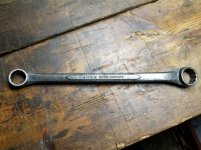
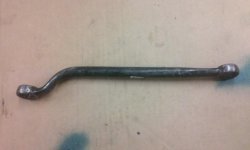
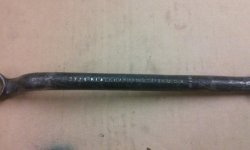
41-W-2068 | WRENCH, box, dble-hd., dble-hex., S-shaped, 1/2-in. both ends
I'm betting that most WWII Harley-Davidson guys don't even know that this wrench exists. It doesn't go in the toolkit carried on the motorcycle, if that's what you're thinking. Like Willys MB and Ford GPW jeep tools, those Harley tools...I'm betting that's a quite valuable wrench.......

I'm betting that most WWII Harley-Davidson guys don't even know that this wrench exists. It doesn't go in the toolkit carried on the motorcycle, if that's what you're thinking. Like Willys MB and Ford GPW jeep tools, those Harley tools...
...do have a hefty value, especially the rare ones.
(EDIT: To view examples, go here.)
This DBE wrench, like all the other tools in the N-19, was used by mechanics at depots in the rear, where vehicles were sent for major repairs and overhauls.
On top of that, note that the 41-T-3367-23 was for a Harley "shaft drive" motorcycle. That refers to the XA, not the famous WLA, which was of course chain-drive. (The WLA had its own special rear echelon support tool-set - 41-T-3367-20, and I'd bet that most WWII Harley guys don't even know that existed, let alone what tools went in it, either.)
The XA was an experimental bike that the Army asked Harley-Davidson to build. (They asked Indian, too.) Only 1,000 were made, all in late 1941 and 1942. Survivors are very rare and command a very high price.
That's why there is no reference to this tool in any of the mid- to late-war Ordnance Supply Catalogs. The rear echelon service tools tool-set was dropped when the bike was.
This wrench is actually a perfect example of those kinds of vintage wrenches that are so rare and so weird that they probably have no value.
Except to guys like me and d42jeep and a couple other guys kooky enough to collect rear echelons tools, which just aren't **** enough for MV shows and displays to be as desirable as on-board tools.
 I don't know, Todd. Sorry. I'm not a WLA guy. (Sacrilege, I know, but I prefer my BSA WDM20 "thumper"!) Go to the link I posted. Or the motorcycle section on the G.
I am laughing because I can just see you having one of those "I think I have that tool!" moments.
I guess I shouldn't've posted that image. Dozens of guys are calling in sick right now to scour their tools for Harley treasures! This hobby is maddening sometimes. It just gets in your blood.
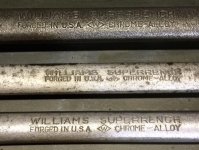
I have, and it's an important historical specimen, lending physical credence to the catalog research revealing this size combination as a military spec driving industry to a wrench not too many mfgrs were making prior to 1941.And (Lugz), you've seen these before, but I have an early Williams transitional wartime marked 'Chrome Alloy' and 'Special' 11/16" & 3/4" where one size marking has been ground off and the 3/4" stamp applied.
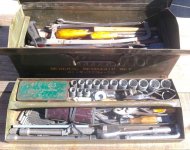
No prob, Bomber. See User's post for the other two sizes in the three-wrench set. The other three-wrench set was dwarfies, double 45* offset: 3/8 x 7/16, 1/2 x 9/16, and 5/8 x 3/4. In my experience, the largest is the hard one to find in that set. Those were the six DBE wrenches in the WWII GMTK, the Army's most basic, common, and prolific service set.Nice post, Lugz, and thanks for the tutorial on wartime DBEs. I need to check my collection for that size combo...
This war-time stuff looks so highly specialized that most regular Joes like me would have no idea what we're looking at without a whole lot of schooling. I could be walking past all kinds of these things at sales that I'm never able to rescue and bring to those who want them because I don't have a clue what they are.
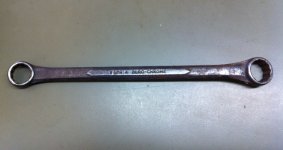
Don, you should go ahead and just send me that short Duro DBE.
I added a few DBEs to the pile this weekend.
Armstrong; Mac; Plomb WF; Chrome Vanadium Steel; Powr-Kraft; Bonney; New Britain.


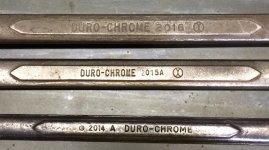
And I thank you for them, Provincial. I agreed to most of them, hence my stated quandary. My doubt hinges on two things: never having seen such a marking on any Duro-Chrome G or (X) wartime wrenches before (I am relying on Don and UNAIU to either confirm that or set me straight on it having other examples), which is a fairly large sample set, and it being such an exotic thing to do, especially during wartime. Also, if it was forged, the die would be more uniform. To my eye, the dots on the left look considerably smaller than the dots on the right. But again, I am not wedded, just leaning. It's a puzzler.
All the Duro-Chrome (X) and G stamped wrenches were all made in WWII with alloy steel and no plating. As for the markings, I was thinking it could be a unit, such as a particular company Ordnance depot (many "Delta" designated units used a triangle as a unit symbol). But the way Don's and mine are identically precise would be hard to duplicate in the field, even with some kind of hotwired device.That guy might have had a lot o wrenches.
But seriously,
If you eye em up next to similar wrenches does the material look any different?
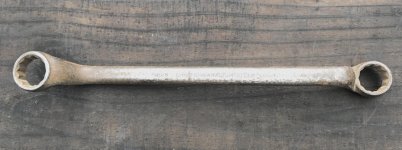
Here is a TuHeX deep 13/16" X 7/8" offset wrench I picked up on Thursday. According to Twertsy these were made between 1934 and 1940 by Bonney.
-Don
BONNEY! I've got a couple of those TuHex wrenches.
Seems like everyone at the time had their own marketing term for the 12pt box wrench. Williams was a DuoHex.
Good find, Don.
You all are finding some really cool DBEs out there! Me, I've found zippo as I'm focused on the new garage build. But it's really nice to live vicariously through the rest of you.

Hopefully you'll be building yourself plenty of wall space for your collection of DBEs!

So, you are building a new shop, just to be better able to display your DBE collection...
I was thinking Duro might have tried a few alloys to get their stuff working right in spite of the restrictions, and put a somewhat subtle mark to track what was working.All the Duro-Chrome (X) and G stamped wrenches were all made in WWII with alloy steel and no plating. As for the markings, I was thinking it could be a unit, such as a particular company Ordnance depot (many "Delta" designated units used a triangle as a unit symbol). But the way Don's and mine are identically precise would be hard to duplicate in the field, even with some kind of hotwired device.
I was thinking Duro might have tried a few alloys to get their stuff working right in spite of the restrictions, and put a somewhat subtle mark to track what was working.
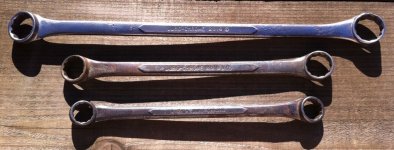
Very cool Don. Probably the only set that exists together.Here is a complete set (3/8" to 1") of early Old Forge wrenches made by Barcalo.
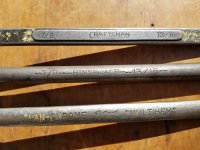
Nice trio of wrenches, Lugz. I especially like those old Hinsdale DBEs.... trio of long 45* double offset pattern DBE wrenches.