To avoid these ads, REGISTER NOW!

garage unfinished vaulted ceiling insulation

guia13

New member
Joined
Oct 19, 2017
Messages
2
Hello,

I realize this subject comes up a lot, but I still have yet to find any answers to meet my needs.
my husband and I are trying to make a workshop from out garage. We live in Los Angeles, winters are mild, but summers are scorchers. Anyway, all the walls have been insulated and dry walled up to 10 feet. The garage has has a vaulted ceiling with one 20 X 20 gable vent on each side. So the dilemma is what do to finish the ceiling. Leave it open, or bring it down and create an attic.
The roof is new. my husband would prefer a vaulted ceiling so he can have it all open. There is no ridge vent because the ventilation comes by way of the gables on each side. Someone advised us to close the gables up and simply ably 1 inch foam board directly underneath plywood roof without leaving any air gaps. Was told that if there is no actual drywall being attached to the rafters then its ok to not have ridge vents. The question is can any type of insulation be attached underneath roof without drywall to hold it in place.

I'm talking to contractors but everyone has a different opinion. Vented attic or Vaulted Ceiling? This is just to make it comfortable so the air conditioning works.
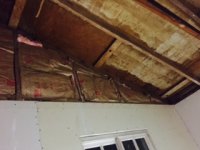
 

Attachments

  • FullSizeRender.jpg
    FullSizeRender.jpg
    32.8 KB · Views: 110
  • IMG_1420.JPG
    IMG_1420.JPG
    28.5 KB · Views: 95
  • IMG_1421.JPG
    IMG_1421.JPG
    31.2 KB · Views: 94
To avoid these ads, REGISTER NOW!

Colin Len

Well-known member
Joined
Jan 30, 2013
Messages
1,233
Location
Long Beach CA
Subcribing. I'm interested to see what the knowledgeable folks here say about the foam attached directly w/o any venting as long as there's no drywall. What were you going to use to attach it and seal it "with no air gaps"?

I am in a similar situation with my garage - would really like to insulate it but not sure what the best plan of attack is. I've only done a little research but the research I did do pointed me towards using closed cell spray foam which would seal the roof and insulate simultaneously. It's not cheap though. If I went that route I'd consider spray foam from the top plate up and standard fiberglass or rockwool for the walls. But again, I need to do more research here once I'm nearing the time to pull the trigger.
 

T_R

Well-known member
Joined
Jul 2, 2015
Messages
902
Location
Maine
I think if you want AC you should install a ceiling at the level of the top of that drywall and insulate above the ceiling. Then all the roof heat transfers into the attic space and not the interior.
 

kbs2244

Well-known member
Joined
Nov 11, 2006
Messages
14,065
IMO
You have a cooling problem, not a heating one.
So
Cut a ridge vent in your new roof.
Cut soffit vents and air passages in your top plate
Put reflective foil on the bottom of your rafters.

All of this will cool the heat off the roof.

Keep your gable vents.
They will allow any heat from below to get out.
 

strutaeng

Well-known member
Joined
Dec 12, 2011
Messages
2,270
Location
Dallas, TX
It looks like typical rafters and ceiling joists to me from the photos. Regardless, it can be done.

You can install some fiberglass insulation in the rafter cavity and some continuous XPS rigid foam, taped at the seams, then the gypsum board. That's essentially a non-vented assembly. Probably 1" minimum thickness for XPS. You still want the minimum total R value recommend. The XPS will prevent condensation problems typical in cavity insulated vaulted ceilings. The vents can be removed or blocked off.

There's a great website called green building adviser.com
I've read some of their articles.
 

strutaeng

Well-known member
Joined
Dec 12, 2011
Messages
2,270
Location
Dallas, TX
The purpose for ventilation is to allow drying of condensation from air leakage. It was traditionally used because houses back then could not be made "air tight."

Most people (including myself) think that ventilation is related to keeping the attic cooler but instead is related to preventing condensation.

Spray foam does essentially the same with a non-vented attic.

The best analogy I can think of is a refrigerator or cooler filled with ice. Since both are sealed airtight, condensation is not a problem and neither are vented. However, if you leave the refrigerator door cracked open, condensation will form as the cool air escapes.

I should add that LA is pretty dry and humidity problems are more prevalent in the SE US.

I hope this helps.
 
To avoid these ads, REGISTER NOW!

Colin Len

Well-known member
Joined
Jan 30, 2013
Messages
1,233
Location
Long Beach CA
It looks like typical rafters and ceiling joists to me from the photos. Regardless, it can be done.

You can install some fiberglass insulation in the rafter cavity and some continuous XPS rigid foam, taped at the seams, then the gypsum board. That's essentially a non-vented assembly. Probably 1" minimum thickness for XPS. You still want the minimum total R value recommend. The XPS will prevent condensation problems typical in cavity insulated vaulted ceilings. The vents can be removed or blocked off.

There's a great website called green building adviser.com
I've read some of their articles.
My understanding was that this was a bad idea having that cavity unvented. But it seems there's all sorts of opinions here - I'm interested to hear any more info. I did some reading last night on greenbuildingadvisor and they said this setup works but all examples were with walls, not a roof. The difference here as I understand it is that the wall could "dry to the outside" since the exterior of the walls are permeable (assuming you're retrofitting a building which is already designed to dry to the outside thru the walls). I'm not too familiar with roof construction and building materials in general but I would think a roof is more water proof and would make it difficult for the rafter cavities to dry to the outside without venting.

With that said, I like this idea if it works - may be a cheaper option for me to insulate my garage and keep my vaulted ceiling.


The purpose for ventilation is to allow drying of condensation from air leakage. It was traditionally used because houses back then could not be made "air tight."

Most people (including myself) think that ventilation is related to keeping the attic cooler but instead is related to preventing condensation.

Spray foam does essentially the same with a non-vented attic.

The best analogy I can think of is a refrigerator or cooler filled with ice. Since both are sealed airtight, condensation is not a problem and neither are vented. However, if you leave the refrigerator door cracked open, condensation will form as the cool air escapes.

I should add that LA is pretty dry and humidity problems are more prevalent in the SE US.

I hope this helps.
As far as the low humidity here, that really depends on where you are. Humidity at my location swings fairly drastically from between 40-85%. I'm close enough to the ocean to get a bit of the marine layer sometimes and far enough from the ocean for it to get very hot and warm. My garage is 75yo so I'm feel like a losing battle when it comes to heating/cooling/ventilation :(
 
OP
G

guia13

New member
Joined
Oct 19, 2017
Messages
2
Hello, thanks so much. Yes humidity is not an issue. It's a dry heat thing... Well it sound like if I have AC, I really should just create a ceiling... well after doing more research we opted for creating an insulated attic. Still worried about the heat, and wonder if two 20 x 20 inch gable vents are enough for a 520 sf garage... I have a headache!
Yes we will definitely do the foil for radiant barrier.
Pack rat the roofing is GAF Timberline reflector Series. Title 24 cool roof compliant...
 

ford33

Well-known member
Joined
Feb 26, 2011
Messages
2,118
Location
Chicago, IL. USA
Attic venting is typically needed to keep your shingle warranty valid. Owens Corning offers a website to calculate the amount and type of venting needed.

Attic venting solutions are in transition now. Some experts recommend no venting while others state to vent. Some people have strong opinions on the topic.

I think you should research attic venting and then decide how you wish to proceed. It is your home and you can choose a solution that fits your budget and needs. Don't let the "experts" tell you there is only one way.

Good luck.

Link to owns corning venting calculator:
https://www.owenscorning.com/roofing/components/vent-calculator
 

Lelandwelds

Well-known member
Joined
Sep 6, 2017
Messages
2,443
Location
Central Texas
Attic venting is typically needed to keep your shingle warranty valid.


Attic venting solutions are in transition now.

Hot roofs are common. Shingle warranties are worthless. Asphalt shingles are a poor choice.


I agree with the second statement. As long as all HVAC is located within the conditioned space, its not as big a deal. She is talking about a garage anyway. It is air conditioned but she isnt building a Taj Mahol.
 

yeldogt

Well-known member
Joined
Jan 2, 2012
Messages
18,184
There is much misunderstood about venting. Studies show the temps of shingles in unvented assemblies to be marginally higher vs properly performing vented assemblies who's purpose is to cool the deck. In most parts of the country the roof shingle color has a greater effect -- -- slope as well. That's not to say that in the hottest environments steps should not be taken to extend roof life. I believe OC makes you call and ask about a particular configuration .. other companies have dripped the clause about unvented roofs.

Condensation problems in attics is often caused by leaks through the ceiling of the living space -- humid air condensing on a cold attic. In the winter warm air rises and will naturally find any opening. You can also have vented attic assemblies -- especially one story structures where the vents will bring in humid air from the ground along a wall in the morning.

To the OP -- don't think 1" will be enough ... and it's difficult to get a tight seal without foaming all the seams.

I did about 30 rehabs starting in the 80's -- mostly craftsman bungalows ... we used traditional fiberglass batt insulation and filled the bays -- creating cathedral ceiling to make the single upper room livable. No penetrations through the ceilings -- no plastic VB -- typical felt and shingles. I sold the last one a few years ago .. never any problems .. and the first ones had typical 3 tabs.

I did a cabin w 2 layers of rigid attached to the face of the rafters -- staggered joints and covered with drywall -- the rafter bays being open and vented with a metal roof ... no penetrations. You can get a tight assembly this way -- but you loose 4" of head room. I was worried about the metal roof condensation ..... today I would spray foam. That's the only vented roof I have ever done.
 

Lelandwelds

Well-known member
Joined
Sep 6, 2017
Messages
2,443
Location
Central Texas
Studies show the temps of shingles in unvented assemblies to be marginally higher

In most parts of the country the roof shingle color has a greater effect

This is off topic but well said. With as many images of burning roofs in California wild fires have been on the news, I dont get why people cover their largest investment with flammable asphalt shingles. Why not cedar shake or thatch and wattle. There are better choices.

Why do people get so worked up over spray foam, unvented attics, housewrap, and PVC air lines?

Did you catch the OP say " I still have yet to find any answers to meet my needs....everyone has a different opinion "?
 
Last edited:
To avoid these ads, REGISTER NOW!
Top Bottom