To avoid these ads, REGISTER NOW!

Water infiltration

garrett1812

Well-known member
Joined
May 23, 2013
Messages
428
Location
Indiana
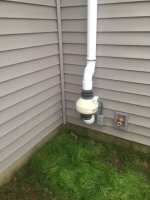
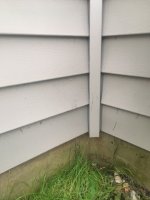
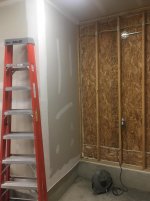
Hi all. I am in the process of finishing the attached garage (just added lots of electrical, now air sealing and insulating and was soon going to be drywalling) when I saw water coming in during a rain storm. Normally this area is covered by bins, so it has probably done this before, but this is the first time I have seen it. The leak seems to be coming in around the sill plate on top of the 12" tall cement stem wall. What is the best way to find out where the water is coming from, and best way to stop it? I know I can pull the bottom few layers of siding, but probably not the corner piece?

Thanks!
 

Attachments

  • 1.JPG
    1.JPG
    92.1 KB · Views: 108
  • 2.JPG
    2.JPG
    89.3 KB · Views: 99
  • 3.JPG
    3.JPG
    89.6 KB · Views: 100
  • 4.JPG
    4.JPG
    83.2 KB · Views: 80
  • floorplan.jpg
    floorplan.jpg
    89.3 KB · Views: 70
Last edited:
To avoid these ads, REGISTER NOW!
OP
G

garrett1812

Well-known member
Joined
May 23, 2013
Messages
428
Location
Indiana
looks like someone has tried to address this issue already .
where in relation to the vent & outlet is the corner pic you show

If you are referring to the foam or white caulk seen from inside the garage, I put this in for air sealing, not water. It also seems to have done nothing for the water.

The corner just left of the vent fan is the corner where water is coming in. Pictures are of the same location, view from inside garage and from outside house.
 

GreyOwl

Well-known member
Joined
Oct 23, 2007
Messages
550
Location
North Las Vegas
Since you have the white caulk already, I'm betting the leak is further up the wall and maybe even at the roof somewhere and running down. Time to remove some more drywall from the other wall.
 

Lelandwelds

Well-known member
Joined
Sep 6, 2017
Messages
2,443
Location
Central Texas
Since you have the white caulk already, I'm betting the leak is further up the wall and maybe even at the roof somewhere and running down. Time to remove some more drywall from the other wall.

Water can run downhill. Sometimes further than you think. I suspect missing flashing, roofing problem, gutter problem, nail in water pipe, etc. Can you photo higher on the wall and the roof?

I would remove interior until I found water stains.

This is one of those PITA problems that will not improve by itself. It needs a fairly quick response. If you're lucky, stalling wont DRAMATICALLY increase the damage and expense.

I was never lucky. My water problem was neglected for years. The estimate was "$5k. Maybe $10k. Could be more."

It cost $300 and 3 months of nights after work and weekends. With no bathroom. And a wife and two kids still at home. Ah, fun times.
 
OP
G

garrett1812

Well-known member
Joined
May 23, 2013
Messages
428
Location
Indiana
Since you have the white caulk already, I'm betting the leak is further up the wall and maybe even at the roof somewhere and running down. Time to remove some more drywall from the other wall.

I really can't see water higher than the sill plate on the inside, but could be behind the wall where I can't see it.

The drywall on the wall to the left is actually just over the tyvek/sheathing from the kitchen wall.
 
OP
G

garrett1812

Well-known member
Joined
May 23, 2013
Messages
428
Location
Indiana
Water can run downhill. Sometimes further than you think. I suspect missing flashing, roofing problem, gutter problem, nail in water pipe, etc. Can you photo higher on the wall and the roof?

I would remove interior until I found water stains.

This is one of those PITA problems that will not improve by itself. It needs a fairly quick response. If you're lucky, stalling wont DRAMATICALLY increase the damage and expense.

I was never lucky. My water problem was neglected for years. The estimate was "$5k. Maybe $10k. Could be more."

It cost $300 and 3 months of nights after work and weekends. With no bathroom. And a wife and two kids still at home. Ah, fun times.

Interestingly I checked the basement (unfinished) and there was no sign of water). Looking from inside the garage, the wall at the left is a wall shared with the kitchen. There is no sign of water there, but that's only looking at the surface of the wall, haven't ripped anything apart.
 
OP
G

garrett1812

Well-known member
Joined
May 23, 2013
Messages
428
Location
Indiana
Here is a higher photo from inside the garage. Will have to wait until tomorrow to take a picture from the outside.
 

Attachments

  • IMG_2816.jpg
    IMG_2816.jpg
    136.8 KB · Views: 55

wssix99

Well-known member
Joined
Mar 2, 2011
Messages
5,162
Location
Chicago, IL
Look up, also. It could be coming from the roof/downspouts and running down the outside of the wall (behind the siding) until it hits the curb.
 

ard

Well-known member
Joined
Feb 16, 2015
Messages
4,391
Location
Sierra Foothills... California
im not sure I would spend the money [in the future] ripping out drywall to find wet. You'll need to repair it later.

Assuming you have looked at roof gutters and valleys. obvious drainage....issue will be improper membrane at some point... siding prolly needs to be peeled up.
 

Lelandwelds

Well-known member
Joined
Sep 6, 2017
Messages
2,443
Location
Central Texas
Look up, also. It could be coming from the roof/downspouts and running down the outside of the wall (behind the siding) until it hits the curb.

Weird how your houseplan is reverse image. I assume the dryer vent and hose bib are on the house wall and not the garage. It doesnt look like water is from slab. Water can wick down the top of the stemwall and show a distance away.

Is it constantly wet? ( bad pex crimp or screw puncture in line)

Wet when it rains? ( is the roof design dumping water down wall? Missing gutter? Reversed flashing?)

Is it worse when you wash 14 loads of clothes? (Drain pipe not glued together. Leaky washer tub.)
 
To avoid these ads, REGISTER NOW!
OP
G

garrett1812

Well-known member
Joined
May 23, 2013
Messages
428
Location
Indiana
Weird how your houseplan is reverse image. I assume the dryer vent and hose bib are on the house wall and not the garage. It doesnt look like water is from slab. Water can wick down the top of the stemwall and show a distance away.

Is it constantly wet? ( bad pex crimp or screw puncture in line)

Wet when it rains? ( is the roof design dumping water down wall? Missing gutter? Reversed flashing?)

Is it worse when you wash 14 loads of clothes? (Drain pipe not glued together. Leaky washer tub.)

I reversed the house plan image because the stock image is reverse of how my house was built. It's not exact to every detail, but shows perspective of where the picture of the water was taken from. The vent and hose bib are on the house wall.

Seems to be only an issue when raining (this is the first time I have ever observed this). There is a drain for the washer in the vicinity, but it was not being used that day.

Gutters are very clean. Next time it rains I will watch from outside for anything obvious.
 
OP
G

garrett1812

Well-known member
Joined
May 23, 2013
Messages
428
Location
Indiana
I will pull off some siding. But what am I looking for? Any diagram of what a proper water tight job looks like?
This is vinyl siding, by the way.
 

matt_i

Well-known member
Joined
Mar 14, 2008
Messages
10,737
Location
SE Michigan
I would take off the bottom layer both sides on the siding, and look at the way the inside corner channel drains. It looks like it was trimmed pretty high to me and also beveled back/upward on the J-channel forms which conduct water. It could be releasing water onto the joint between the stem wall and the bottom plate.

Ideally there would also be housewrap behind it as well, the lower edge of that should be lower than the concrete-to-wood interface, imo.
 

wssix99

Well-known member
Joined
Mar 2, 2011
Messages
5,162
Location
Chicago, IL
I would continue to suspect the gutters,
Often in a valley the water come down so fast that it jumps over the gutter.
The solution is a, "L" shaped shield sticking up on he outside edge of the corner where the gutters meet.
It will split the water into going one way or the other.

https://www.ebay.com/itm/Gutter-Val...d=282571418322&_trksid=p2385738.c100677.m4598

Yea. Getting up on a ladder and taking a look before taking the bottom course of siding off could pay huge free dividends. (BTW - We should probably mention taking siding off isn't so easy since the first course goes on the bottom and successive courses are laid on top.)
 
Last edited:
OP
G

garrett1812

Well-known member
Joined
May 23, 2013
Messages
428
Location
Indiana
I haven't had a chance to look at this yet, but did manage to get home from work before dark today to take a larger picture of the outside. Does this give any clues?
 

Attachments

  • IMG_2823.jpg
    IMG_2823.jpg
    144.6 KB · Views: 36

larry4406

Well-known member
Joined
Jan 27, 2006
Messages
19,453
Location
Northern Virginia
Get a ladder and look up on the roof of the lower portion and inspect the area where the gutter starts.

You need to ensure you have kickout flashing in that area. It ensures that water running down the roof does not then run behind the siding. Common problem with poor siding installation.
 

Attachments

  • Kick out flashing location.jpg
    Kick out flashing location.jpg
    136 KB · Views: 12
  • kickout flashing example.jpg
    kickout flashing example.jpg
    6.3 KB · Views: 17

wssix99

Well-known member
Joined
Mar 2, 2011
Messages
5,162
Location
Chicago, IL
^ I would think a tell tale for something like this would be a leak during heavy rain but not in light rain.
 

Radix2

Well-known member
Joined
May 28, 2014
Messages
1,853
Location
the thumb!, MI
Missing kick out flashing.

I'd guess that 90% of contractors don't do it around here and it is a big problem. Many times you get away without it because rain direction keeps the area fairly dry or the leak is small enough that it takes years before the rot shows up. But these guys can't get it through their heads that the transition from flashing behind the siding to in front of it when the roof ends is critical to stop water from running behind the siding...and no, the poorly installed tyvek is not going to save the day...
 
OP
G

garrett1812

Well-known member
Joined
May 23, 2013
Messages
428
Location
Indiana
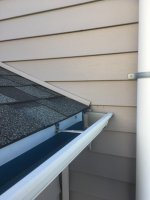
I have been reading on this and found plenty of info about how to install the kickback flashing before the siding and roofing, but is there an easy way to install it now that everything is in place? Hopefully I won't have to rip out a bunch of existing work.
 

Attachments

  • IMG_2839.jpg
    IMG_2839.jpg
    137.3 KB · Views: 7
  • IMG_2840.jpg
    IMG_2840.jpg
    137.2 KB · Views: 5
  • IMG_2842.jpg
    IMG_2842.jpg
    143.4 KB · Views: 5
Last edited:
To avoid these ads, REGISTER NOW!
Top Bottom