To avoid these ads, REGISTER NOW!

How much spray foam?

terabitdan

Well-known member
Joined
Jul 16, 2016
Messages
152
We’re converting our attached garage to living space after building a detached garage. We built the walls out to 5” thick planing on filling it with foam and then cellulose or rock wool for about R28. In the attic we used 2” R-10 XPS board form a ventilation channel and planned on 3” closed cell and then using netting to blow in to R48.

Most of the insulation contractors are saying not to bother with more than 3” of closed cell spray foam all around, saying it won’t make much, if any difference in the comfort or costs.

Anyone have any experience like this? What do you think, does it make sense? I thought the higher R-value would be worth the extra work and cost.
 
To avoid these ads, REGISTER NOW!

tjpavlov

Well-known member
Joined
May 18, 2012
Messages
1,280
Location
Providence, RI
Usually you would spray the foam on the underside of the roof. Around here you end up with an invented roof when you go with foam.
 

Kaizen

Well-known member
Joined
Jan 9, 2015
Messages
6,948
Location
New England
strange a contractor would talk you out of using more. from what I know even on a wall the most r value the better. however getting the spray foam even so a batt will fit in easy will be a pain. think id go all foam or a one inch layer for an air barrier then a batt of insulation or blown in. I hate blown in for walls.
 

strutaeng

Well-known member
Joined
Dec 12, 2011
Messages
2,287
Location
Dallas, TX
Whatever the thicknesses is required to achieve R-value by the building code is what you need. There's a very good article from green building advisor website on this issue.

The whole, "3 inches of spray foam is better than typical installation of X inches of fiberglass," is pure BS.

2-3" of foam will never meet minimum building code R-value.
 

yeldogt

Well-known member
Joined
Jan 2, 2012
Messages
18,184
In the mid atlantic 4" of closed cell gets you to a happy place -- complete encapsulation of the structure .... attic to basement. Crawlspace as well if the building has one .. no ventilation. Have also done partial rehabs w/ additions where I did 2" heavy with bats to get to R code in 2x6 construction. 2" heavy is enough to eliminate condensation dangers on the roof deck in my area.

Foams ability to seal the structure is why it performs so well -- it's able to stop air infiltration ... other systems just can't. All insulation is diminishing returns -- at some point the payback in energy saving is not there. Unfortunately, with current codes we need the 4" to get the R value ... so it's just easier to do a new building with straight foam vs coming back and adding the batts.

With 4+ inches of foam -- the underside of the foam is room temp on a 100 degree day with a black roof ... it's amazing stuff.

I have a problem with the R values -- because the same R with Foam is not the same as with Batts. Batts leak ... we need to rethink the whole thing.
 
Last edited:

Lelandwelds

Well-known member
Joined
Sep 6, 2017
Messages
2,443
Location
Central Texas
You can only spray 3 inches of closed cell per lift. Maybe your guy doesnt like to stand around waiting.

Most of insulations greatest benefits are in the first few inches. Every inch beyond is less of a benefit but is still needed. ( In other words, the first inch saves more energy than the last inch. There is greater energy savings when you take a house from R 0 to R3 than when you take a house from R18 to R21)

https://buildingscience.com/documen...gh-performance-walls-limitations-r-value/view

There is a lot of misunderstanding and deception and incompetence in the insulation industry.
 

Lelandwelds

Well-known member
Joined
Sep 6, 2017
Messages
2,443
Location
Central Texas
Foams ability to seal the structure is why it performs so well -- it's able to stop air infiltration ...

With 4+ inches of foam -- the underside of the foam is room temp on a 100 degree day with a black roof ... it's amazing stuff.

I have a problem with the R values -- because the same R with Foam is not the same as with Batts. Batts leak ... we need to rethink the whole thing.

I couldnt find it but there is a video showing thermal imaging of different insulation systems on a wall with 90° temperature differences between interior and exterior. The fiberglass batt actually had convective circulation in the wall cavity. It was a cool video. The foam was a static picture with no air rising or falling in the cavity.
 

Dragfluid

ALLIANCE MEMBER
Joined
Sep 15, 2013
Messages
17,644
Location
Pillager, MN
I couldnt find it but there is a video showing thermal imaging of different insulation systems on a wall with 90° temperature differences between interior and exterior. The fiberglass batt actually had convective circulation in the wall cavity. It was a cool video. The foam was a static picture with no air rising or falling in the cavity.
And,,,,,,,,,,,,,, I'm sure that the thermal image when using dense pack cellulose would be similar.:)
 

yeldogt

Well-known member
Joined
Jan 2, 2012
Messages
18,184
And,,,,,,,,,,,,,, I'm sure that the thermal image when using dense pack cellulose would be similar.:)

Properly done it's a good system -- I believe you will get around 4 max per inch.

It has to be done correctly -- the wet applied stuff is also interesting ... time will tell how it holds up if not fully filling the bays.

I still like foam for new construction and rehabbing an old building
 

Dragfluid

ALLIANCE MEMBER
Joined
Sep 15, 2013
Messages
17,644
Location
Pillager, MN
Properly done it's a good system -- I believe you will get around 4 max per inch.

It has to be done correctly -- the wet applied stuff is also interesting ... time will tell how it holds up if not fully filling the bays.

I still like foam for new construction and rehabbing an old building

Yup,,,,,,,, mine was nice and tight behind the web. 8 1/2" of it. Plus 1" of Poly-iso on top (R6) to kill any thermal bridging.
 

Jeepster04

Well-known member
Joined
Jun 25, 2013
Messages
3,100
Local contractor also says no more than 3-3.5" is needed. Also talks people into spraying it on the underside of the roof and heating/cooling their attic even through their units are not sized appropriately... then people wonder why their heating bills are so high with their units running constantly and probably kicking the coils on..

Ohh well..
 

jack stand

Well-known member
Joined
Feb 29, 2012
Messages
3,353
Location
Lakes Region Maine
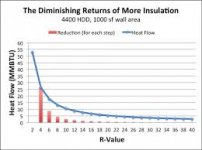
This chart shows the diminishing return, for any type of insulation. Once you hit an R-12/14 it really flattens out. Foam has a huge advantage virtually stopping all air infiltration, the killer of f/g insulation. Your S/F contractor wasn't pulling your leg (too much):beer:
 

Attachments

  • url.jpg
    url.jpg
    10 KB · Views: 148

theoldwizard1

Well-known member
Joined
Feb 22, 2011
Messages
43,243
Location
SE MI
Most of the insulation contractors are saying not to bother with more than 3” of closed cell spray foam all around, saying it won’t make much, if any difference in the comfort or costs.

There is a difference between "won't make much difference" and "not cost effective". Spray foam is expensive. More insulation IS ALWAYS BETTER !

The latest is 1"-2" of spray foam making sure to hit all the corner/joints where there may be an air leak and then your choice of "other" insulation, fiberglass roll/batts/ blown, cellulose or foam board. Rock wool is good, just more expensive than fiberglass or cellulose, but it does have better sound deadening.
 

jack stand

Well-known member
Joined
Feb 29, 2012
Messages
3,353
Location
Lakes Region Maine
Wizard, I thought that the "flash & batt" method (1" spray foam) was found to be problematic due to condensation issues on the back of the "batts" Now what I've been told is a solid 2" is enough for most northern climates to prevent this. This new "wall science" is very confusing and I'll defer to you:thumbup:
 

Voi

Well-known member
Joined
Oct 10, 2010
Messages
5,151
Location
Western South Dakota
Wizard, I thought that the "flash & batt" method (1" spray foam) was found to be problematic due to condensation issues on the back of the "batts" Now what I've been told is a solid 2" is enough for most northern climates to prevent this. This new "wall science" is very confusing and I'll defer to you:thumbup:

There are a handful of articles out there that talk about an R value ratio of foam to "fluffy" insulation. As you go further north the greater the R value in foam needed.

Did the thread starter say what part of the world he's in?
 

yeldogt

Well-known member
Joined
Jan 2, 2012
Messages
18,184
Wizard, I thought that the "flash & batt" method (1" spray foam) was found to be problematic due to condensation issues on the back of the "batts" Now what I've been told is a solid 2" is enough for most northern climates to prevent this. This new "wall science" is very confusing and I'll defer to you:thumbup:

It must be high enough to not allow condensation. My area 2" .. we went a tad heavy ... and I fully foamed the eaves where I would not get the benefit of air circulation in the warm attic. We used typical R13 to fill the bays.

Proper humidity control and fresh air is needed w/ foam.
 
To avoid these ads, REGISTER NOW!

theoldwizard1

Well-known member
Joined
Feb 22, 2011
Messages
43,243
Location
SE MI
Wizard, I thought that the "flash & batt" method (1" spray foam) was found to be problematic due to condensation issues on the back of the "batts" Now what I've been told is a solid 2" is enough for most northern climates to prevent this. This new "wall science" is very confusing and I'll defer to you:thumbup:

I get my info from my daughter's father-in-law who is a certified energy auditor. 2" would obviously be better at sealing any crack that would let moisture get to the insulation from the outside.
 
OP
T

terabitdan

Well-known member
Joined
Jul 16, 2016
Messages
152
I’m in Metro Detroit.

After reading the Building Science article and your feedback I’m leaning toward 4” all around.

Blown in for the walls would be challenging since we used 2x2 strapping to build out to 5” and minimize thermal bridging, I imagine filling the cavity will not be easy, and it’s just a little higher R-value than an inch of closed cell.

That’s why I was leaning toward bats and splitting them in half to fill the space. Much easier to install than cellulose, cheaper than foam.

I wonder if filling the wall cavities to 5” of foam for about $660 and then using blown in to bring the attic to R60 is the smartest choice.


Sent from my iPhone using Tapatalk
 

Voi

Well-known member
Joined
Oct 10, 2010
Messages
5,151
Location
Western South Dakota
Blown in for the walls would be challenging since we used 2x2 strapping to build out to 5” and minimize thermal bridging, I imagine filling the cavity will not be easy, and it’s just a little higher R-value than an inch of closed cell.

Here is one article about using blown in insulation with a Mooney wall like yours. I feel like I've read one more but I couldn't find it. Worth doing a search on Green Building Advisor as well. I typically just use Google to search that site.

https://www.builditsolar.com/Projects/Conservation/MooneyWall/MooneyWall.htm
 

Firebrick43

Well-known member
Joined
May 12, 2015
Messages
14,162
Location
West central Indiana
Here is one article about using blown in insulation with a Mooney wall like yours. I feel like I've read one more but I couldn't find it. Worth doing a search on Green Building Advisor as well. I typically just use Google to search that site.

https://www.builditsolar.com/Projects/Conservation/MooneyWall/MooneyWall.htm

I have actually done this in two buildings, one mine(small shed where my milling machine and lathe are) and the other a friend/neighbors "office" in his pole barn. I got the idea from that article. It was actually pretty easy to do if you use the right blower. My Menards had the correct blower with free rental if you purchased so much insulation.

The 2x2 strapping wasn't an issue at all. Just make sure you have an electric stapler.
 

Lelandwelds

Well-known member
Joined
Sep 6, 2017
Messages
2,443
Location
Central Texas
And,,,,,,,,,,,,,, I'm sure that the thermal image when using dense pack cellulose would be similar.:)

Yes, it was. The dense pack is most impressive when you burn the building down.

Yup,,,,,,,, mine was nice and tight behind the web. 8 1/2" of it. Plus 1" of Poly-iso on top (R6) to kill any thermal bridging.

I could not find or force a builder to do that on my house. I wanted 1" polyiso externally the insulated Zip panels.

Local contractor also says no more than 3-3.5" is needed. Also talks people into spraying it on the underside of the roof and heating/cooling their attic even through their units are not sized appropriately... then people wonder why their heating bills are so high with their units running constantly and probably kicking the coils on..

Ohh well..

At least they are getting effective dehumidification. I think on most jobs, the easier and more effective sealing makes it a wash. It is easy to plug in the numbers and slightly increase the capacity if needed. I think, on most houses, avoiding installing equipment and ductwork in an uncontrolled vented attic means a smaller unit is needed.

This chart shows the diminishing return, for any type of insulation. Once you hit an R-12/14 it really flattens out. Foam has a huge advantage virtually stopping all air infiltration, the killer of f/g insulation. Your S/F contractor wasn't pulling your leg (too much):beer:

Closed cell really ups the impact and racking resistance of the wall, too. The payback charts assume energy costs will not dramatically rise. I would not make that bet. Its hard to put a price on comfort. What if you are without power for two weeks? A little "unnecessary " insulation that is always there and doesnt need fuel stabilizer might come in handy.

I’m in Metro Detroit.

After reading the Building Science article and your feedback I’m leaning toward 4” all around.

Blown in for the walls would be challenging since we used 2x2 strapping to build out to 5” and minimize thermal bridging, I imagine filling the cavity will not be easy, and it’s just a little higher R-value than an inch of closed cell.

That’s why I was leaning toward bats and splitting them in half to fill the space. Much easier to install than cellulose, cheaper than foam.

I wonder if filling the wall cavities to 5” of foam for about $660 and then using blown in to bring the attic to R60 is the smartest choice.
You can build an smart effective building with any material and insulation system. Some are just easier.

With all the freezing temps, mold problems,etc that northerners suffer through, I think I would find something better than some contractor's or daughters father in laws cousin's opinion.

Mine was simple. Heat, humidity bad. Cool good. Snow, what is that?


It just gets me how people spend an extra $20 or $50k on finishes but balk at spending an extra $1000 or two on insulation. Dont get me started on cheap windows.
 

Dragfluid

ALLIANCE MEMBER
Joined
Sep 15, 2013
Messages
17,644
Location
Pillager, MN
Yes, it was. The dense pack is most impressive when you burn the building down.

Yes, I saw that video too. Pretty neat.

I could not find or force a builder to do that on my house. I wanted 1" polyiso externally the insulated Zip panels.
I'm not sure if Polyiso was available when I built the house. Or at least I wasn't aware of it. I had them put 3/4" extruded on the outside of the Builtrite


At least they are getting effective dehumidification. I think on most jobs, the easier and more effective sealing makes it a wash. It is easy to plug in the numbers and slightly increase the capacity if needed. I think, on most houses, avoiding installing equipment and ductwork in an uncontrolled vented attic means a smaller unit is needed.


Closed cell really ups the impact and racking resistance of the wall, too. The payback charts assume energy costs will not dramatically rise. I would not make that bet. Its hard to put a price on comfort. What if you are without power for two weeks? A little "unnecessary " insulation that is always there and doesnt need fuel stabilizer might come in handy.

The power has gone out here in the dead of winter for several hours. You can barely see the thermometer go down!


You can build an smart effective building with any material and insulation system. Some are just easier.

With all the freezing temps, mold problems,etc that northerners suffer through, I think I would find something better than some contractor's or daughters father in laws cousin's opinion.

Mine was simple. Heat, humidity bad. Cool good. Snow, what is that?


It just gets me how people spend an extra $20 or $50k on finishes but balk at spending an extra $1000 or two on insulation. Dont get me started on cheap windows.

Yes, it's pretty amazing that there's that mindset. This morning here, it's 37F. In my Shed, it's 61F. And the heat hasn't been on all night, nor was it on much yesterday. Lutefisk

You're a man after my own heart. My replies in red above.
 
Last edited:

mrpizza

Well-known member
Joined
Nov 1, 2011
Messages
2,935
Location
IL
Whoever said 2-3" of closed cell wont meet building codes needs to read the spec sheets. We spray closed cell that has an R-Value of 6.9 per inch. So, two inches gets you 13.8, so .8 over the code. There is a website you can enter insulation types in and get certificates from the government to prove the value of different types.


In reality, its more like r-25, because you block all the air infiltration.
 
OP
T

terabitdan

Well-known member
Joined
Jul 16, 2016
Messages
152

Dragfluid

ALLIANCE MEMBER
Joined
Sep 15, 2013
Messages
17,644
Location
Pillager, MN
Whoever said 2-3" of closed cell wont meet building codes needs to read the spec sheets. We spray closed cell that has an R-Value of 6.9 per inch. So, two inches gets you 13.8, so .8 over the code. There is a website you can enter insulation types in and get certificates from the government to prove the value of different types.


In reality, its more like r-25, because you block all the air infiltration.
Oh, come on now. Blocked airflow isn't a substitute for R-value. Two different things. Using your math, my walls with the house wrap and the 8 1/2" dense pack must be close to R-70!:lol_hitti
 

d300

Well-known member
Joined
Sep 15, 2017
Messages
109
Location
Oregon high desert
Oh, come on now. Blocked airflow isn't a substitute for R-value. Two different things. Using your math, my walls with the house wrap and the 8 1/2" dense pack must be close to R-70!:lol_hitti

Blocked air flow does not add to the R-value but unsealed walls subtract from the R-value of whatever insulation you put in there. This is why spray foam is so effective. Basically, an R-value of 7 per inch (some variation between manufacturers) will always be 7. Batts, of any kind, and loose fill, of any kind, will degrade substantially over time with air infiltration moving dirt and 'stuff' into the space.
Yes, foam is not cheap. If you plan to move in 5 years then go with something else as it will not pay you back unless the next buyer realizes the advantages and steps up.
Any structure completely foamed will certainly show the benefits every month you pay the utility bills.
 

jack stand

Well-known member
Joined
Feb 29, 2012
Messages
3,353
Location
Lakes Region Maine
Blocked air flow does not add to the R-value but unsealed walls subtract from the R-value of whatever insulation you put in there. This is why spray foam is so effective. Basically, an R-value of 7 per inch (some variation between manufacturers) will always be 7. Batts, of any kind, and loose fill, of any kind, will degrade substantially over time with air infiltration moving dirt and 'stuff' into the space.
Yes, foam is not cheap. If you plan to move in 5 years then go with something else as it will not pay you back unless the next buyer realizes the advantages and steps up.
Any structure completely foamed will certainly show the benefits every month you pay the utility bills.

:beer:
 

Dragfluid

ALLIANCE MEMBER
Joined
Sep 15, 2013
Messages
17,644
Location
Pillager, MN
Blocked air flow does not add to the R-value but unsealed walls subtract from the R-value of whatever insulation you put in there. This is why spray foam is so effective. Basically, an R-value of 7 per inch (some variation between manufacturers) will always be 7. Batts, of any kind, and loose fill, of any kind, will degrade substantially over time with air infiltration moving dirt and 'stuff' into the space.
Yes, foam is not cheap. If you plan to move in 5 years then go with something else as it will not pay you back unless the next buyer realizes the advantages and steps up.
Any structure completely foamed will certainly show the benefits every month you pay the utility bills.

I don't disagree that things have to be sealed up for an effective job. "R-7"? Seems like the R value goes up every time someone picks up the foam torch. How can it be higher than properly sealed Poly-iso? I don't know, I'm asking.
Quite a bit more for materials and labor for foam over dense pack though, correct? Isn't the max # of inches per rise 2? So to get the same thing that I have for example, you'd have to make 4 passes?
 
OP
T

terabitdan

Well-known member
Joined
Jul 16, 2016
Messages
152
I don't disagree that things have to be sealed up for an effective job. "R-7"? Seems like the R value goes up every time someone picks up the foam torch. How can it be higher than properly sealed Poly-iso? I don't know, I'm asking.

Quite a bit more for materials and labor for foam over dense pack though, correct? Isn't the max # of inches per rise 2? So to get the same thing that I have for example, you'd have to make 4 passes?


I have seen number ranging between 6-7 depending on the manufacturer. I think technically its 6.8.

The max depth per pass is also manufacturer specific, and if it's done in two lifts they spray once, complete the layer and then do the second lift, still all in one trip.

Material is definitely more, but labor I doubt it, maybe its a wash on labor costs. The advantage of spray foam is in the same cavity there is higher total R-value and excellent sealing. In my 5" cavity, all spray foam is R-34, 3" of foam and 2" of dense pack is R-28, dense pack is R-19. Even if the dense pack seals as well, which I don think it does, the hybrid results in better overall comfort and savings.

For a roof or ceiling its less of an issue since adding more cellulose is easy and clearly cheaper.


Sent from my iPad using Tapatalk
 

mrpizza

Well-known member
Joined
Nov 1, 2011
Messages
2,935
Location
IL
If you have dense pack and housewrap, put a blower door on your house and see how much air infiltration you have. Its probably a lot more than you think.
 

yeldogt

Well-known member
Joined
Jan 2, 2012
Messages
18,184
I'm doing full foam on my new build -- with everything new ... I get the whole building done in one shot. I will be in this place for a long time .. for the few k .. it's an easy way to go.

Building science loves the rigid foam -- personally, I don't like the double sheathed roof system w/ sandwiched foam or the exterior foam in cold climates -- I see moisture problems .. and it no cheaper. Reminds me of the early problems w/ SIP .... and the flashing is so important with foam outside -- and no good nailing surface.
 

Lelandwelds

Well-known member
Joined
Sep 6, 2017
Messages
2,443
Location
Central Texas
Material is definitely more, but labor I doubt it, maybe its a wash on labor costs. The advantage of spray foam is in the same cavity there is higher total R-value and excellent sealing. In my 5" cavity, all spray foam is R-34, 3" of foam and 2" of dense pack is R-28, dense pack is R-19. Even if the dense pack seals as well, which I don think it does, the hybrid results in better overall comfort and savings.

For a roof or ceiling its less of an issue since adding more cellulose is easy and clearly cheaper.
I toured a "upscale planned neighborhood " builders who heavily promotes a hybrid approach. If you ask pointedly enough, they admit the "eco friendly soy based foam" is applied at 1/4 inch thick and the rest is fiberglass. I decided it was best to use all open cell foam.

I like the soundproofing from cellulose. Its in a more useful frequency range.

If you have dense pack and housewrap, put a blower door on your house and see how much air infiltration you have. Its probably a lot more than you think.

You are not supposed to depend on insulation for sealing. Most leaks are probably from the sill plate and penetrations. House wrap wont fix either source. Foam wont fix sill leaks or penetrations after foam is sprayed.

Dont be so harsh on cellulose. It can dramatically slow the spread of fire.

Building science loves the rigid foam -- personally, I don't like the double sheathed roof system w/ sandwiched foam or the exterior foam in cold climates -- I see moisture problems .. and it no cheaper. Reminds me of the early problems w/ SIP .... and the flashing is so important with foam outside -- and no good nailing surface.

And contractors HATE anything different.

I agree on your roofing point. Exterior foam sheathing is NOT for cost reduction. It is to reduce thermal bridging. Flashing is ALWAYS important. (And often poorly executed) There are easy work arounds for better nailing surfaces.
 
Last edited:
To avoid these ads, REGISTER NOW!
Top Bottom