To avoid these ads, REGISTER NOW!

Concrete footing for lift?

TBoiNasty

Member
Joined
Jun 14, 2017
Messages
15
My slab where I want to put my lift is 4” thick . The lift I’m going to get calls for 4” minimum concrete but I’m not so sure I want to go with the “minimum”.

I was wondering round about how much some of you have paid to get new footing poured for your lifts.
 
To avoid these ads, REGISTER NOW!

pattenp

Well-known member
Joined
Jun 4, 2008
Messages
10,175
Location
Virginia - USA
My 2 post is on 4" concrete and it doesn't worry me a bit. Is your concrete fairly new and in good shape?
 
OP
T

TBoiNasty

Member
Joined
Jun 14, 2017
Messages
15
My 2 post is on 4" concrete and it doesn't worry me a bit. Is your concrete fairly new and in good shape?


The slab is roughly 17 years old and in excellent shape. I’m just worried about later down the road getting stress cracks in the concrete or my lift failing because of that. I could be overthinking things but I think I might want to get this knocked out now rather than later if there is an issue ya know
 

rburke65

Well-known member
Joined
Nov 10, 2007
Messages
12,349
Location
Canfield, Ohio
I think the majority of guys on his site did it themselves. I honestly don't recall reading if someone here paying. I could be wrong.....ask my wife! Maybe someone will chime in here.
 
Last edited:

lakeroadster

Well-known member
Joined
Jan 19, 2015
Messages
5,166
Location
Central Colorado
The slab is roughly 17 years old and in excellent shape. I’m just worried about later down the road getting stress cracks in the concrete or my lift failing because of that. I could be overthinking things but I think I might want to get this knocked out now rather than later if there is an issue ya know

You are wise to question the strength of the existing concrete.

You could have a core sample drilled and tested. That would tell you if it was ok-as-is.
 

wssix99

Well-known member
Joined
Mar 2, 2011
Messages
5,165
Location
Chicago, IL
The slab is roughly 17 years old and in excellent shape. I’m just worried about later down the road getting stress cracks in the concrete or my lift failing because of that.

The cracks you see in concrete are typically not stress cracks due to forces applied due to traffic or other things. They are due to the stresses of the concrete slab shrinking as it cures. At 17 years old, if your slab hasn't cracked badly now - its not going to in the future.

2 post lifts don't stress out the floor like they would seem. Your car sits on just four points when you are parked on the slab. When it's on the lift, it goes to two points. However, the base plate of the lift is much larger than the contact patch of your tires, so the forces get distributed similarly.

The big worry is having the full 4" for the anchor bolts to bite in to. That part is critical.
 

Lelandwelds

Well-known member
Joined
Sep 6, 2017
Messages
2,443
Location
Central Texas
The cracks you see in concrete are typically not stress cracks due to forces applied due to traffic or other things. They are due to the stresses of the concrete slab shrinking as it cures. At 17 years old, if your slab hasn't cracked badly now - its not going to in the future.

2 post lifts don't stress out the floor like they would seem. Your car sits on just four points when you are parked on the slab. When it's on the lift, it goes to two points. However, the base plate of the lift is much larger than the contact patch of your tires, so the forces get distributed similarly.

The big worry is having the full 4" for the anchor bolts to bite in to. That part is critical.

He nailed it. Ditto.

If you replace concrete, remember to bevel the beams instead of stairstep. The guys with the stamps and letters after their name talk about stress rises like they are worse than thin concrete.

You have to cut out a bigger square than needed so you can dowel into the old concrete. The mfg of lifting equipment figure in big safety margins. If 4 " is the minimum, you probably have a 2 to 1 or better margin.

Just dont go too deep. Epoxy or oddball anchors are always out of stock. Waiting 10 days can seem like forever.
 
OP
T

TBoiNasty

Member
Joined
Jun 14, 2017
Messages
15
He nailed it. Ditto.


If you replace concrete, remember to bevel the beams instead of stairstep. The guys with the stamps and letters after their name talk about stress rises like they are worse than thin concrete.


You have to cut out a bigger square than needed so you can dowel into the old concrete. The mfg of lifting equipment figure in big safety margins. If 4 " is the minimum, you probably have a 2 to 1 or better margin.


Just dont go too deep. Epoxy or oddball anchors are always out of stock. Waiting 10 days can seem like forever.


Can you explain what you mean by beveling and stair stepping.


Also, you said don’t go too deep, I’m assuming you mean, make sure the anchors are not past the concrete.
 

wssix99

Well-known member
Joined
Mar 2, 2011
Messages
5,165
Location
Chicago, IL
Also, you said don’t go too deep, I’m assuming you mean, make sure the anchors are not past the concrete.

Yes. Anchor bolts get their holding power in concrete by transferring forces through a stress cone:

appb_fig5.jpg


You want that anchor bolt to bite solidly into the bottom of the slab, to the manufacturer's specification so that cone is appropriately sized. If the bolt is not all the way in, then the cone shorter, where there is significantly less area in the cone to spread out forces. If the bolt is too far in and doesn't bite into the concrete properly, then the cone may not work properly.

There's no reason to sweat this if you have the full 4". An extra inch doesn't do anything for you, strength-wise, because the cone is above the bolt. I think the best practice I see most people take is to get their lift and then take a step back and pour a repar pad (it's not technically a "footer") if they drill for the lift and find the slab is too shallow.


Can you explain what you mean by beveling and stair stepping.

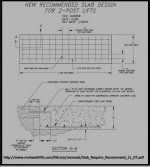
The repair slabs need to be pinned and/or keyed into the original thin slab so they behave structurally as a unit.

View media item 27725
As the lift wants to "tip", with a raised load, the keyed slab will hook into the broader thin slab and help resist that tipping/bending force.
 

sberry

Banned
Joined
Jun 18, 2005
Messages
35,747
Location
Brethren, Michigan
Bolt it down, hundreds of thousands of these are done this way,,, according to the instructions.
The cracks you see in concrete are typically not stress cracks due to forces applied due to traffic or other things. They are due to the stresses of the concrete slab shrinking as it cures. At 17 years old, if your slab hasn't cracked badly now - its not going to in the future.

2 post lifts don't stress out the floor like they would seem. Your car sits on just four points when you are parked on the slab. When it's on the lift, it goes to two points. However, the base plate of the lift is much larger than the contact patch of your tires, so the forces get distributed similarly.

The big worry is having the full 4" for the anchor bolts to bite in to. That part is critical.
 

pattenp

Well-known member
Joined
Jun 4, 2008
Messages
10,175
Location
Virginia - USA
My Challenger 2 post lift specs calls for a pad 47" X 166" X 12" thick key into the existing slab if the existing slab is not 4" thick and 3500 psi concrete. Also instructions say to drill through the floor to install anchor bolts. The thinking is if a anchor bolt messes up you can drive it down into the ground and install a new one using epoxy.
 
Last edited:

LX-Markham

Well-known member
Joined
Apr 27, 2013
Messages
2,930
Location
Markham, Ont.
The requirements are always for the slab thickness. I'm surprised there is never any mention of the subgrade.

I'm glad I cut my slab to install a proper footing. There was a void under my slab.

Concretepadexcavation_zps6f1834f9-S.jpg


Concretepadexcavation2_zpsf7179e76-S.jpg
 

Lelandwelds

Well-known member
Joined
Sep 6, 2017
Messages
2,443
Location
Central Texas
Yes. Anchor bolts get their holding power in concrete by transferring forces through a stress cone:

appb_fig5.jpg


You want that anchor bolt to bite solidly into the bottom of the slab, to the manufacturer's specification so that cone is appropriately sized. If the bolt is not all the way in, then the cone shorter, where there is significantly less area in the cone to spread out forces. If the bolt is too far in and doesn't bite into the concrete properly, then the cone may not work properly.

There's no reason to sweat this if you have the full 4". An extra inch doesn't do anything for you, strength-wise, because the cone is above the bolt. I think the best practice I see most people take is to get their lift and then take a step back and pour a repar pad (it's not technically a "footer") if they drill for the lift and find the slab is too shallow.

The repair slabs need to be pinned and/or keyed into the original thin slab so they behave structurally as a unit.

View media item 27725
As the lift wants to "tip", with a raised load, the keyed slab will hook into the broader thin slab and help resist that tipping/bending force.


What he said. Nice post.


The requirements are always for the slab thickness. I'm surprised there is never any mention of the subgrade.

I'm glad I cut my slab to install a proper footing. There was a void under my slab.


Concretepadexcavation2_zpsf7179e76-S.jpg


There is always a void under the slab. Stuff settles. Even compacted gravel has dirt under it. Your photo shows where the concrete originally touched gravel. There is nothing for scale but that looks like more than four inches. I see sound, defect free concrete.
 

astroracer

Well-known member
Joined
Jun 22, 2005
Messages
3,001
Location
Mid_Michigan
You are worried about nothing...
Bend Pak's "minimum" requirement is 4" @ 3K psi.
It's stated in the floor requirements, here: (scroll down about 3/4's of the way)
http://www.bendpak.com/support/frequently-asked-questions/
As an example: The floor in my shop is 4" 3500 PSI. My 2 post has had an Astro van sitting on it for 4 years, straight, no issues at all. I was working under it last night. :)

If you search some of the MANY other threads on this subject you will see some discussion on the goods and evils of having tapered portions in a monolithic pour. Some say the tapered areas induce more stress into the slab then the point weight of a hoist. I don't know, just saying you are good with what you have... Bolt the lift in and get to work...
Mark
 
OP
T

TBoiNasty

Member
Joined
Jun 14, 2017
Messages
15
Thanks guys.

I’m going to drill a few more spots tonight to make sure my slab is nice and uniformed 4”.

If it all is I’m going to go ahead and skip pouring the footing.


So on a 4” slab would the anchors need to be around 3” deep?
 

astroracer

Well-known member
Joined
Jun 22, 2005
Messages
3,001
Location
Mid_Michigan
When you buy a lift it will generally come with anchors and bolts. The instructions will tell you to drill all the way thru the slab so, if you need to, you can pound a bad anchor thru the slab and install a fresh one.
Mark
 

wssix99

Well-known member
Joined
Mar 2, 2011
Messages
5,165
Location
Chicago, IL
There is always a void under the slab. Stuff settles. Even compacted gravel has dirt under it. Your photo shows where the concrete originally touched gravel. There is nothing for scale but that looks like more than four inches. I see sound, defect free concrete.

+1 Also, there will be more settlement by the foundation walls because it's harder to get good compaction in these areas. Lift posts should not go here (too close to slab edges) and the instructions typically warn about putting them in locations like this.
 

lakeroadster

Well-known member
Joined
Jan 19, 2015
Messages
5,166
Location
Central Colorado
When you buy a lift it will generally come with anchors and bolts. The instructions will tell you to drill all the way thru the slab so, if you need to, you can pound a bad anchor thru the slab and install a fresh one.
Mark

Good advice to always follow the instructions that came with the anchors.

Some specify to not drill all the way through.. it depends on the anchor type.

"But he cautions that drilling to the proper depth is critical, since the anchor uses the bottom of the hole for setting, which requires the proper setting tool to expand the anchor. A stop bit, or drop-in-anchor bit, helps achieve this correct depth"

http://www.concreteconstruction.net...ruction-equipment-tools/anchors-in-concrete_o
 
To avoid these ads, REGISTER NOW!

wssix99

Well-known member
Joined
Mar 2, 2011
Messages
5,165
Location
Chicago, IL
I see this thread isn't too old so I'm going to ask a question about concrete anchors. Has anyone got an opinion (haha of course!) on these?

https://www.amazon.com/dp/B001I3IGR2/?tag=atomicindus08-20

My BenWil lift is used and didn't come with anchors. My slab is 4" thick.


I would not trust it. You need to develop a stress cone in the concrete to get max holding power: https://www.garagejournal.com/forum/showpost.php?p=6732082&postcount=14

With that type of bolt, you don't know where it's grabbing. Your cone could be full size (and safe) or it could be grabbing only at the top, making your cone small (and completely unsafe). (The larger the surface area of the cone, the more holding power.)
 
Last edited:

audioworks04

Well-known member
Joined
Oct 6, 2015
Messages
141
Location
Olathe KS
The cracks you see in concrete are typically not stress cracks due to forces applied due to traffic or other things. They are due to the stresses of the concrete slab shrinking as it cures. At 17 years old, if your slab hasn't cracked badly now - its not going to in the future.

2 post lifts don't stress out the floor like they would seem. Your car sits on just four points when you are parked on the slab. When it's on the lift, it goes to two points. However, the base plate of the lift is much larger than the contact patch of your tires, so the forces get distributed similarly.

The big worry is having the full 4" for the anchor bolts to bite in to. That part is critical.

Perfectly stated. Aslong as you meet the requirement of the lift manufacture you will be fine. They have safety factors in their numbers already. It is more likely for the lift to fail than for the anchors to pull out. Follow the directions on the anchors used to a T, make sure you clean the holes after drilling and get the proper torque.
 

audioworks04

Well-known member
Joined
Oct 6, 2015
Messages
141
Location
Olathe KS
I see this thread isn't too old so I'm going to ask a question about concrete anchors. Has anyone got an opinion (haha of course!) on these?

https://www.amazon.com/dp/B001I3IGR2/?tag=atomicindus08-20

My BenWil lift is used and didn't come with anchors. My slab is 4" thick.

Titan HD anchors are great anchors and is what is holding my lift in. I trust them much more than the included no name expansion anchors. If I remember correctly they have a pull out strength of over 3k lbs. I do large scale commercial concrete construction and use these anchors to brace concrete tilt up panels that weigh upwards of 160k lbs and have never had one pull out or fail.
 

GMCGarage

Well-known member
Joined
Jan 31, 2017
Messages
1,264
My slab where I want to put my lift is 4” thick . The lift I’m going to get calls for 4” minimum concrete but I’m not so sure I want to go with the “minimum”.

I was wondering round about how much some of you have paid to get new footing poured for your lifts.

The lift manufactures give no requirement on size. Could you cut out a 2'x2' square and make 8" deep? Or does it need to be 10'x10'? Granted you could back calculate it based on the anchor strength, and the pullout, but that could get messy if you are not an engineer.

I would say call their tech support and ask to speak to the engineers, and pick their brain. They dont like to end up on the wrong side of things, so they should advise you well.
 

EVOLVO

Well-known member
Joined
Dec 23, 2009
Messages
349
Location
Port Hadlock, Wa
BenWil is long gone, sadly. SVI Inc still has a few parts for these though. On a side note:

is there a way to gauge the psi of a concrete floor poured in 1978?
 

EVOLVO

Well-known member
Joined
Dec 23, 2009
Messages
349
Location
Port Hadlock, Wa
"The lift manufactures give no requirement on size. Could you cut out a 2'x2' square and make 8" deep? Or does it need to be 10'x10'? Granted you could back calculate it based on the anchor strength, and the pullout, but that could get messy if you are not an engineer."

Conversely, how about a 1/2" plate, 2' X 2' bolted to the floor with multiple anchors and then weld the posts to the plates. This would certainly spread the load. Thoughts.
 

GMCGarage

Well-known member
Joined
Jan 31, 2017
Messages
1,264
"The lift manufactures give no requirement on size. Could you cut out a 2'x2' square and make 8" deep? Or does it need to be 10'x10'? Granted you could back calculate it based on the anchor strength, and the pullout, but that could get messy if you are not an engineer."

Conversely, how about a 1/2" plate, 2' X 2' bolted to the floor with multiple anchors and then weld the posts to the plates. This would certainly spread the load. Thoughts.

Now you add it the additional calcs of checking if a 1/2" plate is sufficient for the bending?
 

lakeroadster

Well-known member
Joined
Jan 19, 2015
Messages
5,166
Location
Central Colorado

Attachments

  • Mohawk Slab Retrofit.jpg
    Mohawk Slab Retrofit.jpg
    114.8 KB · Views: 653
Last edited:

cj7jeep81

Well-known member
Joined
Jul 11, 2006
Messages
463
Location
S.E. Indiana
BenWil is long gone, sadly. SVI Inc still has a few parts for these though. On a side note:

is there a way to gauge the psi of a concrete floor poured in 1978?

There are companies that can core drill a sample out of your floor, and test it.

"The lift manufactures give no requirement on size. Could you cut out a 2'x2' square and make 8" deep? Or does it need to be 10'x10'? Granted you could back calculate it based on the anchor strength, and the pullout, but that could get messy if you are not an engineer."

Conversely, how about a 1/2" plate, 2' X 2' bolted to the floor with multiple anchors and then weld the posts to the plates. This would certainly spread the load. Thoughts.

I definitely wouldn't modify an engineered component that I'm going to be lifting multi-ton objects over my head. As others have stated, there is nothing wrong with going with the minimum required. There is a level of saftey built into it, and it's not going to fall over simply because its only 4", and not more. Besides, the base plates on most lifts are already pretty close to 2x2 anyway, so you aren't gaining much.

Drill a hole and measure. If its 4" (or more) and crack free, I'd feel confident installing a lift that calls for 4" minimum.
 

EVOLVO

Well-known member
Joined
Dec 23, 2009
Messages
349
Location
Port Hadlock, Wa
Now you add it the additional calcs of checking if a 1/2" plate is sufficient for the bending?

There are companies that can core drill a sample out of your floor, and test it.

A 1/2" plate with 8 anchors around the perimeter and 8 more within inches around the base of the post seems pretty strong to me. At least that's the seat of my pants feeling!


I definitely wouldn't modify an engineered component that I'm going to be lifting multi-ton objects over my head. As others have stated, there is nothing wrong with going with the minimum required. There is a level of saftey built into it, and it's not going to fall over simply because its only 4", and not more. Besides, the base plates on most lifts are already pretty close to 2x2 anyway, so you aren't gaining much.

Drill a hole and measure. If its 4" (or more) and crack free, I'd feel confident installing a lift that calls for 4" minimum.

I have drilled a couple of holes. I'm right at 4" +- 1/4", no cracks. Another reason I was considering going to the steel plates is that the factory bases are 2" square solid bars with one leg 2 1/2' long another parallel leg about 18" long and 2 bars at 90* and the correct length to accept the post welded between them with 1/2" thick tabs welded on for anchors. These are bolted to the floor and then the post is stood on top of them and secured with 4 1/2" bolts. This is an old lift that came out of a Chevy dealership so they have certainly seen a load of cycles. I think these 2" square bars will be a trip hazard and wanted to eliminate that. Also 2'X2' plates are much larger than other bases I've seen on other brands.
 

carreradt

Member
Joined
Mar 27, 2010
Messages
24
I had a 4x12' section of my 4" +/- thick garage floor cut and removed. Then rebar and "tie ins/pinned" drilled in around the perimeter and 4K concrete poured. Paid $3K. I then drilled 6" holes for a MaxJax install with epoxy anchors. No worries here and didn't want any.
 

ng8264723

Well-known member
Joined
Aug 28, 2006
Messages
743
Location
Oakham MA
Well get an old rotary lift with the old angle iron pieces that stick out. It give you more to bite too
 

lakeroadster

Well-known member
Joined
Jan 19, 2015
Messages
5,166
Location
Central Colorado
I have drilled a couple of holes. I'm right at 4" +- 1/4", no cracks. Another reason I was considering going to the steel plates is that the factory bases are 2" square solid bars with one leg 2 1/2' long another parallel leg about 18" long and 2 bars at 90* and the correct length to accept the post welded between them with 1/2" thick tabs welded on for anchors. These are bolted to the floor and then the post is stood on top of them and secured with 4 1/2" bolts. This is an old lift that came out of a Chevy dealership so they have certainly seen a load of cycles. I think these 2" square bars will be a trip hazard and wanted to eliminate that. Also 2'X2' plates are much larger than other bases I've seen on other brands.

Pictures would be great. A couple things:

  1. Have you inspected the lift for wear? You might be throwing good money after bad.
  2. Are you sure the 2" square solid bars are factory parts, or are they another fellas attempt at re-engineering?
  3. How do you bolt the lift to the 2' x 2' plates? Are you blind tapping the plates?
  4. The 2' x 2' plates will be a trip hazard too.
 

EVOLVO

Well-known member
Joined
Dec 23, 2009
Messages
349
Location
Port Hadlock, Wa
Pictures would be great. A couple things:

  1. Have you inspected the lift for wear? You might be throwing good money after bad.

    Everything looks good. This lift is a single cylinder style with a wide chain instead of cables running over the top to the other post. Only thing in question is the pump and cylinder and I won't know until I fire it up. It was disassembled when I bought it.
  2. Are you sure the 2" square solid bars are factory parts, or are they another fellas attempt at re-engineering?

    Factory part. I got a manual from SVI Inc.
  3. How do you bolt the lift to the 2' x 2' plates? Are you blind tapping the plates?

    I was planning on welding the posts to the plates after standing them up and confirming correct alignment.
  4. The 2' x 2' plates will be a trip hazard too.

    Going from 2" tall to 1/2" equals a 75% reduction in tripability :rocker:

Hope this answers your ?
 

firebirdparts

Well-known member
Joined
Jun 8, 2016
Messages
10,678
Location
Kingsport, TN
You really must not use broad thin plates to "distribute the load". The load on a two post lift is overhung, and the lift will fall over. it has to be bolted to the floor. The weight pushing down is trivial. The overhung load, pulling up, is on a few bolts. On my lift the total area holding it from falling over is 3 square inches (the outboard anchors)

I know the benwil is designed a bit different from most lifts. I am just saying worry about holding it down and you won't get squashed.
 
To avoid these ads, REGISTER NOW!
Top Bottom