To avoid these ads, REGISTER NOW!

Vise Question - Different metal? (Pictures)

pcar964

Active member
Joined
Apr 21, 2015
Messages
30
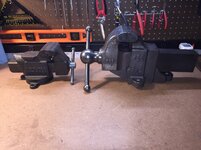
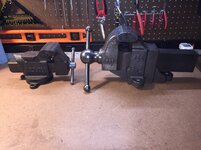
I have recently stripped the paint and rust from a 1938 Rock Island 593 4” vise in my electrolysis tank. When comparing it to a Columbian D43 1/2 I did the same thing with about a year ago, the bare cast iron of the two vises seems to be different. The Rock Island being much lighter and shinier, vs the more dull and dark Columbian.

I was actually anticipating the bigger Rock Island would look similar to my Columbian because I assumed they would have been very similar cast iron underneath. Was this a wrong assumption? Is there something else that could cause the colors to vary so drastically?
896e43a7fa7ced07901cef1aca44c81d.jpg
 

Attachments

  • 896e43a7fa7ced07901cef1aca44c81d.jpg
    896e43a7fa7ced07901cef1aca44c81d.jpg
    596.9 KB · Views: 1
To avoid these ads, REGISTER NOW!

jakemac

Well-known member
Joined
May 21, 2013
Messages
9,035
Location
New England
I'm not a metallurgist, so I can't go into excruciating details.
But the simple explanation is that the term "cast iron" is a common term that umbrellas a category of formulated metals.

Neither of those vise's are cast iron. They're cast steel.
Every foundry may have had their own formula to achieve the strength and other traits they were looking for.
There are also different types of cast steel. They would have slightly different looks when cleaned to bare metal.
 
OP
P

pcar964

Active member
Joined
Apr 21, 2015
Messages
30
I'm not a metallurgist, so I can't go into excruciating details.
But the simple explanation is that the term "cast iron" is a common term that umbrellas a category of formulated metals.

Neither of those vise's are cast iron. They're cast steel.
Every foundry may have had their own formula to achieve the strength and other traits they were looking for.
There are also different types of cast steel. They would have slightly different looks when cleaned to bare metal.


That’s what I figured, a different formula between two different manufacturers. Still, I was surprised to see such a drastic difference. Doea anyone know what color the Rock Island would have been originally?
 
OP
P

pcar964

Active member
Joined
Apr 21, 2015
Messages
30
After the electrolysis and light wire wheel for remaining paint spots, both vises got the same treatment: a light coating of wd40 to prevent rust. I figured a minor patina of light rust would actually look fine so I don’t worry about it. I prefer the bare metal to paint since paint will inevitably be chipped.

(For the record the main screw and nut and all metal-metal contact is lubricated with lithium grease, not the wd40 which I just use on the body to inhibit rust)
 
OP
P

pcar964

Active member
Joined
Apr 21, 2015
Messages
30
Sounds like just a combination of things. Steel type, quality of casting, rust, oxidised WD40 etc.


That’s probably right. I’ll leave the Rock Island as is for a while and see if it darkens at all. Either way I think it’s fine.
 

Rileysan

Well-known member
Joined
Sep 11, 2015
Messages
4,298
Location
Milwaukie, Oregon
These are not made from cast steel, they are different formulations of cast iron. Columbian is rumored to have made their vises with ductile iron and I have no idea what recipe Rock Island used. The vast majority of vises are made with some formulation of gray iron.

I would like to take a vise into work and spark it in the spectrometer to find out what formulas they use, but it's not made for something that size, so I'd have ruin a vise by cutting off a piece that is small enough to fit into one of the machines. If someone would like to donate to that cause, I'll be happy to provide a spectrographic analysis.

Brian
 
To avoid these ads, REGISTER NOW!

Packard V8

Well-known member
Joined
Mar 16, 2009
Messages
7,380
Location
Spokane, WA
Neither of those vise's are cast iron. They're cast steel.
Jake is perty much right on.
T
hese are not made from cast steel, they are different formulations of cast iron.
Sorry jakemac and larry g, but have to agree with Rileysan X2, not true; cast steel is several times more expensive than cast iron. There have been cast steel vises, just not the common Columbian or Rock Island.

But yes, you are correct that cast iron varies greatly in composition. There's a variety known as "hard iron" with a nickel alloy that's used for rock crusher wear plates. Now that would make a helluva vise.

jack vines
 

Rileysan

Well-known member
Joined
Sep 11, 2015
Messages
4,298
Location
Milwaukie, Oregon
T
There's a variety known as "hard iron" with a nickel alloy that's used for rock crusher wear plates. Now that would make a helluva vise.

jack vines

This is funny ... This is exactly what the company I work for specializes in.

We have our own formulations of cast iron used for rock crushing and cement manufacturing, as well as manganese alloy steel castings for mining and rock crusing. I work directly with our chief metallurgist and will often pick his brain on subjects like this. I really want to make a manganese alloy steel anvil, but I'd have to pay our cost per pound to melt the stuff, because we pig and re-use the steel. Last time I asked, it was ~$7/lb.

Brian
 
OP
P

pcar964

Active member
Joined
Apr 21, 2015
Messages
30
Anyone know how to tell which cast iron is better/stronger by the color of the bare metal? :)
 

Maui

Well-known member
Joined
Sep 16, 2012
Messages
2,864
Location
Upstate NY
Nodular cast iron was first invented in 1942/1943 by a fellow named Keith Millis. It has superior ductility to gray cast iron due to the shape of the graphite that is present in the microstructure. In gray cast iron the graphite appears in the form of flakes. These flakes can take on a variety of sizes and shapes. In ductile cast iron the graphite appears in the form of nodules or spheres. One way to tell the two apart is to simply strike the part with a hammer. The gray cast iron part dampens sound very effectively and a hammer blow will usually result in a dull "thud" type of sound. The ductile iron is not as effective at dampening vibration, and will have a distinctly different sound when struck by a hammer.

For anyone interested in learning more about the properties of the different types of cast irons, you can read about it in Chapter 10 of the following book:

https://books.google.com/books/about/Metallurgy_for_the_Non_Metallurgist_Seco.html?id=o-YTN9aXAeIC

Maui
 

Carla

MEMBER EMERITUS
Joined
Nov 27, 2010
Messages
672
I have recently stripped the paint and rust from a 1938 Rock Island 593 4” vise in my electrolysis tank. When comparing it to a Columbian D43 1/2 I did the same thing with about a year ago, the bare cast iron of the two vises seems to be different. The Rock Island being much lighter and shinier, vs the more dull and dark Columbian.

I was actually anticipating the bigger Rock Island would look similar to my Columbian because I assumed they would have been very similar cast iron underneath. Was this a wrong assumption? Is there something else that could cause the colors to vary so drastically?
I'll offer you a theory to test, if I may.......

Its well known that immersion in a caustic bath will darken the surface of iron and steel parts. A hot caustic bath, such as the 'DuLite process', is commonly used to put a dark finish on many steel items, such as tools and firearms parts.

So......with reasonably similar parts, try immersing one part in a fresh caustic solution of a 'rich' water-to-caustic solution, and another for an equal length of time in a similar, but weaker, or partially spent, solution, and note the difference in the colour of the surfaces.

cheers

Carla
 
OP
P

pcar964

Active member
Joined
Apr 21, 2015
Messages
30
I'll offer you a theory to test, if I may.......


Its well known that immersion in a caustic bath will darken the surface of iron and steel parts. A hot caustic bath, such as the 'DuLite process', is commonly used to put a dark finish on many steel items, such as tools and firearms parts.


So......with reasonably similar parts, try immersing one part in a fresh caustic solution of a 'rich' water-to-caustic solution, and another for an equal length of time in a similar, but weaker, or partially spent, solution, and note the difference in the colour of the surfaces.


cheers


Carla


Perhaps I’m not understanding correctly, but wouldn’t that simply test the relative effect of two different strength caustic solutions? It would seem that to test two metals against each other you would want to put them through the same process and control for as many variables as possible. Which is sort of what has already been done in my case - I was just surprised to see such a difference in the color of the bare cast iron between these two vices.
 
Last edited:
To avoid these ads, REGISTER NOW!
Top Bottom