To avoid these ads, REGISTER NOW!

2x4 Garage Wall Insulation Ideas...

BlueHeart

Well-known member
Joined
Jan 2, 2017
Messages
165
Location
Traverse City
My wife and I just moved into our new house back in August and the list of projects that needed to be completed in the house has finally been reduced to a "manageable" length.

Due to the size and setback requirements of our property, I had to make size concessions to the garage in order to fit the required footprint and remain within our set budget.

The garage is still larger than the house :beer: with a 23x38 footprint with 9'8" sidewalls. It has one main door that is 18'x8' and on the back side is a service door and 9'x8' door for drive through access to the back yard.

One thing that I wish I would have changed in hindsight, but didn't realize it's implications at the time of design is the 2x4 walls on top of 6" wide concrete blocks.

I always intended on finishing the garage as my "work shop/ man castle. The wife can have the house!

So now I'm where I'm at today. Thanks to GJ, the entire garage pad, garage apron and sidewalk are set up for radiant heat with only the purchase of a boiler and circulating pumps needing to take place next year.

I've insulated the walls and ceiling temporarily in order to enjoy my space this winter. For the walls I purchased KF R13 fiberglass batts and for the drywalled ceiling I purchased both KF R19 batts and UF batts to go over top of the kraft faced batts. I say "temporarily" because I got the insulation insanely cheap and I'm a firm believer in "the more insulation, the better."

My house is insulated using spray foam in the finished basement and a spray foam/ spider hybrid on the main level. I had the insulator down spray the top plates and complete the attic insulation with R60 levels of cellulose.

In talking with the insulator, he suggested that I fir out the walls to 2x6 thickness and use the same insulation procedure for the garage as was used for the house.

I know that the spray foam will definitely be the best route to take in order to keep air infiltration and noise permeation to a minimum. What I'm struggling with is how to fir out the walls effectively with minimal waste.

Should I cut a 2x4 down to 2 inches? Or should I cut a 2x8 down to three 2" pieces? Or maybe just slap up a 2x4 on 24" centers? With the 1.5 inches that overhang the the concrete block, I could then place 1.5" foam board over the 4 inches of exposed concrete block.

I'm curious what everyone else's opinion is. Thanks for reading.:thumbup:
 
To avoid these ads, REGISTER NOW!

NUTTSGT

Super Moderator
Staff member
Joined
Sep 14, 2009
Messages
50,935
Location
Northern Central Ohio
When I redid the front room in our house, I had to rip off the plaster/lath and it created a problem when I tried to hang drywall. The finished hardwood floor were set away from the wall studs.

My cure was after a insulated the wall cavity, I ran 2x4s horizontally across the wall, filled the gap in with rigid foam and drywalled over that.
 

Voi

Well-known member
Joined
Oct 10, 2010
Messages
5,142
Location
Western South Dakota
Read up on Mooney walls. You run your strapping horizontally to reduce thermal bridging. That's what I would if you really want the deeper walls.

You could also build a double wall with the sill overhanging the block. The overhang could be equal to the thickness of foam you want to insulate your curb with.

I'd probably just do Mooney strapping.
 

dfiler2

Well-known member
Joined
Dec 15, 2014
Messages
2,858
Location
NW Minnesota
2x2 would probably be the most cost effective, you would only be at 5" total but I doubt the cost of the 1/2 " extra you'd get from ripping full 2" pieces would ever pay for itself.
 

Voi

Well-known member
Joined
Oct 10, 2010
Messages
5,142
Location
Western South Dakota
Voi suggestion of a mooney wall is what I would suggest as well. I have done it and it performs awesome with dense pack cellulose.

There has been a thread or two on building sites about spacing Mooney strapping off of walls with rigid foam for a better thermal break. OP could also consider this to make his interior wall covering flush with his block curb.

For example, 2x4 + 1/2" rigid foam spacers + 1 1/2" strapping + 1/2" drywall would equal his 6" curb.

Or if he wants foam over his curb then he could increase the depth of the foam spacers.

As I understand it the spacers only need to be as large as the junction between the vertical studs and horizontal strapping. Maybe continuous at the sill and top plates.

All of this really depends on how the OP wants to insulate the block curb and if he'd like his drywall or whatever to run continuously over that curb insulation.
 
OP
B

BlueHeart

Well-known member
Joined
Jan 2, 2017
Messages
165
Location
Traverse City
When I redid the front room in our house, I had to rip off the plaster/lath and it created a problem when I tried to hang drywall. The finished hardwood floor were set away from the wall studs.

My cure was after a insulated the wall cavity, I ran 2x4s horizontally across the wall, filled the gap in with rigid foam and drywalled over that.
Thanks, I never thought of running the firring horizontally.
Read up on Mooney walls. You run your strapping horizontally to reduce thermal bridging. That's what I would if you really want the deeper walls.

You could also build a double wall with the sill overhanging the block. The overhang could be equal to the thickness of foam you want to insulate your curb with.

I'd probably just do Mooney strapping.
What I thought was the way to go was the double wall. I'll look into the Mooney walls.

2x2 would probably be the most cost effective, you would only be at 5" total but I doubt the cost of the 1/2 " extra you'd get from ripping full 2" pieces would ever pay for itself.
I've thought about the 2x2 straps which are really only 1.5"x1.5" square. This would be the least amount of work, but also the least amount of gain. That's when I realize I would never be happy with taking the easy way out. If anything, I'm the guy who spends more and over builds everything. Why should this be any different?

Voi suggestion of a mooney wall is what I would suggest as well. I have done it and it performs awesome with dense pack cellulose.

There has been a thread or two on building sites about spacing Mooney strapping off of walls with rigid foam for a better thermal break. OP could also consider this to make his interior wall covering flush with his block curb.

For example, 2x4 + 1/2" rigid foam spacers + 1 1/2" strapping + 1/2" drywall would equal his 6" curb.

Or if he wants foam over his curb then he could increase the depth of the foam spacers.

As I understand it the spacers only need to be as large as the junction between the vertical studs and horizontal strapping. Maybe continuous at the sill and top plates.

All of this really depends on how the OP wants to insulate the block curb and if he'd like his drywall or whatever to run continuously over that curb insulation.

While you mentioned some great ideas, would you still do that with spray foam? I don't think I would need to with spray foam blocking any chance of air seepage. As far as the thermal bridging, I think that by placing the "2nd wall" studs on 24" centers that it would eliminate most of the bridging no?
 

Voi

Well-known member
Joined
Oct 10, 2010
Messages
5,142
Location
Western South Dakota
While you mentioned some great ideas, would you still do that with spray foam? I don't think I would need to with spray foam blocking any chance of air seepage.

I actually think if one is spending the money on spray foam then it's silly not to also address thermal bridging. So yes, I'd still do this with spray foam, especially since you're thinking about increase the wall depth anyways. Address thermal bridging isn't always easy in a remodel or retrofit where window planes and jam depths are set but in a new construction garage it shouldn't be as big of a deal.

Basically if one is thinking about furring out an exterior wall I think it's best to run that strapping horizontally.

As far as the thermal bridging, I think that by placing the "2nd wall" studs on 24" centers that it would eliminate most of the bridging no?

As I understand double walls they are spaced apart so none of the framing is touching, including top/bottom plates, so stud spacing shouldn't matter. But studs are sometimes also staggered or spaced differently from the exterior wall.

I'd run the numbers on the amount of material needed for a double wall on 24" centers vs Mooney strapping. I think you'd be time and money ahead on the Mooney wall. But also think about hanging cabinets, etc. on both options.
 

Tj-gord

Active member
Joined
Jan 26, 2017
Messages
26
Location
Northern alberta
A neighbour of mine had the same problem, he decided to batt insulate the studs, poly, then brick 2 inch rigid foam insulation. Drywalled after using longer screws.
 
OP
B

BlueHeart

Well-known member
Joined
Jan 2, 2017
Messages
165
Location
Traverse City
I actually think if one is spending the money on spray foam then it's silly not to also address thermal bridging. So yes, I'd still do this with spray foam, especially since you're thinking about increase the wall depth anyways. Address thermal bridging isn't always easy in a remodel or retrofit where window planes and jam depths are set but in a new construction garage it shouldn't be as big of a deal.

Basically if one is thinking about furring out an exterior wall I think it's best to run that strapping horizontally.


As I understand double walls they are spaced apart so none of the framing is touching, including top/bottom plates, so stud spacing shouldn't matter. But studs are sometimes also staggered or spaced differently from the exterior wall.

I'd run the numbers on the amount of material needed for a double wall on 24" centers vs Mooney strapping. I think you'd be time and money ahead on the Mooney wall. But also think about hanging cabinets, etc. on both options.
Yes, I should have mentioned that there would be "spacing" between the double wall. Whether it's done using Foamular board or air with the spray foam contractor filling the space between. Hopefully later today I can read up on the Mooney walls.
I do have time on my side to run the figures on the difference too.
 
OP
B

BlueHeart

Well-known member
Joined
Jan 2, 2017
Messages
165
Location
Traverse City
A neighbour of mine had the same problem, he decided to batt insulate the studs, poly, then brick 2 inch rigid foam insulation. Drywalled after using longer screws.

I guess I'm not following what you are saying? I understand the batts going in 1st, but isn't the poly another version of the rigid foam?
I plan on covering the insulation in 1/2 inch or thicker plywood for ease of attaching any shelving, cabinets or similar.
 

Firebrick43

Well-known member
Joined
May 12, 2015
Messages
14,033
Location
West central Indiana
If your willing to loose more space and spend more money then go with a double wall. It will perform better than a mooney wall due to additional thickness. I wouldn't go 24" however. I would just offset the studs 8" from the original wall and do 16" centers. I did this on two wood walls in my icf build that are sort of exterior. The mooney wall is a better bang for the buck and you don't loose as much space, and is still pretty good performance.

I am personally not a spray foam fan. To expensive, and not very servicable if repair in the future is required. In my mooney wall I did dense pack cellulose and in my double wall(house still under construction) I am putting 2" xps in between the studs and either wet spray or dense pack again.
 
OP
B

BlueHeart

Well-known member
Joined
Jan 2, 2017
Messages
165
Location
Traverse City
If your willing to loose more space and spend more money then go with a double wall. It will perform better than a mooney wall due to additional thickness. I wouldn't go 24" however. I would just offset the studs 8" from the original wall and do 16" centers. I did this on two wood walls in my icf build that are sort of exterior. The mooney wall is a better bang for the buck and you don't loose as much space, and is still pretty good performance.

I am personally not a spray foam fan. To expensive, and not very servicable if repair in the future is required. In my mooney wall I did dense pack cellulose and in my double wall(house still under construction) I am putting 2" xps in between the studs and either wet spray or dense pack again.

Thanks for the suggestions. The garage will be used for parking our vehicles in the front and the other half will be my work shop/man castle/toy and lawn equipment storage for now. Eventually I would like to build a detached building that I can use for off season storage of tools, equipment and toys PLUS potentially the location of the Boiler (that will serve the garage and heated concrete apron and sidewalk), a sauna and small homemade hot tub for the wife.
The whole reason for the above paragraph is that I don't think that losing a few inches on each wall will be detrimental.
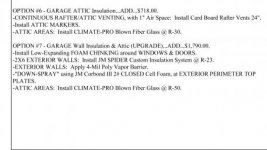
My spray foam contractor quoted me $1790 to insulate.
 
Last edited:
OP
B

BlueHeart

Well-known member
Joined
Jan 2, 2017
Messages
165
Location
Traverse City
Here's a screenshot of the quote.
 

Attachments

  • Screenshot_2017-11-25-15-48-02.jpg
    Screenshot_2017-11-25-15-48-02.jpg
    22.6 KB · Views: 28
Last edited:

terabitdan

Well-known member
Joined
Jul 16, 2016
Messages
152
JM Spider does not look like spray foam at all. Closed cell spray foam is about R6.8 per inch. Using spray foam you would get R20 in the 2x4 walls. They are using blown in fiberglass.

If your going to put up plywood anyway, don’t bother with the double or Mooney walls. Get the JM Spider blown in your 2x4 walls and then add 2” of XPS or Polyiso, then add your plywood using long screws or nails into the existing studs. You’ll get no thermal bridging, easy install, for less money.

XPS runs less than $1/sq ft for 2” R10.


Sent from my iPhone using Tapatalk
 
OP
B

BlueHeart

Well-known member
Joined
Jan 2, 2017
Messages
165
Location
Traverse City
JM Spider does not look like spray foam at all. Closed cell spray foam is about R6.8 per inch. Using spray foam you would get R20 in the 2x4 walls. They are using blown in fiberglass.

If your going to put up plywood anyway, don’t bother with the double or Mooney walls. Get the JM Spider blown in your 2x4 walls and then add 2” of XPS or Polyiso, then add your plywood using long screws or nails into the existing studs. You’ll get no thermal bridging, easy install, for less money.

XPS runs less than $1/sq ft for 2” R10.


Sent from my iPhone using Tapatalk

I see that you are correct about the wall insulation. I will talk to him again about updating the quote for the walls. If I decide to go the route of the Spider in the 2x4 wall and 2" XPS, do I still need a vapor barrier over the foam board? I don't think so, but just want confirmation.
 
To avoid these ads, REGISTER NOW!

stm317

Well-known member
Joined
Aug 8, 2017
Messages
1,339
I'd fur out the studs to the desired depth, and then flash/batt the walls with a foam/ fiberglass combo. An inch or 2 of spray foam will seal everything up, and then you reuse the existing insulation on top.

Since closed cell spray foam gets really expensive, Rigid foam boards properly sealed could be used in place of spray foam, and would allow you to DIY this and save a ton of cash. A 2 inch thick polyiso foam board is around R12 and your current R13 fiberglass on top of that would give you a noticeably higher R value than the dense pack fiberglass in your quote.
 
Last edited:
OP
B

BlueHeart

Well-known member
Joined
Jan 2, 2017
Messages
165
Location
Traverse City
I'd fur out the studs to the desired depth, and then flash/batt the walls with a foam/ fiberglass combo. An inch or 2 of spray foam will seal everything up, and then you reuse the existing insulation on top.

Since closed cell spray foam gets really expensive, Rigid foam boards properly sealed could be used in place of spray foam, and would allow you to DIY this and save a ton of cash. A 2 inch thick polyiso foam board is around R12 and your current R13 fiberglass on top of that would give you a noticeably higher R value than the dense pack fiberglass in your quote.

The dense pack in the quote equates to R23 according to JM. Polyiso is known to loose the R value over time and especially in cold climates (which I live in). XPS is R10 so I would be about the same R value without the cost of firring out the 2nd wall. Using the flash and Spider hybrid method equates to a higher R value of R28(give or take a point), but still needing to fir out the walls.

If the sole deciding factor was cost, the decision would be made. With the ever increasing cost of gas and electric, I keep thinking about the initial cost versus ROI and potentially needing to "redo" in the future for better heat retention.

I did pay more for better insulated garage doors yet the builder used multiple jack studs for each header over the non-weight bearing gable ends making it impossible to properly insulate the gable walls. Of course we're talking a 18x8 door on a 23 ft wall.:wtf:
 
OP
B

BlueHeart

Well-known member
Joined
Jan 2, 2017
Messages
165
Location
Traverse City
The other gable wall has a 9x8 garage door and a 3ft service door, but in between the doors is a solid wall of 2x4s.:wtf:
 

Firebrick43

Well-known member
Joined
May 12, 2015
Messages
14,033
Location
West central Indiana
I would do some research on super insulated wall cold sheathing.

Building scientist are aurguing about foam sheathing and how much is need to keep the sheathing moisture levels down(due to the sheathing being cold and in the dew point). There is a lot of information and some of it is contradicts other information but no one recommends putting foam,spray or sheet, any where but the outside side of the wall. Putting foam on the inside of a super insulated wall is a sure way to have issues.

Now before you guys get your ******* in a bunch this is foam in a super insulated wall. Foil faced 1/2" polyiso on the inside of of a 2x4 wall is of little consequence

Also, where ever you put the foam that is all the air barrier you need. Adding another air barrier (such as visqueen) is a sure way of causing moisture issues
 
Last edited:

stm317

Well-known member
Joined
Aug 8, 2017
Messages
1,339
If you're going to do rigid foam as well as the blown in, then you're right. But I didn't see that mentioned anywhere. Trashing the R13 seems expensive and wasteful, but I don't see a problem chasing a bit higher R value. It's your money and your building.

Just so you know, XPS can lose R value over time as well, and since it's not commonly faced with a vapor barrier, that thermal drift can actually happen faster than it would with faced polyiso. Atleast according to this article:

http://www.greenbuildingadvisor.com/articles/dept/musings/thermal-drift-polyiso-and-xps

This quick rundown of differences in rigid foam has been helpful for me in the past as well:

http://www.finehomebuilding.com/2009/05/01/which-rigid-insulation-should-i-choose
 
OP
B

BlueHeart

Well-known member
Joined
Jan 2, 2017
Messages
165
Location
Traverse City
If you're going to do rigid foam as well as the blown in, then you're right. But I didn't see that mentioned anywhere. Trashing the R13 seems expensive and wasteful, but I don't see a problem chasing a bit higher R value. It's your money and your building.

Just so you know, XPS can lose R value over time as well, and since it's not commonly faced with a vapor barrier, that thermal drift can actually happen faster than it would with faced polyiso. Atleast according to this article:

http://www.greenbuildingadvisor.com/articles/dept/musings/thermal-drift-polyiso-and-xps

This quick rundown of differences in rigid foam has been helpful for me in the past as well:

http://www.finehomebuilding.com/2009/05/01/which-rigid-insulation-should-i-choose

I only have a phone to post with, so please bear with me. My mind goes a lot faster than my thumbs.:beer:

I was thinking the way I would prefer would be spray foam of at least 1 1/2 to 2 inches, then dense pack spider fiberglass to the edge of a firred out 2x6 wall. This is how my house is (except the walls were already 2x6). What was suggested earlier was to have the spider insulation blown in or continue with the KF R13 batts, then place 2" foam directly over the 2x4 wall and side it with plywood. This option would be the same thickness as a 2x6 wall with an R value similar to a spider insulated 2x6 wall with a vapor barrier placed over it. Except using the 2" foam board wouldn't require the extra lumber.

As far as "trashing" the R13 batts, I have zero thoughts of doing that. I have a good friend who will be insulating his garage in the spring and I will sell him all the insulation I already purchased for a couple hundred bucks or so. I bought 17 rolls of R13 for $85 and I have 3 rolls that weren't touched.
The R19 batts I bought cost $150 for the kraft faced batts and another $170 for the unfaced batts.
 
Last edited:

terabitdan

Well-known member
Joined
Jul 16, 2016
Messages
152
What is the exterior of your garage? Based on the quote including vapor barrier I assume there is no building wrap. The building needs to be able to dry to either the inside or outside. Firebrick is right, if you add foam inside don’t use the vapor barrier on the outside.


Sent from my iPhone using Tapatalk
 
OP
B

BlueHeart

Well-known member
Joined
Jan 2, 2017
Messages
165
Location
Traverse City
What is the exterior of your garage? Based on the quote including vapor barrier I assume there is no building wrap. The building needs to be able to dry to either the inside or outside. Firebrick is right, if you add foam inside don’t use the vapor barrier on the outside.


Sent from my iPhone using Tapatalk

It does have a Tyvek house wrap underneath the siding. I may have read FireBrick's post wrong then, I took it as "if you use the foam board insulation, it's redundant to place visqueen (plastic) over the foam board."
Then again, maybe I'm misunderstanding your post. I know that if I have spray foam placed in the wall cavity, I don't want to put plastic up before covering with plywood or drywall.
The Tyvek house wrap is designed to allow the house to breathe yet slow the intrusion of moisture. Kinda like Gore-tex for the house.
 

Attachments

  • 20170222_175517.jpg
    20170222_175517.jpg
    153.6 KB · Views: 17
Last edited:

Firebrick43

Well-known member
Joined
May 12, 2015
Messages
14,033
Location
West central Indiana
I only have a phone to post with, so please bear with me. My mind goes a lot faster than my thumbs.:beer:

I was thinking the way I would prefer would be spray foam of at least 1 1/2 to 2 inches, then dense pack spider fiberglass to the edge of a firred out 2x6 wall. This is how my house is (except the walls were already 2x6). What was suggested earlier was to have the spider insulation blown in or continue with the KF R13 batts, then place 2" foam directly over the 2x4 wall and side it with plywood. This option would be the same thickness as a 2x6 wall with an R value similar to a spider insulated 2x6 wall with a vapor barrier placed over it. Except using the 2" foam board wouldn't require the extra lumber.

As far as "trashing" the R13 batts, I have zero thoughts of doing that. I have a good friend who will be insulating his garage in the spring and I will sell him all the insulation I already purchased for a couple hundred bucks or so. I bought 17 rolls of R13 for $85 and I have 3 rolls that weren't touched.
The R19 batts I bought cost $150 for the kraft faced batts and another $170 for the unfaced batts.

I didn't do a good job explaining things maybe. NEVER, NEVER, NEVER put solid foam of any type on the interior side(as in over the studs suggested by others) of a "SUPER insulated" wall. It causes moisture damage to the ply or OSB exterior sheathing.

Significant thickness of foam only goes against the sheathing, ideally exterior but directly against the interior side of the ply/OSB is ok
This means closed cell spray foam or xps/eps/polyiso cut and inserted between studs and seal the edges with a foam gun. Open cell foam should not go against the ply/OSB.

If you use ANY closed cell foam do NOT use another vapor barrier such as visqueen.

Do you have continuous exterior sheathing. Type? What type of siding? Hopefully vinyl? If wood/hardieplank/smart side I hope there is a rainscreen but I doubt it if they used tyvek.
 
OP
B

BlueHeart

Well-known member
Joined
Jan 2, 2017
Messages
165
Location
Traverse City
I didn't do a good job explaining things maybe. NEVER, NEVER, NEVER put solid foam of any type on the interior side(as in over the studs suggested by others) of a "SUPER insulated" wall. It causes moisture damage to the ply or OSB exterior sheathing.

Significant thickness of foam only goes against the sheathing, ideally exterior but directly against the interior side of the ply/OSB is ok
This means closed cell spray foam or xps/eps/polyiso cut and inserted between studs and seal the edges with a foam gun. Open cell foam should not go against the ply/OSB.

If you use ANY closed cell foam do NOT use another vapor barrier such as visqueen.

Do you have continuous exterior sheathing. Type? What type of siding? Hopefully vinyl? If wood/hardieplank/smart side I hope there is a rainscreen but I doubt it if they used tyvek.

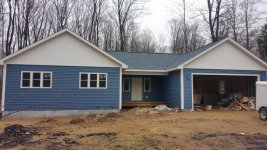
Ok that makes sense to me and actually I thought it was common sense. The house is vinyl sided and the sheathing is OSB.
 

Attachments

  • 20170325_121303.jpg
    20170325_121303.jpg
    149.6 KB · Views: 12
  • 20170112_180109.jpg
    20170112_180109.jpg
    147.3 KB · Views: 16

terabitdan

Well-known member
Joined
Jul 16, 2016
Messages
152
I didn't do a good job explaining things maybe. NEVER, NEVER, NEVER put solid foam of any type on the interior side(as in over the studs suggested by others) of a "SUPER insulated" wall. It causes moisture damage to the ply or OSB exterior sheathing.


Significant thickness of foam only goes against the sheathing, ideally exterior but directly against the interior side of the ply/OSB is ok

This means closed cell spray foam or xps/eps/polyiso cut and inserted between studs and seal the edges with a foam gun. Open cell foam should not go against the ply/OSB.


If you use ANY closed cell foam do NOT use another vapor barrier such as visqueen.


Do you have continuous exterior sheathing. Type? What type of siding? Hopefully vinyl? If wood/hardieplank/smart side I hope there is a rainscreen but I doubt it if they used tyvek.


I used greenbuildingadvisor.com for reference. Multiple articles and questions showing the use of foam board inside the studs.

http://www.greenbuildingadvisor.com...335/proper-wall-attach-rigid-foam-inside-wall

Or this article: http://www.finehomebuilding.com/2010/10/28/can-you-add-rigid-foam-insulation-on-the-inside-of-a-wall which also links to greenbuildingadvisor.com

In both cases XPS is preferred to Polyiso since is is vapor permeable.

The key is that there must be a way for the wall to dry, with XPS and no other vapor barrier the wall can dry to either side.

I am not an expert, but I do read or watch them on YouTube before posting. If you have references that show why its a bad practice please post them.


Sent from my iPhone using Tapatalk
 

Firebrick43

Well-known member
Joined
May 12, 2015
Messages
14,033
Location
West central Indiana
I tried to emphasize certain terms above with quotations

Adding "some" foam to an old 2x4 wall is inconsequential

As stated above I am talking about "super insulated" walls only. And the op wanting to build a double wall is approaching super insulated.

In a standard wall enough heat escapes to keep the entire wall most of the time above the dew point. A super insulated wall is thick enough that at some point in the wall the temp will hit the dew point and then any moisture will condense. If this point is in the cellulose/fiberglass or against the OSB you have rot/decay/mold/fungus issues. By placing closed cell foam in sufficient thickness you keep the wall warm enough that the dew point in the foam where (because it closed cell) can do little damage. The thicker the wall(hence better the insulation) the thicker the closed cell foam has to be to keep the wall above the dew point.

Now I don't want to make specific recommendations as the building scientist themselves can't come to an agreement but all of them would be horrified at putting foam (or vapor barrier) on the interior side of the studs of a super insulated wall.


But don't take my word for it, as stated before research (search)
"Super insulated cold sheathing".
https://www.google.com/search?ei=I2QaWqqrJY3i_Ab4-aK4CQ&sjs=4095&q=super+insulated+wall+cold+sheathing&oq=super+insulated+wall+cold+&gs_l=mobile-gws-serp.1.0.35i39j33i22i29i30l3j33i160.1393.3390..4552.......214.1020.0j5j1............mobile-gws-wiz-serp.......0j0j0i71j0i22i30.sczUdjADh2U%3D
 
Last edited:

stm317

Well-known member
Joined
Aug 8, 2017
Messages
1,339
I was thinking the way I would prefer would be spray foam of at least 1 1/2 to 2 inches, then dense pack spider fiberglass to the edge of a firred out 2x6 wall. This is how my house is (except the walls were already 2x6). What was suggested earlier was to have the spider insulation blown in or continue with the KF R13 batts, then place 2" foam directly over the 2x4 wall and side it with plywood. This option would be the same thickness as a 2x6 wall with an R value similar to a spider insulated 2x6 wall with a vapor barrier placed over it. Except using the 2" foam board wouldn't require the extra lumber.

I'm not a building scientist, but I think I understand some of what is going on here. Your original preference of 1.5-2 inches of foam, followed by blown fiberglass should be fine, provided the foam is closed cell (spray foam or polyiso panels). Other options get more complex, but the idea is that you only want 1 vapor barrier. Traditionally, the vapor barrier is placed on the warm side of the insulation. In cold climates, that's the inside of the wall system, and warm climates it goes on the outside. This vapor barrier can be either plastic sheeting, or some type of facing on the insulation. Spray foam would be non-traditional and shouldn't follow this rule.

Closed cell spray foam or rigid polyiso that is fully sealed on the outside of your wall would act as a vapor barrier, so you do not want a second vapor barrier. Any insulation inside of that would need to be unfaced.
XPS is semi permeable, and not a true vapor barrier, so using that in the walls would require an additional vapor barrier to the inside.
If you used permeable EPS rigid foam in the walls, then a vapor barrier would be needed inside.
 
Last edited:
OP
B

BlueHeart

Well-known member
Joined
Jan 2, 2017
Messages
165
Location
Traverse City
The problem with green building advisor is the cost of admission. With a membership charge of 150/year, I'll pass. I'm not a contractor, yet I can do anything a contractor can do. Sometimes far better than the average one. I suppose I could purchase a monthly subscription...
 
OP
B

BlueHeart

Well-known member
Joined
Jan 2, 2017
Messages
165
Location
Traverse City
I'm not a building scientist, but I think I understand some of what is going on here. Your original preference of 1.5-2 inches of foam, followed by blown fiberglass should be fine, provided the foam is closed cell (spray foam or polyiso panels). Other options get more complex, but the idea is that you only want 1 vapor barrier. Traditionally, the vapor barrier is placed on the warm side of the insulation. In cold climates, that's the inside of the wall system, and warm climates it goes on the outside. This vapor barrier can be either plastic sheeting, or some type of facing on the insulation.

Closed cell spray foam or rigid polyiso that is fully sealed on the outside of your wall would act as a vapor barrier, so you do not want a second vapor barrier. Any insulation inside of that would need to be unfaced.
XPS is semi permeable, and not a true vapor barrier, so using that in the walls would require an additional vapor barrier to the inside.
If you used permeable EPS rigid foam in the walls, then a vapor barrier would be needed inside.

Yes, this is my intention, if not "super insulated". I want to do this once and do it to the highest standards known at this time, within reason. I'm not going to use aero gel as an example of going too far.
I wouldn't even ponder the use of open cell foam spray or board.
 
OP
B

BlueHeart

Well-known member
Joined
Jan 2, 2017
Messages
165
Location
Traverse City
In a way, I've kinda answered my question for this thread. I'm pretty sure I will be adding 2x4s to the inside of the existing wall which will give me a wall cavity 7 inches thick.

The questions that are still there are:

  • Do I place the new wall on 24 inch centers to not only offset the two walls, but to cut down on lumber costs?
  • Should I stay with studs 16 inch on center, but offset 8 inches?
  • Are there other ways to frame the second wall?
  • Do I insulate the exposed concrete block (4 inches from the top of the concrete pad to the bottom plate of the wall) with foam board?
  • Do I stop the plywood at the concrete block, take it to the floor or change from plywood to green wood?
 
Last edited:

Voi

Well-known member
Joined
Oct 10, 2010
Messages
5,142
Location
Western South Dakota
I didn't do a good job explaining things maybe. NEVER, NEVER, NEVER put solid foam of any type on the interior side(as in over the studs suggested by others).

Ok that makes sense to me and actually I thought it was common sense.

In your reply in post 20 it sounded like you were considering a continuous layer of foam on the interior. I'm glad to hear that's not the case. I have read the argument that interior rigid foam might be acceptable in an occasionally heated garage but I wouldn't do it.

To be clear, my suggestion of using rigid foam spacers on a Mooney wall is just small blocks, say 2" x 4" at each junction where the horizontal strapping attaches to the vertical studs. In this way drying occurs the same as in a regular wall.

However, as wall thickness goes up there is still the issue of the sheathing temperature possibly being too cold. I would search around for free articles or forum posts on GBA about where to put moisture barrier, if any, in a double wall (assuming you go that route) for your climate zone. BTW, I agree with you about paying for GBA membership.

If you zero in on a choice or two I would recommend posting (for free) on their forum and see what their advice is for your climate zone.
 

Firebrick43

Well-known member
Joined
May 12, 2015
Messages
14,033
Location
West central Indiana
In a way, I've kinda answered my question for this thread. I'm pretty sure I will be adding 2x4s to the inside of the existing wall which will give me a wall cavity 7 inches thick.

The questions that are still there are:

  • Do I place the new wall on 24 inch centers to not only offset the two walls, but to cut down on lumber costs?
  • Should I stay with studs 16 inch on center, but offset 8 inches?
  • Are there other ways to frame the second wall?
  • Do I insulate the exposed concrete block (4 inches from the top of the concrete pad to the bottom plate of the wall) with foam board?
  • Do I stop the plywood at the concrete block, take it to the floor or change from plywood to green wood?

I would do 16 inches, for strength to hang things and keep the ply from curling and looking wavy.

I would do the foam on the block as well, stopping the ply at it. To cover the foam I would use synthetic stucco with a double (or even triple) layer of fiberglass mesh unless you can find the heavy 14oz mesh. Really damage resistant if you do.
 

yeldogt

Well-known member
Joined
Jan 2, 2012
Messages
18,184
Why not just use more closed cell foam and be done with it -- keep the 2x4 walls ? Why go to all the expense and trouble of furring it out ?

KISS .....

Yes -- 2x6 walls would have allowed an easy hybrid application -- but the cost and time of adding the furring and doing the two part insulation should be folded back into the cost of more foam. It's a better way to go. Thermal bridging is a minor issue .. very minor through 3.5 inches of wood and 5/8 of drywall.

GBA is great for an interesting read -- but, they have been incorrect many times over the years. They love all the outside rigid foam and sealed sheathing products .. I think it's going to be a big disaster.

I guess if they fully embraced spray foam (closed) -- they would be out of business.
 
To avoid these ads, REGISTER NOW!
Top Bottom