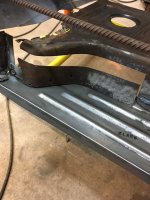
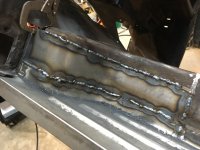
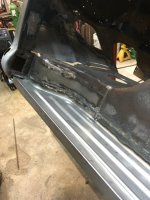
Andy
When I had my shops no one welded with the tig just the mig and we had very few failures and when we did it was always the techs lack of skill.
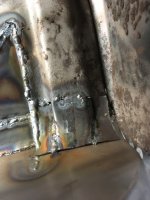
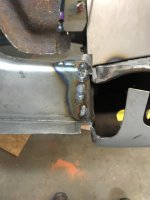
Your welds look as good as many of my techs welds did I'm impressed
Watching your progress makes me want to pull my cabover back in the shop and weld on it a bit.
Thanks for the kind words! Wish you lived closer, we'd pull the COE over to my place and have at it in your spare time. Ford, isn't it? I'd love to learn from you.
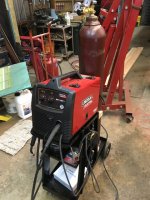
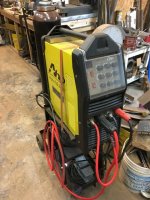
My experience was if that Lincoln clicks between power settings, You want to be closer to correct in the wire size than you need to be with my Miller which has a variable knob.
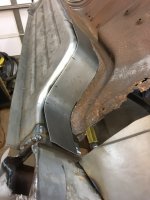
That Stude will be plenty solid when you are done I think.
Yes, the Lincoln has step power settings (voltage I believe) and variable wire feed. I don't know enough about MIG yet to understand when the setting is not ideal. The machine has a pretty good chart inside the box cover plate and I've just been going by that.
I hope it will be solid and with no rattling when my granddaughter gets it to drive. If she is still young enough to drive, that is.
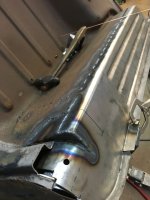
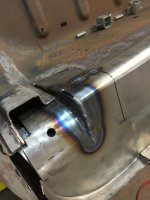
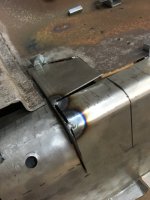
Welds are certainly looking much better! All it takes is a little practice. Welding in general is about 20 % know how and about 80% practice.
Ask 10 weldors and you'll get 12 opinions...so here's mine. For what you're doing, TIG doesnt have any real big advantage over gas welding. A lot of professional restorers actually prefer gas welding, it has a sort of self annealing that makes the weld easier to planish. Some even go so far as to say they wont MIG at all because the weld is so hard.I do think its a heck of a lot easier to spot weld with the MIG, especially if you're having to hold the piece with one hand.
The big reason I like MIG instead of stick for some jobs, is that there's no slag to clean up, and you dont have to keep changing rods. The biggest reason the rest of the world likes it, is there's less skill involved. Pop always said he could teach a one armed monkey to run a MIG gun.Of course, as you have discovered, its very easy to get a good looking weld that just lays on top of the surface and has no penetration.That is why you see so many shoddy repairs from backyard , self taught "welders". I have a nice 220V Miller MIG machine, and I use it a lot (well, I used to) but its not a do-all, end-all solution for everything...it has its place. So does gas welding.

Good Progress...carry on.

Thanks for the Coke.
Thanks for the kind words and great comments. I sure understand the variety of advice from experienced welders. When I was a welding engineer in an ASME Code shop we were subject to all the Section IX requirements but in reality we have very few procedures we used for most of the work. ASME welding procedures require you specify variables such as voltage, amperage, and travel speed. Some engineers expect the welders to follow the procedure. In my experience if the weld has to pass radiographic examination you best let the welder do it as he likes. Try telling a successful welder he is traveling too slow or too fast.

Welding rod, preheat, interpass temperature, and post heat are really the only variables which must be maintained so long as the radiograph is good. I've known some real crackerjack welders but all their experience was in pressure vessels and piping.
I thought I would have trouble controlling the heat and warpage with gas and wanted to get into TIG in large part to build up parts for repair machining. I might ought to try some panel welding with gas, though. Thanks for the comments on those processes.
I have Ed Barr's
Sheet Metal Fabrication book. It seems quite authoritative. He's almost my neighbor up in Kansas, looks like they have quite a school up there. But I need more of an explanation as to why you planish welds. I'm a little fuzzy there.
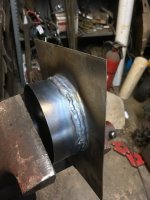
These TIG weld deposits don't seem to be very hard. And I haven't pounded on the MIG welds much. I really bought the MIG for structural, primarily the 16 gauge and heavier brackets on the Studebaker. It worked OK on the 18 gauge but as my son in law (Code welder, large pressure vessels) pointed out today, when you interrupt weld you start with no gas and finish with no gas so you get some rough looking welds. The MIG (at least mine) does not have a post flow like the TIG.
When I get to welds where I only have access to one side, like the door skins, and which will be visible, it seems I can get a better weld with less metal with TIG (or gas) but if I have good fitup maybe a series of MIG tacks will be better (and colder). Do I sound confused?
I like not changing rods with the MIG, but I also can't weld on thin stuff very good with stick. When we started putting in pipe root beads with MIG they were very wide root gaps (5/32" or more) on rolling welds. still TIG on root on all in position welds. Of course pipeliners stick the root and fill, all downhill. Given the choice on sticking a structural weld I'm always going to do downhill stringers.
But I digress. I've still got a lot of hidden welding to do on the Studebaker so I need to figure out what I want to use where. For patch panels it seems a TIG tack is quick and neat.
Please keep watching me and pass along your wisdom. And don't be frustrated if I seem to ignore you.

Thanks for the visit!!
Andy: my uncle had a 200+ acre farm, but the freeway cut it in half when i was maybe 6 or 8 years old that left him about 100 acres with about half on each side of the freeway. i'm guessing he had maybe about 100 dairy cows that he'd milk and have around crapping on the awesome river bank's sand where we all liked to go swimming. speaking of which ever sink your barefoot in what you thought was a hard cow pie (or buffalo chip is maybe what you call them) and have it be soft in the middle?
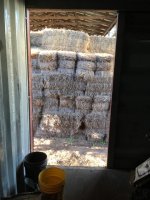
I probably caught and stacked more of those square type bales than was able to throw them and my other cousins liked driving the tractor which i think i only did a few times cause i liked faster vehicles at the time.
Welding and talk about welding is AWESOME so keep up the good work and I hope the door still fits and i'm guessing that it will.
i stopped for an ice tea (or sweet tea if you don't like regular ice tea) and didn't see any, but did notice you were running a bit low on cokes so when you feel better a refill of the machine might be in order.

Glad you know what handling square bales is all about!
Barefoot in the pasture when green manure oozes between your toes is just a reality of barefoot on the farm as a kid. They are cow patties or cow pies. Buffalo chips come from the American Bison and are not found native on my farm. Even so, if they are green I don't think they classify as "chips" yet. Apparently they made great cooking and heating fuel for the pioneers. Other than the crappy smell.
Spent the day doing chores, looking for antique dishes in the attic (don't even ask) and bull shopping. Hooked up the trailer and drove the five miles to the friend who has a good bull for sale. He was a big guy, maybe 2,500#. And when we were there he was upset with the company. Enough that I did not buy him. Great bull but his disposition could get you killed and I'm not finished with the Studebaker yet, so if I got killed by the new bull my granddaughter would be disappointed. And I don't want to disappoint her.
So we came home with an empty trailer. I decided to let my bull heal and keep using the neighbors bull until the neighbor figures out I'm liking his bull in my pasture. Reminds me of the story arguing with an inspector (or auditor) is like mud wrestling with a pig. After a while you start to realize the pig is enjoying it. When the neighbor figures out I'm actually happy to use his bull for free he may try to keep him home.
Also took my wife to the big city for lunch, bought a bit of feed for the calves, and stopped by Harbor Freight

Had a good day




 Thanks for stopping by.