Private Lugnutz
Well-known member
INTRODUCTION
As I reported on the Garage Sale thread a week or so ago, I found this coil of 1-inch diameter manila rope.
View media item 77675
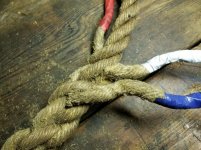
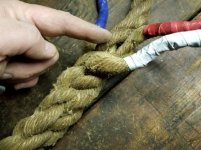
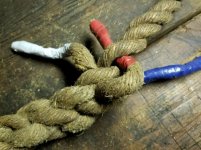
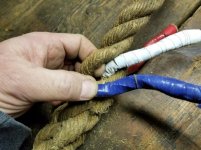
Whenever I find a coil of genuine 3-strand 1-inch diameter manila rope, I make as many WWII-spec tow ropes as I can out of it. If you’ve ever seen a WWII jeep at a car show or a parade, you’ve probably seen them wrapped around the front bumper. They were 20-22 feet in length, including the eyes spliced into each end. To make one, you need 25 feet of rope. All my tow ropes have splices with at least four tucks, sheared, seered, and whipped, usually with a strand of manila from the same rope, although I have also whipped them with 22 gauge wire.
Here’s one on my jeep.
View media item 76003
When I casually mentioned that I was going to make a few bumper tow ropes out of this coil, a couple guys on the Garage Sale thread asked me if I would do a DIY tutorial on splicing and whipping.
I was reluctant at first, but what the heck - this is it.
CAVEAT
I know there are many “How to…” YouTube videos and step-by-step process diagrams out there on the web for splicing and whipping. In fact, that’s the first thing I told the guys who asked me to do this. When I reviewed them, though, I discovered that most of them were working with much smaller rope, and usually nylon. Working with 1-inch hemp or manila rope, which is thick and not nearly as cooperative, is a whole ‘nother animal. I also found myself wanting to interject a helpful tip or two or three here and there about techniques I felt the other tutorials were missing.
I don’t profess to be an expert. I learned splicing and whipping – and all other types of basic marlinspike, from my dad, who was a deckhand in the Merchant Marines on the Great Lakes, the Mississippi, and open water before WWII, a quartermaster second class in the pilothouse on a destroyer ****** in the US Navy during WWII, and a pilot in the Coast Guard for a few years after WWII. He was 40 when I was born, and I was 40 when he died eighteen years ago and I still miss the heck out of him, especially at times like this.
View media item 78209
I know what he taught me and that’s what this tutorial will show. Nothing more, nothing less.
(Please hold off on replies until I'm done so as not to break up the flow.)
As I reported on the Garage Sale thread a week or so ago, I found this coil of 1-inch diameter manila rope.
View media item 77675
Whenever I find a coil of genuine 3-strand 1-inch diameter manila rope, I make as many WWII-spec tow ropes as I can out of it. If you’ve ever seen a WWII jeep at a car show or a parade, you’ve probably seen them wrapped around the front bumper. They were 20-22 feet in length, including the eyes spliced into each end. To make one, you need 25 feet of rope. All my tow ropes have splices with at least four tucks, sheared, seered, and whipped, usually with a strand of manila from the same rope, although I have also whipped them with 22 gauge wire.
Here’s one on my jeep.
View media item 76003
When I casually mentioned that I was going to make a few bumper tow ropes out of this coil, a couple guys on the Garage Sale thread asked me if I would do a DIY tutorial on splicing and whipping.
I was reluctant at first, but what the heck - this is it.
CAVEAT
I know there are many “How to…” YouTube videos and step-by-step process diagrams out there on the web for splicing and whipping. In fact, that’s the first thing I told the guys who asked me to do this. When I reviewed them, though, I discovered that most of them were working with much smaller rope, and usually nylon. Working with 1-inch hemp or manila rope, which is thick and not nearly as cooperative, is a whole ‘nother animal. I also found myself wanting to interject a helpful tip or two or three here and there about techniques I felt the other tutorials were missing.
I don’t profess to be an expert. I learned splicing and whipping – and all other types of basic marlinspike, from my dad, who was a deckhand in the Merchant Marines on the Great Lakes, the Mississippi, and open water before WWII, a quartermaster second class in the pilothouse on a destroyer ****** in the US Navy during WWII, and a pilot in the Coast Guard for a few years after WWII. He was 40 when I was born, and I was 40 when he died eighteen years ago and I still miss the heck out of him, especially at times like this.
View media item 78209
I know what he taught me and that’s what this tutorial will show. Nothing more, nothing less.
(Please hold off on replies until I'm done so as not to break up the flow.)