To avoid these ads, REGISTER NOW!

The VISES of Garage Journal

slothfryk

ALLIANCE MEMBER
Joined
Jul 10, 2017
Messages
32
Location
Camarillo, CA
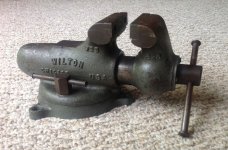
PeteA, I really appreciate the fully dismantled pics. I was saying earlier that I like that little mid-range vise because I felt it was designed to handle decent loads. I didn't know if the through-jaw slide. That square plate that the screw abuts is really the signature of this one design. The remainder of the Wilton 645 line that I have seen look like a dynamic jaw that is pressed onto the slide, limiting the forces it can sustain.

Your project looks likes it's coming along. Be sure to post more pics of the project.

Oh, and to all the other fellas, I really love the truly aged and heavier vises. I'm just stuck in a corner of the world without much history, or respect for such. Slim pickins and no spare time to get to the flea markets and traders, so I get hosed.

Sent from my Pixel using Tapatalk
 
To avoid these ads, REGISTER NOW!

Rileysan

Well-known member
Joined
Sep 11, 2015
Messages
4,298
Location
Milwaukie, Oregon
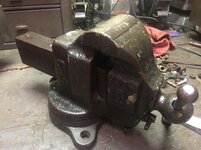
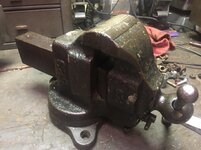
Athol no 523 3in jaw 27 pound quick release vise. The knurled knob rotates 90* and another lever locks the knurled knob under spring tension in place letting the nut to drop down keeping the nut from engaging the screw so the jaw may be quickly adjusted. And then by pressing up on the second lever it brings the nut back up and rotates the knurled knob back for the screw to engage and let the vise clamp. 8f9b8027bcae51fda2bdfd46c2c9d67f.jpgf17a00967be7821152e40ac40bfbcb97.jpge30592a336f8e5658a524f4f5ca2ca85.jpg05530353371e564739215afc911210fb.jpg6bfded5fe0e3fbacaef7ee55c4b3a0f0.jpg0896286b48548cdea95be51a2c8826a1.jpg4f7dba58399b719e268b3e5c3a45b78e.jpg


Sent from my iPhone using Tapatalk

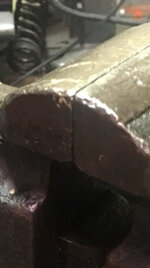
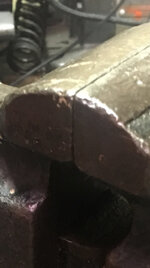
Very interesting vise, Rusty! I have the versions without the quick-release and love them (613 & 623). However, can you take a closer look at the jaws on the dynamic side? Your dynamic looks suspiciously like the replaceable jaw from a Parker. I'm wondering if you have a Frankenvise in your possession.

Brian
 

Attachments

  • f17a00967be7821152e40ac40bfbcb97.jpg
    f17a00967be7821152e40ac40bfbcb97.jpg
    117.3 KB · Views: 1
  • 8f9b8027bcae51fda2bdfd46c2c9d67f.jpg
    8f9b8027bcae51fda2bdfd46c2c9d67f.jpg
    117.4 KB · Views: 1
  • e30592a336f8e5658a524f4f5ca2ca85.jpg
    e30592a336f8e5658a524f4f5ca2ca85.jpg
    60.8 KB · Views: 1
  • 05530353371e564739215afc911210fb.jpg
    05530353371e564739215afc911210fb.jpg
    74.3 KB · Views: 0
  • 4f7dba58399b719e268b3e5c3a45b78e.jpg
    4f7dba58399b719e268b3e5c3a45b78e.jpg
    74 KB · Views: 0
  • 0896286b48548cdea95be51a2c8826a1.jpg
    0896286b48548cdea95be51a2c8826a1.jpg
    54.8 KB · Views: 0
  • 6bfded5fe0e3fbacaef7ee55c4b3a0f0.jpg
    6bfded5fe0e3fbacaef7ee55c4b3a0f0.jpg
    109.2 KB · Views: 2

KMScott

Well-known member
Joined
Feb 14, 2012
Messages
4,642
Location
Daufuskie Island, South Carolina
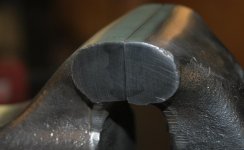
Here's a close-up of the jaws on my 623

Brian

Brian
How did they cast those guys in during the casting process? Maybe added a type of Braze? I have removed many cast jaw and replaced them with replaceable ones and when I got down to cast and the hard steel I could not see any different color bonding material like brass. Sure a mystery to me. The Reeds and Hollands had kind of the same shape on the back side of the jaws.
 

Attachments

  • Facing Hard Smooth Jaw Inserts (11).jpg
    Facing Hard Smooth Jaw Inserts (11).jpg
    98.7 KB · Views: 28
Last edited:

taumac

Well-known member
Joined
Aug 30, 2011
Messages
8,104
Location
Brooksville, Fl
To answer the Reed vise “R” question it stands for “Revised”. As for numbers on some Reeds like the “Reed 104” the information I got was this.

I use 4 in jaws for jaw width but the last number is jaw width.

104 fixed base, fixed jaw
204 swivel base, fixed jaw
304 fixed base, swivel jaw
404 swivel base, swivel jaw

Now numbers would still be correct if there was a “R” next to them it’s just a “revised” model.

a77b0b83e22e2b4aa8b9b319b6020160.jpg
 

Attachments

  • a77b0b83e22e2b4aa8b9b319b6020160.jpg
    a77b0b83e22e2b4aa8b9b319b6020160.jpg
    153.8 KB · Views: 3
Last edited:

rusty65

Well-known member
Joined
Mar 20, 2012
Messages
2,279
Location
Pekin,IL
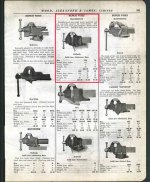
Drives: unfortunately the catalog page isn’t mine just a picture I found on the worthpoint website.

I found that joe striper on his Facebook page vice man he has a breakdown of the internals of the vise with multiple pictures and a really good description of how the whole mechanism works. I’m going to share just one of his photos because I’m to much of a wimp to take it apart like he did.

51d6f9c9dcd65b2ea2d02beed1919a6e.jpg
ab5d94ea0014d168e82f1d13a959fccc.jpg


Sent from my iPhone using Tapatalk
 

Attachments

  • ab5d94ea0014d168e82f1d13a959fccc.jpg
    ab5d94ea0014d168e82f1d13a959fccc.jpg
    483.2 KB · Views: 1
  • 51d6f9c9dcd65b2ea2d02beed1919a6e.jpg
    51d6f9c9dcd65b2ea2d02beed1919a6e.jpg
    798.9 KB · Views: 1

gman007

Well-known member
Joined
May 17, 2017
Messages
2,736
Location
West Michigan
To answer the Reed vise “R” question it stands for “Revised”. As for numbers on some Reeds like the “Reed 104” the information I got was this.

I use 4 in jaws for jaw width but the last number is jaw width.

104 fixed base, fixed jaw
204 swivel base, fixed jaw
404 swivel base, swivel jaw.

Now numbers would still be correct if there was a “R” next to them it’s just a “revised” model.

I could swear that I had seen models also with A, B and possibly C designations we well as R but now I can not find a single reference to these Googling, I must have been hallucinating (and that would NOT be the first time :) )
 

drivesitfar

Well-known member
Joined
Oct 23, 2013
Messages
36,034
Location
Pacific Northwest
Rusty: thanks for the details and more pics!!

Taumac: if it's as simple as that it sure makes sense so we'll see.

007: yep i'm sure i own or have seen A's after the model #, and the C's are for C series with PIPE JAWS, but not sure i've seen a B so keep researching and you are not dreaming or losing it.
 

taumac

Well-known member
Joined
Aug 30, 2011
Messages
8,104
Location
Brooksville, Fl
I could swear that I had seen models also with A, B and possibly C designations we well as R but now I can not find a single reference to these Googling, I must have been hallucinating (and that would NOT be the first time :) )


Well you are correct there are different models of Reed vises with like 3C or 4C. I’m not familiar with that series of Reeds.
 

taumac

Well-known member
Joined
Aug 30, 2011
Messages
8,104
Location
Brooksville, Fl
Rusty: thanks for the details and more pics!!


Taumac: if it's as simple as that it sure makes sense so we'll see.


007: yep i'm sure i own or have seen A's after the model #, and the C's are for C series with PIPE JAWS, but not sure i've seen a B so keep researching and you are not dreaming or losing it.


Well there is this ad.

41035008d389268183d9e484c132bebe.jpg

And this ad

f221ab3f7688ab139d7b0402c922379e.jpg

In the second ad for example it’s still say a 104 with a added swivel base kit.
 

Attachments

  • 41035008d389268183d9e484c132bebe.jpg
    41035008d389268183d9e484c132bebe.jpg
    153.8 KB · Views: 1
  • f221ab3f7688ab139d7b0402c922379e.jpg
    f221ab3f7688ab139d7b0402c922379e.jpg
    174.1 KB · Views: 1

drivesitfar

Well-known member
Joined
Oct 23, 2013
Messages
36,034
Location
Pacific Northwest
Taumac: you didn't need to send me a PM with these cause i usually end up reading all the posts on this thread at some time or another. thanks for the catalog pages and i hope that Reed's lettering system is as simple as that. you'll notice in the first add since you are now getting into the REEDS with the big LOGOS that there are N's (non swivel) and S's (swivel bases) and all their #'s start with a 1 and no 2's.

the REED C series vises might one of the best users made especially the ones pre 1950's that have the old REED LOOK and castings. the 3C and 4C's are beasts and unless you are putting transmissions or airplane parts in them a 1C or 2C might be all the vise you'd ever need and I think you might already own a REED so you know how nicely they are made.

here's my 2C and i forget how much it weighs, but it's stout for a 4.5 inch jaw vise.

ALL: so is this the last of R's on a REED or just the beginning cause i'm sure some of us want to know the date they changed and what the A stands for?

cheers
 

Attachments

  • WP_20170104_003[16366].jpg
    WP_20170104_003[16366].jpg
    106.2 KB · Views: 65

Rileysan

Well-known member
Joined
Sep 11, 2015
Messages
4,298
Location
Milwaukie, Oregon
Brian
How did they cast those guys in during the casting process? Maybe added a type of Braze? I have removed many cast jaw and replaced them with replaceable ones and when I got down to cast and the hard steel I could not see any different color bonding material like brass. Sure a mystery to me. The Reeds and Hollands had kind of the same shape on the back side of the jaws.

Metallurgically speaking, I don't know the answer.

Hardened steel jaws have a much higher melting point than the iron used in most vises, so there's no adhesion from the metals mixing, nor am I aware of any sort of flux being used in these castings.

If I were to make an educated guess, I would say that it has to do with the thermal expansion of the hardened steel jaws being greater than that of iron alloys. Gray iron, for example, has very little thermal expansion in a liquidus state, so a gray iron casting will change very little in size as it cools. However, a hardened steel jaw placed into the mold will grow in size as the temperature increases from the molten iron. As the casting cools, the hardened steel jaws will shrink and tighten around the iron casting. This would explain why cast-in harden jaws are always like the letter 'E' or similarly shaped.

If I were at work (I haven't been in over 3 months due to my surgery), I would have access to a photo library on my PC and I could show you how we place steel inserts into our molds to allow the machining of threaded holes in alloys that can't be machined. It's a fascinating process!

I hope this helps!

Brian
 
Last edited:

KMScott

Well-known member
Joined
Feb 14, 2012
Messages
4,642
Location
Daufuskie Island, South Carolina
Thanks Brian. Makes the flat jaws like what is used in the Rock Islands more puzzling unless there is a shape not seen in the side view. When I get to this restore on this RI 75 I will be watching for a odd shape behind the hard as hell jaw. I hope your therapy is going well and wish you a full recovery.
 

Attachments

  • Rock Island 75  5 inch jaws (3).jpg
    Rock Island 75 5 inch jaws (3).jpg
    126.3 KB · Views: 49

va.grouseman

Well-known member
Joined
Mar 26, 2011
Messages
4,965
Location
Southern-Central VA.
Previously posted by Drivesitfar.


ALL: enjoy your Friday and weekend. i'm not buying this one and wondered if anybody else owns a PERFECTION 31 or knows more about it. it looks kinda like an Athol or maybe it was a small company?


https://www.garagejournal.com/forum/attachment.php?attachmentid=714397&d=1513355638

https://www.garagejournal.com/forum/attachment.php?attachmentid=714398&d=1513355638
---------------------------------------------------------------------------------------------------------------------------


Here's one Drive.---Not to pretty but a fairly solid vise.---Don't have any info or history on them.---And someone else on here has one but I can't remember who it was.---Maybe they will chime in.
 

Attachments

  • 100_3768.jpg
    100_3768.jpg
    148.5 KB · Views: 41
  • 100_3767.jpg
    100_3767.jpg
    148.6 KB · Views: 60
  • 100_3776.jpg
    100_3776.jpg
    146.3 KB · Views: 38

akasrick

Well-known member
Joined
Apr 10, 2017
Messages
795
Location
south jersey
Thanks Brian. Makes the flat jaws like what is used in the Rock Islands more puzzling unless there is a shape not seen in the side view. When I get to this restore on this RI 75 I will be watching for a odd shape behind the hard as hell jaw. I hope your therapy is going well and wish you a full recovery.

Metallurgically speaking, I don't know the answer.

Hardened steel jaws have a much higher melting point than the iron used in most vises, so there's no adhesion from the metals mixing, nor am I aware of any sort of flux being used in these castings.

If I were to make an educated guess, I would say that it has to do with the thermal expansion of the hardened steel jaws being greater than that of iron alloys. Gray iron, for example, has very little thermal expansion in a liquidus state, so a gray iron casting will change very little in size as it cools. However, a hardened steel jaw placed into the mold will grow in size as the temperature increases from the molten iron. As the casting cools, the hardened steel jaws will shrink and tighten around the iron casting. This would explain why cast-in harden jaws are always like the letter 'E' or similarly shaped.

If I were at work (I haven't been in over 3 months due to my surgery), I would have access to a photo library on my PC and I could show you how we place steel inserts into our molds to allow the machining of threaded holes in alloys that can't be machined. It's a fascinating process!

I hope this helps!

Brian
Something that Hollands put out. I don't know where I saved it from.
Second page, 2nd. paragraph, They write of their process. Third paragraph I got hung up thinking they painted their letters, after I found some white paint after stripping mine, sorry no picture. Settled that they were talking about their machining and not talking about having females delicately hand painting the finish.

akasrick
 

Attachments

  • hollands%205.jpg
    hollands%205.jpg
    126.6 KB · Views: 75

KMScott

Well-known member
Joined
Feb 14, 2012
Messages
4,642
Location
Daufuskie Island, South Carolina
It seems they are talking about the spindle and nut more then how they added the hard jaw face. They mention that the jaws are faced and made to a special formula. I believe when they mention how the screw is steel and electrically welded might mean how they attach the spindle threads to the handle end. I believe most friction welded these spindles and did not cut the major thread diameter from a solid bar. The nuts are mentioned too as being a malleable steel. Thanks akasrick for adding these two pages.
 

Rileysan

Well-known member
Joined
Sep 11, 2015
Messages
4,298
Location
Milwaukie, Oregon
It seems they are talking about the spindle and nut more then how they added the hard jaw face. They mention that the jaws are faced and made to a special formula. I believe when they mention how the screw is steel and electrically welded might mean how they attach the spindle threads to the handle end. I believe most friction welded these spindles and did not cut the major thread diameter from a solid bar. The nuts are mentioned too as being a malleable steel. Thanks akasrick for adding these two pages.

It was an interesting read, but mostly just marketing lingo. Still, I liked it.

Manufacturing methods tend to be trade secrets, so I doubt we'll see something written by a vise manufacturer on how they create the bond between disparate ferrous alloys. I will ask our chief metallurgist what he thinks, the next time I check in at work (next week).

Brian
 

trijeff

Well-known member
Joined
Jan 21, 2015
Messages
1,359
Location
Northern Cali
Brian
How did they cast those guys in during the casting process? Maybe added a type of Braze? I have removed many cast jaw and replaced them with replaceable ones and when I got down to cast and the hard steel I could not see any different color bonding material like brass. Sure a mystery to me. The Reeds and Hollands had kind of the same shape on the back side of the jaws.
Just on one side of my Reed 104-1/2 R I see a wavy line of "something". You can see the straight jaw line and then look towards you (in this photo). It's colored nearly the same as both the jaw and the somewhat polished jaw tower on either sidenof it but, especially in person, you can see it is clearly something different. Like the flux or bonding material you guys are talking about. Not on the other jaw at all. Probably hard to pick up on in this photo.44acdffc8c5ab5af28c88ca0da76aed2.jpg
 

Attachments

  • 44acdffc8c5ab5af28c88ca0da76aed2.jpg
    44acdffc8c5ab5af28c88ca0da76aed2.jpg
    86.3 KB · Views: 2

akasrick

Well-known member
Joined
Apr 10, 2017
Messages
795
Location
south jersey
Just on one side of my Reed 104-1/2 R I see a wavy line of "something". You can see the straight jaw line and then look towards you (in this photo). It's colored nearly the same as both the jaw and the somewhat polished jaw tower on either sidenof it but, especially in person, you can see it is clearly something different. Like the flux or bonding material you guys are talking about. Not on the other jaw at all. Probably hard to pick up on in this photo.44acdffc8c5ab5af28c88ca0da76aed2.jpg

Again another Hollands ad, probably found on your site.

akasrick
 

Attachments

  • 2133568985_1925-ad-vises-record-parker-rae-keystone-radiovise-.jpg
    2133568985_1925-ad-vises-record-parker-rae-keystone-radiovise-.jpg
    120.1 KB · Views: 71
  • 44acdffc8c5ab5af28c88ca0da76aed2.jpg
    44acdffc8c5ab5af28c88ca0da76aed2.jpg
    82.3 KB · Views: 8

gman007

Well-known member
Joined
May 17, 2017
Messages
2,736
Location
West Michigan
Something that Hollands put out. I don't know where I saved it from.
Second page, 2nd. paragraph, They write of their process. Third paragraph I got hung up thinking they painted their letters, after I found some white paint after stripping mine, sorry no picture. Settled that they were talking about their machining and not talking about having females delicately hand painting the finish.

akasrick
Thanks for posting this, it gave me great pleasure reading these pages!

While I do not want to go on a tangent on the subject at hand here, I can not help but marvel at the fact that every information mentioned in this catalog from marketing, to manufacturing (be it not very detailed for obvious trade secret reason), the quality check, packaging , the financial and delivery terms, etc. can be found in some modern company's catalog today.

In other words many decades or even a century ago these smart cookies invented all these processes, methods and principles. Granted the technology of manufacturing and commerce is superior today but all the underlying principles were laid out so solidly by these forefathers that they still apply today! Hats off to these folks! :bowdown:

Sorry for the soap box speech, Now back to vises :lol:
 
Last edited:
To avoid these ads, REGISTER NOW!

gman007

Well-known member
Joined
May 17, 2017
Messages
2,736
Location
West Michigan
Metallurgically speaking, I don't know the answer.

Hardened steel jaws have a much higher melting point than the iron used in most vises, so there's no adhesion from the metals mixing, nor am I aware of any sort of flux being used in these castings.

If I were to make an educated guess, I would say that it has to do with the thermal expansion of the hardened steel jaws being greater than that of iron alloys. Gray iron, for example, has very little thermal expansion in a liquidus state, so a gray iron casting will change very little in size as it cools. However, a hardened steel jaw placed into the mold will grow in size as the temperature increases from the molten iron. As the casting cools, the hardened steel jaws will shrink and tighten around the iron casting. This would explain why cast-in harden jaws are always like the letter 'E' or similarly shaped.

If I were at work (I haven't been in over 3 months due to my surgery), I would have access to a photo library on my PC and I could show you how we place steel inserts into our molds to allow the machining of threaded holes in alloys that can't be machined. It's a fascinating process!

I hope this helps!

Brian

Could the hardened steel jaws be “forge welded” to cast iron vise like it is done in anvil manufacturing where the face plate is forge welded to cast anvil body?
 

BMR24

Well-known member
Joined
Oct 2, 2017
Messages
234
Location
Rocky Mountains Colorado
Could the hardened steel jaws be “forge welded” to cast iron vise like it is done in anvil manufacturing where the face plate is forge welded to cast anvil body?

I always thought that's how they did it, but wouldn't that and the cast in process not allow for heat treating of the jaws? Wouldn't the quench ( oil or air quench) cause the hot ductile iron to either crack or become white iron?
 

gman007

Well-known member
Joined
May 17, 2017
Messages
2,736
Location
West Michigan
I always thought that's how they did it, but wouldn't that and the cast in process not allow for heat treating of the jaws? Wouldn't the quench ( oil or air quench) cause the hot ductile iron to either crack or become white iron?

I was under the impression that for anvils the quenching and hardening of the face plate is done before forge weld (so there is no further quenching during forge weld process) but I could be wrong. Regardless the point I am trying to make is that however it is done for anvils (which we know works, the face plate stays hard and anvil body does not crack)
might have been done with these vise jaws.

Now if I was to speculate how exactly they do it for anvils (as I am do not know exactly), would it be possible that when anvil body is removed from cast but it is still red hot, to forge weld it to the plate which is heated hot enough but not too hot to loose its hardness by pressing them together under immense pressure to fuse?
 
Last edited:

Rileysan

Well-known member
Joined
Sep 11, 2015
Messages
4,298
Location
Milwaukie, Oregon
Forge welding would be highly unlikely on the E shaped jaws, but certainly a possibility for the flat jaws like Rock Island

Sent from my LGL41C using Tapatalk
 

CrotalusAtrox

Well-known member
Joined
Mar 5, 2016
Messages
796
Location
The Great Southwest
Cleaned up the 403.5 Reed didn’t need much but wanted to get it lubed up and some of the dirt off.
 

Attachments

  • 19431A86-9108-47E3-8145-75EB6B87BB0D.jpg
    19431A86-9108-47E3-8145-75EB6B87BB0D.jpg
    19.4 KB · Views: 103
  • 30160302-15CE-4AC1-8DF4-1D2DE28EDD11.jpg
    30160302-15CE-4AC1-8DF4-1D2DE28EDD11.jpg
    13.9 KB · Views: 77
  • 8C457806-AB2A-49A9-B77B-41414467FD08.jpg
    8C457806-AB2A-49A9-B77B-41414467FD08.jpg
    12.2 KB · Views: 75
  • B3F1E686-C6A9-4160-BE9D-DA1F90999CD7.jpg
    B3F1E686-C6A9-4160-BE9D-DA1F90999CD7.jpg
    16.7 KB · Views: 74
  • 99124E23-FE78-42D2-A532-1E35EF1D0ADE.jpg
    99124E23-FE78-42D2-A532-1E35EF1D0ADE.jpg
    17.5 KB · Views: 89

drivesitfar

Well-known member
Joined
Oct 23, 2013
Messages
36,034
Location
Pacific Northwest
CA: a vise almost begs you to buy them so they can spend time on your bench. WELL DONE!!

TJ: hard to say if that was an original stain or flux or ?? or one made by a previous user?

ALL: wasn't there a few pages posted either on this thread or maybe the vise repair 101 thread where REED was mentioning how they cast in their hardened jaws?
 

rusty65

Well-known member
Joined
Mar 20, 2012
Messages
2,279
Location
Pekin,IL
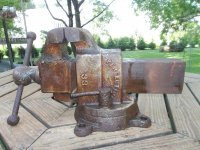
Two different Athol vises one is a model 728 with the ratchet hub and swivel jaw 3 1/2 in wide jaws and the other is a model 523 3in jaws. My guess is the model 523 dates from around the 1930s era and the model 728 I think is probably a 1920 era vise. 2f50c23c4ae54d84746118435d30291b.jpg


Sent from my iPhone using Tapatalk
 

Attachments

  • 2f50c23c4ae54d84746118435d30291b.jpg
    2f50c23c4ae54d84746118435d30291b.jpg
    808.6 KB · Views: 3
Joined
Dec 19, 2017
Messages
15
Location
Midwest
So I just snatched this vise from becoming brake rotors and was interested in knowing a little more about it. WELL... it landed me here in this thread and I have never been so excited about vise's. So here's my addition.

Chas Parker No. 984, 4" jaws, static mount.

It was in the bin with 6 other 3 1/2"-4" jaw Columbians, now after reading through this epic thread I regret not saving them all. The only reason I grabbed the Parker was because of the horn on the back of the anvil.
 

Attachments

  • IMG_20171219_125808_059.jpg
    IMG_20171219_125808_059.jpg
    136.5 KB · Views: 60
  • IMG_20171219_130027_727.jpg
    IMG_20171219_130027_727.jpg
    135.7 KB · Views: 48
  • IMG_20171219_125823_164.jpg
    IMG_20171219_125823_164.jpg
    137.3 KB · Views: 44

gman007

Well-known member
Joined
May 17, 2017
Messages
2,736
Location
West Michigan
So I just snatched this vise from becoming brake rotors and was interested in knowing a little more about it. WELL... it landed me here in this thread and I have never been so excited about vise's. So here's my addition.

Chas Parker No. 984, 4" jaws, static mount.

It was in the bin with 6 other 3 1/2"-4" jaw Columbians, now after reading through this epic thread I regret not saving them all. The only reason I grabbed the Parker was because of the horn on the back of the anvil.

derby
welcome to the vise nuts club! :lol:

Well you picked the best of the bunch and that is for sure a nice one, at 76 lb it is pretty stout one for a 4" vise.

Please make sure to find a large storage area for the rest of the vises that you are going to accumulate as you have now caught the bug and it is not something that can be easily cured :beer:
007

PS
Obviously you are not going to use the horn and anvil for anything as it is a vise and not to be used as an anvil right?
 
Last edited:

Shiftless

Well-known member
Joined
Mar 9, 2014
Messages
14,553
Location
East Bay SFO
This one followed me home this morning. Wasn't lucky enough to find it in a scrap bin though.
(but I did find a really old post mount Reed in a dumpster once...)

Model 825 with the 2 1/2 inch jaws in case you don't recognize it.

Fellow GJ member JZiggy was the first to alert me to this for sale on C/L the next town over.
The seller told me that there were 13 calls after me, some saying it was worth more money, but the guy was honorable and sold it to the first responder...ME!
Thanks again Ziggy :beer:
 

Attachments

  • image.jpg
    image.jpg
    149.3 KB · Views: 36
Last edited:

gman007

Well-known member
Joined
May 17, 2017
Messages
2,736
Location
West Michigan
This one followed me home this morning. Wasn't lucky enough to find it in a scrap bin though.
(but I did find a really old post mount Reed in a dumpster once...)

Model 825 with the 2 1/2 inch jaws in case you don't recognize it.

shift
Very nice! I might be loosing track but I could swear you already have baby and toddler wiltons, do you not? Stop hoarding them and leave some for rest of us :lol_hitti
007
 

Shiftless

Well-known member
Joined
Mar 9, 2014
Messages
14,553
Location
East Bay SFO
shift
Very nice! I might be loosing track but I could swear you already have baby and toddler wiltons, do you not? Stop hoarding them and leave some for rest of us :lol_hitti
007

Thanks 007:
The toddler was the missing one in my bullet collection. The baby 2 incher on a swivel base (not the Pow-R-Arm) has been on my shelf for some time now. My search for the 2 1/2 incher is now over. I doubt that I will ever stumble over a nicer example. Here is the GJ obligatory beer bottle for scale photo.
Although not shown, the end cap (painted) is still present!
 

Attachments

  • image.jpg
    image.jpg
    146.6 KB · Views: 48
Last edited:

trijeff

Well-known member
Joined
Jan 21, 2015
Messages
1,359
Location
Northern Cali
Good idea!
Right now I am working on additional shelving (None of us ever run out of shelf space do we? :evil: )
Maybe a Christmas family photo would be in order???
I have no idea what you are talking about ;)

93730533ca41b3f26da699e4bd4848f1.jpg
 

Attachments

  • 93730533ca41b3f26da699e4bd4848f1.jpg
    93730533ca41b3f26da699e4bd4848f1.jpg
    119.2 KB · Views: 0
To avoid these ads, REGISTER NOW!
Top Bottom