To avoid these ads, REGISTER NOW!

Wiring with 16 ga wire Celing fans

600SL

Well-known member
Joined
Apr 26, 2012
Messages
1,794
Location
Connecticut
I just purchased a ceiling fan for my shop. I read a section in the NEC 314.16(B)(1) exception for ceiling fans. I believe it states that I do not have to count conductors in a box for volume calculations if I use up to 4 #16's or smaller. So I would like to use #16 so I can fit everything into a 13 CU handy box.

My question is I cannot seem to find THHN in 16 ga so what are my alternatives and are they available in colors. I would like to run through EMT.

Also any good sources of supply.

Thanks John
 
To avoid these ads, REGISTER NOW!

American Locomotive

Well-known member
Joined
Jan 8, 2017
Messages
11,014
Location
Rhode Island
The smallest circuit breaker most (if not all) home/residential breaker panels have is 15A. #16 wire is not rated for 15 amps of current, which is why you cannot readily find it, or a 16 gauge NM either.
 

purplezr2

Well-known member
Joined
Jun 1, 2010
Messages
5,300
Location
Central MN
I just purchased a ceiling fan for my shop. I read a section in the NEC 314.16(B)(1) exception for ceiling fans. I believe it states that I do not have to count conductors in a box for volume calculations if I use up to 4 #16's or smaller. So I would like to use #16 so I can fit everything into a 13 CU handy box.

My question is I cannot seem to find THHN in 16 ga so what are my alternatives and are they available in colors. I would like to run through EMT.

Also any good sources of supply.

Thanks John

Is there any volume to the fan itself?
 

Bert_

Well-known member
Joined
Dec 24, 2016
Messages
9,777
Location
NW Iowa
I don't have my code book handy but I don't recall anything in that section that would allow you to use #16 for a branch circuit. #14 is generally the smallest size allowed for branch circuits, which is what your ceiling fans would fall under.

You can get #16 and #18 TFFN, which is similar to THHN, but again generally you can not use it for a branch circuit. It is usually used for control circuits or other low power controls.

The real question is why in the world do you want to use a handy box?!
 

pattenp

Well-known member
Joined
Jun 4, 2008
Messages
10,175
Location
Virginia - USA
The exception is for the fixture wires that are from the fan, not the circuit wires that provide power. As said the smallest circuit you can have is a 15A which is #14 wire.
 
OP
6

600SL

Well-known member
Joined
Apr 26, 2012
Messages
1,794
Location
Connecticut
The smallest circuit breaker most (if not all) home/residential breaker panels have is 15A. #16 wire is not rated for 15 amps of current, which is why you cannot readily find it, or a 16 gauge NM either.

That does make sense but then why is 16 ga and ceiling fans even mentioned if its not an option.
 

Norcal

Well-known member
Joined
Mar 16, 2008
Messages
13,770
Your not going to be able to use 16 AWG & be compliant, use a proper box as handy boxes are a POS at best, and the reason you can't find 16 THHN is because there is no such beast, the product is 16 gauge TFFN. 14 AWG is minimum for your application.
 

Bert_

Well-known member
Joined
Dec 24, 2016
Messages
9,777
Location
NW Iowa
That does make sense but then why is 16 ga and ceiling fans even mentioned if its not an option.

The section you are referencing is only talking about box fill, the rules for sizing wire are in another section. I'm guessing they are talking about the fixture wires coming out of the fan and when they must be counted for box fill, but like I said I don't have a code book handy.
 

pattenp

Well-known member
Joined
Jun 4, 2008
Messages
10,175
Location
Virginia - USA
The fan is not an issue. Its the switch box on the wall. Power comes in and 4 16 ga wires + ground go out.

You can't use #16 from the wall switch box to the ceiling box where the fan hangs. You need to use as a minimum #14 for the circuit, that includes the run from the switch box to the fan box. The only #16 allowed is the fixture wires that connect the fan to the circuit wires at the mounting location of the fan. Fixture wires are the wires that the manufacturer provide as part of the fan unit and are not to be extended and used beyond the mounting box.

The exception in 314.16(B)(1) makes no reference to fans.
 
Last edited:
OP
6

600SL

Well-known member
Joined
Apr 26, 2012
Messages
1,794
Location
Connecticut
The exception is for the fixture wires that are from the fan, not the circuit wires that provide power. As said the smallest circuit you can have is a 15A which is #14 wire.

In this case I will have two 12 ga + ground wires coming into a switch. Then four 16 ga wires + ground going from the switch to the fan. So does that count as coming from the fan or is it going to the fan? Do I meet the exception?

The wires on the fan are 18 ga. The fan current draw is 0.9A max.
 

Bert_

Well-known member
Joined
Dec 24, 2016
Messages
9,777
Location
NW Iowa
In this case I will have two 12 ga + ground wires coming into a switch. Then four 16 ga wires + ground going from the switch to the fan. So does that count as coming from the fan or is it going to the fan? Do I meet the exception?

The wires on the fan are 18 ga. The fan current draw is 0.9A max.

You can't use #16 for a branch circuit, doesn't matter what the fan draws. Listed products are often allowed to use smaller wires, but field wiring is NOT.

You must use #14 if on a 15A breaker or #12 on a 20A breaker. This is a simple branch circuit so NO EXCEPTIONS.
 
Last edited:
OP
6

600SL

Well-known member
Joined
Apr 26, 2012
Messages
1,794
Location
Connecticut
You can't use #16 from the wall switch box to the ceiling box where the fan hangs. You need to use as a minimum #14 for the circuit, that includes the run from the switch box to the fan box. The only #16 allowed is the fixture wires that connect the fan to the circuit wires at the mounting location of the fan. Fixture wires are the wires that the manufacturer provide as part of the fan unit and are not to be extended and used beyond the mounting box.

The exception in 314.16(B)(1) makes no reference to fans.

Thanks

So my take on this is that this exception applies only to the box the fan is mounted on.

Correct 314.16(B)(1) does not specifically mention fans. It was a fan sight that referred me to the 314.16(B)(1) exception.

I will need to make room for a 4" square box and proceed with 14 ga.

Now question Number 2

Power to the switch is coming off a 20Amp circuit. Does that mean I need to use 12ga wire for the four wires that feed the 0.9A fan?
 
Last edited:

pattenp

Well-known member
Joined
Jun 4, 2008
Messages
10,175
Location
Virginia - USA
Thanks

Now question Number 2

Power to the switch is coming off a 20Amp circuit. Does that mean I need to use 12ga wire.

Yes. a 20A circuit requires at least #12 Cu. That is the wire from the breaker to any outlet/box on that circuit.
 
OP
6

600SL

Well-known member
Joined
Apr 26, 2012
Messages
1,794
Location
Connecticut
Yes. a 20A circuit requires at least #12 Cu. That is the wire from the breaker to any outlet/box on that circuit.

Ah you ruined my day.

That means a whole new circuit or wire everything with 12 ga about 500 ft of 12 ga for all the fans I plan on installing.

Thanks for the help to all who contributed.

John
 

teamextreme

Well-known member
Joined
Aug 10, 2013
Messages
867
Location
Lakewood, CO
I will need to make room for a 4" square box and proceed with 14 ga.

This will be the best decision you make. Handy boxes, as mentioned above and in numerous other threads, are complete pieces of ****. They do not provide adequate room for just about anything, save a single pole switch and one pair of wires.

Nobody has mentioned this, and I couldn't tell if you are planning on hanging the fan from the handy box or if this is just a switch or junction box, but fans must be hung from approved ceiling fan hanger boxes, not HB's nor 4 squares.
 

Bluevista

Well-known member
Joined
Dec 13, 2017
Messages
86
Location
N.E. Ohio
Put in switched receptacles then connect 16 gauge appliance pigtails to the fans and plug them in a-la shoplights.
Problem solved.;)
 
OP
6

600SL

Well-known member
Joined
Apr 26, 2012
Messages
1,794
Location
Connecticut
This will be the best decision you make. Handy boxes, as mentioned above and in numerous other threads, are complete pieces of ****. They do not provide adequate room for just about anything, save a single pole switch and one pair of wires.

Nobody has mentioned this, and I couldn't tell if you are planning on hanging the fan from the handy box or if this is just a switch or junction box, but fans must be hung from approved ceiling fan hanger boxes, not HB's nor 4 squares.

I find handy boxes to be OK once you know what your getting into and realize there will be no add on's or power takeoffs, just like you say a single pole switch and a pair of wires.

Fan is mounted directly to a purlin. Box for connections will be to the side.
 
To avoid these ads, REGISTER NOW!

Bert_

Well-known member
Joined
Dec 24, 2016
Messages
9,777
Location
NW Iowa
I find handy boxes to be OK once you know what your getting into and realize there will be no add on's or power takeoffs, just like you say a single pole switch and a pair of wires.

Fan is mounted directly to a purlin. Box for connections will be to the side.

Got a pic / link for the fan? I haven't seen any that mount beside the box. A lot of the industrial fans you put a J bolt though the back of an oct. box and into a structural member.
 
OP
6

600SL

Well-known member
Joined
Apr 26, 2012
Messages
1,794
Location
Connecticut
Got a pic / link for the fan? I haven't seen any that mount beside the box. A lot of the industrial fans you put a J bolt though the back of an oct. box and into a structural member.

Temporarily connected for the moment. Plan is to mount box on side of purlin above fan.
 

Attachments

  • IMG_20171227_130430969_HDR[1].jpg
    IMG_20171227_130430969_HDR[1].jpg
    141.9 KB · Views: 38
  • IMG_20171227_214244531[1].jpg
    IMG_20171227_214244531[1].jpg
    145.8 KB · Views: 49

Bert_

Well-known member
Joined
Dec 24, 2016
Messages
9,777
Location
NW Iowa
Something like this is generally the way these fans are supposed to be mounted / wired. The J bolt goes though the box. But maybe your fan allows other methods since that looks like cord coming out of the downrod. Check the instructions to be sure.

27567374489_cdbb0bec03_z.jpg
 

teamextreme

Well-known member
Joined
Aug 10, 2013
Messages
867
Location
Lakewood, CO
I would mount a metal ceiling fan box direct to the purlin where you mounted the fan and mount the fan to the box. The way it's supposed to be connected. All connections and 16awg non-building wiring kept within the j-box. The only downside, if you consider as such since it's an unfinished surface, is the canopy won't be flush with the purlin.
 
OP
6

600SL

Well-known member
Joined
Apr 26, 2012
Messages
1,794
Location
Connecticut
Bert and extreamteam that is the way my instructions show. But my beam is at an angle. Box cant be mounted that way without 20° wedge.

Any code violations with running the wire to a separate box?
 

75gmck25

Well-known member
Joined
Jul 21, 2014
Messages
1,328
Location
Alexandria, VA
Most fan manufacturers offer a sloped ceiling adapter for their fans, so you can just mount the fan junction box parallel to the purlin and still have the fan hang down straight. Have you checked to see if there is one for your fan?

If there is no sloped ceiling adapter, I would just cut a piece of wood at the right 20 degree angle and screw/bolt it to the purlin so that you have a flat surface about 6"x6". Then screw/bolt a standard fan junction box to the wood. Paint the wood the same color as the purlin and it will become invisible.

Bruce
 

grounded-b

Well-known member
Joined
Oct 23, 2012
Messages
285
Location
Milwaukee, WI
Yes. If it's connected to a 20A circuit, then you MUST use a minimum of #12AWG wire for your branch circuit wiring. It does not matter the amp draw of the load.
 
OP
6

600SL

Well-known member
Joined
Apr 26, 2012
Messages
1,794
Location
Connecticut
Most fan manufacturers offer a sloped ceiling adapter for their fans, so you can just mount the fan junction box parallel to the purlin and still have the fan hang down straight. Have you checked to see if there is one for your fan?

If there is no sloped ceiling adapter, I would just cut a piece of wood at the right 20 degree angle and screw/bolt it to the purlin so that you have a flat surface about 6"x6". Then screw/bolt a standard fan junction box to the wood. Paint the wood the same color as the purlin and it will become invisible.

Bruce

There is a slope ceiling adapter but it really isn't made to mount to a purlin and it will cost about 4 in in height. Possibly put me below the 10' minimum and it is expensive.

Cutting the wedge is an option but the best I can do is a hack job. Its actually 18.43°. Best I could do is about 20° with a circular saw on a 2x6 from both sides.

Is this really necessary to meet code? I will be doing about 6 of these.
 
OP
6

600SL

Well-known member
Joined
Apr 26, 2012
Messages
1,794
Location
Connecticut
Yes. If it's connected to a 20A circuit, then you MUST use a minimum of #12AWG wire for your branch circuit wiring. It does not matter the amp draw of the load.

I will be using 12 ga. I actually found I can get 100' of 12 ga for about the same price as 100' of 14 from Home depot.

OK so no since 4 wires are going in 1 conduit, do I need to derate them and use #10:dunno:
 

arkieguide

Well-known member
Joined
Aug 10, 2017
Messages
50
Install proper size box. Next forget #16 and use #14, wg - I only use #16 and smaller inside control cabinets for - usually machinery. Please do not skimp on wire size.
 

Bert_

Well-known member
Joined
Dec 24, 2016
Messages
9,777
Location
NW Iowa
There is a slope ceiling adapter but it really isn't made to mount to a purlin and it will cost about 4 in in height. Possibly put me below the 10' minimum and it is expensive.

Cutting the wedge is an option but the best I can do is a hack job. Its actually 18.43°. Best I could do is about 20° with a circular saw on a 2x6 from both sides.

Is this really necessary to meet code? I will be doing about 6 of these.

Yes you do need to put the box in the required location to meet code. The wires coming out of the fan do seem to have a protective sheath but I doubt is is rated to be run free air. What you propose it the same as running individual wires across your ceiling, not ok.

Those fans will usually tolerate some slope without a "wedge" or special bracket. The J bolt allows the fan to hang straight.
 
OP
6

600SL

Well-known member
Joined
Apr 26, 2012
Messages
1,794
Location
Connecticut
Install proper size box. Next forget #16 and use #14, wg - I only use #16 and smaller inside control cabinets for - usually machinery. Please do not skimp on wire size.

#12 is being dictated by my CB size so I guess I'm stuck there.
 
OP
6

600SL

Well-known member
Joined
Apr 26, 2012
Messages
1,794
Location
Connecticut
Yes you do need to put the box in the required location to meet code. The wires coming out of the fan do seem to have a protective sheath but I doubt is is rated to be run free air. What you propose it the same as running individual wires across your ceiling, not ok.

Those fans will usually tolerate some slope without a "wedge" or special bracket. The J bolt allows the fan to hang straight.

Makes sense. Yes I'm only going 4" but if the code doesn't allow 40 ft then I guess it doesn't allow 4".

So I just ordered a fly cutter for my milling machine and will be making some 18.5° shims to mount a box to.

It will be a while but I will post the final solution.
 
OP
6

600SL

Well-known member
Joined
Apr 26, 2012
Messages
1,794
Location
Connecticut
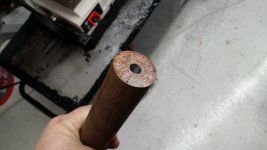
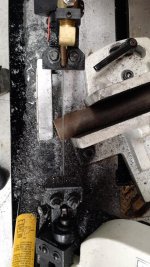
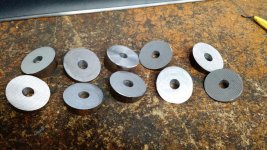
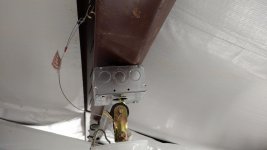
So I ended up making 18.5° shims using a 1.5" rod drilled and then cut at the proper angel. A shim is placed on each side of the purlin and the hook and box now level.

Had to use a 4" x 2 1/8" square box to get the capacity OK for 8 12 ga + ground and the hook going through. Now just waiting for the wires to come in.
 

Attachments

  • IMG_20180106_134826812.jpg
    IMG_20180106_134826812.jpg
    140.3 KB · Views: 8
  • IMG_20180106_134928887.jpg
    IMG_20180106_134928887.jpg
    155.6 KB · Views: 8
  • IMG_20180106_152541861.jpg
    IMG_20180106_152541861.jpg
    156.6 KB · Views: 9
  • IMG_20180107_175051588.jpg
    IMG_20180107_175051588.jpg
    143.5 KB · Views: 12
  • IMG_20180107_175036709.jpg
    IMG_20180107_175036709.jpg
    144.1 KB · Views: 11

Bert_

Well-known member
Joined
Dec 24, 2016
Messages
9,777
Location
NW Iowa
Nice job on those shims, that looks great!

I think you might have mentioned that the fans are borderline being to low. Those downrods can be shortened pretty easily if you are worried about it. I've cut them down 8-10" quite a few times so people don't have to worry about hitting them with equipment.

Those reversing fans are a bit of a pain to wire as your finding out with all the box fill problems. I've always ran them on a 15a circuit for that very reason. The fans don't draw much and the smaller wire is easier to deal with in boxes and conduit fill.
 
OP
6

600SL

Well-known member
Joined
Apr 26, 2012
Messages
1,794
Location
Connecticut
Nice job on those shims, that looks great!

I think you might have mentioned that the fans are borderline being to low. Those downrods can be shortened pretty easily if you are worried about it. I've cut them down 8-10" quite a few times so people don't have to worry about hitting them with equipment.

Those reversing fans are a bit of a pain to wire as your finding out with all the box fill problems. I've always ran them on a 15a circuit for that very reason. The fans don't draw much and the smaller wire is easier to deal with in boxes and conduit fill.

Thanks and thanks to everyone for the help. Now that I have a working solution it wont be to difficult.
 
To avoid these ads, REGISTER NOW!
Top Bottom