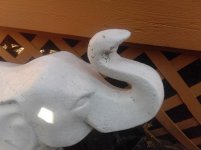
We've done some cement lawn statuary repair before. But this one is a very tricky repair. Not sure the size we're dealing with here. The larger it is, the more difficult to make it look right because you have more surface area the eye can examine. What further compounds the challenge is that you have a pair, so the eye will compare the one against the other.
You don't say how much this is worth to you. If it's a 'spare no expense' send it to a professional. Research their skills and results first.
Your biggest challenge is the rebar. There's no way you can bend it back to the original shape without removing the entire broken trunk. Even then, metal stretches when bent, but you might get close enough.
Some have suggested making a mold. Seems natural to think of this, but this is a lot harder than it sounds, not just in getting the mold right, but in actually reproducing a replacement part for the broken areas. At best, I think you'd have to make a mold to reproduce the entire trunk and cut away what's left of the old. Even if you wrapped a partial mold around it, you're still dealing with the separated trunk tip and the bent rebar. Then you'll have to get the right filler in it and be able to hold it both in correct position and shape.
Your biggest advantage is that this is a MCM design that is stylized and so is lacking in minute anatomical detail. Reproducing the original lines is less of a problem.
I cannot fully determine from the photos whether the remaining unbroken portions are structurally sound themselves. Let's assume they are for now.
The other consideration is that you MUST have some basic skill at carving or sculpting. If you don't,but still concerned that it looks right when finished, you're simply not the person to do this repair.
Looks like the rebar is only bent out at the curve where it bends up at a radius. Cut it there. Then try to fit the separated section into the remaining groove in the intact half of the trunk. I'd be careful trying to bend the section to fit the groove. I'd probably continue cutting off pieces of that radius bend (the area where it appears to have been bent in the fall) until I can get the separated section with the trunk tip flush. Once I can get the separated part to fit together correctly to the main statue body, I'd glue it in place with JB Clear Weld epoxy. Now I have a good foundation on which to complete the repair.
For these kinds of fillers, we've tried a number of materials, including all the stuff recommended by many for such repairs. Of course, none of these arts/crafts folks are mechanics, and so don't have knowledge of what's available in that field! The best we have found are the rolls of radiator repair epoxy that's like a clay. You knead the two parts together per instructions, then start rebuilding the trunk with it. Use JB gas tank radiator repair putty #62020. We use JB for everything--no need to experiment with other brands, you KNOW JB will get the job done right! This filler will not shrink or warp as it hardens. One hour work time lets you sculpt and carve as you go. When hard, this patch is sandable. Again, no notes on the size so I don't know how much you'll need. It will also re-enforce the surrounding parts because it's stronger than the original concrete. You can try body filler, may be easier to sand when done, but it doesn't handle like modeling clay, where the JB does. Occasionally we've had to bore small holes in the remaining concrete to insert pegs that will help hold the JB in place when cured. Fill any remaining cracks and gaps with traditional JB Weld (including the cracks I see in the trunk tip) and sand to shape when cured. Repaint both statues with the same coating. Display the two separated on lawn, like one elephant on each end of a long flower bed to keep the eye from comparing them side by side. Buy the kids minibikes so they'll never think about riding elephant statues again.
Hope this helps.