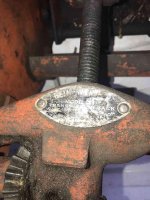
Hi, I’m new here and looking for some info on a Hein Werner 500lb Transmission Jack. It’s orange in color, it’s a hand crank jack and seems to be some what older. It’s has the maker and model badge on it, but difficult to read. I don’t have pics of it as of now but will later today. I’m wondering how old it is and what it might be worth.

You are using an out of date browser. It may not display this or other websites correctly.
You should upgrade or use an alternative browser.
You should upgrade or use an alternative browser.
Hein Werner Transmission Jack
- Thread starter T21basher
- Start date
CrackedHead
Active member
If you posted a picture that would help. Typically they aren't worth much, I picked up a Hein-Werner model 61 transmission jack last year for $100. Works well but leaks. Perfect for what I do at home.

CrackedHead
Active member
Wow, that one is an old one 
Billy Jack
Well-known member
Wow, that picture (aside from the color) brings back some memories! My Dad had a small transmission shop in the late 50's to mid 60's. I spent many a night in my childhood under a car with him, turning the wheels and cranks while he was lining up the bellhousings of a Powerflite, Torqueflite or Powerglide. I think I might still have one of the pan guides that clamps on the crossbar.
Bill
Bill
Wow, that picture (aside from the color) brings back some memories! My Dad had a small transmission shop in the late 50's to mid 60's. I spent many a night in my childhood under a car with him, turning the wheels and cranks while he was lining up the bellhousings of a Powerflite, Torqueflite or Powerglide. I think I might still have one of the pan guides that clamps on the crossbar.
Bill

 View attachment 1
So do you know much about these jacks?
Sent from my iPhone using The Garage Journal mobile app
Billy Jack
Well-known member
It's been over 30 years since I've seen one, but I'll tell you the basics if you're not familiar with it.So do you know much about these jacks?
For installation, you sit the transmission pan on the X-shaped saddle, then adjust sliding guides on the rails to keep the trans in place. Obviously, the big wheel raises and lowers the trans. The two other adjustments are for angle adjustments, both north-south and east-west. When you'd remove the trans on vehicles that had front motor mounts only, the rear of the motor would droop, so the bellhousing flange wasn't plumb. To properly mate the trans bellhousing, you adjusted the angle of the saddle from horizontal so that it matched the motor angle. Transmission pans weren't always flat or level, so sometimes you had to angle the saddle to match up with the alignment pins and bolt holes on the motor. Also, you'd have to roll the jack and trans under the car to the floorpan tunnel, then raise it into place while you were lying on a creeper.
I should also mention that matching the jack to the angle of the sagging transmission was also necessary for safe removal. You'd use the jack to slightly lift the trans, next remove the crossmember, then lower the trans to allow access to the upper bellhousing bolts. Once all the bolts were out, you'd again adjust the saddle angle to match the trans, then pull it back to separate.
Many of the 50's and 60's automatics had cast iron cases, so they were quite a bit heavier than the later aluminum-case versions. Many also had a fifth brake drum on the trans tailshaft that served as the parking brake, even more weight.
I kinda have this in reverse order, but the installation process required more fiddling with angles and height than removal, so that came to mind first.
Only two of your pictures made it, but I can still visualize most of the front end of the jack from memory.
Bill
Last edited:
gpw_42
Well-known member
T21 posted a couple more pics here:
https://www.garagejournal.com/forum/showthread.php?t=391247
https://www.garagejournal.com/forum/showthread.php?t=391247