To avoid these ads, REGISTER NOW!

Planning a Garage; Should I Plan for Solar

LifeLongWNYer

Well-known member
Joined
Oct 23, 2013
Messages
1,231
Location
South of Rochester, NY
I am working on a garage and wonder about modifying the roof to be able to hold more solar panels. Basically, it is 40' x 40' with attic trusses to allow light item storage in the center portion.

To minimize the snow slide on to the apron in front of my overhead doors I am thinking about offsetting the ridge so it is 8' to 10' from the front eave, giving me a fairly steep pitch on that side, and a more shallow pitch on the rear. The idea it to get less snow on the front to slide off, plus, by making the pitch steep, the snow slides off quickly, and I don't have to keep cleaning it off of the ground in front of the doors. I am thinking that the longer rear roof would give me more space, to allow the mounting of more solar panels, than if the ridge were to be in the center of the building. In other words, the rear roof will have a ~30-32' x 40' space for panels, instead of 20' x 40'. The front will face north, so no panels there.

So a related question is whether the solar panels will "work" well on a shallower pitch, or will they cover with snow and lose efficiency. Here, in western NY we get quite a bit of snow, currently we are at a bit over 120" this year, so I am thinking that it might be a factor.

Also, I've no idea what solar panels weigh, should the trusses be beefed up to handle the added weight?


.
 
To avoid these ads, REGISTER NOW!

cybrdyke

Well-known member
Joined
Sep 9, 2014
Messages
3,446
Location
USA
On a much smaller scale, I've been wondering the same thing. I have a satellite dish on my roof and I installed a dish heater on it so that it would melt off any snow or ice. It works beautifully. I wonder if the same thing or similar is available for the solar panels I'm installing. Of course, it should be low powered enough to run off the batteries and be self sustaining.
CD
 
OP
L

LifeLongWNYer

Well-known member
Joined
Oct 23, 2013
Messages
1,231
Location
South of Rochester, NY
We received about an inch of snow last night, and this morning as I went for coffee, I paid close attention to all the solar panels in my route. They were all covered with snow, and I couldn't help but wonder how well they are working. Actually, this area has a LOT of "mostly" cloudy days, sometimes we go a week without seeing the sun.....I wonder if solar panels are worth the cost.

On the other hand, I see more and more going up. I need to talk to someone who owns them, not the installer.


.
 

Git

Well-known member
Joined
May 18, 2008
Messages
6,894
Location
S Cal
You can get a pretty good idea how well solar works in your area using this calculator

http://pvwatts.nrel.gov/pvwatts.php

Enter your real address because it is going to pull up the weather data for your area. On the next page, off to the right, you will see "Draw your System". If you click on that, you should see a satellite photo of your house and you can then click on the corners of the roof to get an approximate idea of how big of a system you could fit. For the rest of the system info, you can use this:

module type = premium
array type = fixed roof
system loss = 14 (the default but it is kind of high)
tilt - do you know the angle of your roof or use the default 14
azimuth - what direction does your southernmost roof face?

The next screen should show you how many kilowatt hours per year your system would generate

Regarding the installation - keep in mind the panels themselves are actually attached to rails that are attached to each truss/joint which spreads the load out quite a bit. For example, I have a concrete tile roof with trusses yet nothing had to be changed when our solar panels were installed. If you get serious and start talking to solar companies, they would provide you more info

Lastly, it seems pretty common in my area that the installation is 'guaranteed' to produce a certain amount of kWh per year. If the system does not meet the standard, the solar company pays the difference on your electric bill
 

tyme2par4

Well-known member
Joined
May 16, 2016
Messages
571
Location
NH
solar panels are about as slick as a metal roof. So if your pitch is enough that snow will come off of a metal roof, it will also come off of the solar panels. They do however start to warm up quickly when the sun comes out. So if there is only a coating to an inch or 2, they will start producing power and melt the snow, which will make it slide off quicker.
They are going to weigh about 35-40lbs per panel (being aprox 3x5ft each). Usually if you are building to the current code, there is plenty of strength.
As for the lower pitch, how low are you talking? Lower pitch will give you more power during the summer, but less during the winter. And as mentioned before, reduce the snow sliding off. Typically the ideal slope is equal to your latitude, which I'm guessing is roughly 42 degrees.
 

cybrdyke

Well-known member
Joined
Sep 9, 2014
Messages
3,446
Location
USA
Doesn't it also depend on the type of panel? For instance, a monocrystalline panel will produce zero power if only a portion of the panel is shaded or covered with snow. A polycrystalline panel will at least produce some power if it's shaded or has snow on it.
CD
 
OP
L

LifeLongWNYer

Well-known member
Joined
Oct 23, 2013
Messages
1,231
Location
South of Rochester, NY
Thanks Git for the calculator. It figured about $576.00 per year, but I think my system could be about 3 times the 269 sq ft in the example. I guess it is time to contact a dealer.

I like the idea of them "guaranteeing" the generating capacity, it takes a lot of the risk out of the equation.


.
 

nadogail

Well-known member
Joined
Jan 23, 2009
Messages
31,961
Location
Coronado, CA
solar panels are typically adjusted for your latitude on installation.

IMHO you cant be too rich, too handsome, or too slender.
 

Git

Well-known member
Joined
May 18, 2008
Messages
6,894
Location
S Cal
Doesn't it also depend on the type of panel? For instance, a monocrystalline panel will produce zero power if only a portion of the panel is shaded or covered with snow. A polycrystalline panel will at least produce some power if it's shaded or has snow on it.
CD

I think it depends more on the type of inverter.

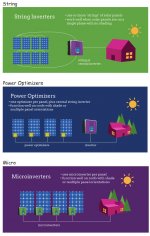
There are three types of inverters. String, Micro and then you have power-optimisers

With your basic string inverter, a little bit of shade (I would also assume snow) can bring down the output of the entire array.

Here is a pretty good article :
https://www.energysage.com/solar/101/string-inverters-microinverters-power-optimizers/

attachment.php
 

Attachments

  • SNAG-758.jpg
    SNAG-758.jpg
    111.1 KB · Views: 555
Last edited:

6768rogues

Banned
Joined
Nov 28, 2007
Messages
4,524
Location
Western NY
After I quit working for the county I was facilities director for one of the local public school systems. We looked into solar because we used lots of electricity and had acres of flat roofs. The engineers we used did not include any electricity generation from winter months in their calculations because it was assumed that the panels would be covered with snow. For a large scale system, the utility wanted almost as much money to be our backup as we previously paid for electricity, so it would not save us much money. We were the largest consumer of electricity in our village, and it was costly to maintain the infrastructure if we were not buying as much electricity. With a small residential system, that is not the case. Also, at the school most of our consumption was in the winter and most of the solar output would be in the summer, so it did not make sense and we did not do it. Not applicable to your case, but interesting how it worked out.
Personally, I don't consider energy saving measures that do not pay back in 7 years or less. It is purely a personal threshold that I feel comfortable with. That is the number I have always used and maybe I should reconsider as I get older. I am not interested in something that will take 15 or 20 years to pay back.
Yes, the weight of those panels should be added to the dead load rating of your trusses.
Usually with a low pitch the panels are elevated to be at the optimal pitch for collecting sunlight. Every leg or mounting point is a potential source of a leak.
It all depends on how much you think you can save measured against how much the system will cost, with everything that is needed to make it work. Most electricity is made with natural gas and fracking has flooded the market with gas, making prices go down or at least stabilize.
By the way, be careful about where you park if you think snow will slide off. My son parked his pickup by his barn and snow slid off and hit his truck, caving in the entire side. He had to have repairs done on every panel from bumper to bumper, including a new box side. I put my garage doors in the gable end.
 

cybrdyke

Well-known member
Joined
Sep 9, 2014
Messages
3,446
Location
USA
I think it depends more on the type of inverter.

There are three types of inverters. String, Micro and then you have power-optimisers

With your basic string inverter, a little bit of shade (I would also assume snow) can bring down the output of the entire array.

Here is a pretty good article :
https://www.energysage.com/solar/101/string-inverters-microinverters-power-optimizers/

Wow. My system is nothing like any of those. I have a panel, which is connected to a charge controller, which is connected to a battery, which is connected to an inverter.
It looks like the system in that article doesn't use any batteries and goes right from the panel to an inverter.
I guess there's alot of different systems out there.
 

Git

Well-known member
Joined
May 18, 2008
Messages
6,894
Location
S Cal
I think you will find most solar installations nowadays are 'grid-tied'. Excess electricity produced during the day flows back through your meter onto the grid and you get credit for it. Then at night, instead of relying on batteries, you draw electricity from the grid. Sounds like your talking about an 'off grid' system

Even with some of the credits/rebates they are currently offering, having battery backup is still too expensive for me to consider it.
 
OP
L

LifeLongWNYer

Well-known member
Joined
Oct 23, 2013
Messages
1,231
Location
South of Rochester, NY
I stopped in to a local panel supplier and one thing he told me was interesting. He said, at least in this part of the country, you should size the panel capacity to "about" match the amount of electricity that you use. The power that you generate is put into the grid, and the utility gives you "credits" for that. Then, when you aren't making juice, the power that you use from the power company uses up those "credits".

At the end of the game, if you generated as many credits as you used, you have a "zero balance" and owe the power company nothing. ( Except for all the fees and charges, which never go away ) Having a negative credit balance means you owe them money, just like before you had the system. The rub is having extra, and unused, credits. He said the power company will pay you for them, BUT, they don't pay YOU as much for YOUR power as THEY charge for THEIR power. In other words, you are selling them cheap power, which they are turning around and selling to your neighbor for a higher price.

Another consideration, ( he said ) is that if you install a system which generates substantially more power than you can conceivably use, the rebates diminish rapidly. I guess they don't want you competing with the power company with a system paid for by rebates.

So, THAT is all what a panel dealer told me, I'd be interested in knowing how accurate that is.


.
 

Git

Well-known member
Joined
May 18, 2008
Messages
6,894
Location
S Cal
I would say that what you were told is fairly accurate

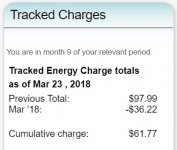
I pay some fees monthly - about $12 to $15, but really I am on an annual billing plan. They call it the 'relevant period' and after the twelve months, we settle the bill and start into another 12 month period.

For example, I am currently in the 9th month of the relevant period and my electric bill shows that I owe them $61. With better weather ahead (more sunny days) this should easily turn into a $ credit on my bill by the end of the 12th month. BUT, if I do have a $ credit, they will only pay out at the wholesale rate, which is about $.02 per kilowatt hour. Normally when I use electricity from the grid, they charge me anywhere from $.12 to $.37 depending on the Time Of Use (TOU) So, you are not going to get rich by selling excess electricity back to the power company

My system was sized at 120% of the previous year's electrical usage, which is the maximum our utility will allow. Keep in mind the panels will degrade over time and so will their output. To put this into perspective, my annual electrical usage was about $3,500 and we did everything possible to save on electricity
 

Attachments

  • SNAG-0163.jpg
    SNAG-0163.jpg
    24 KB · Views: 14

tyme2par4

Well-known member
Joined
May 16, 2016
Messages
571
Location
NH
I stopped in to a local panel supplier and one thing he told me was interesting. He said, at least in this part of the country, you should size the panel capacity to "about" match the amount of electricity that you use. The power that you generate is put into the grid, and the utility gives you "credits" for that. Then, when you aren't making juice, the power that you use from the power company uses up those "credits".

At the end of the game, if you generated as many credits as you used, you have a "zero balance" and owe the power company nothing. ( Except for all the fees and charges, which never go away ) Having a negative credit balance means you owe them money, just like before you had the system. The rub is having extra, and unused, credits. He said the power company will pay you for them, BUT, they don't pay YOU as much for YOUR power as THEY charge for THEIR power. In other words, you are selling them cheap power, which they are turning around and selling to your neighbor for a higher price.

Another consideration, ( he said ) is that if you install a system which generates substantially more power than you can conceivably use, the rebates diminish rapidly. I guess they don't want you competing with the power company with a system paid for by rebates.

So, THAT is all what a panel dealer told me, I'd be interested in knowing how accurate that is.

That is the basics of net metering. It would be a good idea to confirm with your POCO what their terms are, as they can vary quite a bit across the country. As Git said, most won't allow you to go more than 10-20% above what your previous years bill was, as they don't want to be paying you for power.

The best course of action would be to get in contact with a couple of local solar installers and ask them for perspective quotes. If you're doing a shingle roof, they would probably work with the roofers to add the mounts as they do the roofing, saving some time and money. If you do metal, they may have some suggestions on what type of metal roofing would be easier for them.
 

Cword

Well-known member
Joined
May 25, 2006
Messages
294
Location
Calgary, Alberta
I didn't plan for solar back in 2001 when I built the shop, but as of yesterday there's 16 panels up there. Inspection is Monday, so if all goes well we're live next week.
P1040711.JPG
 

75gmck25

Well-known member
Joined
Jul 21, 2014
Messages
1,325
Location
Alexandria, VA
In reference to power company rates - for anyone who has a choice of power companies, have you tried to compare rates and figure out if one company gives you a better deal on purchase if you have solar, or gives you a better rate when you return power to the company?

This site maps out the "energy choice" states, but beyond that I don't know much about it.
http://competitiveenergy.org/consumer-tools/state-by-state-links/

Bruce
 

tyme2par4

Well-known member
Joined
May 16, 2016
Messages
571
Location
NH
Here in NH, we have the Utility that brings you the power. You pay them for transmission, distribution and service charges. Then you can either buy power from them, or from a third party supplier. They all just buy off the bulk market and resell to you, so you have to pay attention every year to their rates. I usually switch suppliers every year to go with the lowest rate.
Some of them will allow you to use net metering, while some may not. I think that's something you'd really have to take up with your specific supplier.
 

yeldogt

Well-known member
Joined
Jan 2, 2012
Messages
18,184
The rules allowing net metering where you get full credit for the power is already gone around me ... it made sense early on as a way to entice people to install. But, it's too costly to the whole system -- early adopters end up not paying for the grid. And the grid can't take the added power flowing backwards in many areas.

IMO it's more logical to spend funds to make the building more efficient and then install a smaller system to minimize the building use of the grids power ... the solar industry obviously just wants to sell panels -- so more panels attached to less efficient buildings makes more money for the industry.
 

Toomanytools?

Well-known member
Joined
Nov 4, 2010
Messages
855
Location
Washington
To OP your post 13 is accurate. You want to be as close to your usage as possible even under is fine. Most people with solar will adjust their habits and turn lights off or set thermostats lower to save on heating. Most installs are grid tied the off grid is expensive for battery storage. I have a friend looking into solar in Washington state this is what he found, some may apply to you.

The state and federal incentives are dropping and PPL buyback program with lock in pricing is decreasing from .21 cents per kilowatt to .16 cents per kilowatt on June 31st. So we thought we should look back into solar. A $50K investment will generate 12Kw of power or an average of $122.00 of electricity per month over a 12 month period. 80% of the total cost is paid for by Federal and state rebates over 8 years? That also corresponds with the ROI for the $50K about 8 years for us. Panels are warranty 25 years and guarantee 80% efficiency at 25 years.

12Kw is the maximum power you can produce and be classified as residential / eligible for the fed& state rebates.

12Kw = 23 to 24 panels depending on the manufacturer.
I have thought of solar to offset the use in my new shop but have too many projects to make it worthwhile.
 
To avoid these ads, REGISTER NOW!

Falcon67

Well-known member
Joined
Jun 11, 2009
Messages
18,371
Location
Merkel, TX
In reference to power company rates - for anyone who has a choice of power companies, have you tried to compare rates and figure out if one company gives you a better deal on purchase if you have solar, or gives you a better rate when you return power to the company?

This site maps out the "energy choice" states, but beyond that I don't know much about it.
http://competitiveenergy.org/consumer-tools/state-by-state-links/

Bruce

You have to check with the individual provider. When we were on a co-op, they did not net meter. Period. And they sold solar arrays to boot. And charged pretty high rates for here - .14~.17 per kWh. I think Our backend source (AEP) will net meter but it'll likely be at a wholesale rate around .03~.05 and not likely the .09 we pay the retail provider. I have not asked our current retail provider because we're not doing any solar at this time.
 

tyme2par4

Well-known member
Joined
May 16, 2016
Messages
571
Location
NH
The rules allowing net metering where you get full credit for the power is already gone around me ... it made sense early on as a way to entice people to install. But, it's too costly to the whole system -- early adopters end up not paying for the grid. And the grid can't take the added power flowing backwards in many areas.

That's not really true, just what the utilities are trying to convince people.
If you look at research done by more solar friendly utilities you'll find quite the opposite. The value of the energy the utilities purchase from net metering is higher than what they pay for it. Mainly because they no longer have to distribute it. Distributed solar actually reduces the strain on the distribution and transmission system.

The downfall comes when the rate of penetration increases to much higher levels, and you start seeing the "duck curve". At that point utilities need to start incentivising integrated storage along with the solar, or implement TOU rates.
 
OP
L

LifeLongWNYer

Well-known member
Joined
Oct 23, 2013
Messages
1,231
Location
South of Rochester, NY
Interesting 75GMCK25. Where I live, there is only one "supplier" of electricity, the utility company. There are a lot of "other" firms offering to sell electricity here, but all are just brokers. They buy it someplace and sell it to their customers. The electricity still comes over the utility companies lines and through their meter.

Three years ago I built a spreadsheet which analyzed the costs of power from the "brokers" versus the utility company and was surprized to find little difference. The actual electricity was lass expensive, but one i added in the government fees, surcharges, and other costs ( like a charge the the utility charges for buying "foreign" power ) the difference was minimal, not worth the effort of changing over.

Those other resellers WERE advertising ALL the time on radio and TV, but I've noticed that ad's have stopped. Maybe it is time to get the spreadsheet out and update it. I'm interested in the thoughts of those who have two real utility companies to choose from have to say. In full disclosure, I have only a home and small garage, maybe my usage was below the breakeven point.


.
 

Git

Well-known member
Joined
May 18, 2008
Messages
6,894
Location
S Cal
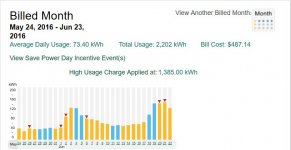
I was just looking at some older electrical bills/usages

This was in May 2016 before we had solar installed. To be fair, my son and his family were visiting from Texas and they like to run the air conditioner, a lot. At the time we were on the 'tiered' rate system where the more electricity you use, the more you pay (the highest tier is almost double the cost of the lowest tier)
attachment.php


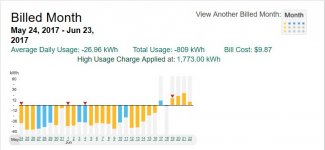
And this is May 2017 after solar - we generated more electricity that we used and banked 809 kWh

attachment.php
 

Attachments

  • May 2016.jpg
    May 2016.jpg
    73.6 KB · Views: 221
  • May 2017.jpg
    May 2017.jpg
    62.4 KB · Views: 222
OP
L

LifeLongWNYer

Well-known member
Joined
Oct 23, 2013
Messages
1,231
Location
South of Rochester, NY
I am doing further planning on the advisability of solar and wonder whether I consider my ACTUAL TOTAL electricity cost, or only the electricity used.

The "total" costs include a number of fees, surcharges, and other costs, which our kind and generous NY Public Utility Commission allows the utilities to pass on to the end user. These vary from month to month, depending on unknown ( to me ) factors. There is one line on my bills which is for "electricity" but it only includes a certain number of KwH, and the other usage I have is broken into two other line items, which makes it complicated to determine my actual cost of electricity.

My bill does show the monthly meter readings, though, so while I can't easily determine my cost, I CAN easily figure exactly how much juice I used. Is this number helpful?


.
 

tyme2par4

Well-known member
Joined
May 16, 2016
Messages
571
Location
NH
Some utilities will force you to pay the service fees regardless of your solar generation. It would be best to review the net meetering agreement that your utility offers. That way you can determine if you only need to cover your kWh usage, or if you want to target the dollar value that you pay.
 
OP
L

LifeLongWNYer

Well-known member
Joined
Oct 23, 2013
Messages
1,231
Location
South of Rochester, NY
Just a quick update.... If I divide my last total electric utility bill, by last months total usage, I am paying 12.2 cents per kWh. If I divide my "cost for electricity" ( only ) by my usage, I am paying 2.5 cents per kWh. Quite a difference.

It is amazing, there is always one line item on the bill which is sometimes a negative number, meaning that it lessens my bill, but that number is peanuts, compared to all the other "add on's" which are positive numbers. It is hard to win in NYS.


.
 

Git

Well-known member
Joined
May 18, 2008
Messages
6,894
Location
S Cal
You need to know your annual electrical usage in kWh which will help you size your system. Different people are looking for different things - do you want 100% of your usage, or are you on a tiered electrical plan and you just want to stay out of the highest tier?

What you paid that year for that electricity comes in handy to figure out how long it will take to recover your money. It also helps to know what the net metering agreement is for your area.

Last fall I switched to a Time Of Use plan because it was supposed to save me money, but I think it is and I pay a flat fee of around $.50 per day for grid charges, etc. I am going to change back to the the tiered plan
 

tyme2par4

Well-known member
Joined
May 16, 2016
Messages
571
Location
NH
Just a quick update.... If I divide my last total electric utility bill, by last months total usage, I am paying 12.2 cents per kWh. If I divide my "cost for electricity" ( only ) by my usage, I am paying 2.5 cents per kWh. Quite a difference.

It is amazing, there is always one line item on the bill which is sometimes a negative number, meaning that it lessens my bill, but that number is peanuts, compared to all the other "add on's" which are positive numbers. It is hard to win in NYS.

$.025/kWh sounds too low.
Even if it is, that's probably just the energy charge. You should also have a transmission and distribution charge that is per kWh. In my area T&D is about half the total cost.
Can you attach a pic of a recent bill?
 

cupcakemike

Active member
Joined
May 5, 2018
Messages
29
I work at a power plant, I don't know the dirty details of distribution and transmission but the stats we are always fed is generation, transmission, and distribution each run about 1/3 of the total cost of electricity. We are considered a "non-profit" and only produce electricity for our parent companies. We currently "cost" our parent companies about $27/megawatt. They have sunk a ton of their investment into windmills cause that's the hot thing now and natural gas and coal are so cheap that they say we "cost too much".

Doing the math thats about $.027/kwh. Take that times 3 and you get about $.09/kwh, so if the customers were charged somewhere around $.10/kwh we'd be happy. I am serviced by one of our owner companies and guess what, I pay approx. $.16/kwh.

The math ***** and that's coming from someone sorta on the inside. The bottom line is those bastards will get ya however they can, and the government will make it the easiest they can for them to do so.
 

EltonS29

New member
Joined
Feb 15, 2018
Messages
2
You have done a tremendous job, I think everything will turn out. I believe that it is possible to install panels from the north side, but then you need a drive to use stocks on sunny days.
Nowadays, there are so many kinds of lighting, they are distinguished both by the power of lighting and by the type of energy consumption. I'm currently working on a lighting plan for my country house, or rather a garden with a magnificent fountain and garden paths that are there. I would like to do something extraordinary and completely new, like a masterpiece of art. I also paid attention to the solar lights, to use them for garden paths. I would also like to decorate the fountain so that there is light from the water, but I can not find something suitable yet.
 
OP
L

LifeLongWNYer

Well-known member
Joined
Oct 23, 2013
Messages
1,231
Location
South of Rochester, NY
Yup, Tyme2Par4, that lower number is only for the electricity. It is all the added fees and charges that get me. Some are listed as a percentage, but I don't know what number that percentage is derived from. Other fees are the same dollar amount from month to month. Next, some are a multiplier which is tiny, ( one of the is "0.0069686" ) but they multiply that by the total kWh usage to get a dollar number which is added to the bill. Finally, I do get some kWh "free" which is included in my monthly "basic service" and they charge by the kWh for the usage over that. Some of the added charges utilize my total kWh usage as a multiplier, others only use the "overage" between my "free" power and my total.

It is a complicated billing system, and I think the utility wants it that way, as does the Public Utility Commission, to keep us homeowners in the dark, so to speak. Even the names of those add-on's don't make sense. ( What is a "legacy transition charge" or a "SBC"? )

I intend to swing back to the solar system installer with a couple of bills, but I understand that HE has a vested interest in the sale too! He is going to lean toward selling me the largest system that he can get away with.

I'll try to attach a bill, but since the photohosting service quit playing with GJ, I haven't had much luck with that. At this point, I am leaving toward just using my total bill amount, and dividing it by the used kWh according to my meter readings. That would yield the $ 0.122/kWh number that i cited earlier.


.
 

n20junkie

Well-known member
Joined
Aug 22, 2010
Messages
538
Location
Grand Island, NY
I own my 5k solar system in WNY.

Don't do it. This will be the second year my system needs repairs due to squirrels making nests under the panels, and I will not generate enough to pay the system off before it becomes inefficient due to age.
 

tyme2par4

Well-known member
Joined
May 16, 2016
Messages
571
Location
NH
I own my 5k solar system in WNY.

Don't do it. This will be the second year my system needs repairs due to squirrels making nests under the panels, and I will not generate enough to pay the system off before it becomes inefficient due to age.

Tell your installers they need to install a critter guard. It's a wire mesh that goes around the perimeter of the array. I'm surprised they didn't offer it to you the first time they had to repair it.
 

tyme2par4

Well-known member
Joined
May 16, 2016
Messages
571
Location
NH
N20Junkie, I am curious about "becomes inefficient due to age". I've never heard that before, why is your system like that?

All solar panels decrease in efficiency with age as the silicon degrades. It's typically only around 1% per year or so. The industry assumes a 20% loss in efficiency is enough to qualify it as a failure. In actuality, it's still going to continue producing power, just not as much.

What you're seeing from n20junkie is just someone with a bad taste in their mouth due to a poor installer. A good installer would have addressed the squirrel issue the first time. A great one would have recognized it beforehand, and added a critter guard during the original install.
 

matt151617

Well-known member
Joined
Dec 17, 2011
Messages
488
Location
New Jersey
I will also add one of my coworkers had solar put on his house. The installers did a crappy job, causing a roof leak and major $$$ in repairs. To get to the rotten rafters and roof decking, the panels have to be removed, which is another expense. Just something to keep in mind; the roof will need to be replaced at some point.
 

Git

Well-known member
Joined
May 18, 2008
Messages
6,894
Location
S Cal
the roof will need to be replaced at some point.

That is going to depend on where you live....

In S Cal, all the houses I have lived in for the last 35+ years all have had concrete tile roofs.

Regarding roof leaks - that is what you get when you go with the 'lowest bidder'

Anyone interested in solar - I still have this thread bookmarked from a couple of years ago and it is well worth the read:

https://www.solarpaneltalk.com/foru...eally-bad-looking-for-some-help-advice-please

This is how his low bid contractor originally installed the roof mounts from that thread. In the end, the homeowner did it right:
attachment.php


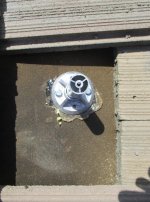
This is how my mounts are installed. The roof tiles are removed so the standoff be can be screwed directly to the truss. They are then sealed and flashed and the roof tiles are replaced. A second flashing is installed and then the bracket to hold the rails. Installer provided 10-year warranty against leaks.... Definitely not the cheapest bid
 

Attachments

  • 7.jpg
    7.jpg
    142.4 KB · Views: 110
  • SNAG-018.jpg
    SNAG-018.jpg
    121.3 KB · Views: 16
  • SNAG-019.jpg
    SNAG-019.jpg
    147.1 KB · Views: 15
  • SNAG-021.jpg
    SNAG-021.jpg
    146.8 KB · Views: 14
  • SNAG-022.jpg
    SNAG-022.jpg
    148.1 KB · Views: 16

tyme2par4

Well-known member
Joined
May 16, 2016
Messages
571
Location
NH
That is going to depend on where you live....

In S Cal, all the houses I have lived in for the last 35+ years all have had concrete tile roofs.

Regarding roof leaks - that is what you get when you go with the 'lowest bidder'

Anyone interested in solar - I still have this thread bookmarked from a couple of years ago and it is well worth the read:

https://www.solarpaneltalk.com/foru...eally-bad-looking-for-some-help-advice-please

Exactly. Do your research and find a contractor who will do it right, and stand by their work. There are plenty of reputable companies out there, but also plenty of scammers out to make a buck at your expense.

A properly installed system will NOT leak. If you're building a new building, you don't have to worry about replacing the roof anytime soon. Even when you do, it's not terribly expensive to have them come remove the panels and put them back up.
 
To avoid these ads, REGISTER NOW!
Top Bottom