To avoid these ads, REGISTER NOW!

VISE REPAIR 101 all vise repairs, lubricants, sources for parts and the tricks to fix

To avoid these ads, REGISTER NOW!

GETRIDAONE

Well-known member
Joined
May 21, 2013
Messages
1,549
Location
Auburn, GA
Thanks Guys,
I did do the lettering in gray but it blends in to well and doesn't show up. The base lock nut and wrench were gone when I got it so I used a wrench I had. I changed the collar screw instead of using the brass one.
 

Attachments

  • 20180529_150822.jpg
    20180529_150822.jpg
    142.5 KB · Views: 33

Carla

MEMBER EMERITUS
Joined
Nov 27, 2010
Messages
672
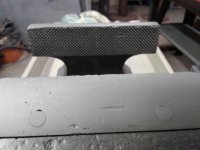
I finished repairs on the Parker 975 from page 302, post 6027. I filled the hole in the bottom with a low temp melt alloy that is harder than solder. Next was an adjustable nut stop instead of a standard pin. The 3/8" handle screw threads were stripped and I put in a helicoil and a 5/16" screw, spring, and ball bearing. The swivel base shoulder bolt needed a bushing to fit tight. Last thing was a shim under the collar to get the last litle bit of backlash out. Forgot to mention filing the serrations on the jaws and some clean up on top of them . All considered, I am happy with the way it turned out.

Well done, Get................... : )
 

Red_SC

New member
Joined
Nov 25, 2013
Messages
4
A little while back I acquired this vise. I can’t find anything online about it, it appears to be in good condition but is missing a thrust bearing assembly. It’s a very well made vise with gibs.

Does anyone have a pic of what these parts should look like? I’ve been going through this thread, but haven’t found one that’s made this way. It looks like a block would go in the square hole for a thrust washer or bushing to bear on. I’m a machinist and can make whatever I need, but seeing how it’s supposed to look would help.
 

Attachments

  • 185EF5FB-E7E6-4020-BA06-550DA4CDB8D3.jpg
    185EF5FB-E7E6-4020-BA06-550DA4CDB8D3.jpg
    147.9 KB · Views: 41
  • F69B3B9D-B713-4C2D-B497-9E19E623C27D.jpg
    F69B3B9D-B713-4C2D-B497-9E19E623C27D.jpg
    147 KB · Views: 37
  • ACCD1ACD-15C0-49F9-952D-39F3D3F05AFA.jpg
    ACCD1ACD-15C0-49F9-952D-39F3D3F05AFA.jpg
    157.5 KB · Views: 41

akasrick

Well-known member
Joined
Apr 10, 2017
Messages
795
Location
south jersey
A little while back I acquired this vise. I can’t find anything online about it, it appears to be in good condition but is missing a thrust bearing assembly. It’s a very well made vise with gibs.

Does anyone have a pic of what these parts should look like? I’ve been going through this thread, but haven’t found one that’s made this way. It looks like a block would go in the square hole for a thrust washer or bushing to bear on. I’m a machinist and can make whatever I need, but seeing how it’s supposed to look would help.


A well documented takedown and restore of a similar vise. With pictures.
Maybe of help

https://www.garagejournal.com/forum/showthread.php?p=5800723&posted=1#post5800723

akasrick
 
OP
D

drivesitfar

Well-known member
Joined
Oct 23, 2013
Messages
36,026
Location
Pacific Northwest
Get: I always enjoy seeing your restorations and you've expanded your skills quite a bit over the years. if you want to show your jaws and what a hand filing job looks like feel free to if you have the time.

i'm curious since you and others are doing these nice pin upgrades holding the vise nuts in place do you have a rule for how tightly you hold the pin in place. do you leave a small gap say 1/8 of an inch or within thousand's of an inch or snug it up?

great stuff and keep up the great work.

Red: that thread of Mark's on the FPU Bison made in Poland vice isn't exactly the same as your German made vice that might be a Leinen or another quality vice, but it might give you some ideas. if you have more questions post up pictures and ask otherwise best of luck.
 

GETRIDAONE

Well-known member
Joined
May 21, 2013
Messages
1,549
Location
Auburn, GA
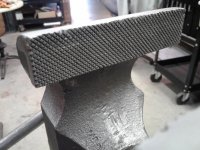
On this one the jaws had a lot of chips knocked off around the edges. It also had flat spots on the serrations in those areas. I filed on the top and sides as best I could to make it more presentable. Some of the flat spots were to deep so there is not much you can do with those. I used a belt sander on the top to get the really rough dings off. I stopped on this one because I didn't want to take of to much metal. I filed the pins back flush after putting the jaws back on.
The adjustment screw holds the nut tight on this one. ( No Nut Movement ) It all depends on how the screw aligns through front and into the nut. On some vises the nut will have to move a bit so the screw or spindle doesn't bind. I hate backlash so I will make them as tight as possible.
 

Attachments

  • 20180530_111345.jpg
    20180530_111345.jpg
    150.9 KB · Views: 39
  • 20180530_111510.jpg
    20180530_111510.jpg
    117.3 KB · Views: 37

akasrick

Well-known member
Joined
Apr 10, 2017
Messages
795
Location
south jersey
i'm curious since you and others are doing these nice pin upgrades holding the vise nuts in place do you have a rule for how tightly you hold the pin in place. do you leave a small gap say 1/8 of an inch or within thousand's of an inch or snug it up?

great stuff and keep up the great work.

Drives My problem was the was the vise nut. Dought it has ever touched the pin since it came out of the factory. The pin came out easily enough, ground the tip off a screwdriver and used as a punch. The nut had to be coaxed out with a block of wood and hammer then filed, probably too much, to fit its channel. Just a wee bit of blacklash now with the pin just placed into its hole.
Heck of a job that Get does

akasrick
 

454ragtop

Well-known member
Joined
Mar 24, 2008
Messages
5,011
Location
Carver, MA
Picked up a Wilton 1755 Tradesman that appears to have spent time mounted on the back of a concrete form truck. Looks like no hope to get the jaws off without drilling out the screws. Anybody know what size the low head screws are for the jaws and pipe jaws, maybe 1/4-20 x 1/2"? Need to order some stuff from Mcmaster, and would like to order some screws.
TIA, Jim
 

Carla

MEMBER EMERITUS
Joined
Nov 27, 2010
Messages
672
i'm curious since you and others are doing these nice pin upgrades holding the vise nuts in place do you have a rule for how tightly you hold the pin in place. do you leave a small gap say 1/8 of an inch or within thousand's of an inch or snug it up?

Actually, if one could leave a known .001 clearance, that would be pretty much optimal. However, the generality of vises, with the possible exception of the German 'reversed jaw' dovetailed version, are not made that precisely.

Usually, the main screw nuts of American vises are iron castings, with their dovetail surfaces used 'as cast', fitting into a dovetail area of the fixed jaw casting which is also used 'as cast', with the nut deburred as necessary to fit smoothly into the jaw.

As a generality, the nut will have a certain small amount of lateral play in the fixed jaw casting when assembled, which is needed for the nut to find its position in the jaw for alignment with the main screw.

A common assembly method for American vises is to place the nut in its dovetail in the jaw casting, observe that it fits freely, and has a little bit of lateral play when it is stopped at the front of the dovetail in the jaw. Then. one drives in the retaining-pin, and, using a suitable long drift, bends the retaining-pin down firmly over the nut to lock it in place.

Then, one must slightly free the nut, which is done with the same drift, by driving the nut back 'one whack worth', which should free the nut in its dovetail by the desired .001, allowing the nut whatever freedom of lateral movement it may have, to allow for error in the main screw position. If one gets .002 or .005 of play, no problem, but any more will be noticeable in backlash as the main screw is turned to open the vise. Note that I said 'one whack'.....sometimes it may really take two or three, of decreasingly gentle nature, to free the nut.

An exception to the above is the Reed make, in which the dovetail in the fixed jaw was accurately machined with a special milling setup, and the nut dovetail accurately machined, from cast iron on the earlier production, or from steel on Reed's vises made after sometime in the late '30's.

Those fit up accurately, and can be snugged in position. The earlier Reed vises used the same small diameter retaining-pin as most other makes, bent to snug the nut. After 1938, they used a patented system with a screw adjustment to retain the nut, and allow for a simple adjustment to take up any wear. You may look this up on Google patent, and wonder why it took a good idea, so really obvious, so long to be developed and put into production.

cheers

Carla
 

454ragtop

Well-known member
Joined
Mar 24, 2008
Messages
5,011
Location
Carver, MA
Picked up a Wilton 1755 Tradesman that appears to have spent time mounted on the back of a concrete form truck. Looks like no hope to get the jaws off without drilling out the screws. Anybody know what size the low head screws are for the jaws and pipe jaws, maybe 1/4-20 x 1/2"? Need to order some stuff from Mcmaster, and would like to order some screws.
TIA, Jim

Ended up working on this, got those SOB bolts out. Had 1/4"-20 X 1/2" for the pipe jaws and 1/4"-20 X 3/4" for the main jaws. Unfortunately 1 of my jaws broke or was broken. Anybody have 1 serviceable 5-1/2" jaw they can part with? Don't think I want to invest in a new jaws for this, if I don't have to.
 

akasrick

Well-known member
Joined
Apr 10, 2017
Messages
795
Location
south jersey
A common assembly method for American vises is to place the nut in its dovetail in the jaw casting, observe that it fits freely, and has a little bit of lateral play when it is stopped at the front of the dovetail in the jaw. Then. one drives in the retaining-pin, and, using a suitable long drift, bends the retaining-pin down firmly over the nut to lock it in place.

Then, one must slightly free the nut, which is done with the same drift, by driving the nut back 'one whack worth', which should free the nut in its dovetail by the desired .001, allowing the nut whatever freedom of lateral movement it may have, to allow for error in the main screw position. If one gets .002 or .005 of play, no problem, but any more will be noticeable in backlash as the main screw is turned to open the vise. Note that I said 'one whack'.....sometimes it may really take two or three, of decreasingly gentle nature, to free the nut.

cheers

Carla

Carla, thanks for the insight, that explains why thy look so badly deformed sometimes. I'll have to give that a go on a project.

akasrick
 

txlonghorn1989

Well-known member
Joined
Feb 27, 2017
Messages
2,786
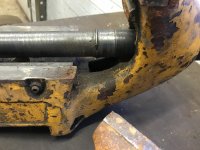
I just picked up this Reed 214 R vise. This will be the first vise I've disassembled and restored. Trying to get the dynamic jaw off, I believe the screw has passed the threads but it isn't separating from the base/static jaw. It was difficult to turn for the last half due to rust but more likely dried up grease and dirt. What/how should I use to get it loose at this point? See pic 1.

What is the process to remove the swivel base? What tool should I use to loosen that big bolt on the bottom? Does the swivel lock get removed after the swivel base is removed?

The swivel lock seems to be frozen. Is there anything I can use to loosen it up that won't remove what little paint is left on the vise? I'm kind of digging the old paint/patina.

Thanks!
 

Attachments

  • IMG_6878.jpg
    IMG_6878.jpg
    148.9 KB · Views: 45
  • IMG_6870.jpg
    IMG_6870.jpg
    151.2 KB · Views: 33

txlonghorn1989

Well-known member
Joined
Feb 27, 2017
Messages
2,786
TX, IIR there is a set screw holding the main screw in place? :headscrat

Outlaw,
I just noticed these in the back of the vise. The set screw wasn't even up against that threaded piece. Do both of these come out? What happens then? Given that set screw wasn't tight, it isn't intuitively obvious to me what it does or how/what it holds in place and before I remove one or both I'd like to understand what's going on here. ????

Thanks!
 

Attachments

  • IMG_6879.jpg
    IMG_6879.jpg
    100.5 KB · Views: 38
To avoid these ads, REGISTER NOW!

txlonghorn1989

Well-known member
Joined
Feb 27, 2017
Messages
2,786
Okay, I got the dynamic jaw off. Looking down at it from the backside I was able to see how it was still staying together. A shot of PB Blaster and 15 seconds later it was apart.

Now about the swivel lock and the swivel base...
 

KMScott

Well-known member
Joined
Feb 14, 2012
Messages
4,642
Location
Daufuskie Island, South Carolina
Outlaw,
I just noticed these in the back of the vise. The set screw wasn't even up against that threaded piece. Do both of these come out? What happens then? Given that set screw wasn't tight, it isn't intuitively obvious to me what it does or how/what it holds in place and before I remove one or both I'd like to understand what's going on here. ????

Thanks!

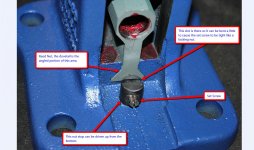
Pretty simple, the nut is held in place with the set screw pushing the nut forward, looks like some one backed the set screw out and after 40+ years everything is gummed up tight. The set screw block drives up from the bottom and needs to be soaking for a bit to loosen up maybe a little heat will help free up the set screw. The nut is held in by a dove tail slide and maybe soak it in Lacquer thinner for a bit and try to drive it back with a hard wood block, clean everything up and reassemble so your nut floats just a little to help align the Spindle with the nut. Do not forget the grease, it looks like your nut has been dry for a while. Good luck TX.
 

Outlawmws

Well-known member
Joined
Aug 9, 2011
Messages
39,246
Location
The Badlands
TX I was talking about the center screw on the swivel base. The slot will need a fairly large drag ling adjusting socket. Looks like a socket with a straight blade screwdriver bit.
 

va.grouseman

Well-known member
Joined
Mar 26, 2011
Messages
4,965
Location
Southern-Central VA.
A big drag link socket and 1/2'' impact driver will move the big bolt holding the base on.---But soak it in some kind of penetrant first.---Or as some on this thread have done, fashion your own drag link out of a socket and a thick washer.


By the ay Tx, that's a very nice specimen you have there.
 
Last edited:

Hephaestus29

Well-known member
Joined
Mar 13, 2011
Messages
2,984
Location
Indianapolis
Does anyone have a spare revolving base for
a Rock Island 6” No 55 Vise they care to part
with? If not I guess I’ll just mount it as is. Thanks
 

txlonghorn1989

Well-known member
Joined
Feb 27, 2017
Messages
2,786
A big drag link socket and 1/2'' impact driver will move the big bolt holding the base on.---But soak it in some kind of penetrant first.---Or as some on this thread have done, fashion your own drag link out of a socket and a thick washer.


By the ay Tx, that's a very nice specimen you have there.

va.g and all,
Does that bolt screw off counter-clockwise? I can easily turn it by hand about an inch either direction before it tightens up. Just want to be sure before I try to give it a hard go. I reckon I'll let it loosen overnight with some PB Blaster.

Also, anything I need to know about the swivel lock? Will it be obvious once the bottom base comes off?

How do I get the handle and the vise screw away from the dynamic jaw? I removed the set screw near the oil hole. It almost looks like there's another set screw in there but the slot is too shallow to get a driver on so I'm thinking maybe not. Wondering if that piece that allows the handle to turn the vise screw doesn't unscrew in some fashion. ???

Sure would be nice if someone had done a thread when they restored their Reed 214 R. :)

Thanks for all the help guys!

Mike
 

Shiftless

Well-known member
Joined
Mar 9, 2014
Messages
14,550
Location
East Bay SFO
The collar on my Reed 406 had 2 set screws. I don’t know if this is factory original or not.
The nose piece does NOT unscrew from the main screw.
The collar that holds the main screw into the slide is easily accessible from underneath. Rotate the handle until you see the set screws. Unscrew the one or two set screws from the collar and pull the main screw out. Don’t lose the collar or those little set screws.
 
Last edited:

454ragtop

Well-known member
Joined
Mar 24, 2008
Messages
5,011
Location
Carver, MA
TX, the setscrew in the side locks the split nut, which is right behind the flattened meatball. It has notches in the face, tap it around counter clockwise with a punch or screwdriver. The center bolt underneath just unscrews counter clockwise like a normal bolt. You need to get the swivel lock free and removed before it will come apart though.
Also, it's your vise, so do what you want, but I don't remove the main nut from the body unless there is a specific problem requiring it. I know some guys like to say they completely disassembled the vise, but seems you can end up making a problem where none existed. YMMV
 
Last edited:

va.grouseman

Well-known member
Joined
Mar 26, 2011
Messages
4,965
Location
Southern-Central VA.
Tx, it unscrews counterclockwise.---Probably has grease or rust build-up in the threads past 1 inch of turn that makes it tighten up again.---Let it soak overnight and then work it back and forth, picking up a little forward progress as you go.


454 makes a good point, but I like to take them down in order to grease moving internal parts good.---Again, your vise, your call.
 

txlonghorn1989

Well-known member
Joined
Feb 27, 2017
Messages
2,786
Pretty simple, the nut is held in place with the set screw pushing the nut forward, looks like some one backed the set screw out and after 40+ years everything is gummed up tight. The set screw block drives up from the bottom and needs to be soaking for a bit to loosen up maybe a little heat will help free up the set screw. The nut is held in by a dove tail slide and maybe soak it in Lacquer thinner for a bit and try to drive it back with a hard wood block, clean everything up and reassemble so your nut floats just a little to help align the Spindle with the nut. Do not forget the grease, it looks like your nut has been dry for a while. Good luck TX.

KMScott,
I wish I could say that I followed all you said but I'd be lying. When you write "the nut" I assume you're referring to the piece that is dove-tailed at the bottom which the vise screw (the "spindle"?) goes into. Correct? That set screw came out very easily by hand. If we're talking about the same set screw. It doesn't appear that the piece that holds the set screw comes out. Or does it? Also, from what you've written it sounds like the "nut" ("holds" the vise screw aka the "spindle"(?) ) is able to travel just a bit forward and backwards. Is that correct? You're suggesting I clean that area. Thinking about it as I write this maybe the "nut" is removable because you couldn't get it in there unless the piece which holds the set screw was removable. That piece does have a slot at the top, so does it unscrew to free the "nut" which could then be slid out the back? Is the piece holding the set screw typically freed with a large screwdriver or maybe a drag link socket (didn't know what these were called so I'm learning a lot here today!).

Thanks!
 

txlonghorn1989

Well-known member
Joined
Feb 27, 2017
Messages
2,786
TX, the setscrew in the side locks the split nut, which is right behind the flattened meatball. It has notches in the face, tap it around counter clockwise with a punch or screwdriver. The center bolt underneath just unscrews counter clockwise like a normal bolt. You need to get the swivel lock free and removed before it will come apart though.
Also, it's your vise, so do what you want, but I don't remove the main nut from the body unless there is a specific problem requiring it. I know some guys like to say they completely disassembled the vise, but seems you can end up making a problem where none existed. YMMV

454,
That is what I was thinking regarding removing the split nut. Are you calling the split nut the main nut or the piece that the vise screw fit into with the dove-tailed bottom? I probably wasn't going to remove that until reading the comments from KMScott. Again, if we're talking about the same things. if that can lead to problems where none existed before I'd rather not mess with it. Am I in synch with you?

My reason for wanting to remove the split nut is so I can get the meatball and handle nice and shiny. Yes?

PS

All who care, should I start a separate thread on this topic or leave it here for others to find in the Vise 101 thread?

Thanks!
 

Shiftless

Well-known member
Joined
Mar 9, 2014
Messages
14,550
Location
East Bay SFO
454,


My reason for wanting to remove the split nut is so I can get the meatball and handle nice and shiny. Yes?

PS

All who care, should I start a separate thread on this topic or leave it here for others to find in the Vise 101 thread?

Thanks!


This kind of question is why this thread was started in the first place.

Sorry I misled you earlier. Your vise uses the split nut and not the collar with the set screws.
IIWY, I too would leave it alone. You can do a good job cleaning up the meatball with a wire wheel. I have even used a mini stainless steel wire wheel mounted on a Dremel tool to get into tight spots.
 

KMScott

Well-known member
Joined
Feb 14, 2012
Messages
4,642
Location
Daufuskie Island, South Carolina
KMScott,
I wish I could say that I followed all you said but I'd be lying. When you write "the nut" I assume you're referring to the piece that is dove-tailed at the bottom which the vise screw (the "spindle"?) goes into. Correct? That set screw came out very easily by hand. If we're talking about the same set screw. It doesn't appear that the piece that holds the set screw comes out. Or does it? Also, from what you've written it sounds like the "nut" ("holds" the vise screw aka the "spindle"(?) ) is able to travel just a bit forward and backwards. Is that correct? You're suggesting I clean that area. Thinking about it as I write this maybe the "nut" is removable because you couldn't get it in there unless the piece which holds the set screw was removable. That piece does have a slot at the top, so does it unscrew to free the "nut" which could then be slid out the back? Is the piece holding the set screw typically freed with a large screwdriver or maybe a drag link socket (didn't know what these were called so I'm learning a lot here today!).

Thanks!

OK, Pictures are worth a thousand words. Please do not be confused that this vise is not a swivel base model. It has the same setup as yours. remove the set screw block by using a punch and drive it up from the bottom. I hope this makes sense to you.
 

Attachments

  • Reed_Nut_and_stop.jpg
    Reed_Nut_and_stop.jpg
    118.2 KB · Views: 58

Carla

MEMBER EMERITUS
Joined
Nov 27, 2010
Messages
672
Sure would be nice if someone had done a thread when they restored their Reed 214 R. :)

Thanks for all the help guys!

Mike
Hi, Mike,

Your 214R is the very uncommon 'filer's vise' pattern, with the higher jaws, but it is otherwise exactly the same as any 200R series Reed, from the little 203R to the rather heavy 206R.......any disassembly, assembly, and restoration details will be the same.

Just for info, a Reed vise number of 103-106 indicates a non-swivel base, and the 400 series, which is found in the 3-1/2 to 6 inch sizes, denotes a swivelling back jaw and swivel base.

All of those, built after approx 1940, which can be identified by the 'short nose' main screw, are the same, other than the specific details of the base type or the jaw arrangement. Any Reed 'R' restoration detail info you may find here or on the internet will apply to your project, as well....... : )

cheers

Carla
 

chrisnazzy

Well-known member
Joined
Apr 20, 2013
Messages
1,671
Location
Arizona
TX, i was working on this and I see KMScott handled the nut and nut stop part so here is some more.

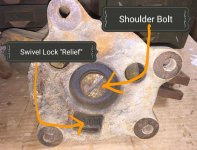
First pic: The large slotted bolt in the bottom is the shoulder bolt. It unthreads counter clockwise. Once it and the swivel lock down are removed you can separate the vise from the swivel base. Once you unscrew the swivel lock down you can rotate the vise until the lockdown bolt lines up with the "relief" in the swivel base and the bolt can slip out.

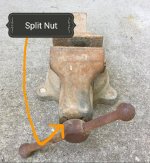
Second Pic: The small slotted screw you've already removed from the side of the vise retains the split nut. The split nut retains the spindle and is located right behind the "meatball". It has slots in it that as stated you can position a small punch in and lightly tap it back counter clockwise to be able to remove the spindle shaft from the dynamic jaw. Once out be careful to not drop the 2 pieces of the split nut.

Hope this helps.
20180602_183028.jpeg20180602_182606.jpeg

Sent from my SM-G930P using Tapatalk
 

txlonghorn1989

Well-known member
Joined
Feb 27, 2017
Messages
2,786
<B>Shiftless</B>,
Thanks. I'll see if my 20 year old Dremel has a mini-stainless steel wire brush and if not I'll try to find one. Great idea!

<B>KMScott</B>,
Thanks for the pic w/ arrows! Absolutely clear now!

<B>Carla</B>,
Thank you for the Reed education! It will help knowing that any info on these other Reeds is relevant to mine.

<B>chrisn</B>,
Thanks. That does help.

I'm sure I'll have other questions. Thanks all for the help so far!!!

Mike
 

Shiftless

Well-known member
Joined
Mar 9, 2014
Messages
14,550
Location
East Bay SFO
You’re welcome Tex.
None of us were born knowing what we now know. We got here by learning from those who came before us.
 

Shiftless

Well-known member
Joined
Mar 9, 2014
Messages
14,550
Location
East Bay SFO
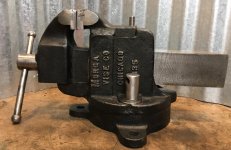
Here is the Morgan 335 that I cleaned up this afternoon.

Double swiveller. Lots of wire wheel work.
It came from a vintage Jeep repair shop in the burn area of Santa Rosa CA.
The old guy’s shop didn’t burn but all around there was devastation so he decided to retire instead of staying in the middle of it all.

I polished the lettering prior to the refinish and buffed off the stain with 320 grit paper after it dried to reveal and highlight the detail. Looks almost like chrome.

I don’t know what happened to the “N” in Morgan. Maybe it wore off long ago with grinding or maybe the original casting guy messed up ????? :dunno:

Maybe it’s like the U.S. Mint 1955 Lincoln penny double die obverse error and now worth tons of money. :)
 

Attachments

  • 2678B1B0-ED1A-4E58-9B35-F44501F59AA6.jpg
    2678B1B0-ED1A-4E58-9B35-F44501F59AA6.jpg
    152.6 KB · Views: 30
  • DA3A3117-A599-4EA2-A934-4EB03DABE9F8.jpg
    DA3A3117-A599-4EA2-A934-4EB03DABE9F8.jpg
    149.1 KB · Views: 33
Last edited:
OP
D

drivesitfar

Well-known member
Joined
Oct 23, 2013
Messages
36,026
Location
Pacific Northwest
Tex: great to see you found a nice Reed vise in the wild cause those that left the factory prior to 1960 are some of my favorites.

i know this thread is getting pretty big, but there should be a few Reed restorations here in it. when I started it a few years ago there were tons of small 10 to 100 post threads on certain vise restorations and even knowing there was one it was hard to find if it hadn't had a post in a while. there are also threads of old Craftsmans made by Reed that would be helpful and sometimes searching through Google first might get you links to older threads that GJ's search engine couldn't find.

for your information purposes even though a lot of the information on how to take apart your reed have already been covered by some of the members that take them apart and put them together quite often here are a few links and hoping PHOTOBUCKET didn't wipe out all the good pictures:

Grigg's Reed 4c where he actually made a new split nut:

https://www.garagejournal.com/forum/showthread.php?t=232946&highlight=grigg+reed

Polar's Reed 3c where a hawk flew in his kitchen window and landed on the handle of his vise that he actually had in his kitchen:

https://www.garagejournal.com/forum/showthread.php?t=236714&highlight=Polar+reed

good luck with your spiffing up and if you are liking the old paint and don't want to take it down to bare metal do like i did on my Reed 2c and just clean it up and put BLO over the old paint. I kinda like it that way too.

good luck and nice find!
 

Attachments

  • Reed 2c 1 (2).jpg
    Reed 2c 1 (2).jpg
    115.9 KB · Views: 30
  • Reed 2c (2).jpg
    Reed 2c (2).jpg
    83.3 KB · Views: 25
  • moved Reed 2c onto oak shelving unit & metal bins 2.jpg
    moved Reed 2c onto oak shelving unit & metal bins 2.jpg
    152.8 KB · Views: 35
To avoid these ads, REGISTER NOW!
Top Bottom