To avoid these ads, REGISTER NOW!

Multihead minisplit and modulation

yeldogt

Well-known member
Joined
Jan 2, 2012
Messages
18,184
I'm home today -- and it's hot. Decided to test and play around w/ my 30k BTU three 12k head Mitsubishi Hyper mini split. I have one head in a sun room and two take care of large bedrooms on the second floor of my beach place.

The one bedroom was off and the other two on -- obviously a sun room in the day time is going to need more cooling. The line to the sun room was freezing -- second bedroom was cool/cold .. third was obviously not on. As I played around with all of the units -- it's clear the outdoor unit can modulate to each head what it needs. It's not sending cold refrigerant to each unit and using the fan to modulate -- it's sending the refrigerant as needed. I could turn them each off and that line set would warm.
 
To avoid these ads, REGISTER NOW!

rlitman

Well-known member
Joined
Oct 18, 2010
Messages
24,633
Location
Long Island
Yep, that's how they work. Variable orifice valves. Nifty, right?

I've been told that some Daikin units can actually have one head heating, while another is cooling.
 

PoorOwner

Well-known member
Joined
Feb 10, 2007
Messages
5,032
Location
CA
Mitsubishi in heating mode and under certain room temp will stop the fan all together to avoid drafts, that's when you can observe the circuit blowing warm air once in a while and then stop to maintain temperature, you haven't seen it on yours? and it DOES maintain temperature, just not in a sense that it will turn way down to < 2000 BTU, over an hour yes, but not in that minute. It does what it says in the brochure, you get different temperature in different rooms.

Cooling mode with the fan on all the time, hard to tell if the coil is flowing or not unless you have a temp probe on the line.

I just don't think that electronic expansion valves can translate flow to a precise BTU, the valve is a stepper motor with hundreds of positions, the programming has got things like superheat, and oil flow, to worry about based on sensor inputs of that moment. We would never know what it does exactly.
 
OP
Y

yeldogt

Well-known member
Joined
Jan 2, 2012
Messages
18,184
Was told that this was the way they worked -- with the other thread discussing this issue -- wanted to take a look.

I guess it's a question of how precise the equipment and controls -- the mitsubishi requires no input .... never touch the control in AC.

PoorOwner: have not noticed that in heating
 

aunsafe2015

Well-known member
Joined
Apr 2, 2016
Messages
436
Location
Northern VA
Was told that this was the way they worked -- with the other thread discussing this issue -- wanted to take a look.

I guess it's a question of how precise the equipment and controls -- the mitsubishi requires no input .... never touch the control in AC.

PoorOwner: have not noticed that in heating
I just wish we had more info. I can look at the engineering manual for the Carrier 5-stage and see exactly how many BTU it puts out in stage 1, stage 3, and stage 5.

I can see the minimum and maximum for the Mitsubishi single-zone units.

Why for the multi-zone units do they only provide a single operating capacity?


Yeldogt, do you get a sense for how often the Mitsubishi units are short cycling compared to whatever you replaced with them?
 
OP
Y

yeldogt

Well-known member
Joined
Jan 2, 2012
Messages
18,184
I just wish we had more info. I can look at the engineering manual for the Carrier 5-stage and see exactly how many BTU it puts out in stage 1, stage 3, and stage 5.

I can see the minimum and maximum for the Mitsubishi single-zone units.

Why for the multi-zone units do they only provide a single operating capacity?


Yeldogt, do you get a sense for how often the Mitsubishi units are short cycling compared to whatever you replaced with them?

My memory is the 30k unit has a minimum of 6k and the heads are 2 or 4 k -- is that what you are speaking of. None are in tiny bedrooms ...I don't get any impression of any short cycling. The 3T carrier 3 zone 5 speed unit takes care of the core of the house -- the mini does the two second floor bedrooms and the sunroom addition. I never hear any of it running .. I can't say enough about the Carrier 5 speed.

In my new house I do have some odd challenges -- with a bilevel space. I may have to go with a small floor unit. The regional rep indicated that they don't publish some the specification or proprietary control operations ... ??
 

aunsafe2015

Well-known member
Joined
Apr 2, 2016
Messages
436
Location
Northern VA
My memory is the 30k unit has a minimum of 6k and the heads are 2 or 4 k -- is that what you are speaking of.

Yes, but if you look closely, Mitsubishi has different submittal sheets for the indoor heads when they are being used in single zone vs multi-zone configuration. The multi zone submittal does NOT give the minimum capacity of the indoor units... So I'd be curious to know where you are getting the 2-4k figure. I assume it's from the submittal for the head in single zone mode... And I don't think we can assume that applies to multi zone use.
 
OP
Y

yeldogt

Well-known member
Joined
Jan 2, 2012
Messages
18,184
When planning the first system using two of the cassettes we (installation company and myself) were trying to understand how the units differed in operation vs the nicer wall head units with the occupancy eye. Clearly w/o the eye the cassettes were going to operate differently ... it was during those discussions that we learned that the cassettes (and many others) used a three speed fan.

I was a bit concerned that the operation/comfort would be compromised if the units (cassettes) really only had three setting. With no good spot for the head units -- the cassettes looked like the best option. The installation company was the highest level Mitsubishi installer -- whatever that's called. They had done a lot of installs -- but not the ceiling units with the three (3) head compressor. They were also a top carrier dealer and I was trying to decide on the Greenspeed vs the 5 speed for the core of the house. This was a 30+k install ... so it was not something to mess up.

While the above was occurring we were living nearby in a big victorian(friends) that had a year old Fujitsu 7 head system that used the inside distribution boxes w/ one external compressor. I knew the guy who installed that system and he was giving me an estimate for Fujitsu .. and Trane.

To make a long story short -- after talking to the east coast rep and another guy at Mitsubishi corporate technical. They basically told me not to worry -- that yes, the high end head had the most sophisticated controls ... but the ceiling units can fully modulate and the fan speed stepped in auto. The technical guy is the one who told me they don't publish the operation.

My only guess is that when only one head is turned on ... that head has to take the full 6k .. when more then one is on -- it can split the flow. From my observation yesterday -- there was not a lot coming out of the second ceiling unit .. not 6k. My guess is the unit has to ramp on and off under that light load. The Fujitsu Installer was honest and told me that he did not have anything that would work as well as the three head hyper that it was the best out there -- and Trane did not have a match for the 5 speed.

When I did the second system at the beach -- I did the three heads with the eye. The split output of the head units really works
 

Jackfre

Well-known member
Joined
Dec 26, 2010
Messages
4,411
Location
N CA
YD, can you get your hands on a data-logger to read the amperage draw on the condenser while you are noodling around on the unit? You could pick up the draw on the evaporators as well if you can get a 4 point unit. I think that would be useful information.
 
OP
Y

yeldogt

Well-known member
Joined
Jan 2, 2012
Messages
18,184
YD, can you get your hands on a data-logger to read the amperage draw on the condenser while you are noodling around on the unit? You could pick up the draw on the evaporators as well if you can get a 4 point unit. I think that would be useful information.

Don't have an amp meter ....sorry.
 

theoldwizard1

Well-known member
Joined
Feb 22, 2011
Messages
43,218
Location
SE MI
Yep, that's how they work. Variable orifice valves. Nifty, right?
I am not a HVAC guy, but I understand the heating/cooling cycle better that the average person.

You reference an "orifice valve". Is this different from the thermostatic expansion valve (TXV) ? Clearly, when cooling loads differ between air handlers different amounts of "working fluid" need to be delivered to the TXV.

Do you have any diagrams of this ?
 
OP
Y

yeldogt

Well-known member
Joined
Jan 2, 2012
Messages
18,184
I am not a HVAC guy, but I understand the heating/cooling cycle better that the average person.

You reference an "orifice valve". Is this different from the thermostatic expansion valve (TXV) ? Clearly, when cooling loads differ between air handlers different amounts of "working fluid" need to be delivered to the TXV.

Do you have any diagrams of this ?


The flow is controlled by a pulse modulating valve -- remember the gas expansion is being done at the outdoor unit. That's why both lines must be insulated. The expansion must occur prior to the valve. The control and interaction of the heads is what's adding to the cost .. and the systems are not the same.

It's all proprietary equipment. Dankin was the first with this equipment and call it VRV w/copyright ... that's why everyone else calls it VRF. Fujitsu was the first to bring the smaller systems to the USA using the secondary boxes. Mitsubishi went the Multi head using one compressor. They don't tell you how it's all working beyond pointing out the components.

A multi head unit typically has greater head capacity -- since a given building envelope is never going to need all the capacity at once the multi head units allow for greater flexibility while keeping the outdoor unit in it's peak operating band.
 
To avoid these ads, REGISTER NOW!

Jackfre

Well-known member
Joined
Dec 26, 2010
Messages
4,411
Location
N CA
The other thing to look at with the multis is the total line set lengths allowed as well as min/max numbers for each evap.
 
OP
Y

yeldogt

Well-known member
Joined
Jan 2, 2012
Messages
18,184
The other thing to look at with the multis is the total line set lengths allowed as well as min/max numbers for each evap.

The home run systems - like the Mitsubishi 3 head systems that I have used have impressive lengths -- it's obviously got to be thought out but it allows for much flexibility.

When you bump up to the distribution box -- the numbers increase. I have been in 4 very large 3 story victorians era homes using the Fujitsu system -- it's impressive. I'm going to visit a Mitsubishi system at some point this summer using a combination air handler and heads (not installed yet).
 

theoldwizard1

Well-known member
Joined
Feb 22, 2011
Messages
43,218
Location
SE MI
The flow is controlled by a pulse modulating valve -- remember the gas expansion is being done at the outdoor unit. That's why both lines must be insulated. The expansion must occur prior to the valve. The control and interaction of the heads is what's adding to the cost .. and the systems are not the same.
Sorry, your explanation is just not "clicking" with me. I need some diagrams/chalk talk !
 
OP
Y

yeldogt

Well-known member
Joined
Jan 2, 2012
Messages
18,184
Sorry, your explanation is just not "clicking" with me. I need some diagrams/chalk talk !

A typical AC system w/ condenser and evaporator has the metering device at the evaporator -- there are various types. The gas expands at the evaporator cooling the coils absorbing heat -- the remaining cold refrigerant is returned to the compressor to be pressurized and sent through the condenser where heat is given off.

With a mini the metering occurs outside -- in effect all the tubes (line set) and evaporator are the evaporator. There is some additional expansion -- that's why everything needs to be insulated and the tubes are about the same size.

Think of it like a hot water system and radiators ....zones.
 

theoldwizard1

Well-known member
Joined
Feb 22, 2011
Messages
43,218
Location
SE MI
A typical AC system w/ condenser and evaporator has the metering device at the evaporator -- there are various types ...
Okay, I understand what you are talking about
Thermal EXpansion Valve (TXV or TEV). This are usually controlled by a capillary tube connected to a pipe very near the evaporator. Some are now controlled by a small motor and a computer reads the temperature off of the pipe.

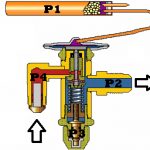
txv_edit1-150x150.jpg
Electronic-expansion-valve.jpg


Any heat pump will have to have 2 or more TXV. One at each evaporator/condenser. Plus a reversing valve and one way valve. Lot of plumbing !
 
Last edited:

PoorOwner

Well-known member
Joined
Feb 10, 2007
Messages
5,032
Location
CA
Old wizard you can go to Mitsubishi and download whichever service manual you want.
Refrigeration diagram is inside these manuals.

They typically have one EEV for each zone. That’s all the metering that done. I still don’t think it can divide BTU precisely. It may have a few presets and that’s it.

Imagine you are asked to write the code to program PWM values for these EEVs based on the duty cycle of the compressor, inverter, indoor head unit temperature. The metric that you would program that is not going to be in BTUs. The inverter can only control the compressor in about 6 steps. Some have 10.
 
OP
Y

yeldogt

Well-known member
Joined
Jan 2, 2012
Messages
18,184
Old wizard you can go to Mitsubishi and download whichever service manual you want.
Refrigeration diagram is inside these manuals.

They typically have one EEV for each zone. That’s all the metering that done. I still don’t think it can divide BTU precisely. It may have a few presets and that’s it.

Imagine you are asked to write the code to program PWM values for these EEVs based on the duty cycle of the compressor, inverter, indoor head unit temperature. The metric that you would program that is not going to be in BTUs. The inverter can only control the compressor in about 6 steps. Some have 10.


What divides the units is this capacity -- the ability to match the loads. The better units do have variable drive and metering ... the Mitsubishi engineer told me this a few years ago.
 

u3b3rg33k

Well-known member
Joined
Dec 18, 2017
Messages
4,048
Old wizard you can go to Mitsubishi and download whichever service manual you want.
Refrigeration diagram is inside these manuals.

They typically have one EEV for each zone. That’s all the metering that done. I still don’t think it can divide BTU precisely. It may have a few presets and that’s it.

Imagine you are asked to write the code to program PWM values for these EEVs based on the duty cycle of the compressor, inverter, indoor head unit temperature. The metric that you would program that is not going to be in BTUs. The inverter can only control the compressor in about 6 steps. Some have 10.

I can't disagree more vehemently with you here. inverters put out a given frequency, and if you've ever listened to music or used a smartphone, you'd know that any frequency you want can be generated. you can have any amount of power you want at whatever frequency you'd want (rock concert). with a cheap inverter, you can have regulation to the Hz. with a good inverter and positive feedback (position sensor), you can know exactly how much slip you have and control the drive frequency to maintain a constant shaft speed even with varying load at a given frequency.

heck, 1970s technology can control a 6 chambered controlled combustion/gas expansion power unit to 6000 discrete speeds from 500-6500RPM, all while not blowing out a secondary platinum/rhodium coated ceramic honeycomb combustor!
this is more commonly known as a "car engine".
:lol_hitti
6 steps in your car would be hilarious.

/rant
 
Last edited:

rlitman

Well-known member
Joined
Oct 18, 2010
Messages
24,633
Location
Long Island
I can't disagree more vehemently with you here. inverters put out a given frequency, and if you've ever listened to music or used a smartphone, you'd know that any frequency you want can be generated. you can have any amount of power you want at whatever frequency you'd want (rock concert). with a cheap inverter, you can have regulation to the Hz. with a good inverter and positive feedback (position sensor), you can know exactly how much slip you have and control the drive frequency to maintain a constant shaft speed even with varying load at a given frequency.

heck, 1970s technology can control a 6 chambered controlled combustion/gas expansion power unit to 6000 discrete speeds from 500-6500RPM, all while not blowing out a secondary platinum/rhodium coated ceramic honeycomb combustor!
this is more commonly known as a "car engine".
:lol_hitti
6 steps in your car would be hilarious.

/rant

Totally agreed. I believe he is confused by the nature of a 6 or 12 pulse inverter. This has nothing to do with the number of frequencies it can produce.
 

PoorOwner

Well-known member
Joined
Feb 10, 2007
Messages
5,032
Location
CA
I made a mistake in that I mean these machine do step in a set "hz" increments, it does results in a staircase graph in terms of output levels.

However Friedrich claims theirs can work in 1hz increments
 

Attachments

  • Screen Shot 2018-06-07 at 9.32.25 PM.jpg
    Screen Shot 2018-06-07 at 9.32.25 PM.jpg
    19.6 KB · Views: 11
OP
Y

yeldogt

Well-known member
Joined
Jan 2, 2012
Messages
18,184
I made a mistake in that I mean these machine do step in a set "hz" increments, it does results in a staircase graph in terms of output levels.

However Friedrich claims theirs can work in 1hz increments


There is a difference between the controller and the devise. Some compressors and metering devises do have a set number of steps.

inverter controls ..since they use current on and off have a natural limit in steps.
 
To avoid these ads, REGISTER NOW!
Top Bottom