To avoid these ads, REGISTER NOW!

Those with T1-11 siding with horizontal seams

daveindenver

Member
Joined
May 12, 2018
Messages
22
Hi. For those with T1-11 sheet siding such as the LP SmartSide stuff - where there are horizontal **** joints, do you have any flashing involved in the seam? I am talking about the joints such as on the gable ends or if you have higher than 9ft walls you probably have one all the way around. I just had a garage built and all there is over the horizontal joints is a trim board that is caulked on the upper part. I was not happy when it was being done that way but it does seem to be pretty common. Now though, I am having water coming in a couple places during heavy rains and I am pretty sure that is where it is coming from. I am sure the builders solution is going to be to send his handy-man who I am sure will just apply some additional caulk around where I am seeing water come in. I have included a picture. Under the horizontal trim board there is an uneven **** joint with no flashing.

I know how it is supposed to be done - overlapped or with Z flashing and no trim board at all or possibly with Z flashing over the trim board. I am asking if many have it as I have it with no problems because I believe I see it this way a lot - it's tough to tell without trespassing but I see a lot that look like they are just trim boards covering the seam at least.

I want to fix this water issue once and not have to worry about it.
 

Attachments

  • garage_front.jpg
    garage_front.jpg
    160 KB · Views: 359
To avoid these ads, REGISTER NOW!

yeldogt

Well-known member
Joined
Jan 2, 2012
Messages
18,184
One of my pet peeves with trades people -- the overuse and reliance on caulk. Part of it is the way some manufacturers recommend the use .... it gives a false product life spans. Anytime I pick up a tube -- I question why I'm using it and wheat going to happen when it fails.

To answer your question -- yes I do see it .. but it's wrong. The trim strip should be fully caped and angled ... just like a window or door. Placing the trim over a properly Z flashed T-11 does not stop water from sitting behind the trim --- but would have stopped the water from getting into the house.

I wonder what the joint looks like?
 
OP
D

daveindenver

Member
Joined
May 12, 2018
Messages
22
One of my pet peeves with trades people -- the overuse and reliance on caulk. Part of it is the way some manufacturers recommend the use .... it gives a false product life spans. Anytime I pick up a tube -- I question why I'm using it and wheat going to happen when it fails.

To answer your question -- yes I do see it .. but it's wrong. The trim strip should be fully caped and angled ... just like a window or door. Placing the trim over a properly Z flashed T-11 does not stop water from sitting behind the trim --- but would have stopped the water from getting into the house.

I wonder what the joint looks like?

My guess is the joint is ragged. Sad but I probably don't have much of a choice with the builder other than to let him come and caulk it. Then I can figure out how to fix it so I won't have to worry about it.
 
Last edited:

yeldogt

Well-known member
Joined
Jan 2, 2012
Messages
18,184
Judging from the way they built the rest of it, my guess is the joint is ragged. Sad but I probably don't have much of a choice with the builder other than to let him come and caulk it. Then I can figure out how to fix it so I won't have to worry about it.

I get it ... what so pisses me off is it's really not much harder to do it correctly. Currently -- you are annoyed ... you want the guy to come back -- and you can't recommend him. No one wins ...

I'm an old house guy. Studied historic buildings and restoration early in my college career before switching majors ... other than sealing glass to a window -- and to shed water from stone/wood joints .. old building don't have any. They flash.

People use caulk all over a roof -- including ice and water shield products -- then put nails through it? No logic in it
 

ddawg16

Well-known member
Joined
Jul 11, 2008
Messages
21,005
Location
S. California
I get it ... what so pisses me off is it's really not much harder to do it correctly. Currently -- you are annoyed ... you want the guy to come back -- and you can't recommend him. No one wins ...

I'm an old house guy. Studied historic buildings and restoration early in my college career before switching majors ... other than sealing glass to a window -- and to shed water from stone/wood joints .. old building don't have any. They flash.

People use caulk all over a roof -- including ice and water shield products -- then put nails through it? No logic in it

Like Green and Green? FLW?

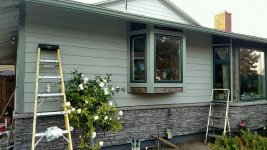
I just refaced the front of my house....it used to be vert 1x6 T&G boards....did a lot of clean up....termite damage repair....changed the electrical and plumbing....added insulation and shear wall.

Then put in new windows properly flashed. Even without tar paper, water will not get in.

I put ledger stone at the bottom....any moisture that gets behind has a path out....proper weep screed at the bottom. The interface between the LP Smartside and top of the ledger stone has proper flashing. Should any moisture get behind the LP Smartside...it will exit at the flashing before it gets a chance to go down behind the ledger stone.

I did NOT use flashing above the windows. The windows themselves are flashed and sealed. I have that long overhang so water does not have an easy way to get in. If it does, I have the recommended caulk in the right places.

I contemplated using flashing on the bottom part of the windows....but there was no real way to attach it so it would do any good. The window facing has a lip and the lower trim kinda tucks under it. All the trim is primed and painted....and I run a generous bead of caulk on top of the trim board before I put it in place....then caulk again after it's installed. It's been a year and it all still looks perfect.

But then again....I'm in California....rain is not our issue.....lack of it is...........
 

Attachments

  • FrontSidingDone.jpg
    FrontSidingDone.jpg
    157 KB · Views: 132

Radix2

Well-known member
Joined
May 28, 2014
Messages
1,853
Location
the thumb!, MI
Hi. For those with T1-11 sheet siding such as the LP SmartSide stuff - where there are horizontal **** joints, do you have any flashing involved in the seam? I am talking about the joints such as on the gable ends or if you have higher than 9ft walls you probably have one all the way around. I just had a garage built and all there is over the horizontal joints is a trim board that is caulked on the upper part. I was not happy when it was being done that way but it does seem to be pretty common. Now though, I am having water coming in a couple places during heavy rains and I am pretty sure that is where it is coming from. I am sure the builders solution is going to be to send his handy-man who I am sure will just apply some additional caulk around where I am seeing water come in. I have included a picture. Under the horizontal trim board there is an uneven **** joint with no flashing.

I know how it is supposed to be done - overlapped or with Z flashing and no trim board at all or possibly with Z flashing over the trim board. I am asking if many have it as I have it with no problems because I believe I see it this way a lot - it's tough to tell without trespassing but I see a lot that look like they are just trim boards covering the seam at least.

I want to fix this water issue once and not have to worry about it.
I saw your other post first, and put my rant over there on builders bs about not doing proper flashing. As you say, it would have taken a whole 5 extra minutes to put the flasing down before nailing the siding...

Unfortunately the correct fix is now very difficult and you are faced with keeping the caulk perfect forever.

Make sure you are using good polyurethane caulk. Of course the builder probably put some cheap **** on there that will make it even tougher.

Darn it.
 

brokeboater

Well-known member
Joined
Apr 19, 2018
Messages
331
Location
North Central Florida
I resided my mobile home with SmartPanels seven years ago and haven't had any problems. I since rebuilt my pump house, shed and built a 13x36 shop using the stuff. I have the same kind of design with a horizontal joint but I overlapped the upper using firing strips. Z flashing would have accomplished the same thing. What you have there is and always will be a problem. That kind of non-sense is why I do everything myself whether I know what I'm doing or not. I can think of several cobbled together fixes for the abomination you have there but I doubt with a brand new garage you would want to go there. At the very least I'd get rid of the cover board. Tape 1/4" or so on either side of the seam and caulk it all with the best quality caulk you can get. Make sure the caulk is squeezed into the joint very well. Then prime and paint.

Even by my standards SmartPanels are cheap. Pretty much impossible to remove if they've been property installed but cheap to replace. Rip the upper section off and reinstall with Z flashing or remove that trim board and install SmartPanels either over the top of the upper section or on firing strips after removing the upper portion. If someone is careful and a little bit skilled (I know that's asking quite of bit from a contractor) they could cut new panels that would fit tightly against the upper trim board and that seam could be caulked to good effect because it's in a protected from runoff water area.

Good luck.
 

Bretny

Well-known member
Joined
Jul 31, 2017
Messages
3,918
Location
Dutchess county NY
I have a seam like that on my gabel ends on my 1997 built garage. It has Z flashing and then they stuck a trim board over it. The trim board is rotted and so is the bottom of the upper piece of T1 11. I bought the place 8 yrs ago and it was rotted then. There was also water leaking in above the windows. The horizontal trim they used between the foundation blocks and the t1 11 on the bottom of the wall also rotted. So flash it in aluminum or side it is the really only awnser.

T1 11 is only a bandaid until you side it to me. Painting t1 11 is not worth my time when i can side it my self once and never have to do it again.
 

Norcal

Well-known member
Joined
Mar 16, 2008
Messages
13,769
Z-bar is your friend, if big box stores do not have it, a decent lumber yard should have it.
 

GrayFlattop

Well-known member
Joined
Jan 18, 2018
Messages
1,051
Location
Chicago
Hi. For those with T1-11 sheet siding such as the LP SmartSide stuff - where there are horizontal **** joints, do you have any flashing involved in the seam? I am talking about the joints such as on the gable ends or if you have higher than 9ft walls you probably have one all the way around. I just had a garage built and all there is over the horizontal joints is a trim board that is caulked on the upper part. I was not happy when it was being done that way but it does seem to be pretty common. Now though, I am having water coming in a couple places during heavy rains and I am pretty sure that is where it is coming from. I am sure the builders solution is going to be to send his handy-man who I am sure will just apply some additional caulk around where I am seeing water come in. I have included a picture. Under the horizontal trim board there is an uneven **** joint with no flashing.

I know how it is supposed to be done - overlapped or with Z flashing and no trim board at all or possibly with Z flashing over the trim board. I am asking if many have it as I have it with no problems because I believe I see it this way a lot - it's tough to tell without trespassing but I see a lot that look like they are just trim boards covering the seam at least.

I want to fix this water issue once and not have to worry about it.

Z flashing at this joint is the only effective way to deal with this detail. When I built my garage almost 30 years ago, I bent up a few pieces of copper into z flashing for the gable ends. The visible "leg" was only about 1/2" which I covered in masking tape before spraying the garage - it weathered into a nice little detail that probably nobody noticed but me.

A Z flashing detail should have been specified in the drawings or written building specifications, if not it is still adopted practice. If I was contracting this out, the builder would not see the final payout until it was corrected. Unless you are already finished on the inside, it's not the end of the world to retrofit this. If you don't feel like fighting with the contractor - then it's up to you to fix it right and fix it once.

Caulking is not a viable solution for more than a few months. Any "professional" that would resort to this. - or that would cover it with a trim board and caulk - simply does not know enough about their craft - they are unqualified.

Please refer to the manufacturer's installation instructions - page 4 where "horizontal beltline joint" details are described: https://lpcorp.com/resources/produc...panel-siding-application-instructions-english

My site-built flashing protected that joint very well. A few years ago I re-did the siding using fiber cement lap siding to more closely match the look of the house (Cedar bevel siding). This joint held up very well. There were other areas that ultimately succumbed to undetected termite damage, but that was repaired / remediated before the fiber cement went up.
 

dave_dj1

Well-known member
Joined
Feb 3, 2018
Messages
222
Location
Jackson, NY
Have the builder run a skill saw across the top and bottom of that board, take it off along with the siding, put the Z flashing in top and bottom and put a new board in, even 5/4 if you want it to protrude. They make flashing either 3/4 or 5/4.
 
To avoid these ads, REGISTER NOW!
OP
D

daveindenver

Member
Joined
May 12, 2018
Messages
22
Thank you for all the responses!

I was hoping for a few "had it like that for 10 years with no problems" but I am not too surprised.

Cutting it out top and bottom is a possibility. I'd have to check where it would line up with the top plate.

I actually sent that same SmartSide instruction pdf to him when I first questioned his methods. It did no good obviously and I relented and said the most important thing is that it does not leak and if this is an accepted practice, then it is fine. I trusted his experience which I will never do again.

Not sure exactly what I am going to do at this point. I'll have to think about my options.
 
Last edited:

dave_dj1

Well-known member
Joined
Feb 3, 2018
Messages
222
Location
Jackson, NY
Maybe you could add some blocking if it's too far above the plate. Looks like he follows what the trailer and shed builders do :(
 

Bretny

Well-known member
Joined
Jul 31, 2017
Messages
3,918
Location
Dutchess county NY
Just because its accepted practice dosnt mean it needs to be done that way on your building.

I think part of my issue was that the top piece of siding sat in the bottom of the Z flashing. This could not let it dry out..and im sure the trim covering the whole thing didnt help.
 

Radix2

Well-known member
Joined
May 28, 2014
Messages
1,853
Location
the thumb!, MI
Warranty with proper flashing and installation -50 yrs

Without - none.

This is the siding version of drilling holes and making random cuts in trusses....
 

theoldwizard1

Well-known member
Joined
Feb 22, 2011
Messages
43,238
Location
SE MI
I know how it is supposed to be done - overlapped or with Z flashing and no trim board at all or possibly with Z flashing over the trim board.

Why no trim over a Z flashed horizontal **** joint ? You definitely do NOT want caulk along the bottom of the trim board so that water can get out.
 

Motown

Well-known member
Joined
May 11, 2011
Messages
1,703
Location
SE Michigan
Smart Side, specifies a specific caulk to use with their product. Its OSI Max-Quad. Stuffs a little over $7 a tube at HD.
 

GrayFlattop

Well-known member
Joined
Jan 18, 2018
Messages
1,051
Location
Chicago
Why no trim over a Z flashed horizontal **** joint ? You definitely do NOT want caulk along the bottom of the trim board so that water can get out.

The Z flashing would have to extend OVER the top of the trim to be effective.

Otherwise water will collect behind the trim - and specifically in the sidings vertical grooves. And caulking will not be an effective barrier for very long.
 

theoldwizard1

Well-known member
Joined
Feb 22, 2011
Messages
43,238
Location
SE MI
Why no trim over a Z flashed horizontal **** joint ? You definitely do NOT want caulk along the bottom of the trim board so that water can get out.
The Z flashing would have to extend OVER the top of the trim to be effective.

Otherwise water will collect behind the trim - and specifically in the sidings vertical grooves. And caulking will not be an effective barrier for very long.
The point of flashing is to prevent water from getting inside of a building. Who cares if water gets behind the trim as long as it has a way to get out ? Priming and painting the back side of the trim will make it last longer
 

yeldogt

Well-known member
Joined
Jan 2, 2012
Messages
18,184
The point of flashing is to prevent water from getting inside of a building. Who cares if water gets behind the trim as long as it has a way to get out ? Priming and painting the back side of the trim will make it last longer

w/o a flashing ..any horizontal applied trim will rot eventually if water can get behind it.
 

KenC

Well-known member
Joined
Dec 20, 2009
Messages
2,594
Location
oklahoma
Not an ideal fix, but without a huge amount of tearoff/reinstall this is what I'd do:
Get a few tubes of the best polyurethane caulk you can find.

pull the trim.
fill the gap between the sheets level full with caulk
use new trim
rip a bevel on both sides of the trim. top angle down and out, bottom angle up and in to create a drip edge.
paint all sides before install
Put a good bead of caulk on the siding to hit top, inside of the new trim before putting it on.
If you do this right the caulk will extrude a little bit up and out, tool that down.
The trim is now sealed to the siding and the grooves are open to allow water to shed.
 

GrayFlattop

Well-known member
Joined
Jan 18, 2018
Messages
1,051
Location
Chicago
The point of flashing is to prevent water from getting inside of a building. Who cares if water gets behind the trim as long as it has a way to get out ? Priming and painting the back side of the trim will make it last longer

The point of flashing is to direct / divert water away from building elements. Water will always take the shortest path unless otherwise guided.

In theory - "as long as it has a way to get out" is correct, but I'd bet the trim isn't held away from the siding with a 3/4" spacer. Water will get behind it, the trim and the siding will decay prematurely and you will create a place that termites will love to call home.

Trim + caulk will work for a year or so, but it will eventually fail.
 
To avoid these ads, REGISTER NOW!
Top Bottom