To avoid these ads, REGISTER NOW!

The VISES of Garage Journal

gman007

Well-known member
Joined
May 17, 2017
Messages
2,743
Location
West Michigan
That's a big boy 6" vise. The only Starrett/Athol catalog page I have shows the 626 as the predecessor to the 926 and lists the weight at 205 lbs. No surprise though as Athol vises certainly have extra "heft" in all the right spots.

Congratulations. I would have gladly taken a road trip for that one if the price was right!

Sent from my SM-G930P using Tapatalk

:+1:

The vise spread sheet lists the weight for 626 at 175 lbs and 926 at 182 lbs.
But there is also an entry for a 926C at 205 lbs which might be a combo vise (there is no link for a photo but there is a photo for 925C which show it is a combo- well despite the usual missing pipe jaws) and 926C being a combo explains the extra weight.

Regardless as Chris said these Athols are pretty hefty even for a 6” vise.
 
To avoid these ads, REGISTER NOW!

mike_paxton

Well-known member
Joined
Dec 15, 2013
Messages
905
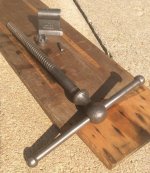
The only possible useful donor parts might be the main screw/handle and the nut

gman007:

When I first saw Bulldog #52 Vise, was kind of shocked as owner had said it was in pretty good shape.

After I saw it, still felt that there was some parts on it (see pic 1) that might work as a donor, so pulled them off for a future save.

Mike
 

Attachments

  • IMG_0198.jpg
    IMG_0198.jpg
    145.5 KB · Views: 27
  • IMG_0194.jpg
    IMG_0194.jpg
    149.1 KB · Views: 26
  • IMG_0195.jpg
    IMG_0195.jpg
    152.2 KB · Views: 27

gman007

Well-known member
Joined
May 17, 2017
Messages
2,743
Location
West Michigan
gman007:

When I first saw Bulldog #52 Vise, was kind of shocked as owner had said it was in pretty good shape.

After I saw it, still felt that there was some parts on it (see pic 1) that might work as a donor, so pulled them off for a future save.

Mike

Mike From what I have seen in the past on epry when I was desperately searching for vise parts the main screw for this size vise was going for around $30-$40 and the nut for around $20. And prices might have even gone up higher since. So if you have not invested much into the vise you did well.

BUT in my view more importantly one donor vise can provide enough parts to possibly revive several other vises. Even just with these two parts, you can turnout to be the “vise hero” saving the “vise day” for possibly two other vise guys :thumbup:
 
Last edited:

Mark in Indiana

Well-known member
Joined
Aug 11, 2010
Messages
3,057
Location
Southern Indiana
eddieK and Outlaw:

Thanks for info on the jaws.

If the jaws were the only problem with vise, I'd probably do what you suggested.

Here is some other pics of same vise from other angles.

Mike

Seems to be common with Prentiss vises?
Here are some pictures of another broken Bull Dog.
Sad that morons are allowed to use big hammers.
 

Attachments

  • BROKEN BULL DOG4.jpg
    BROKEN BULL DOG4.jpg
    149.1 KB · Views: 43
  • BROKEN BULL DOG3.jpg
    BROKEN BULL DOG3.jpg
    150.1 KB · Views: 46
  • BROKEN BULL DOG2.jpg
    BROKEN BULL DOG2.jpg
    152 KB · Views: 50
  • BROKEN BULL DOG1.jpg
    BROKEN BULL DOG1.jpg
    150.5 KB · Views: 55

gman007

Well-known member
Joined
May 17, 2017
Messages
2,743
Location
West Michigan
Breakage in general is common with Prentiss vises. At least 50% of them I see are broken.

Conventional wisdom is that Prentiss vises were less ductile and more brittle hence more prone to breakage when subjected to abuse than other brands. Supposedly this is particularly true about the Prentiss slides but based on the last two anecdotal examples perhaps this is true not just for the slides but also the rest of the vise too.
 
Last edited:

PacificaVette

Well-known member
Joined
Nov 30, 2013
Messages
187
Location
Pacifica, CA
Conventional wisdom is that Prentiss vises were less ductile and more brittle hence more prone to breakage when subjected to abuse than other brands. Supposedly this is particularly true about the Prentiss slides but based on the last two anecdotal examples perhaps this is true not just for the slides but also the rest of the vise too.

Funny---I've never seen a broken Prentiss vise. I have three Prentiss vises, and they all work fine, with no signs of any damage. You're probably right---they are good vises and stand up well unless abused.
 

gman007

Well-known member
Joined
May 17, 2017
Messages
2,743
Location
West Michigan
Funny---I've never seen a broken Prentiss vise. I have three Prentiss vises, and they all work fine, with no signs of any damage. You're probably right---they are good vises and stand up well unless abused.

I have only one and it is in great shape and I believe many members here have a lot of Prentiss in good working order.

But then again on this thread presumably there have been more posts about Prentiss vises with such issues than other brands. However, even then One can not fault the vise if it’s dropped or it slide is used as an anvil or it subjected to abuses that the vise was not designed for. Having said that it seems some brands take unfair abuse and punishment better than others.
 

ganymede

Well-known member
Joined
Nov 29, 2012
Messages
2,332
Location
New England
I see more broken Prentiss than any other brand but it wouldn't stop me from picking one up and using it should the opportunity arise.
My buddy has one that he pulled out of a machine shop dumpster and hes been using it for years now.
Also the great firearms inventor John Moses Browning had a Prentiss on his bench so that overrides everything else. :)
 

oneoldboot

Member
Joined
May 16, 2018
Messages
18
Location
Pa
Not sure if this qualifies as a clamp or vise. It holds a saw blade in place for sharpening.
 

Attachments

  • 20180713_121442.jpg
    20180713_121442.jpg
    161.6 KB · Views: 69
  • 20180713_121519.jpg
    20180713_121519.jpg
    157.9 KB · Views: 74
Last edited:

chrisnazzy

Well-known member
Joined
Apr 20, 2013
Messages
1,671
Location
Arizona
I have 2 Prentiss vises and both are free of any cracks or damage. I've passed on several others that did have the seemingly characteristic tail crack. Ultimately I'm not sure any vise could stand up to what some hammer wielding idiots apparently think they can. I do agree though that over the last year since getting into collecting and restoring vises, I've seen more broken Prentiss vises than any other vintage brand by a sizable margin.

Sent from my SM-G930P using Tapatalk
 

Outlawmws

Well-known member
Joined
Aug 9, 2011
Messages
39,296
Location
The Badlands
I have three Prentiss vises, None are broken. Supporting what has been said, its the luck of the draw... Some get dropped/abused, some don't
 

trijeff

Well-known member
Joined
Jan 21, 2015
Messages
1,359
Location
Northern Cali
an alternate perspective on the broken Prentiss vises ... maybe really similar damage rates as other vises, but able to still work afterwards whereas others when damaged were fatally so. In other words, maybe we just see wrecked Prentiss more because they still work and the others were trashed. Just an idea. The two Prentiss I have are so big as to take abuse (98) or so small it didn't see it (jewelers).

Sent from my SM-G900T using Tapatalk
 

kwoswalt99

Well-known member
Joined
Oct 24, 2015
Messages
701
Location
Detroit
an alternate perspective on the broken Prentiss vises ... maybe really similar damage rates as other vises, but able to still work afterwards whereas others when damaged were fatally so. In other words, maybe we just see wrecked Prentiss more because they still work and the others were trashed. Just an idea. The two Prentiss I have are so big as to take abuse (98) or so small it didn't see it (jewelers).

Sent from my SM-G900T using Tapatalk

I’ve actually seen more broken Parkers than I have Prentiss. Probably just because they’re more common.
 

mgmlvks

Well-known member
Joined
Jul 28, 2017
Messages
200
Location
Leavenworth, KS
Found a No-Name 4.5" Swivel Jaw with Swivel Base on a FB ad. Think it is a pattern vise due to the slender and deep jaws. No real abuse, just honest wear and tear and it all works fine.

Taking advantage of all the advice here - I did not ask too many questions and basically got in the truck and drove 50 miles at the first available opportunity. We worked a good package deal with some other items and ultimately paid meaningfully less than the asking price.

Only mark I see is "148" over the spindle.

Can anyone help ID the maker, model and age?

43387966342_72659abced_z.jpg


42531561555_01b8549027_z.jpg


42531567905_e00d30166b_z.jpg


43436286731_707d0aa429_z.jpg
 
Last edited:
To avoid these ads, REGISTER NOW!

gman007

Well-known member
Joined
May 17, 2017
Messages
2,743
Location
West Michigan
Prentiss coachmaker’s vise, probably a model 148. Age is old.


:+1: On Prentiss Coachmakers but I am not sure if the model is in fact 148 as vise spread sheet does not have such a listing but it does have a listing for a Prentiss Coachmakers model 26 which has 4.5" jaws, weight 67 lbs, swivel base and swivel jaws which seems to fit the bill for all the supposed stats (brand, type, jaw width, swivel base, swivle jaw, push/pull swivel lock arm).

Mgmlvks Very nice score :thumbup:
 

Attachments

  • Prentiss 26.jpg
    Prentiss 26.jpg
    145.7 KB · Views: 49
Last edited:

nutjob

Well-known member
Joined
May 8, 2008
Messages
808
Location
NE, PA
Picked up this Reed 406 R this weekend. 164lbs of vise! Came apart pretty easy. Its is primer and almost ready for color.

What color? I think these were black? I am thinking of green, see sample pic or a dark green. Anyone know what that color is?

Any suggestions?

Thanks

Kevin
 

Attachments

  • sample color.jpg
    sample color.jpg
    83.6 KB · Views: 66
  • IMG_0717.jpg
    IMG_0717.jpg
    138.5 KB · Views: 64

Josh C

Well-known member
Joined
Feb 28, 2018
Messages
97
Location
Dugspur, VA, USA
Hey folks have a question. I’m not very knowledgeable on vises so before I destroy something that may at least have some interesting historical value thought I would ask. Have a Reed 104 that I picked up today from a Craigslist add. Now I own and have seen other Reeds but this is new to me. On the left side if you were faceing the vise mounted on a bench there is a What appears to be metal tag, riveted in. Any ideas ? Heavy paint is totally obscuring anything legible for me. Thanks in advance as I’m sure someone has seen this before. Josh
 

Attachments

  • 8D16EA07-A833-4A77-95E9-9FF8E0B2C902.jpg
    8D16EA07-A833-4A77-95E9-9FF8E0B2C902.jpg
    90.5 KB · Views: 88

rusty65

Well-known member
Joined
Mar 20, 2012
Messages
2,279
Location
Pekin,IL
My guess would be your seeing a inventory tag some one attached to the vise at some point. Which I believe adds to the intrigue of the vise and its history. I believe you could probably use some very mild simple green just soaked on a shop rag and that paint on the top may just come off and leave what’s underneath intact as it looks like hastily applied house paint. Of course I’m sure others have more experience just my two cents and if you get it unearthed I wouldn’t mind seeing what it says.


Sent from my iPhone using Tapatalk
 

jrobb316

Well-known member
Joined
May 18, 2014
Messages
1,377
Location
WI
A lot of companies asset tag their property. Back in the day they used metal tags, today we use stickers or tamperproof foil labels, etc. Definitely ads to the mystery, good luck finding out what it says and that's a nice vise.
 

Outlawmws

Well-known member
Joined
Aug 9, 2011
Messages
39,296
Location
The Badlands
Soak that part in Simple green and get the old paint off.

If that had been a Rock Island, every one would have said it was a Britman Electric tag...

But I agree likely an asset tag. Depending on the company that could increase its value!
 

MayerMR

Well-known member
Joined
Feb 13, 2018
Messages
831
Location
Dallas, Texas
Picked up this Reed 406 R this weekend. 164lbs of vise! Came apart pretty easy. Its is primer and almost ready for color.

What color? I think these were black? I am thinking of green, see sample pic or a dark green. Anyone know what that color is?

Any suggestions?

Thanks

Kevin

I did my Reed 1C in a bright, lime green, and while it sounds terrible, it actually turned out really nice, imo :beer:

IMG_20180410_231026.jpg
 

MayerMR

Well-known member
Joined
Feb 13, 2018
Messages
831
Location
Dallas, Texas
Hey folks have a question. I’m not very knowledgeable on vises so before I destroy something that may at least have some interesting historical value thought I would ask. Have a Reed 104 that I picked up today from a Craigslist add. Now I own and have seen other Reeds but this is new to me. On the left side if you were faceing the vise mounted on a bench there is a What appears to be metal tag, riveted in. Any ideas ? Heavy paint is totally obscuring anything legible for me. Thanks in advance as I’m sure someone has seen this before. Josh

My guess would be your seeing a inventory tag some one attached to the vise at some point. Which I believe adds to the intrigue of the vise and its history. I believe you could probably use some very mild simple green just soaked on a shop rag and that paint on the top may just come off and leave what’s underneath intact as it looks like hastily applied house paint. Of course I’m sure others have more experience just my two cents and if you get it unearthed I wouldn’t mind seeing what it says.


Sent from my iPhone using Tapatalk

I think what I'd do in this situation is take some of the gel paint stripper and put in on part of the vise away from that tag in a few different areas. Depending on the type of paint, it may crumple and be able to be pulled off in just a few seconds, but it could take a couple of mins. Test a few areas and get an idea of how long it takes. Once you have a good idea, then get a spray bottle full of water and apply some on the corner of that tag by a rivet with a q-tip and wait the requisite amount of time, use a plastic scraper to remove it and then spray it with water to dilute/remove the stripper. Rinse/repeat until it's done. More than likely that tag was missing paint/etc before it was repainted, or it may just be a stamped brass plate. Who knows, either way, proceed with caution and see what you can preserve!
 

MayerMR

Well-known member
Joined
Feb 13, 2018
Messages
831
Location
Dallas, Texas
Picked up this Bridgeport 6'' milling vise for a song the other day - it was heading to the scrapper, so it was a save! Someone had welded some plates to top of it, and it may be missing the jaws, can't really tell and I haven't really inspected it too closely yet, but it'll be fun restoration. Darn thing weighs about 70lbs or so. Much heavier than it looks for something with the smallish dimensions that it has. I'd love to use it on my DP, but to be honest, I think it might be too heavy the table, so I may have to let'er go.

IMG_20180706_183335.jpg


IMG_20180706_183344.jpg
 

Josh C

Well-known member
Joined
Feb 28, 2018
Messages
97
Location
Dugspur, VA, USA
Thanks to all on the input for trying to figure out the tag riveted on the 104 Reed I picked up. Have a heat gun and thinking about trying that, this paint practically falls off. Do have some simple green to and I guess that would be the milder and probably smarter first step ��. Hey Mayer- really like the green paint you layed on that Reed. Very sharp and nice work. I will keep you all abreast of my findings, even if I totally botch the tag. Josh
 

KMScott

Well-known member
Joined
Feb 14, 2012
Messages
4,642
Location
Daufuskie Island, South Carolina
Picked up this Reed 406 R this weekend. 164lbs of vise! Came apart pretty easy. Its is primer and almost ready for color.

What color? I think these were black? I am thinking of green, see sample pic or a dark green. Anyone know what that color is?

Any suggestions?

Thanks

Kevin

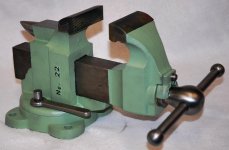
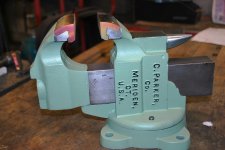
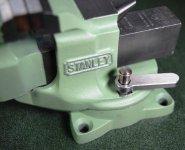
Here is a Parker 22 I did in a color close to yours along with this Stanley. I used Valspar Satin Leafy Rise. As a note both of these vise's have custom swivel bases made with the brake shoe design.
 

Attachments

  • Parker #22-2-2016 (5).jpg
    Parker #22-2-2016 (5).jpg
    115.9 KB · Views: 75
  • DSC_0070.jpg
    DSC_0070.jpg
    144.9 KB · Views: 82
  • Stanley SW  1-937jaws (16).jpg
    Stanley SW 1-937jaws (16).jpg
    109.5 KB · Views: 75
  • Stanley SW  1-937jaws (20).jpg
    Stanley SW 1-937jaws (20).jpg
    110.5 KB · Views: 69

Josh C

Well-known member
Joined
Feb 28, 2018
Messages
97
Location
Dugspur, VA, USA
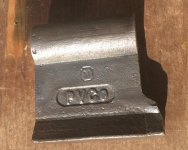
So I acquired a Reed 104 vise yesterday and posted a question to see if anyone had any info on what looked to be a tag or plate riveted to the side. Several folks chimed in with thoughts on the tag and ideas to gently remove the paint covering it. Thanks to those folks as the input was appreciated. After probably about 4 hours(est) of trying different methods and soakings (and frequently running short on patience as I usually do) I wanted to show you all what was underneath

Now I am pretty much in the dark for knowledge about the ACCO VISE CO other than having seen one or more here. I’d be interested to hear from you all with pretty much anything you might have on it or why this Reed has their tag on it, or maybe something about the “Manley Manufacturing Division “ at the American Chain and Cable Company. I wondered if maybe they produced Paul Bunyan, the Jolly Green Giant and Chuck Norris or possibly those guys had jobs there during high school or something.... 😁 Josh
 

Attachments

  • EFBEFB89-A229-4608-A295-3BDB5B83C127.jpg
    EFBEFB89-A229-4608-A295-3BDB5B83C127.jpg
    123.8 KB · Views: 91

Ole Slewfoot

Well-known member
Joined
Feb 22, 2016
Messages
5,098
Location
Freedom, CA
A little story from 1946
AMERICAN CHAIN & CABLE COMPANY, Inc.


p1
A Short Story

About a mile behind the front lines in Germany
two American soldiers were sprawled out in a make-
shift overnight shelter. Like all GIs, they were happy
to find they were from the same hometown. Both
were York boys and buddies on sight.

"So you're from York," slowly remarked Bill, the
one with blond hair.

"Yeh, and I wish I was there right now!" answered
Ken, a short stocky boy. "Say, what did you do in
York?"

"Drove a truck. What did you do?"

"I worked over at the American Chain," Ken
replied.

Bill lifted himself onto his elbow. "They have quite
a plant in York. Make a lot of tire chains, don't they?"

"Buddy, they make plenty of products for war and
for peace, too, and ..."

"You know," interrupted Bill, "I'm interested in
Acco. My father worked there for a long time. Tell
me, did you ever hear how they happened to pick
out our town as the big chain city?"

"Well, the way I got it, the present American
Chain plants started from a small chain shop that
was opened about 1870 by a man named Addison
Shaffer. His shop was on South Pershing Avenue,
right off Market Street. About nine years later J. C.
Schmidt built a new chain plant on East Walnut
Street and hired Addison Shaffer as his foreman.
Around 1889, Mr. Schmidt built a larger plant. You
may have heard it called the Schmidt Plant. It's still
standing near State Street, alongside the Pennsyl-
vania Railroad. A few years after this Mr. Schmidt
imported the first electric welder and mechanical
former for making chain. At first, he had a lot of
grief with this new development, but after a lot of
experimenting he made it work. And, buddy, that


p2

sure made a big difference in chain-making."

Bill butted in and asked, "How come you know
all this?"

"I ought to know something about it, my father
and grandfather worked for American Chain," was
Ken's answer.

"Go ahead. I'm listening."

". . . well, Mr. Schmidt's business got so big he
became interested in plants in Carlisle and Brad-
dock, Pa., and Columbus and Mansfield, Ohio. Then,
he formed the Standard Chain Company which did
a lot of business with the Weed Chain Tire Grip


Company. That's the company that was started about
1905 by W. B. Lashar. In 1912, Mr. Lashar organized
the American Chain Company, Inc. Shortly after,
about 1916, American Chain bought the Standard
Chain Company, including the Schmidt Plant in
York and the other plants in Pennsylvania and Ohio,
and built the big E. W. Plant at East Princess and
Charles Streets. That's when my dad went to work
there. As a matter of fact, he worked in the Malle-


p3

able Foundry that was built out in East York about
1919. You know they use a lot of malleable castings
in the chain business."

"But, how about the Wright-Manley Plant?" asked
Bill. "I used to make deliveries out there with my
truck."

"Oh! they came into the picture in 1927 and 28.
The Manley Manufacturing Company located in
West York was acquired by the American Chain
first. About a year later, the Wright Manufacturing
Company, of Lisbon, Ohio, was acquired and moved
to York in 1928 to their present location. In August
of 1938, Manley production was moved over from
West York and consolidated with Wright; thus the
Wright-Manley Plant. That is where they make
Wright Hoists and Cranes and Manley Garage
Equipment . . . ," Ken paused, raised his hand and
grinned broadly.

"Huh! What's the matter?" asked Bill, surprised.

"Look," smiled Ken, "You probably think I've been
trying to sell you the American Chain. Let's turn in.
I'll tell you more the next time."

"Well, O.K., but it sure seemed good to get back
to York for awhile and I learned something about
American Chain."

Acco Products for War

The two York boys over there on the other page
discussed the history of the American Chain & Cable
Company at York. But even they probably didn't
realize the wide variety of vital products made by
Acco for war and for peace. For instance, right in
the kit of those soldiers there probably were several
hand grenades. In each hand grenade there is a
tiny cotter pin that is an important part of the gre-
nade. That is made at York.

Chain is doing many war jobs. Tire Chains kept
American and Allied armies moving toward Ger-
many through snow, mud and ice. In the South
Pacific, Weed Chains did duty on many formerly
Jap-held islands.

On Sea, On Land and In the Air

The winning of a battle really begins at home. In
America's factories a prodigious job of production
has helped the man at the front to beat a tough
enemy. Acco has helped these factories, these Amer-
ican plants with products such as Wright Hoists and
Cranes and Acco Sling Chains which keep war
goods moving along the production lines. Once the
product is made, it's necessary to get it to the fight-
ing fronts FAST. That's where the Merchant Marine
and Naval Supply comes in and they use such Acco
products as Topping Lift Chain which is used on the
rigging that handles the cargoes and Cargo Slings,
Hatch Beam, Cargo Net and Deck Lashing Chain.


p4


All types of Naval Combat vessels are equipped
with Acco Chains and Wright Hoists. For example,
here are a few: Anchor Chain, Guard Rail Chain,
Debarkation Chain Ladders, Bunk Chains, and Para-
vane Chains.

Wright and Ford Crane and Hoisting Equipment
is being used for the handling of bombs, torpedoes,
heavy shells, aeroplanes and for maintenance ser-
vice aboard ships in practically all branches of our
Marine service, as well as on field trucks and in
munition dumps.

Many of the principal shipyards in all parts of our
country have been equipped with Wright cranes
which are being used for the building of ships of
the "big battle wagon" down to the P.T. type.

The Acco Malleable Foundry has contributed
immeasurably to the war program through the fur-
nishing of critical castings to many of the leading
industrial concerns engaged in war contracts.

One of the perplexing problems of the Navy was
solving the problem of lifting heavy bombs into
planes. Here, the Manley Division at York worked
right with the Navy and developed a portable bomb
hoist, and bomb trucks. This is one of the production
accomplishments that helped to earn the coveted
Army-Navy "E" awarded to all divisions located
in York.

Acco Products tor Peace

It's interesting to note that while York-made Acco
products are vital during war years, they are equally
important during peace times. Let's start with the
basic industries. Coal mining, metal mining and
quarries must have chain for their operations.

Many kinds of animal chains such as tie-outs,
halter chains, pump chain, log chains, are used by
farmers in their daily work.

Constructing America's roads and buildings takes
a lot of chain, too.

America's automobiles and trucks are serviced
with Manley garage equipment such as jacks,
wrecking cranes and presses.

Nearly every kind of an industrial plant uses Acco
Chain, made in York. Wright Hoists and Cranes also
serve America's industries. Often chain and malle-
able castings become part of the product made in
that plant. Sling Chain is used for material handling
in moving items along the production lines.

The American Chain & Cable keeps pace with
modern developments through highly developed re-
search and experimental facilities. Just as in war
Acco's experience and skill was devoted to the prob-
lems of our fighting forces, they are ready to resume
their service to peacetime industries.

Acco's diversified products are vital in war
essential in peace.
 

Josh C

Well-known member
Joined
Feb 28, 2018
Messages
97
Location
Dugspur, VA, USA
Sir Slewfoot- Many thanks for that rather interesting and informative history of the ACCO CORP. Rather enjoyed it. May today be the day that you find your “holy grail” of vises. -Josh
 

Maui

Well-known member
Joined
Sep 16, 2012
Messages
2,893
Location
Upstate NY
Nutjob,

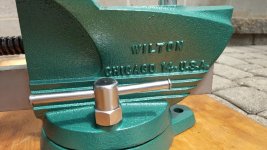
Here is a Wilton Shop King with 5" wide jaws that I recently restored. I painted it with Rustoleum hammered deep green, and I really like this color. It comes across as a mint green.

Maui
 

Attachments

  • Wilton 20180714_122019.jpg
    Wilton 20180714_122019.jpg
    150.7 KB · Views: 81
  • Wilton 20180714_122117.jpg
    Wilton 20180714_122117.jpg
    148.3 KB · Views: 69
To avoid these ads, REGISTER NOW!
Top Bottom