New member here. Long time lurker. First time poster. I have a 24x24 unheated attached garage in Iowa. When I bought the house last fall, the drywall had never been finished. I hired a semi-retired former union commercial drywaller to finish the drywall. He did an ok job for the most part on the walls but a piss poor job on the ceiling. All of the seams are already cracking/coming apart. Part of the problem is the ceiling is attached to trusses 24" on center, which I think is too far apart. The guy I hired indicated so. What can I do before I fix the cracking to try to prevent the seams from coming apart again? I know this may be a losing battle in an unheated space. Thanks in advance.


You are using an out of date browser. It may not display this or other websites correctly.
You should upgrade or use an alternative browser.
You should upgrade or use an alternative browser.
How to prevent drywall cracking in unheated garage
- Thread starter 86Vette
- Start date
pattenp
Well-known member
I have the same problem with attic truss in my uninsulated/unheated garage. Between walking in attic and hot to cold changes the ceiling seams have cracked. I tried fixing the seams but after awhile the cracks return. I just gave up and live with the cracked seams.
Musicinabottle
Banned
- Joined
- Jul 24, 2016
- Messages
- 3,371
Is it all the joints or just the **** joints? Are you sure he used tape on ALL the joints?
One thought I had was gluing 1x6s to the attic side of the ceiling with construction adhesive along all the joints and screwing the finished side of the drywall to those 1x6s to add more rigidity to the seams. Crazy idea or could it help?
It's cracking/coming apart at all the joints and yes he used mesh tape on all the joints.
I've never seen a pro use mesh. Around here they mud, bury paper tape in the joint, then mud. My attached uninsulated garage is doing the same thing, I think it's one of those things you have to live with.
Last edited:
One thought I had was gluing 1x6s to the attic side of the ceiling with construction adhesive along all the joints and screwing the finished side of the drywall to those 1x6s to add more rigidity to the seams. Crazy idea or could it help?
I'm sure that would help. My new house is a ranch so the entire living area is directly under 2' on center trusses. There was a lot of failing joints in our foyer and main hallway. We dug the tape out, one of us went into the attic and held a 2x4 across the seam, the other drove drywall screws into it. Retaped, mudded, sanded, primed and painted. It's been 6 months and no more cracks.
Musicinabottle
Banned
- Joined
- Jul 24, 2016
- Messages
- 3,371
It's cracking/coming apart at all the joints and yes he used mesh tape on all the joints.
That's probably why it's cracking then. Professionals don't use that ****. It's for rookies. They use that tape in mobile homes all the time because it does allow more flexing than standard paper tape.
I've never seen a pro use mesh. Around here they mud, bury paper tape in the joint, then mud. My attached uninsulated garage is doing the same thing, I think it's one of those things you have to live with.
+1. Paper tape is stronger than mesh. And use the setting type taping mud, not the drying type, or all-purpose or topping type.
How big are the cracks overall?
I guess it wouldn't be entirely accurate to call them "cracks". They're more "ripples" along the seams really. And they're not huge...just enough to be noticed and bother me.
GrayFlattop
Well-known member
I'm not sure that any tape / mud combo will work with spacing that far apart AND in a garage that may "flex" a bit more that a house (when subjected to wind loads combined with seasonal changes in the framing lumber due to humidity fluctuation. If all the joints line up on a single framing member (not staggered) this for sure is going to lead to that condition. This is a problem that is amplified by being in an unconditioned space, but is also due to the large relative span magnifying the movement.
I think you have three choices:
1. Try the Flexible caulk solution mentioned above.
2. Tear down the drywall on the ceiling - install RC channel 16" o.c. - to the ceiling framing members and the screw the drywall to the RC channel.
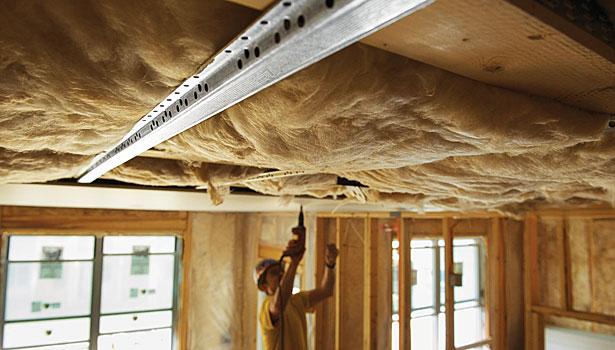
https://www.wconline.com/articles/89218-preventing-ceiling-cracking-with-resilient-channels
3. Learn to not look at the ceiling and live with it. Cracked drywall still looks better than OSB!
I think you have three choices:
1. Try the Flexible caulk solution mentioned above.
2. Tear down the drywall on the ceiling - install RC channel 16" o.c. - to the ceiling framing members and the screw the drywall to the RC channel.
https://www.wconline.com/articles/89218-preventing-ceiling-cracking-with-resilient-channels
3. Learn to not look at the ceiling and live with it. Cracked drywall still looks better than OSB!
pcmeiners
Well-known member
"It's cracking/coming apart at all the joints and yes he used mesh tape on all the joints."
If it is relatively new construction, cracks/ripples. will be an issue due to the wood shrinking. Second issue is 24" centering is asking a lot of sheetrock, especially in unheated areas. Mesh tape is a joke, ANYTHING, such as mesh tape, which stretches even a tiny amount will cause cracks. Pros do not use mesh unless they enjoy losing clients .
In unheated areas oil based paint should be used to prime sheetrock (light coat), far less affected by moisture; light coat allows water vapor to pass through. Latex top coat is OK.
If it is relatively new construction, cracks/ripples. will be an issue due to the wood shrinking. Second issue is 24" centering is asking a lot of sheetrock, especially in unheated areas. Mesh tape is a joke, ANYTHING, such as mesh tape, which stretches even a tiny amount will cause cracks. Pros do not use mesh unless they enjoy losing clients .
In unheated areas oil based paint should be used to prime sheetrock (light coat), far less affected by moisture; light coat allows water vapor to pass through. Latex top coat is OK.
I guess it wouldn't be entirely accurate to call them "cracks". They're more "ripples" along the seams really. And they're not huge...just enough to be noticed and bother me.
The problem is most likely the wide beam space as others have pointed out but the other problem is if it is ripples then there is probably a void behind the tape so now without cutting the tape you can't even fill the ripple I would suspect. And then cutting the tap is just going to really make the problem more profound. I'm just goign to venture a question here... Do you really need to have a perfect sheetrock finish? I have one in my garage and if I had done the thinking before hand I would have had my builder put a wall above my garage insulate it against the living space. and I would have just left the beams showing in my garage so I could stick stuff up in the rafters....
Just throwing it out there as a thought, your problem sounds like a solution for my light storage to me, lol

Musicinabottle
Banned
- Joined
- Jul 24, 2016
- Messages
- 3,371
If it allows for more flexing, then shouldn't it be better than paper tape?
No. That's why it cracked was because it flexed. Flex, bad!
PelicanPines
ALLIANCE MEMBER
Flexible paintable caulk.
Apply like mud.
They did this on the ceiling of my old front porch... IT WORKED... for the most part.
dfiler2
Well-known member
Around here most homes and garages are built with rafters on 24" center, I don't think that's your problem.
Around here most homes and garages are built with rafters on 24" center, I don't think that's your problem.
rafters and trusses are two different things. Trusses move more and puts more stress on drywall, especially where the wall and ceiling meet. This is most obvious during the first year when things are drying out, and insulation can
make it even more so.
Musicinabottle
Banned
- Joined
- Jul 24, 2016
- Messages
- 3,371
Paper flexes as easily, or more so, than mesh. Neither will hold up if the rock moves. I would guess I see 100 paper failures for each mesh failure, but that's probably the use ratio also. But, I see pro's use mesh to fix a failure 5:1 over using paper. That says something to me, but generally it's because it's easier to blend in the mesh, plus mesh works better if you're doing thick mud or floating out a patch,as you can do more than one layer as needed. I personally use mesh almost always for patching. I even have a higher strength mesh for deep patching. And/or use several layers. The only area that i have a marked preference for paper is corners, it makes a smoother corner.
The answer I've always been given by pro's for using paper is that it is cheaper, feeds through a banjo/bazooka/box more easily, and is easier to cover smoothly in a conventional joint. However, I see them use mesh a lot in patching, uneven joints, thick joints, and gaps. The answer I've been given when I asked is that it is less likely to fail in those cases.
Okay. I just know that in the 30 plus years I've been in the home building business, I've never seen my drywall guys use the mesh tape. I know that I've done a bunch of work on mobile homes and they sure use it on them. The tape is much more stable than the mesh. Grab a piece of paper tape and a piece of the mesh tape and try racking them and you can immediately see that the paper tape is more stable. Same with the drywall itself. It would fall apart before you even got it on the ceiling or wall if it were faced with the mesh.
No. That's why it cracked was because it flexed. Flex, bad!
haha oh ok, I get it now. Thank you.
Musicinabottle
Banned
- Joined
- Jul 24, 2016
- Messages
- 3,371
haha oh ok, I get it now. Thank you.
Right on! Glad I could help.
Paper flexes as easily, or more so, than mesh. Neither will hold up if the rock moves. I would guess I see 100 paper failures for each mesh failure, but that's probably the use ratio also. But, I see pro's use mesh to fix a failure 5:1 over using paper. That says something to me, but generally it's because it's easier to blend in the mesh, plus mesh works better if you're doing thick mud or floating out a patch,as you can do more than one layer as needed. I personally use mesh almost always for patching. I even have a higher strength mesh for deep patching. And/or use several layers. The only area that i have a marked preference for paper is corners, it makes a smoother corner.
The answer I've always been given by pro's for using paper is that it is cheaper, feeds through a banjo/bazooka/box more easily, and is easier to cover smoothly in a conventional joint. However, I see them use mesh a lot in patching, uneven joints, thick joints, and gaps. The answer I've been given when I asked is that it is less likely to fail in those cases.
Paper has a shear strength and mesh does not. I'm not sure why anyone would feed mesh through a banjo. That was the only real benefit of mesh over paper; it's self adhesive so you can just stick it down on the seam and mud over it. It's the 1 that takes less time of the 2.
Unfortunately, that's the technique that has given mesh a bad rep. If you stick it to the wall, the mud doesn't get under it, and it can delaminate the patch, and doesn't adhere well.
It's the technique advised by the manufacturers of the tape. Surely they care about the reputation of their products. They make it self adhesive for a reason! Mesh has no bending stiffness. It does not increase the moment of inertia of the joint. Where it sits in the mud does not matter. As a tensile member it can go anywhere.
6768rogues
Banned
I have seen mesh tape crack more frequently than paper tape. I had some seams with mesh tape that kept cracking, so I overlaid them with paper tape and a wide seam. It never cracked again.
Musicinabottle
Banned
- Joined
- Jul 24, 2016
- Messages
- 3,371
Unfortunately, that's the technique that has given mesh a bad rep. If you stick it to the wall, the mud doesn't get under it, and it can delaminate the patch, and doesn't adhere well.
Properly used, you mud the wall (just like with paper tape), and then embed the mesh in it. The strength of the mesh is in combination with the mud, it makes a composite material, similar to steel reinforced concrete as opposed to plain concrete.
However, mesh tape is not a substitute for paper tape. Paper tape is the appropriate material for most seams. Mesh is applicable to thick sections, uneven sections, patch and repair, and sections that may move slightly and tear the paper. In those cases, it's performance exceeds paper. For taping simple seams, it is an inferior material, and often used by amateurs like you describe above, by sticking it to the wall. It keeps them from having to learn how to properly prep and embed paper tape. But, degrades the overall performance compared to properly applied paper.
It's not a paper - good, mesh - bad simple equation. Both have their suited uses, and need to be used appropriately.
The shear strength of paper to resist shrinkage cracking is greatly over-rated. If you get shrinkage/expansion in the structure, it will tear the paper at the joint, as that's the weakest link. It would also tear mesh, although it might retain some integrity across the crack. If you are able to restrain the joint by how you screw the drywall down to the studs/rafters/trusses, the sheetrock itself will crack somewhere. No kind of tape is able to resist this type of failure.
Huh? Gosh I hate to say it, but you're wrong on all points except that middle sentence. The paper never cracks, it's the mud that cracks at the seam or to the side of the tape as it breaks loose from the mud bond at the drywall. The fiber tape is even more resistant to breaking on account of the fact that it's fiberglass strand. It's just that it doesn't bridge the mud that well is why it's more apt to crack. Anyways. Use what you like but there's a reason the pros use paper tape and it has more to do than being banjo or bazooka compatable.
BillK
Well-known member
Vette,
I am certainly not a drywall expert but the drywall in my attached unheated 22x22 garage looks pretty much like the day we bought our house new in 1978. Not the smoothest joints but definitely no cracks. I painted it right after we moved in and have not touched it since. Mine is trusses on 24" centers also. Must have something to do with the installation.
I am certainly not a drywall expert but the drywall in my attached unheated 22x22 garage looks pretty much like the day we bought our house new in 1978. Not the smoothest joints but definitely no cracks. I painted it right after we moved in and have not touched it since. Mine is trusses on 24" centers also. Must have something to do with the installation.
Leaflessshadetree
Well-known member
Cover the seams with battens.
Dirtydan69
Well-known member
I you want to minimize cracking you can’t under any circumstances use ready mix out of a bucket, box or whatever. There is nothing wrong with paper tape. In my opinion it’s stronger. As for mud you have to use setting type compound out of a bag. Mix it yourself. Someone else stated this and they are absolutely correct. Learned this 40 years ago.
My parents had a house built in 1995. The garage is 24x24 unseated as well. It completely finished and painted. The drywall has never cracked in 23 years. We get temps regularly in -20F during winter. 100 in the summer. I’m not sure what was done different. I’m not sure if the trusses are 18 or24” centered though.
I've had experience with cracks and repairing them and this is my experience....don't use premixed joint compound to fix the crack. Rip out old tape and use durabond 90 (yes, the powdered stuff you mix) to set the paper or mesh tape. This stiff dries much harder than premix. Then use premix to feather and finish the job. This will give a much longer lasing result.
Tom
Tom
Musicinabottle
Banned
- Joined
- Jul 24, 2016
- Messages
- 3,371
I can easily see that your experience has been this; but I've seen all three failure modes. In the past 6 months, I've had to do two warranty call backs against professional rockers, where the paper tore at an unsupported seam. Based on those, I could easily say that the mode of failure is paper tearing. But, like I said, I've seen all three modes of failure. That's the problem with anecdotal observations of one person, they are limited in scope, not definitive.
However, no reason to argue, I'll readily concede that paper tape is the correct seam material for nearly all cases. I've said that in my previous posts.
What I would like to point out to the OP is that the mesh tape didn't cause the cracks, he needs to look for the root cause, and a way to fix it. Just retaping with paper won't likely fix the problem. It will just give a false sense that the problem is cured until the next time it cracks. Then, it might crack by the paper tearing loose, and a person could blame using the wrong mud. And try again with different mud, and again, and again, using different materials. Doing something to span the crack, like his idea of a backer board, will probably fix the problem, regardless of what he uses to retape with. Or, if the trusses are moving a lot seasonally, it might move the problem to another joint. It might take some truss bracing to fix the problem then. Sheetrock cracking on truss ceilings is a hard problem to solve.
We're arguing about drywall tape!
There is no doubt that the human collective almost certainly has more experience than I do. I have to admit that I'm not a drywall finisher by trade, but I've got all the tools for it, and have done new construction and remodels in addition to having a house leveling business. So let's just say that I've certainly paid my dues with respect to new installation, to repairing cracks! I admit that anything is possible, especially with an unsupported seam. I'd have to say that if you have a joint that physically is ripping the paper tape, then it'd be safe to say then that fiber mesh tape would also fail in terms of exposing a crack at that joint. I also know that there are so many different types of shifting that causes drywall cracking, and having worked on a great deal of mobile homes where they almost exclusively use the mesh tape, I've seen drywall crack where there wasn't even a seam! All I can say is that from my practical experience, the paper tape is less prone to mud cracking on account of the fact that it doesn't have as much flex as does the fiber tape.