To avoid these ads, REGISTER NOW!

Upgrading Electrical Service to Detached Garage

nitroracer

New member
Joined
Jul 15, 2012
Messages
2
Location
Shippensburg, PA
I'm looking for some help to learn the right way to upgrade the power going out to my detached garage. Currently I have a 25x25 2-bay garage with power fed from what appears to be a single 15A breaker in the house. There is no sub-panel in the garage, just a handful of lights and outlets. I'd like to do a major upgrade, so that I can have Level-2 electric car charging OR a welder plugged in out in the garage, I don't foresee the need to ever run both at the same time. I have the charger, but not a welder yet. I'm assuming this will go on a 40-50A breaker of its own. The good news is the house is currently setup with a 200A service and I am not taking full advantage of all that capacity in the house.

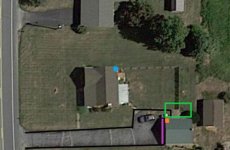
The image below (Capture2c) shows my current situation;

Blue = Home fuse panel, 200A
Orange = Existing power entry to detached garage, from the side wall
Purple = Short concrete apron
Green = Potential third garage bay expansion
Black = Existing blacktop


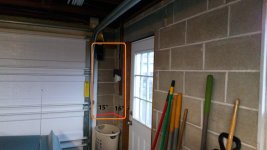
This may be added complication, but I would like to run my power in such a way that I could add a third garage bay someday where the green box is shown. What I don't know is the best route to get it there and what my limitations are in terms of electrical code for locating a subpanel in that corner of the garage. I have limited wall space in that corner 15-16" and I'm not sure if that is an option for the sub-panel. I've been browsing around garage journal, but I feel like I need some basics before I can dive into this one. Any help is appreciated.
 

Attachments
  • Capture2c.jpg
    Capture2c.jpg
    19.8 KB · Views: 56
  • 20180816_194310.jpg
    20180816_194310.jpg
    118.1 KB · Views: 77
  • DSC_0130_a.jpg
    DSC_0130_a.jpg
    115 KB · Views: 82
  • DSC_0131.jpg
    DSC_0131.jpg
    110.9 KB · Views: 75
Last edited:
To avoid these ads, REGISTER NOW!

bruincounselor

Well-known member
Joined
Sep 12, 2015
Messages
84
Location
North Dakota
When I built last summer I updated to 400a. 200 for house and 200 for garage. It cost very little extra to overbuild it. I'm ready for whatever the future brings (fast charging?, welder?, table saw? a/c? - all at the same time? No problem).
 

75gmck25

Well-known member
Joined
Jul 21, 2014
Messages
1,326
Location
Alexandria, VA
I have a similar layout with my garage door area, and I put the subpanel on the wall between the door frame and the corner. I had 32" from the door casing to the wall, and I screwed down a 24" wide by 36" tall piece of plywood on the wall. I then mounted a 100 amp sub-panel on the wall (its about 15 1/2" wide), and also used the extra space next to it to mount the light switches. My 2" conduit runs down the wall to an LB, then through the wall to another LB, and down into the ground.

One of the most common wiring schems for a detached garage is to run 2-2-2-4 AL Mobile Home Feeder (MHF), and breaker it at the main panel with up to a 90 amp breaker. I have found that at the big box stores a 100 amp main breaker panel with 24 breakers is almost the same price as smaller sub-panels, so I suggest using something similar. It gives you more flexibility than buying a small 6 or 8 breaker panel.

MHF can be direct buried, but most use conduit (I suggest 2") to protect it, and to provide flexibility for repair or pulling a new cable. It needs to be run in conduit wherever its exposed above ground, or where it runs inside a structure.

Bruce
 
OP
N

nitroracer

New member
Joined
Jul 15, 2012
Messages
2
Location
Shippensburg, PA
When I built last summer I updated to 400a. 200 for house and 200 for garage. It cost very little extra to overbuild it. I'm ready for whatever the future brings (fast charging?, welder?, table saw? a/c? - all at the same time? No problem).

Bruin, how much extra are we talking? I'm just getting familiar with the cost here.


I have a similar layout with my garage door area, and I put the subpanel on the wall between the door frame and the corner. I had 32" from the door casing to the wall, and I screwed down a 24" wide by 36" tall piece of plywood on the wall. I then mounted a 100 amp sub-panel on the wall (its about 15 1/2" wide), and also used the extra space next to it to mount the light switches. My 2" conduit runs down the wall to an LB, then through the wall to another LB, and down into the ground.

One of the most common wiring schems for a detached garage is to run 2-2-2-4 AL Mobile Home Feeder (MHF), and breaker it at the main panel with up to a 90 amp breaker. I have found that at the big box stores a 100 amp main breaker panel with 24 breakers is almost the same price as smaller sub-panels, so I suggest using something similar. It gives you more flexibility than buying a small 6 or 8 breaker panel.

MHF can be direct buried, but most use conduit (I suggest 2") to protect it, and to provide flexibility for repair or pulling a new cable. It needs to be run in conduit wherever its exposed above ground, or where it runs inside a structure.

Bruce

Bruce, thanks for the details! I have been browsing around and the mobile home feeder cable does seem like a good match for what I am trying to accomplish. I would want to run everything in conduit as well for peace of mind if I'm going through the trouble. I'd like to run a network cable out there as well, is that something I should put in separate conduit at a different depth?
 
To avoid these ads, REGISTER NOW!

mike93lx

ALLIANCE MEMBER
Joined
Dec 9, 2013
Messages
37,642
Location
Richmond, VA
yes, separate conduit for low voltage. run at least two network cables so when one has a problem, you aren't screwed.
 

AntonLargiader

Well-known member
Joined
Nov 20, 2016
Messages
1,372
Location
Charlottesville, VA
Your easiest and cheapest solution is 60A service out there with #6 copper wire. It's the minimum for what you want, but for a 50A charger and basic garage stuff it's fine and you can pull it through a 3/4" or 1" conduit. If you want to build on and have more of a shop than a garage, go bigger like 90A or 100A (#4 copper or #2 aluminum wire). That's a lot; you don't need 200A.

I think it's OK for the door to be in the 30" wide space that the panel needs, but that garage door track could technically be a problem.
 

wyliesdiesels

Well-known member
Joined
Aug 14, 2012
Messages
20,031
Location
Modesto, CA
Your easiest and cheapest solution is 60A service out there with #6 copper wire. It's the minimum for what you want, but for a 50A charger and basic garage stuff it's fine and you can pull it through a 3/4" or 1" conduit. If you want to build on and have more of a shop than a garage, go bigger like 90A or 100A (#4 copper or #2 aluminum wire). That's a lot; you don't need 200A.

I think it's OK for the door to be in the 30" wide space that the panel needs, but that garage door track could technically be a problem.

For 100a, would need #3 THWN copper or #1 al...
 

75gmck25

Well-known member
Joined
Jul 21, 2014
Messages
1,326
Location
Alexandria, VA
When I connected power to my garage I found that the hardest work was when I used a small trencher to make the 18" deep trench. I rented it from HD and it was not self-propelled. In my case the direction of the cut went up a slight hill, so pulling the trencher uphill took even more muscle.

Once I got the 60 foot trench done, laying in conduit was the easy part, so I wanted to have lots of future flexibility. I installed 2" conduit for the MHF, and then put 1.5" conduit next to it for my coax and Cat 6. The 2" conduit comes up to the garage with a long sweep and an LB on the end. With an LB on both ends, 2" conduit, and frequent application of lubricating foam there was no problem pulling MHF.

Bruce
 
To avoid these ads, REGISTER NOW!
Top Bottom