To avoid these ads, REGISTER NOW!

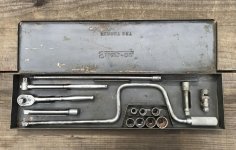
Need help on how to clean this wartime snap on set

Superdavey

Well-known member
Joined
Apr 23, 2016
Messages
45
Location
Canada
I recently picked up this vintage snap on set , all pieces marked either G or E . Which is wartime production. My understanding is that they used cadmium to plate these tools , which is quite toxic from what I've read. I was going to wire wheel them but that seems to be out of the question now.

Would an evaporust bath be enough or is that equally as toxic ?

I'm not sure either if these tools are actually cadmium plated but they do look to have a powdery type of residue on them ..

If anyone's got some experience with this I'd appreciate it a lot
 

Attachments

  • image.jpg
    image.jpg
    152.7 KB · Views: 328
Last edited:
To avoid these ads, REGISTER NOW!

d42jeep

Well-known member
Joined
Oct 22, 2014
Messages
16,555
Location
Northern California
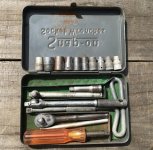
My experience is that Snap-on tended to use Cad finish less than many of the other wartime manufacturers. They are often either plain steel or a dark oxide finish. If you have sockets with rust, a bath in Evaporust will help. I definitely would stay away from a powered wire wheel to be safe. Here are my Ferret and Midget sets.
-Don
 

Attachments

  • 951FD568-AA62-46C7-AB91-D0BACA0DC53E.jpg
    951FD568-AA62-46C7-AB91-D0BACA0DC53E.jpg
    153.2 KB · Views: 113
  • 769F7ADB-4034-4CC0-B49A-CE73E5E25B0A.jpg
    769F7ADB-4034-4CC0-B49A-CE73E5E25B0A.jpg
    83.2 KB · Views: 88
  • 0557BAD0-3D48-4739-BDB2-9370443DF41A.jpg
    0557BAD0-3D48-4739-BDB2-9370443DF41A.jpg
    148.2 KB · Views: 106
  • D66EA45B-9A41-47D6-BD71-CA2DB653153F.jpg
    D66EA45B-9A41-47D6-BD71-CA2DB653153F.jpg
    145.1 KB · Views: 97
  • BDB0824A-EF91-49A8-A5AC-9177E6750451.jpg
    BDB0824A-EF91-49A8-A5AC-9177E6750451.jpg
    149.1 KB · Views: 104

Oldtuleguy

Well-known member
Joined
Nov 4, 2017
Messages
10,459
Those look really good. Just some evaporust for rust spots. Wire wheeling is pretty harsh and generally frowned upon as it damages any remaining factory finish and can potentially release toxins.
 

thehorse13

Well-known member
Joined
Mar 15, 2015
Messages
3,478
Location
Jefferson County, WV
You can clean them with a plastic bristle brush and simple green. Cad is dangerous when airborne.

That said, personally, I'd leave them alone after a light wipe down. Nice stuff!
 

PFSard

Well-known member
Joined
Sep 12, 2013
Messages
2,423
Location
Mesa, AZ
They are cadmium. I'd just leave them as is myself. they look great in the photos anyway.

It is a nice set. How do you know they are cadmium plated? This has come up on GJ on other occasions. Is there a positive test for cadmium? Would Snap-On keep records about production methods for wartime tools?
 

Private Lugnutz

Well-known member
Joined
Mar 30, 2012
Messages
30,606
Location
The Authentic Jersey Shore
I have had wartime Snap-on tools ("2", even rarer "3", and "E" and "G" codes) with a zinc or other phosphate finish, which is milky and chalky in residue form, but the large majority are either plain steel or cadmium-plated. Other mfgrs (such as SK, to name only one prominent example) favored black oxide, which was actually invented during the war. And some tools were enameled, mainly single- and double-open end or combination wrenches and adjustable wrenches. Those were the only specified finishes during WWII.

Cadmium is softer, much less dense, and also much duller or less shiny than chrome, and it can appear chalky when it wears. Can you post close-ups of some of the individual tools? As close as you can get but staying in focus.

Meanwhile, Ill see if I can find some pics I have posted before of three Walden sockets: plain steel, cadmium-plated, and chrome-plated, which illustrates the differences very well.
 
Last edited:

Private Lugnutz

Well-known member
Joined
Mar 30, 2012
Messages
30,606
Location
The Authentic Jersey Shore
Here ya go. Left to right: plain steel, cad, and chrome.

attachment.php


This one is worn, obviously, and easier to detect because of that. Some cad tools that have been well-kept and hardly used can be harder to identify - but again, they are typically gray, softer and much less shiny.
 
OP
S

Superdavey

Well-known member
Joined
Apr 23, 2016
Messages
45
Location
Canada
Some of the extensions seem to be just oxidized metal. Here are some close ups of the pieces

Would evaporust remove the cadmium ?

image.jpg

image.jpg

image.jpg


image.jpg

image.jpg

image.jpg
 
Last edited:
To avoid these ads, REGISTER NOW!

ganymede

Well-known member
Joined
Nov 29, 2012
Messages
2,332
Location
New England
Op
Those are some nice pieces .
The amount of rust is really small.
Id just wipe em with an oily rag and display them as great examples of wartime tools.
 

Private Lugnutz

Well-known member
Joined
Mar 30, 2012
Messages
30,606
Location
The Authentic Jersey Shore
Superdavey,
Thanks for the closeups. While it's always hard to definitively identify a finish in photos, those look like cadmium, maybe possibly some kind of phosphate. It's not plain steel or chrome, for sure. Whatever it is, it is in exceptional condition. Your pieces are near mint-y, and I second (seventh?) what everyone else has already advised. Out of politeness, everyone is probably understating the the recommended course of action. Many of us have collected sets far, far worse, with pieces coated and/or frozen with stubborn rust. Those need long baths in a derusting formula of choice. Your pieces are better than fine as is.
 

Mr. Franco

New member
Joined
May 19, 2020
Messages
2
Location
Illinois
Hello, I'm reading this string because I recently cobbled together a set of old craftsman wrenches from a late collector's barn sale. Also thinking about buying the rest of this man's extensive socket wrench collection but I digress. I'm concerned about cadmium on my new old wrenches and I'm wondering if there's a test out there that can tell me if these are toxic and I shouldn't plan on using them or even ultimately leaving them to my kids. Most are marked with a "V" on the raised panel. Most are also dull-ish and leave a blackish residue on my hands that makes me think of aluminum or zinc or something. Any advice is much appreciated.
-Mike
 

DadsTools

Well-known member
Joined
Jul 27, 2017
Messages
1,852
Hello, I'm reading this string because I recently cobbled together a set of old craftsman wrenches from a late collector's barn sale. Also thinking about buying the rest of this man's extensive socket wrench collection but I digress. I'm concerned about cadmium on my new old wrenches and I'm wondering if there's a test out there that can tell me if these are toxic and I shouldn't plan on using them or even ultimately leaving them to my kids. Most are marked with a "V" on the raised panel. Most are also dull-ish and leave a blackish residue on my hands that makes me think of aluminum or zinc or something. Any advice is much appreciated.
-Mike
Sears used cadmium for a very short period of time in the early 1950s (53-54?). They can be distinguished by the relatively dull look members in this thread have been describing. As long as it stays on the tool it should be fine. I'm not familiar with cadmium leaving a black residue on your hands just by handling them. The residue might be something accumulated on them from how they were stored?

The CM "V" code is for the manufacturer Moore and later Easco, about 1945 to 1986. Those embedded in double lines like ====v==== are from about 1946 to 1969.

Is cadmium poisonous? Yes. Should you have a problem just by occasionally handling the tools? Probably not.
 

Mr. Franco

New member
Joined
May 19, 2020
Messages
2
Location
Illinois
Ah, okay. Thanks for bringing me back down to earth on this. Yeah, I see the pics of the dull grey/silver, and mine aren't nearly as powdery looking, but just want to be sure. Anyway, thanks for the info. Narrowing the risk to the 1953 years makes me feel more comfortable with my find. Cheers!
 
To avoid these ads, REGISTER NOW!
Top Bottom