
I've searched the internet as well as this forum specifically and can't find any information on this. The question I have pertains to locking grip pliers for welding. I've noticed that some of the pliers have thin, smooth jaws, while others have really thick, textured jaws.
The best examples I can give are on this page for Bollmann-Selzer welding locking pliers (the manufacturer of locking pliers for Knipex, NWS, Elora, and more).
Notice the first pair have steel jaws that are thin and smooth in texture:
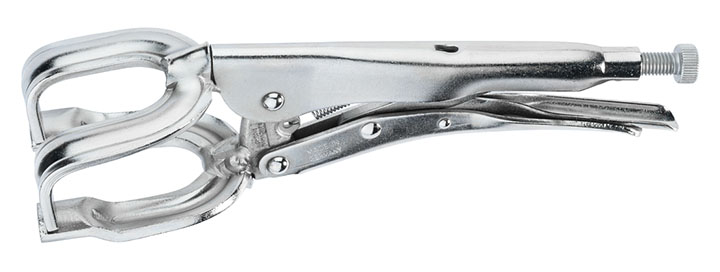
The second set have malleable cast iron jaws that are thick and rough in texture:

For awhile I couldn't figure out why you would want one versus the other unless it had to do simply with strength/durability versus price.
However, I eventually found that Facom lists their thick-jawed locking pliers as being for arc welding, with the feature of "light alloy spatter-proof jaws".


This seems to be a clue, but assuming this is also the reason for the thick-jawed variants for the Bollmann-Selzer pliers, it still begs the question... what makes the jaws spatter-proof? Is it the material? If so, why is one a light alloy and the other is malleable cast iron? Is it the texture? Is it the thickness or heat resistance?
I've tried googling everything from what causes spatter to what differentiates arc welding pliers from other welding pliers, and more. Nothing I search turns up any information on why these pliers exist or how they work.
Given this day in age, I'm astounded that this information doesn't seem to be findable on the internet. It's especially hard to believe that tool makers would sell these tools without ever explaining anywhere on their websites or in their catalogues why they exist or how they work. And yet here we are.
Is this knowledge just so common among welders that it doesn't need to be said? Is it a secret of the pros not meant for general dissemination? Does anyone know? Help!
By the way, I do have examples of each of these. I have some Knipex (Bollmann-Selzer) pliers with the malleable cast iron jaws, Elora (Bollmann-Selzer) pliers with the thin steel jaws, and Elora (Grip-on) pliers with the light alloy jaws. I didn't realize the jaws were different when I bought them until I got them. That's when I started looking around and couldn't find anything out.
The best examples I can give are on this page for Bollmann-Selzer welding locking pliers (the manufacturer of locking pliers for Knipex, NWS, Elora, and more).
Notice the first pair have steel jaws that are thin and smooth in texture:
The second set have malleable cast iron jaws that are thick and rough in texture:
For awhile I couldn't figure out why you would want one versus the other unless it had to do simply with strength/durability versus price.
However, I eventually found that Facom lists their thick-jawed locking pliers as being for arc welding, with the feature of "light alloy spatter-proof jaws".
This seems to be a clue, but assuming this is also the reason for the thick-jawed variants for the Bollmann-Selzer pliers, it still begs the question... what makes the jaws spatter-proof? Is it the material? If so, why is one a light alloy and the other is malleable cast iron? Is it the texture? Is it the thickness or heat resistance?
I've tried googling everything from what causes spatter to what differentiates arc welding pliers from other welding pliers, and more. Nothing I search turns up any information on why these pliers exist or how they work.
Given this day in age, I'm astounded that this information doesn't seem to be findable on the internet. It's especially hard to believe that tool makers would sell these tools without ever explaining anywhere on their websites or in their catalogues why they exist or how they work. And yet here we are.
Is this knowledge just so common among welders that it doesn't need to be said? Is it a secret of the pros not meant for general dissemination? Does anyone know? Help!
By the way, I do have examples of each of these. I have some Knipex (Bollmann-Selzer) pliers with the malleable cast iron jaws, Elora (Bollmann-Selzer) pliers with the thin steel jaws, and Elora (Grip-on) pliers with the light alloy jaws. I didn't realize the jaws were different when I bought them until I got them. That's when I started looking around and couldn't find anything out.


