To avoid these ads, REGISTER NOW!

Air Comp arrived a week early; I'm behind now

jproaster

Well-known member
Joined
Aug 26, 2018
Messages
170
Location
SE Tennessee
Greetings all.
Got the call from Lowes today- Quincy qt 54 ac is in; it's a week early and it's rainy. So the platform out back will have to wait. So I picked up my map gas kit (ts8000) today. Saw that Lowes has plenty of copper. However, I still need the regulators, filters, etc.

1. At AC- I know I need a hydraulic hose and ball valve.
Do I need a regulator here? THe TPTools diagram shows no regulator.

After the line splits in main work room-concerning accessories:

2. Line A to abrasive cabinet.
I'm assuming a regulator and water separator.

3. Line B to all purpose use, tools and hopefully able to send a hose out the door occasionally to do outdoor blasting - moto frames and other items not too big.
I'm assuming a regulator and water separator here too.

So. Do I need a coalescing filter?
Should I have a regulator at the ac?
Having lost my extra time to search ebay, amazon, etc for
accessories...would you buy used regs? 2 or 3?
Any particular brand of water filters? New or used?

What else am I missing?

Thanks so much for the help you've given. I'm almost there now...I hope.

John
 
To avoid these ads, REGISTER NOW!

Toothaker

Well-known member
Joined
Nov 25, 2016
Messages
1,367
Location
Wichita, Kansas
I'm going through the same exercise here. I found that most of the affordable brass fittings are Class 125, rated for 125 PSI. There are such things as Class 250, which is rated for 250 PSI. I used Class 250 between the tank and the first regulator. After that is is Class 125. After that first regulator I have my 40 micron filter, 5 micron filter and 0.1 micron coalescing filter. Then I have my line regulator, which I set to 95 PSI.

Your Quincy QT-54 goes up to 175 PSI, and that's not easily adjustable. You'll need a regulator near the compressor. Filters have a max PSI rating - usually in the 125 - 140 PSI range.

I am using PneumaticPlus filters and regulators from Amazon.
 
Last edited:

ItsNemo

Well-known member
Joined
Mar 5, 2016
Messages
4,806
Location
Canada
Ingersoll Rand makes a 250psi capable filter/regulator combo in various line sizes. When I installed my air setup off the 175psi compressor in my basement, goes through a 1/2" shutoff on the tank, 1/2" 300psi air hose into the filter/regulator which steps me down to 120psi (or whatever I choose) and then into 150psi rated black pipe up to my garage...garage has a couple different drops with appropriate filters/regulators/oilers on them which gives me control in there. Setup works well this way.
 

Git

Well-known member
Joined
May 18, 2008
Messages
6,894
Location
S Cal
What makes you think you have to rush down there an pick it up right now? One time I ordered a small shed and didn't really need it right then and there. They would call and I would say I would come in to get it - finally, they delivered it to for me for free
 

matt_i

Well-known member
Joined
Mar 14, 2008
Messages
10,752
Location
SE Michigan
Your Quincy QT-54 goes up to 175 PSI, and that's not easily adjustable.

Disagree to the point one removes the cover on the pressure switch and turns the nut on the big vertical spring with the proper sized nut driver. Main thing is to steer clear of the electricity that's contained therein.

I run my compressor around 130psi max. Why run it any harder than necessary? Yes more air can be packed in the same space. However the air volume that one gets from 0-100 is less costly than than from 100-175, by virtue of having to work against lower restriction.

I don't think there's a bad choice as to where to put your regulator. However if you run the pipe--distribution system at 175psi you need a little thought as to whether the components can handle that pressure reliably.

I regard the coalescing filter as the "2nd stage" after a cyclonic filter. Think of roughing and finishing tool in analogy. However the coalescing filter will have more noticeable restriction.

Personally I like Master Pneumatic but would be fine with Norgren, SpeedAire, SMC, Numatics, basically industrial components that one would typically afford good-used. You said you have no time to search for such gems so I'd just say Amazon.
 
Last edited:

sberry

Banned
Joined
Jun 18, 2005
Messages
35,747
Location
Brethren, Michigan
You bought a 2 stage for a reason. Its designed to run at the factory pressure settings. Leave it the fuk alone and avoid the temptation to turn every knob before you get started. The engineers at the plant spent a lot of money to set it up that way and make it difficult to fool with but someone can always find a way I spose.
 

sberry

Banned
Joined
Jun 18, 2005
Messages
35,747
Location
Brethren, Michigan
1. At AC- I know I need a hydraulic hose and ball valve.
Do I need a regulator here? THe TPTools diagram shows no regulator.
Note that TP does not show a regulator there and,,, it is a valve then hose. As for minor efficiency,, you bought this to do work not to be energy efficient for the work done. Air by nature isn't efficient, tying to save 5$ a year turning it down kind of defeats the purpose. If a guy was to pump it to 130 could have bought a compressor for half price.
 
Last edited:
To avoid these ads, REGISTER NOW!

sberry

Banned
Joined
Jun 18, 2005
Messages
35,747
Location
Brethren, Michigan
You can do that, no law against it but why? You came here to learn something didn't you? One of the first things should be,,, keep it as simple as it needs to be, don't add every piece they ever invented, copy masters instead of invent your own especially when one has minimal experience.
 
Last edited:

Citation

Well-known member
Joined
Jan 20, 2016
Messages
3,225
Location
Indy
Generally it's best to do something like tank -> shut off valve -> plumbing to drops (including a flexible line or copper coil from compressor to the wall) -> regulators at the drop. That lets each local drop pick its pressure. However, if you are the only person using the system then you could put a regulator by the tank (after the valve).

My dad's shop was original set up with several drops and no central regulator. Recently we got him a new compressor. He was concerned about the higher operating pressure of the new unit (I don't agree given its 175 peak vs probably 155 for the old compressor). He wanted to either turn down the cut off pressure or add a regulator at the tank. We did the local regulator. Under some loads the regulator will make a noise called "horning" (or something like that). My understanding is it's a pressure vibration caused by the interaction of the tank, regulator and the specific flow rate a few tools demand (not a high flow rate). I think it was the Parker website that said this could caused premature regulator wear but was otherwise not a big deal.
 
OP
J

jproaster

Well-known member
Joined
Aug 26, 2018
Messages
170
Location
SE Tennessee
You can do that, no law against it but why? You came here to learn something didn't you? One of the first things should be,,, keep it as simple as it needs to be, don't add every piece they ever invented, copy masters instead of invent your own especially when one has minimal experience.


Thank you for your frankness. I learn best this way.

And I don't know why/ what I read earlier today...but I must've sensed a necessity for a ac regulator.

So. No reg for the ac.

Thanks all for helping me think these things through
 
Last edited:
OP
J

jproaster

Well-known member
Joined
Aug 26, 2018
Messages
170
Location
SE Tennessee
Ordered:

2 of ARO F35341-400-VS Air Line Filter, 1/2" NPT - 150 psi Max Inlet

TEKTON 46363 1/2-Inch I.D. by 6-Foot 250 PSI Rubber Lead-In Air Hose with 1/2-Inch MPT Ends

2 of Dixon R74G-4RG Norgren Series Regulator with Gauge, 1/2" Size, 220 SCFM, 1/2" Port Size, 5-150 PSI
 

sberry

Banned
Joined
Jun 18, 2005
Messages
35,747
Location
Brethren, Michigan
However, if you are the only person using the system then you could put a regulator by the tank (after the valve).
I buy this idea. In a smaller shop or in an area it could be as simple as a single regulator. You can hook a ton of stuff to 1 if you are only using one at a time. If there is substantial transmission then there are gains for using 175 and regulating at point of use.
I am not scared to add something elswhere it works out I need it. The air extension to my paint area is after regulation and do have a small secondary for paint guns after that. I am tempted to want to plumb a regulator on a sandblaster.
The reason for 175 air is that single stage is ok to 120 or so, shuts off at 130 or 135 tops, starts the comp at 90. This is before any transmission loss. A 2 stage is starting the comp at 135, 130 and can deliver more than the tool on it rated capacity,,, like air gun for instance. This allows more delivery than the unit can make on its own.
As I mention the other day, have 200 gallons of tank and only 3 hp as the main. `The big tank and adequate line let it get all the whoosh it needs.
 

sberry

Banned
Joined
Jun 18, 2005
Messages
35,747
Location
Brethren, Michigan
Thank you for your frankness. I learn best this way.

And I don't know why/ what I read earlier today...but I must've sensed a necessity for a ac regulator.

So. No reg for the ac.

Thanks all for helping me think these things through
I done this wrong or the hard way for a long time. Sometimes a couple pieces of pipe to a good location and a regulator screwed to it was sufficient. In my own case have some long runs and add another valve ahead of the regulator that is local. On a smaller garage the one at the tank can be sufficient.

This one has a local valve and a unit from Home Depot. after the valve it had reducing bush, 3/8 hyd ******, a 3/8 hyd 90 although could have twisted the unit on with a conventional elbow too. Tapped one port on the reg to a reel, connected by common hose barb. One port got a gage.
All fixed, only quick connect being at the business end of the hose, rest all cheap fittings.
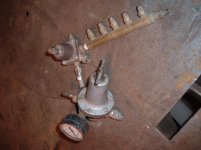
Pic 2 is a couple old regs I dug up, I had a cheap one that actually work for 20 years give it up. I was going to replace it from the store then realized about 15 ft away had this take off, dam, ported all the same as the other one, took only a few mins to fit and I actually took this one apart, cleaned it a little and bench tested it. Worked great, didn't leak, had the repair for free.
So,,, start simple, get a couple hoses if you have to and plumb it all up, test the layout, use or move it, later convert any extra hose in to extensions, fixed whips or put it on a reel. 1 well placed reel is as good as a hydrant every 4 ft etc. I don't mind a maunual but usually put the 50 ft hoses on a 100 ft reel so a guy can zing and doesn't have to fussy level wind. Retractors for overhead and on occasion can swivel a reel, make it so it reaches out the door etc. Instead of outdoor hydrants simply walk out the door, some cases a port thru the wall.
 

Attachments

  • air reggy.jpg
    air reggy.jpg
    67.7 KB · Views: 32
  • air regs oldies.jpg
    air regs oldies.jpg
    147.5 KB · Views: 27
Last edited:
OP
J

jproaster

Well-known member
Joined
Aug 26, 2018
Messages
170
Location
SE Tennessee
Thanks for sharing your tips and experiences sberry. I assume you learned a ton without having much extra cash to blow on regulators over the years.

Trailered my quincy home today...in the rain : )
 

sberry

Banned
Joined
Jun 18, 2005
Messages
35,747
Location
Brethren, Michigan
I got no problem using some used equipment. I got quite a bit of stuff, if I had to get it all new at every turn I would never start or get it done. I come up with some best designs that way. I kind of collect this type of thing if I think it may work.
I got a used junk comp from a friend a while back. As a unit it was dangerous, I condemed it but salvaged the components.
 
Last edited:
To avoid these ads, REGISTER NOW!
Top Bottom