To avoid these ads, REGISTER NOW!

Any motor control/automation gurus in here?

Razorhunter

Well-known member
Joined
Apr 25, 2013
Messages
393
I've recently taken great interest in building phase converters, and also playing with VFD's etc. Not to mention hooking up any machine that I can manage to add to the shop.
So, I'm looking for a better Fluke meter, which brings me to you guys.
I was looking at the Fluke 375FC. Its AC/DC, it does Frequency/Hertz, and also capacitance from 1-1000mfd.
I dont know if it does anything more as far as motor check and evaluation goes, but I'm thinking those options are only available on more expensive models?
I dont even really know what all else is available as far as motor evaluation options go? I'm still learning.
I do kmow I've read these meters can check insulation, and there is something called "megger" or something like that, but again, more research time on my end is needed.
Basically, I'm wondering if there is another model Fluke you guys recommend for industrial automation tyoe work (mainly machinery motor control evaluation type work)? Thanks for any help.
 
To avoid these ads, REGISTER NOW!

Aceman

Well-known member
Joined
Jan 28, 2007
Messages
2,513
Location
Eastern Oregon
Generally, I use a combination of Fluke T+ Pro, 376, 289, and 1507 when doing motor and controls troubleshooting.

I don't see how it's practical to own all these meters as a diy'er unless you're very serious about it. I do this for a living though.
 
OP
R

Razorhunter

Well-known member
Joined
Apr 25, 2013
Messages
393
Yeah thanks Aceman, I am indeedvwry serious, but I won't be buying numerous meters any time soon. Just looking for something good to start out with initially.
 

RPH

Well-known member
Joined
Dec 17, 2006
Messages
4,190
Location
Michigan Thumb
I work on Induction Heating systems and utilize nothing but Fluke meters for diagnostics. Tektronics for oscopes. The 289 will do you fine for the Diy approach. The systems I work with go up to 500kHz and up to 3 megawatt output.
 

Bert_

Well-known member
Joined
Dec 24, 2016
Messages
9,758
Location
NW Iowa
Probably 95% can be done with any plain jane meter. I still use a first series fluke 77 from the 80's for most day to day stuff, even have the plug in amp clamp for it though I don't really use that. Most of the stuff I work on is old so not many VFD's or PLC stuff.

If your working on a lot of single phase motors I like a good cap tester. I have a plug in one that tests with high voltage rather than 9v or so that the multi meters use. Sometimes they test good on a multimeter but are very leaky or short at operating voltage.
 
OP
R

Razorhunter

Well-known member
Joined
Apr 25, 2013
Messages
393
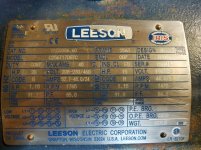
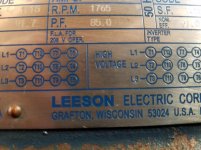
Thanks for the info guys. Here's one issue I currently need help with. Can you tell me how to ohm out this 12 lead 20hp motor I've got? As you see, its dual voltage, and with 12 leads, I do not know which leads to check against each other?? Here's the schematic on motor plate. Which leads do I test against one another to ohm check it? Low voltage (230v) is on the left.
 

Attachments

  • 20181007_145552.jpg
    20181007_145552.jpg
    147.1 KB · Views: 73

wyliesdiesels

Well-known member
Joined
Aug 14, 2012
Messages
20,032
Location
Modesto, CA
The functions you need are frequency, current, voltage, resistance. Also need a megger.

You could do all that with 2 meters- a clamp meter and a megger.

I have a Fluke 381 which is handy to have when remotely starting motors.
 
OP
R

Razorhunter

Well-known member
Joined
Apr 25, 2013
Messages
393
Nameplate pics. Again guys, if anyone could help me, I'm trying to find out which leads are paired up for which coils to ohm check this motor. Being a 12 lead motor, the schematic on the plate shows the following leads go together for low voltage:
1, 12, 7, and 6
2, 10, 8 and 4
3, 11, 9 and 5

So exactly how do I ohm it out? Which leads do I test against each other with the ohmmeter??? Thanks for any help.
 

Attachments

  • 20181007_183631.jpg
    20181007_183631.jpg
    150.6 KB · Views: 54
  • 20181007_183623.jpg
    20181007_183623.jpg
    157 KB · Views: 49

Bert_

Well-known member
Joined
Dec 24, 2016
Messages
9,758
Location
NW Iowa
What are you trying to figure out by ohm-ing it? A test like that doesn't really tell you anything unless the motor is completely fried.
 

Mr. T

Well-known member
Joined
Sep 4, 2013
Messages
636
Location
Central PA
Meters: Can’t go wrong with the 87-V but they aren’t cheap. The 117 is probably more than enough meter for 99% of the situations you’re going to encounter. Plus it’s reasonably priced.

As far as your motor goes; does it have an issue or are you just poking at it for fun?

The only time I’ve ohmed out individual windings were because the motor was rewound and I want to double check that the windings still match the terminal diagram before I hook it back up to power. If you’re just looking for a shorted winding go each phase to ground. With the power off of course.
 
Last edited:
OP
R

Razorhunter

Well-known member
Joined
Apr 25, 2013
Messages
393
What are you trying to figure out by ohm-ing it? A test like that doesn't really tell you anything unless the motor is completely fried.

Yes that's exactly what I want to check. This motor is not under power and I have no idea of its condition or history.
 

Mr. T

Well-known member
Joined
Sep 4, 2013
Messages
636
Location
Central PA
Yes that's exactly what I want to check. This motor is not under power and I have no idea of its condition or history.


Pull the jumpers off and look for continuity to the frame. A good visual isn’t a bad idea either. Look for charring and other signs of heat. A good sniff test doesn’t hurt. That’s just the electrical side though. See how much play there is in the bearings.

What’s the motor for? 20hp is a little guy for industrial but an absolute monster to have on a residential service.

Also, forgot to mention, I have a fluke 373 that is awesome for motors and HVAC work.
 

swaterbenny

Well-known member
Joined
Nov 22, 2009
Messages
215
Location
New Richmond, WI
I'm a little stumped actually, I'm not sure if it's a wye or delta motor so, it makes it hard to trace the winding's.

Use the ohm meter to check for continuity of the wires to each other one at a time mark any pairs, see if you have three that trace as connected.

I use a Fluke 323 basically all the meter you need as an industrial electrician, just wish it had a light. The fanciest meter in the world is worthless if you don't know how to use it.

Ben
 

Bert_

Well-known member
Joined
Dec 24, 2016
Messages
9,758
Location
NW Iowa
It's a 12 lead motor so it could be wired wye or delta because all the wires are brought out, no internal connections. It does look like it is designed to be wired delta to run on standard voltages.
 
OP
R

Razorhunter

Well-known member
Joined
Apr 25, 2013
Messages
393
Pull the jumpers off and look for continuity to the frame. A good visual isn’t a bad idea either. Look for charring and other signs of heat. A good sniff test doesn’t hurt. That’s just the electrical side though. See how much play there is in the bearings.

What’s the motor for? 20hp is a little guy for industrial but an absolute monster to have on a residential service.

Also, forgot to mention, I have a fluke 373 that is awesome for motors and HVAC work.

There are no jumpers (that I can see anyway) unless they are located outside of the box???
This motor will be my idler for a 20hp RPC I'm building. Bearings are perfect. I just dismantled, cleaned the old grease out, and ordered some new Chevron and also Mobil polyurea base greases (manuf recommended lubes) to re lube them, just be on the safe side.
 
To avoid these ads, REGISTER NOW!

walta

Well-known member
Joined
Jan 13, 2017
Messages
2,313
Location
Dutzow Missouri
I like my Fluke 87V.

I have never thought” I need it know of the frequency AC power on this circuit”

How and when does anyone find frequency useful in a multi meter?

Walta
 

mm08822

Well-known member
Joined
Jan 13, 2012
Messages
6,004
Location
NJ
The individual windings are:
1-4, 7-10
2-5, 8-11
3-6, 9-12
Motor n/p provides high/low voltage connections for delta configurations of the windings.

Isolate each winding before you test. I would expect each winding's test reading to be close to the others if not defective.
 
OP
R

Razorhunter

Well-known member
Joined
Apr 25, 2013
Messages
393
Thank you mmo8822, thats what I needed! Another guy on another forum posted the exact same numbers/leads for an ohm test as well.
 
OP
R

Razorhunter

Well-known member
Joined
Apr 25, 2013
Messages
393
930 dreamer, that is the plan, not just for testing, but that will be its sole purpose, as an idler motor for a Rotary Phase Converter. However, how can I be sure I'm spinning it in the right direction initially? Trying to think how I can make sure that the 120v pony motor is spinning this big 20hp in the correct direction? I'd hate to spin it up say, CW, then throw 240v to it while it wants to spin in the CCW direction. How should I approach this?
 

930dreamer

Super Moderator
Staff member
Joined
Oct 7, 2009
Messages
22,963
Location
Amarillo,TX and Stinnett,TX
I know I wondered about this before, when I had two RPC operating in tandem, but I don't think it matters which direction the idler spins under power. I just wired them both to spin in the same direction after starting.

This from the PM;

"Actually, the motor on single phase input (which is what it will have) can go either direction. The single phase doesn't have a specific direction to go, you can reverse it by the direction you start it, same as you do with a single phase motor."

Pick one. Stick with that direction and don't worry about it

Where are you located? Might want to add it to your profile?
 
Last edited:

clubairth

Banned
Joined
Dec 24, 2014
Messages
263
Really like my Fluke 87V. True RMS meter. Back-lighted display too.

Maybe consider getting a used one? Got mine on EBay and it looked brand new and was less than half the price of new!
.
.
.
 

Mr. T

Well-known member
Joined
Sep 4, 2013
Messages
636
Location
Central PA
There are no jumpers (that I can see anyway) unless they are located outside of the box???

This motor will be my idler for a 20hp RPC I'm building. Bearings are perfect. I just dismantled, cleaned the old grease out, and ordered some new Chevron and also Mobil polyurea base greases (manuf recommended lubes) to re lube them, just be on the safe side.


By jumpers I mean the metal bars connecting the terminals, I’m sure there is a more technical term that I’m unaware of or forgetting.

And if the the bearings were in good shape to begin with that’s a pretty good sign of the overall condition of the motor. Thermal runaway in the windings has a tendency to cook the bearings in my experience. At least on this type of motor.
 

Matt Matt

Well-known member
Joined
May 11, 2017
Messages
523
Location
Ontario
930 dreamer, that is the plan, not just for testing, but that will be its sole purpose, as an idler motor for a Rotary Phase Converter. However, how can I be sure I'm spinning it in the right direction initially? Trying to think how I can make sure that the 120v pony motor is spinning this big 20hp in the correct direction? I'd hate to spin it up say, CW, then throw 240v to it while it wants to spin in the CCW direction. How should I approach this?
Three phase motors can spin in either direction. So whatever direction your pony spins the idler, that’s the direction it will go.

Once it’s up and running come back with your voltages
L1 to L2=
L2 to L3=
L1 to L3=

You can keep adding 100 µF (in parallel) capacitors To boost the generated leg voltages.

My 20 horse power RPC pulls about 80 amp single phase on start up. I’m using on auto start system not a pony. My 20 hp RPC is also coupled with a 15 kVA transformer. It comes up to speed in two seconds.
 
Last edited:

nsula_country

Well-known member
Joined
May 23, 2013
Messages
1,534
Location
Northwestern Louisiana
For vfd's, you NEED low pass filter. The 87v has it, dont know about cheaper meters.

I have a 187 as my go-to meter. It was a little cheaper than the 87V, but is now out of production. Still a fine meter... Can be had on EBAY.

Dingleburry, is your avatar the tine gear from a Troy-Bilt Horse? If its not, it looks like the one I replaced this spring!

CT
 

Dingleburry

Well-known member
Joined
Mar 2, 2016
Messages
593
Location
Great white north in an igloo
I have a 187 as my go-to meter. It was a little cheaper than the 87V, but is now out of production. Still a fine meter... Can be had on EBAY.

Dingleburry, is your avatar the tine gear from a Troy-Bilt Horse? If its not, it looks like the one I replaced this spring!

CT

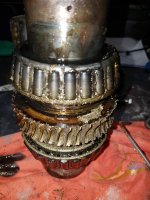
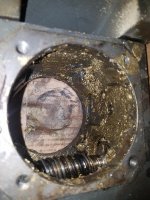
Haha that *****. It was an industrial worm and wheel gearbox from work. Vertical shaft, bottom lip seal wore out, thats what happens when it runs dry.
Thats whats left of the wheel gear.
Heres another pic.

And ya thats a good meter but didnt see anything about low pass filter. Very different HZ and voltage readings without it. I believe newer meters have it built in now, and not on/off option like the 87v has.
 

Attachments

  • 20180514_131957.jpg
    20180514_131957.jpg
    125.4 KB · Views: 23
  • 20180605_110959.jpg
    20180605_110959.jpg
    120.2 KB · Views: 30
Last edited:

nsula_country

Well-known member
Joined
May 23, 2013
Messages
1,534
Location
Northwestern Louisiana
Haha that *****. It was an industrial worm and wheel gearbox from work. Vertical shaft, bottom lip seal wore out, thats what happens when it runs dry.
Thats whats left of the wheel gear.
Heres another pic.

And ya thats a good meter but didnt see anything about low pass filter. Very different HZ and voltage readings without it. I believe newer meters have it built in now, and not on/off option like the 87v has.

The tine drive is designed exactly like the gearbox you had there. I believe the fail mode on the tiller was a combination of low lube level and the rear taper roller bearing (thrust end) failed. Lots of brass everywhere!

I can honestly say that I have not used the frequency function of the meter. I will check the output of some VFD's we have at the plant and what the meter vs drive display read. We don't have any applications where our drives go above 90-100 Hz. The 187 is less than 10 years old. Don't know why Fluke discontinued it. I always end up with the odd products... I do get it certified annually.

CT
 

Dingleburry

Well-known member
Joined
Mar 2, 2016
Messages
593
Location
Great white north in an igloo
The tine drive is designed exactly like the gearbox you had there. I believe the fail mode on the tiller was a combination of low lube level and the rear taper roller bearing (thrust end) failed. Lots of brass everywhere!

I can honestly say that I have not used the frequency function of the meter. I will check the output of some VFD's we have at the plant and what the meter vs drive display read. We don't have any applications where our drives go above 90-100 Hz. The 187 is less than 10 years old. Don't know why Fluke discontinued it. I always end up with the odd products... I do get it certified annually.

CT

Haha yea always a good time when theres no gear teeth left.
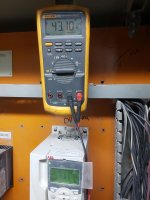
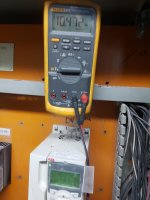
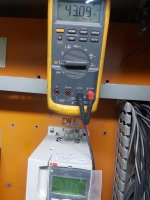
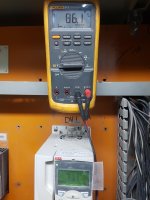
Heres some readings from a vfd i did.
Volts without low pass: 159vac
With low pass: 86vac
Hz without low pass: in 600v range it was really jumpy but 43hz to 59hz
In 60v range i got 10.47 Khz
With low pass on, in 600v range dead nuts on 43.10hz
In 60v range low pass on 43.09 hz
Low pass in the pic is above the V icon. So you know which on has it on.

This is a question ive been wanting to ask for while now. How far out has your meter ever been/how many years have you had it?
Im curious if non lab accuracy test equipment even needs to be re certified? Guess it depends what your doing with it really...
 

Attachments

  • 20181011_162710.jpg
    20181011_162710.jpg
    76 KB · Views: 20
  • 20181011_162851.jpg
    20181011_162851.jpg
    80.7 KB · Views: 26
  • 20181011_162932.jpg
    20181011_162932.jpg
    68.2 KB · Views: 30
  • 20181011_163005.jpg
    20181011_163005.jpg
    79 KB · Views: 30
  • 20181011_162636.jpg
    20181011_162636.jpg
    79.9 KB · Views: 17
Last edited:
To avoid these ads, REGISTER NOW!
Top Bottom