mgmlvks
Well-known member
Looks like "NIKON" to me...?
Kinda does - I'm good with that


Looks like "NIKON" to me...?
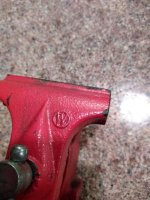
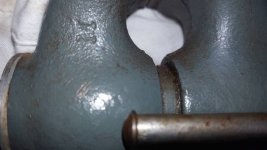
One the pics from EeekPay shown below. What are the marks below "M-H", looks like N KC M? If so would that be North Kansas City Missouri?

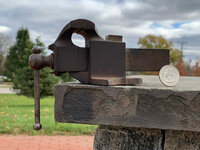
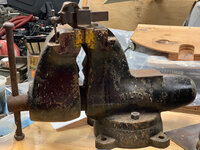

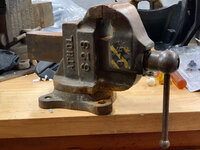


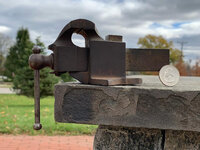
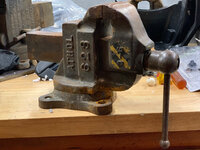


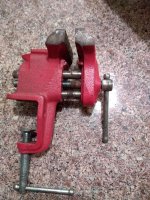
The mother in law sent me a pic of a Charles Parker she dug out of some straw in one of their barns - looks pretty rusty and I can't tell if the static jaw is broken/welded or if it is just a clump of cow manure <
Anyone have any idea what it might be? Looks like a 3-4 incher...not sure what series had the lettering in an arc. I won't be able to grab it for a few more months.
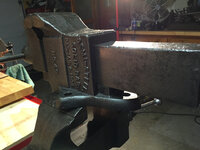

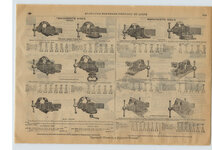
My newest additions. A sweet 2” baby Prentiss watchmakers vise and a ratchet style athol 623. I was actually surprised how small the Prentiss was but it’s beautiful.
The athol spindle was either swapped or someone put the wrong spindle on the wrong vise from the factory. The 723 is the one that’s supposed to have the ratchet style handle.


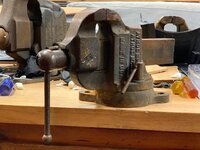


My newest additions. A sweet 2” baby Prentiss watchmakers vise and a ratchet style athol 623. I was actually surprised how small the Prentiss was but it’s beautiful.
The athol spindle was either swapped or someone put the wrong spindle on the wrong vise from the factory. The 723 is the one that’s supposed to have the ratchet style handle.
Your Athol vise is a late model 623RH. For whatever reason, Athol changed the 700 series model # to a 600 series # sometime in the 1950's.
I knew this would confuse someone with your vise who didn't have the newer catalog information.
Very nice vises!
This is 2 hours away from me, 4" Columbian. The guy is asking $95. Wish it was closer.

Rods measure 5" end to end. Mine says 38a on the movable jaw and 38 on the main casting. It has a swivel base, but maybe it was added later? Don't know.
I believe you are absolutely correct! I dropped you some old catalog scans and some other member photos of their Morgan 138 vises with different castings. The 1963 scan is the first listing of the no-38 stationary model, everything before was only offered as a no-138 swivel model.
Very nice vise and probably getting added to my bucket list.
Bought today a Columbian 144M - ok deal for $25, looks like a nice heavy-duty mechanics/machinist vise, I was looking for one for a while. Always wanted one with a really big handle - you know what they say about big handles
Spent some time cleaning, and found something worrisome - a pertty big crack on the dynamic jaw under the jaw face.
I was thinking that I can probably grind and weld it, but then it occurred to me that it might be the kind of iron that doesn't take to welding well. Can anyone give me some info? Is this vise borked and is now light-duty only until it breaks, or can it be fixed? Am I possibly making a mountain out of a molehill?
I don’t want this badly enough to pay the sellers asking price of 150.00, but it’s hard to look away from. It’s in such beautiful condition that it’d almost be a shame to clean it up in any way....
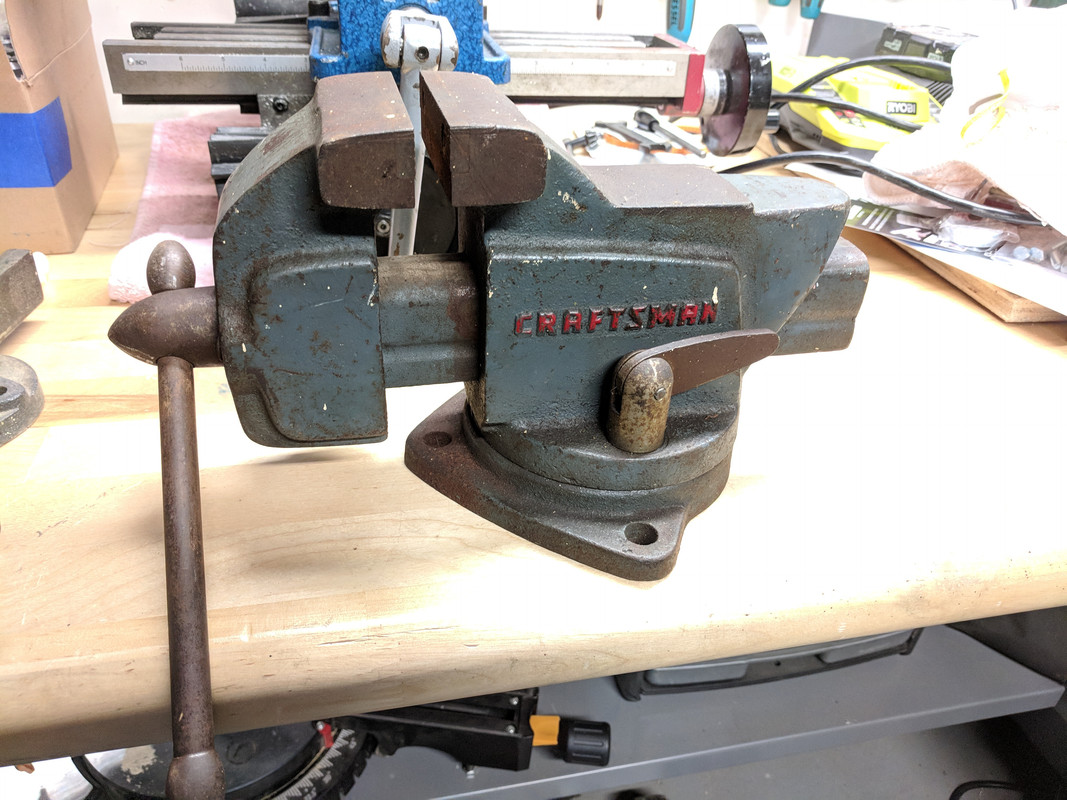
I don’t want this badly enough to pay the sellers asking price of 150.00, but it’s hard to look away from. It’s in such beautiful condition that it’d almost be a shame to clean it up in any way....
Techna
While this is a nice vise in its own right, it is not one of the Craftsman 519X series which are highly sought after. Therefore some (including myself) would consider $150 as being too high.
Techna
While this is a nice vise in its own right, it is not one of the Craftsman 519X series which are highly sought after. Therefore some (including myself) would consider $150 as being too high.
I passed on one that wasn't as nice for $25, it just didn't work with my schedule. I agree $150 is way too much, you can actually have a 05195 from eBay for that price.
You're both totally and completely right...but I just loved that airplane nose cone-esque main screw spindle and art deco design.
Dungeon
It ***** that there is a crack. Stating the obvious, a repaired vise is rarely (if ever) as strong as an undamaged one. In any case one of the supposed better ways to repair cracked cast iron vises is brazing.
Even assuming you know how to braze (as honestly personally I am not sure if this vise is worth the expense of a profession braze job) in trying to grind and then patch the face of the jaw where the crack is and then grinding it flat all the way back to the face so that inserts fit properly will remove most of the braze material and might not add much additional support.
I suppose you could braze area under the jaw as well as the back of the jaw to provide some additional support.
Or you could conceivably go Frankenstein and drill and tap under and the back of the jaw and use bracing plates across the crack both under and back of the jaw. Or may be drill a thin hole across the width of the jaw and use a long bolt/nut to hold the two sides of the jaw together. All of which might also end up in fact weakening the structural integrity.
If this was my vise I would use as is but use it gently and look for another vise of same or better quality. There are still plenty of basic US made mechanics vises at reasonable prices out there. Or even with some luck you might be able to find a nice machinist vise for a good price.
I would also recommend while searching to look for covered screw types (not exposed screw like this one) which are generally more heavy duty.
Best of luck
Could you go more into reason welding is generally avoided? I am an amateur when it comes to welding, and having watched a number of videos of people welding together vises and anvils from railroad rails, I got wondering if maybe welding isn't as out of the question.as I thought.
The issue is with the metal used in vises - it's a cast ductile steel/cast iron, both of which are very difficult to weld correctly. You usually have to v-notch the cracked area, extensively pre-clean the areas to be welded, pre-heat the piece, weld with a NI rod (if memory serves me correct) and then let it cool very slowly by burying the piece in sand or something similar. When I was in school, I failed many times trying to get it right, and usually the metal was weakened and broke near the welds if the weld held at all. Brazing is a much better option for cast metals, but even this is not nearly as strong and is likely to break in a high stress area over time.
Railroad rails are a different metal entirely. They are usually an extruded steel alloy (perlite maybe?) and is very hard but much easier to weld.
- how would a crack like that form? The ductile nature of the material would generally prevent this, correct?
I am assuming misuse - clamping something on one side of the jaws and either over-torquing or hammering on it, neither of which should be done with a vise.
The ductile nature of the material would generally prevent this, correct?
I am assuming misuse - clamping something on one side of the jaws and either over-torquing or hammering on it, neither of which should be done with a vise.
DungeonGman,
Thank you for the lengthy reply! Sad to hear that it's the worse case and not much can be done once a crack develops in a stressed area.
Could you go more into reason welding is generally avoided? I am an amateur when it comes to welding, and having watched a number of videos of people welding together vises and anvils from railroad rails, I got wondering if maybe welding isn't as out of the question.as I thought.
I am in agreement regarding any other forms of bracing - it's just as likely to weaken it at best leaving you where you started, plus the work involved.
Barring repairs, the plan was is to keep it light duty and look for another as you suggested. In any event, I am only $25 out for it, and it is still usable, so not much loss there.
And thank you for the tip about the different screw type! Do you have an example of one? I have only ever seen the jaws that are screwed at the face or pinned. The screws on this one were so bad I had to hammer them out with an impact because the faces were completely chewed up. But then the vise looks to be a better part of the century old with a lot of use, so that follows.
My coach maker vise arrived yesterday. Way too much paint but it is complete and useable!
Ok, teach me...what is coach maker vise for? Why are the jaws so tall? I saw a Morgan 138 on FB the other day.
Can we see a couple more pics of your 436A? I have a 433 1/2A. It has the later style square jaws and I'm pretty sure the swivel lockdown bolt is original and it doesn't have a wrench. Seems like i've seen several of the later Parker's with the lower profile hex head lockdown and no wrench. Something else to cross reference, in what way is your swivel base attached to the main body of the vise? Shoulder bolt or cast in peg with washer and c-clip?
Sent from my SM-G930P using Tapatalk
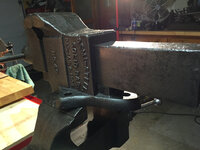
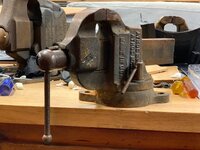
You asked for photos so I stayed up till 4 am last night cleaning and mounting the vise. Not one of the monster vises most people on here seem to be looking for, but I wanted one to use that had the pipe jaws. I really appreciate the old paint and at some point will probably do something with the bright shiny screws that hold the pipe jaws to keep with the vintage look.

The name itself implies what they were historically used for, namely for making parts for coaches/carriage. In general they are great for woodworking.
The tall jaws allows clamping large pieces of wood to hold but with not so much pressure as to mar the wood. Quiet often the jaws are also smooth for the same reason.
You asked for photos so I stayed up till 4 am last night cleaning and mounting the vise. Not one of the monster vises most people on here seem to be looking for, but I wanted one to use that had the pipe jaws. I really appreciate the old paint and at some point will probably do something with the bright shiny screws that hold the pipe jaws to keep with the vintage look.
Misuse of some type....throwing a cheater bar on the handle, a blow with a hammer, twisting the work piece in the jaws, pressing bearings....I've seen a vise break from being dropped on concrete.
It's not that hard to break a vise if you abuse it. If you use it as intended, it will last many lifetimes.
The metal isn't ductile steel alone - it's an cast alloy that's a bit stronger than straight cast iron alone because of additives in the mix. It's still brittle, which is why it cracks and breaks off in chunks rather than stretching. Each manufacturer had their own recipe.
I am no metallurgist...maybe somebody can chime in on metal composition used for castings.
Dungeon
MissileBear already addressed your question (and I must add, much better than I could or know about the subject matter) regarding welding vs brazing.
As for the screw, the recommendation was not per se about the "type" but rather it is about the fact that the vises whose screw is enclosed in the slide bar, generally tend to be a lot heavier and beefier than the exposed screw vises. I have attached two examples of two basic Columbian Mechanics vises (photo 1 and 2 are of an exposed screw vise and photos 3, and 4 of none exposed screw).
By the way there are few very interesting hefty exposed screw vises that are exception to this general rule. I have attached a photo of an exposed screw Vanderman 3 (photo 5) which has 6" wide jaws and weighs 162 lb!
You asked for photos so I stayed up till 4 am last night cleaning and mounting the vise. Not one of the monster vises most people on here seem to be looking for, but I wanted one to use that had the pipe jaws. I really appreciate the old paint and at some point will probably do something with the bright shiny screws that hold the pipe jaws to keep with the vintage look.
You asked for photos so I stayed up till 4 am last night cleaning and mounting the vise. Not one of the monster vises most people on here seem to be looking for, but I wanted one to use that had the pipe jaws. I really appreciate the old paint and at some point will probably do something with the bright shiny screws that hold the pipe jaws to keep with the vintage look.
Next task, find and acquire even better looking sibling
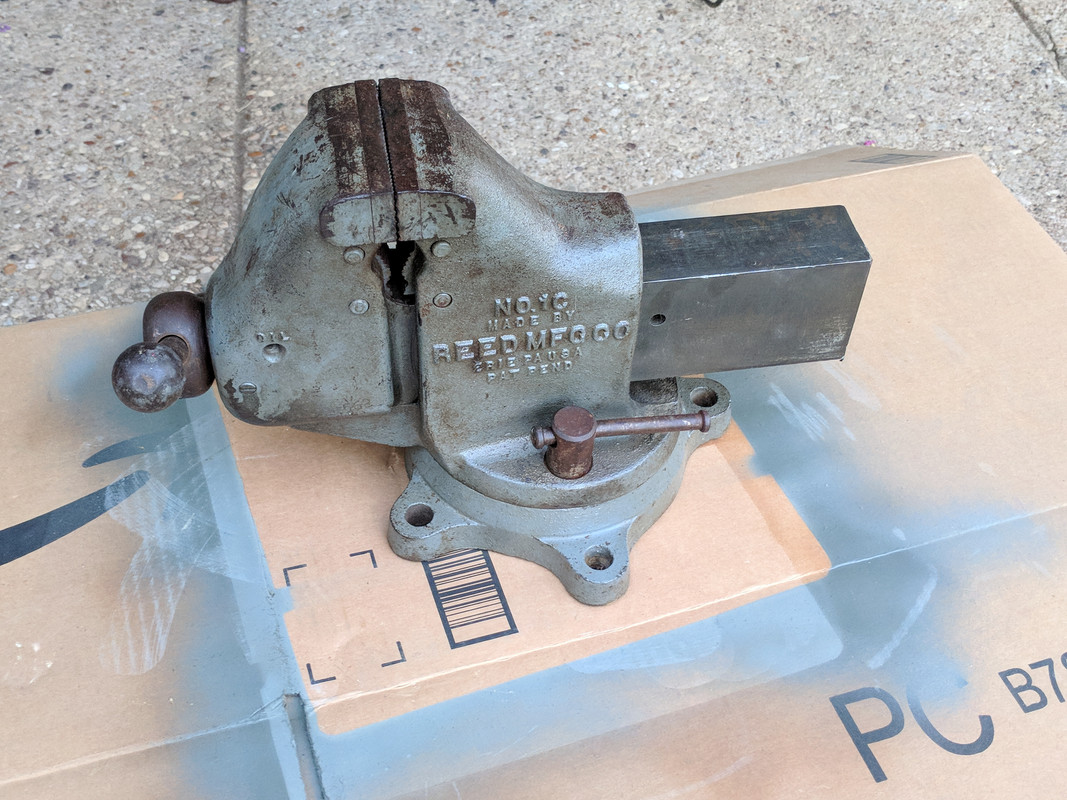
Dungeon
MissileBear already addressed your question (and I must add, much better than I could or know about the subject matter) regarding welding vs brazing.
As for the screw, the recommendation was not per se about the "type" but rather it is about the fact that the vises whose screw is enclosed in the slide bar, generally tend to be a lot heavier and beefier than the exposed screw vises. I have attached two examples of two basic Columbian Mechanics vises (photo 1 and 2 are of an exposed screw vise and photos 3, and 4 of none exposed screw).
By the way there are few very interesting hefty exposed screw vises that are exception to this general rule. I have attached a photo of an exposed screw Vanderman 3 (photo 5) which has 6" wide jaws and weighs 162 lb!
You asked for photos so I stayed up till 4 am last night cleaning and mounting the vise. Not one of the monster vises most people on here seem to be looking for, but I wanted one to use that had the pipe jaws. I really appreciate the old paint and at some point will probably do something with the bright shiny screws that hold the pipe jaws to keep with the vintage look.
 but I thought I'd post the photos here for future reference - it does appear to be in excellent original condition.



I will be using it to hold sheet metal parts that I am forming, the smooth jaws will be good for holding things that would be marked by the cross hatching found on a machinest or mechanics vise. I've been looking for one for a few years and this one was close and fairly priced.Ok, teach me...what is coach maker vise for? Why are the jaws so tall? I saw a Morgan 138 on FB the other day.
I saw that vise on Ebay....Oxford, PA right?