To avoid these ads, REGISTER NOW!

Electronic Ballasts and Radio Noise

Friartuck

Well-known member
Joined
Apr 13, 2007
Messages
123
Location
Monmouth County, NJ
Checking in with the forum members of a problem I recently experienced in basement shop lights. I replaced a few ballasts from magnetic ballast to the newer multi voltage electronic versions. This is for fixtures with two eight foot T12 single pin bulbs. The newer ballasts produce an interference noise through the FM radio. And its the fixture with the new ballast, proved by disconnecting the suspect fixture and the radio clears up. I also noticed this with the brand new fixtures (has four T-8 bulbs) installed in the garage shop (presumably they too use newer multi voltage ballasts). All fixtures are hot and neutral correct with grounds. Anyone else experience interference problems like this?? A search of the forum didn't reveal anything.

Chris (central NJ)
 
To avoid these ads, REGISTER NOW!
OP
F

Friartuck

Well-known member
Joined
Apr 13, 2007
Messages
123
Location
Monmouth County, NJ
The archive Threads referenced by Falcon67 document the interference problem, but I didn't see anything on which brands are better and if any correct the problem.
 
OP
F

Friartuck

Well-known member
Joined
Apr 13, 2007
Messages
123
Location
Monmouth County, NJ

pattenp

Well-known member
Joined
Jun 4, 2008
Messages
10,175
Location
Virginia - USA
I know that. The post name was "Buzzing Bulbs", the filter solution was in post #18 for RF noise.

Buzzing bulbs and RF interference are two differant problems. the filter mentioned above is specifically designed for Flourescent lighting applications. Mouser has none in stock, but is available from Newark Electronics:

http://www.newark.com/te-connectivi...wer-line-filter-3-9a/dp/21M5963?ref=lookahead

Data sheet is:
http://www.te.com/commerce/Document..._PRODUCT_GUIDE_FL_SERIES_0611.pdf2-6609092-3
 

mrb

Well-known member
Joined
Dec 31, 2008
Messages
3,734
you need to buy 'residential grade' ballasts -these meet more stringent FCC requirements vs the commercial grade ones which put out alot of rf
 

olytdi

Well-known member
Joined
Dec 3, 2011
Messages
2,202
Location
Olympia, Washington
So if you have, say, an in-ine bank of flourescents, do you need an RF filter for each fixture or can this be wired such that the entire bank is filtered? I've got a total of eight four-lamp fixtures to filter. RF drives me nuts but that's a lot of $$ if a filter is needed for each fixture.
 
OP
F

Friartuck

Well-known member
Joined
Apr 13, 2007
Messages
123
Location
Monmouth County, NJ
olytdi,

The answer to your question is the current rating of the filter. The one mentioned above has a maximum rating of 3.9 Amps which is about three or so fixtures. They do make filters with higher current ratings, but the price rises as well. Go through the catalog or call the manufacturer for help. Depending on the layout of the fixture bank, one filter may not do it. The intent of the filter is to suppress the interfence and ground it at its source (the ballast). Putting in a filter at one area and has another ballast 10-15 feet away may not be effective enough.

mrb said it above, use residential grade ballasts (which likley includes the filters internal to the ballast), but no one has listed a manufacturer or part number that conforms to this.

Follow up: In a PM from a GJ user, they listed Sylvania Quicktronic QT2x32 T8/120 ISN-SC ballasts with success for T-8 bulb fixtures. Here is the data sheet which oddly does not list Residential under the Applications listing:
http://www.elightbulbs.com/pdfs/sylvania/Sylvania-Quicktronic-T8-Instant-Start.pdf

To help document this topic a little more, the offending Ballasts are from Advance.
Another PM from a GJ user used GE ballasts with good results.

Friar
 
Last edited:

olytdi

Well-known member
Joined
Dec 3, 2011
Messages
2,202
Location
Olympia, Washington
olytdi,

The answer to your question is the current rating of the filter. The one mentioned above has a maximum rating of 3.9 Amps which is about three or so fixtures. They do make filters with higher current ratings, but the price rises as well. Go through the catalog or call the manufacturer for help. Depending on the layout of the fixture bank, one filter may not do it. The intent of the filter is to suppress the interfence and ground it at its source (the ballast). Putting in a filter at one area and has another ballast 10-15 feet away may not be effective enough.

mrb said it above, use residential grade ballasts (which likley includes the filters internal to the ballast), but no one has listed a manufacturer or part number that conforms to this.

Follow up: In a PM from a GJ user, they listed Sylvania Quicktronic QT2x32 T8/120 ISN-SC ballasts with success for T-8 bulb fixtures. Here is the data sheet which oddly does not list Residential under the Applications listing:
http://www.elightbulbs.com/pdfs/sylvania/Sylvania-Quicktronic-T8-Instant-Start.pdf

To help document this topic a little more, the offending Ballasts are from Advance.
Another PM from a GJ user used GE ballasts with good results.

Friar

Thanks much for the insightful response. I will have to do a little more research on this. I'd sure like to supress each bank somehow (and at a reasonable cost!). I choke at the thought of replacing all of the ballasts when I should have done this right the first time. I remember just getting the fixtures and thinking that they all were the same. Apparently not! Who knew?

Good thread. Perhaps will keep someone else from putting-up the wrong fixtures the first time!:thumbup:
 

Fred43

Member
Joined
Apr 20, 2012
Messages
14
Location
Bellingham, MA
To eliminate RF caused by Fluoresent lights try geting your power for the radio fron a circuit unrelated to the lighting circuit. If the two items are in the same 2 wire or 3 wire cable you could get static on the radio. Also check the grounding of the ballast to the fixture can. Scrath the paint on both ballat and can. If there is only one fixture on the circuit causing the problem that could be it. Also check the ground on the receptical that feeds the radio.

I had static interfering with my computer in my office until I did a minor tighten up of the grounds. Hope this is the inexpensive solution.
 

olytdi

Well-known member
Joined
Dec 3, 2011
Messages
2,202
Location
Olympia, Washington
To eliminate RF caused by Fluoresent lights try geting your power for the radio fron a circuit unrelated to the lighting circuit. If the two items are in the same 2 wire or 3 wire cable you could get static on the radio. Also check the grounding of the ballast to the fixture can. Scrath the paint on both ballat and can. If there is only one fixture on the circuit causing the problem that could be it. Also check the ground on the receptical that feeds the radio.

I had static interfering with my computer in my office until I did a minor tighten up of the grounds. Hope this is the inexpensive solution.

I can try the ground check but I use battery power on the radio! It's definitely worse on AM but present on FM as well.
 
OP
F

Friartuck

Well-known member
Joined
Apr 13, 2007
Messages
123
Location
Monmouth County, NJ
Update. Thought this was worth sharing with the GJ group: Before investing in the suggested filter, I redid the ground lead and how its attached to the ballast. The fixture on both sides of the ground screw and both sides of the metal tabs of the ballast were sanded to bare metal, a large fender washer (also sanded both sides), a ground lug which was soldered to the ground lead, another smaller flat washer sandwiched with a stainless nut. Note there were two small nubs under the ballast for grounding. Approx 80% of the nosie is eliminated. Only a faint hiss is heard at low volume.

It may be worth making good ground connections before investing in filters.

Chris
 

Attachments

  • IMG_8436.JPG
    IMG_8436.JPG
    47 KB · Views: 66
To avoid these ads, REGISTER NOW!

Screw Loose Dan

Active member
Joined
Jul 24, 2011
Messages
40
Location
Collegeville, PA
Friartuck - Glad to hear grounding yours made a significant improvement. I spent a bit of time going completely overboard grounding every piece of the fixture, but it didn't help with my installation at all.

Also, I would recommend the filters from my thread mentioned earlier ONLY if you can't find residential grade ballasts. For my particular setup, residential ballasts aren't an option - so filters it was. But, even better is proper grounding, if it works for you.
 

Kevin C

Well-known member
Joined
Aug 4, 2011
Messages
1,653
Location
Portland OR
Industrial rated ballasts only need to meet class A for EMI but are required to have much a much lower power factor. For applications like a shop with a lot of lights the power factor becomes more important.

Also, THD for consumer ballasts is really high, like up to 150% VS 10 to 30% for commercial. It seems difficult to find a class B ballast rated with low THD and that is power factor corrected.

With non powerfactor rated ballasts, the current and the voltage are way out of phase. If you try and load that circuit close to its rated capacity ( 80% rule) you will find that the true current is much higher. For most of us this is not a big deal since it takes a lot of light to fully load a 20 amp circuit. In theory, you should be able to put 30 4' double bulb lamps on one 20 amp circuit ( 60 watts per, 80% capacity). In practice with consumer ballasts it could drop to as low as 15 (.5 power factor 80% Amp rating). 20 double bulb T8 consumer fixtures on one circuit could get the breaker to trip.

The reason I looked at this....

When I wired my new shop I decided to reuse my T8 double bulb lights form the old garage. Most were only 3-5 years old and in good shape. Home Depot open bulb with a protective grate. I bought three more so that I had all matching lights.

The gotcha is that current building code required all receptacles to be on a GFI. The idea is that any socket can be repurposed to run a power tool. This includes my ceiling mounted outlets. No matter that they are 10' up. And of course they all need to be child proof , tamper resistant sockets. You never know when a 6 year old is going to climb a ladder and put a metal object into socket.

The problem is that consumer ballasts , while good for EMI tend to trip GFI's. Those lights that worked perfectly in my old shop now trip the GFI. To meet code, I either need to get low THD ballasts or hard wire all my shop lights.

Kind of annoying. I know there are ballasts out there that are consumer rated, have low power factors and low THD. I just need to find them.
 
OP
F

Friartuck

Well-known member
Joined
Apr 13, 2007
Messages
123
Location
Monmouth County, NJ
Regrettably, as of 7May12 I have to report the radio interference noise is back at about the same level or slightly worse. I'll check the connections at the panel, but it looks like filters or good rated ballasts will be in order.
 

Kevin C

Well-known member
Joined
Aug 4, 2011
Messages
1,653
Location
Portland OR
While I dont have a problem receiving FM in my shop I did upgrade my sound system to a streaming player. I use two different systems. One is a Logitech Boombox ( have had it a few years). The other is just my work shop PC setup to stream off the Internet.

I coupled the PC with a used set of Logitech Z-2300 speakers ($80 used is a good deal) and ended up with a really powerful sound system that sound really nice.

Also a digital radio should work better, AM will be the worst, FM should be better.
 
OP
F

Friartuck

Well-known member
Joined
Apr 13, 2007
Messages
123
Location
Monmouth County, NJ
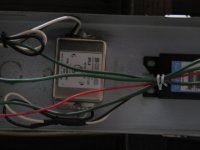
Another follow up to this unwanted RFI noise saga. I installed the above suggested filter which according to the data sheet was designed for suppressing Flourescent fixture ballast noise. It helped, but some light hissing was still heard when plugging and unplugging the fixture. The leads between the ballast and the filter were soldered and kept short. At $22 a clip, I would seek out a good Residential rated ballast before doing filters....

:sad:
 

Attachments

  • IMG_8456.JPG
    IMG_8456.JPG
    75.7 KB · Views: 38

PA Electrician

New member
Joined
Sep 29, 2017
Messages
3
GE232-120-RES for 2-lamp T-8
GE432-120-RES for 4-lamp T-8
Twist line and neutral wires into a pair.
Twist red and blue wires into a pair.
Radio noise gone.
 

Algoma56

Well-known member
Joined
Apr 16, 2007
Messages
67
Location
Sault Ste. Marie, ON
Just did a search for this, when I added a new/old fixture to my string of lights in the garage. It's a 4 tube T8 fixture. As soon as I put power to it, the radio started to crackle. I'm going to try some if the tips suggested above to see if noise gets reduced.
Fixture is a commercial one, so if I can't get noise down, I'll just put a lead and plug on it, to use only when needed, and I'll listen to something other than the radio at that time.
 

dclafleur

Active member
Joined
Jan 26, 2010
Messages
27
Location
Tulsa, Oklahoma
I hadn't considered this but I've had issues with my stereo in my shop only picking up static and I experimented last night and it happens when I flip on my back half lights. I want to replace all the fixtures with LED lights anyways, I'll add this to the list of justifications..
 

tonyciambrone

Well-known member
Joined
Nov 4, 2015
Messages
1,152
Location
Northern Illinois
Yeah this is a dated issue in my opinion. The cost to change a ballast in a 2 bulb fixture is basically the same to put 2 direct wire led tubes in it.

Problem solved.
 

cybrdyke

Well-known member
Joined
Sep 9, 2014
Messages
3,444
Location
USA
I want to replace all the fixtures with LED lights anyways, I'll add this to the list of justifications..

Not so fast...
There are still drivers inside the LED bypass tubes and they can cause the same interference issues that the fluorescent ballasts cause. Drivers and ballasts are very similar things.
There are multiple reports on Garage Journalof interference by LED tubes, so dont assume that this will solve your issue. It might, but it might not.
Good luck,
CD
 
To avoid these ads, REGISTER NOW!
Top Bottom