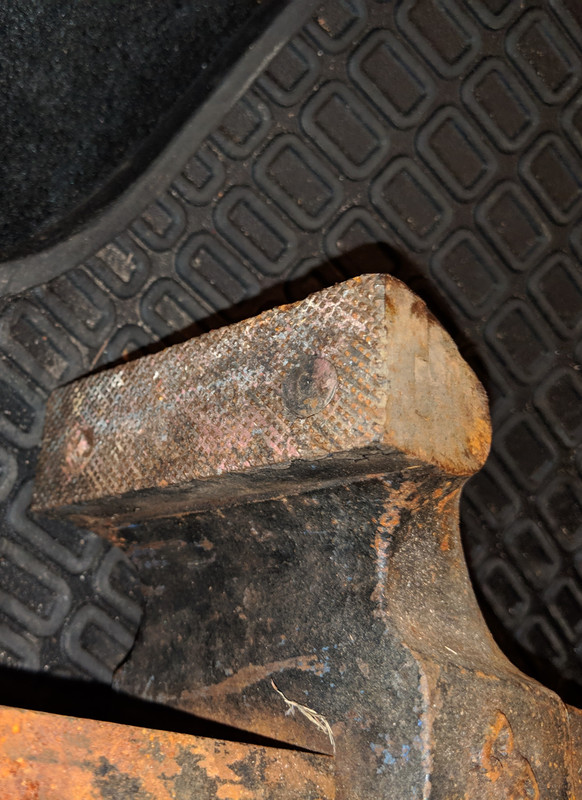
Dr Scott Both the Parker and Reed turned out fanatic. The Parker in particular is in a class of its own
Hmmm, that Parker looks to be developing a crack in the back corner of the slide.



Dr Scott Both the Parker and Reed turned out fanatic. The Parker in particular is in a class of its own

That’s beefy! Very nice!Most recent vise acquisition was a big Wilton I found on CL for cheap.
The plan is to clean it up and put it on the workbench in the new garage I’m building.
Sent from my iPhone using The Garage Journal mobile app
finished it with Black Oil from Sculpt Nouveau. Great stuff, dries like BLO.
Went to order this and the clear wax from the Sculpt Nouveau website, shipping was $30 to PA. I tried most of the distributors listed and not one of them have both products in the small sizes listed.
Is this stuff really worth that much? The product itself did not seem too expensive.
Thanks
Kevin
Thanks again for spending time to give me great advise. I'm still looking for a really good used one but I may just spend the money for a new one.
Right now I'm looking at this one.
https://www.jbtoolsales.com/wilton-...EFz2mIO-9_ac-v8wr0F-LR_eZ7PtXNDxoCaUcQAvD_BwE
Okay just my opinion here but before I would ever fathom spending $589 on a vise I would consider all other options.Thanks again for spending time to give me great advise. I'm still looking for a really good used one but I may just spend the money for a new one.
Right now I'm looking at this one.
https://www.jbtoolsales.com/wilton-...EFz2mIO-9_ac-v8wr0F-LR_eZ7PtXNDxoCaUcQAvD_BwE

Yes kind of. I measured the gap and drilled and reamed a hole in a 1/2" round bar with the offset (.055) to fit the 5/16 pin. The nut has about .010 gap. A little room for misalignment in the spindle assy.
I finished a Reed 104 today too. On that one I made a setup like in the newer Reeds with a set screw. I'll add a few pic"s. The Reed had cast in jaws and I removed them and replaced them with custom jaws. Copied the Starrett 4" jaws. New handle and finished it with Black Oil from Sculpt Nouveau. Great stuff, dries like BLO.
Okay just my opinion here but before I would ever fathom spending $589 on a vise I would consider all other options.
If you are willing to accept that kind of budget I'm confident you could hop on eBay and check out probably 100's of vises that would be better quality than the Tradesman and less money. I'm not knocking the Tradesman but I haven't spent much more than that on 20 vintage American vises.
I hopped on eBay and went to my normal saved search. I sorted highest priced to lowest and quickly looked over everything down to about $300. IMHO, if I was looking to spend $300-500 this is what I'd buy. Seller specifically listed with "make offer" option so good likelihood he's a little flexible on price! Completely stripped to bare metal so not trying to hide anything with paint. Plus you could actually buy a set of Kevin's hard jaws for this late model Reed and still be less than the Tradesman.

Your 1760 should be worth far more than $75 if cleaned up and restored nicely. I've seen them sell for $200 and up. Honestly it's not a bad vise for what you have into it.Guys,
I need a little guidance. I mentioned earlier that I had picked up a Wilton 1760, ahead of time I had hoped it was a "real" bullet, but it's just a bullet-lite. Well, I just need to replace a few screws, scour it of 30 years of crud, paint it and take down the top of the jaws on my MAX disc sander (wonderful tool!) just to clean them up. Other than that it is a kosher vise.
But.......it is not what I wanted. There's a minty Wilton 500S up for sale locally for $475 with no offers being accepted (I have asked). That is way more than I would normally consider spending on a vise, and it's a 2 hour round trip BUT I am thinking I can sell the 1760 for a small profit once it's cleaned up and painted - I am guessing $75 which would lower the effective cost of the 500S to $400.
As usual, I don't NEED another vise, especially a $475 vise, and I have been resisting - successfully - for several weeks but what do your think?
Your 1760 should be worth far more than $75 if cleaned up and restored nicely. I've seen them sell for $200 and up. Honestly it's not a bad vise for what you have into it.
If you really want to move it down the road and get a better vise fix it up nice and offer it to Slednut. He posted just a few posts before yours that he was considering a new 1765 Tradesman for $589! I quoted his post and offered him some alternative options but if a Tradesman would be fine for him maybe you guys can help each other out.
Sent from my SM-G930P using Tapatalk
but I think what Ken is saying he can make $75 in profit (I seem to remember he might have paid $150 for it, if so the sale price will be $225) And his point is that after recouping his initial $150 from the sale he will have $75 towards the $475 which makes his effective cost $400. otherwise he would be short changing himself on the Tradesman sale.Got it. That makes way more sense and after re-reading his post I'm thinking that's what he meant too.Chris
When I first read the post, I scratched my head about the $75 too
Well at least I hope that is what he is saying

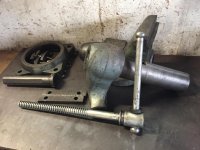
And keep in mind that Tradesman is not a true Wilton bullet. Supposedly it is not made from the same steel as bullet vises and in particular its jaw inserts and pipe jaws are powder steel and not very strong. In fact if one was dead set on getting a Tradesman, I would seriously consider replacing the OEM powder steel jaws with hardened steel jaw inserts from Dr. Scott . So considering the overall cost and quality of Tradesman, personally I really like Chris's proposal.
gman: Of course autopts or other Wilton experts knows better than I, but I heard that 500S etc bullets get 70K psi iron, whereas the tradesman series get 60K psi. Of course a lot of the vises we all buy are 30K psi, so 60K is pretty darned good! Also, I wonder if the sintered metal jaw weakness is similar to the Parker slide weakness - i.e. apocryphal? My jaws sure look OK, and sintered metal works well for brake discs which is kind of a life support product?
Any experts care to comment?

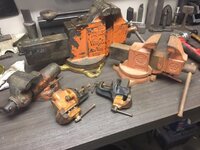
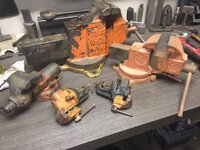
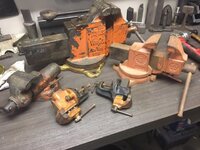
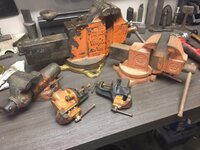
Kind of an odd trend but I just noticed that five of the last six vises I’ve found have
Been painted orange.
Orange is my favorite color. If it starts bugging you let me know and I'll come take one or two off your hands!Kind of an odd trend but I just noticed that five of the last six vises I’ve found have
Been painted orange.
Sent from my iPad using The Garage Journal mobile app
You can send that Prentiss over. Help me help you.Kind of an odd trend but I just noticed that five of the last six vises I’ve found have
Been painted orange.
Sent from my iPad using The Garage Journal mobile app
You can send that Prentiss over. Help me help you.
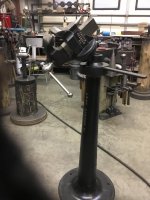
Latest addition
Latest addition
 whatever it is, very cool
Latest addition
Ken
I am definitely not a Wilton expert and frankly no vise expert period. But I have seen broken tradesman jaw inserts in person and to be honest at the breakage point the structure was very grainy. Now does sample of 2 make good statistics, probably not. But the question might be is powdered steel as strong as say tool steel?
It will for sure be interesting to hear what experts like Dr Scott and Autopts have to say about this.
I'll give this topic a shot. The reason Powdered Metal Molds are built is to save on material (Tool Steel) and cutting those pesky serrations. Cutting serrations are very time consuming, if you could build a mold and kick a set of jaws out in 45 seconds then you have found a way to make jaws cheap. I am not a expert on material in Powder Metal but have built metal molds in the late 90's. Powdered metal is a some kind of metal material mixed with a binder. The molds can have multiple cavities. The mold is big and can weight up to 1500 lbs. The reason for the mass is when the material is injected into the cavity it is under extreme pressure where the mass will keep the mold from bowing due to injection pressure.
Molds for metal injection have a high shrink rate, most plastic injection molds are around .006/inch. Metal Molds are up to .02 to .024 per inch. So a 6 x 1 set of jaws will have a cavity size around 6.135 x 1.023 or so. The core will have the serrations and screw holes and the cavity will be flat. The runners which is a channel where the material flows into the mold is around 3/16 round or a 6 degree flat channel. The Gate is the final opening into the cavity and much smaller in size since the material starts to cool as it travels to the cavity and under extreme pressure heats up as it is pushed into the cavity. Maybe a second or two is all the time it takes to fill all the cavities. The Mold has water all around the cavities to cool the blanks.
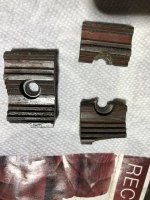
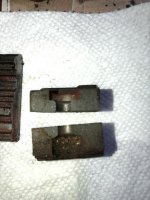
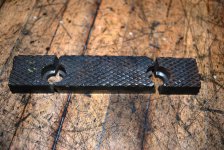
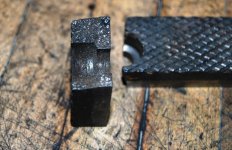
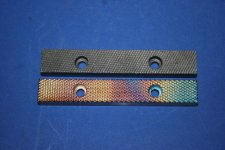
The jaws come out pretty close to the size of the cavity and very fragile. Then they go into a oven and baked where the binder dissolves and the jaws shrink to 6 x 1. I took a few pic's of a set of broken jaws and noted how they built this set. Sharp corners are a no no in mold making, a very high stress area that will crack under pressure, that is why these jaws broke. The jaws after shrinking are not flat but kind of wavy, the hardness is as high as the ones I build but can not take any stress unlike toolsteel. The screw holes in this broken set of jaws are built with a taper where the screw tighten up on, this area should be flat. Why they built it this way is a question I would ask if I seen this on a part design. The Asian's built this mold very cheap, the cavity and coring still has the cutter marks from a end mill. The metal molds I built were ground or EDM'd. The last picture shows a jaw where the serrations were pressed on, I do not think these Asian jaws were powder metal. This was my experience with powdered molds back in the late 90's. I am sure the material has changed some. Kind of long winded answer.

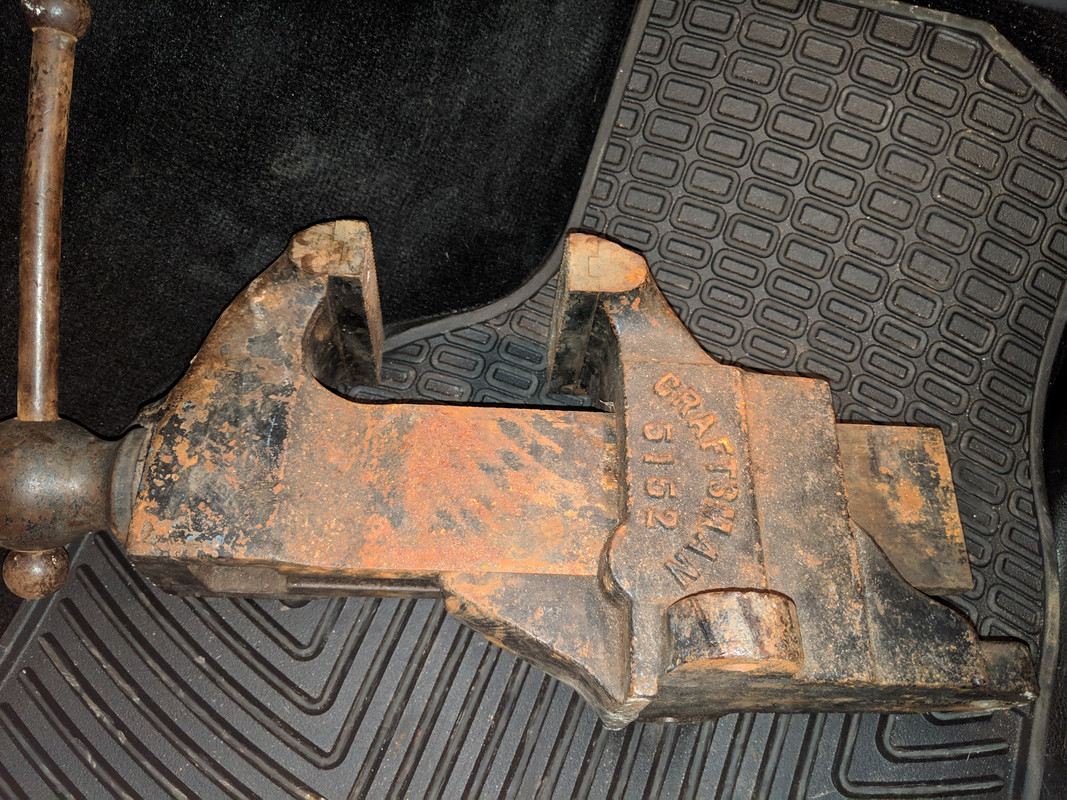
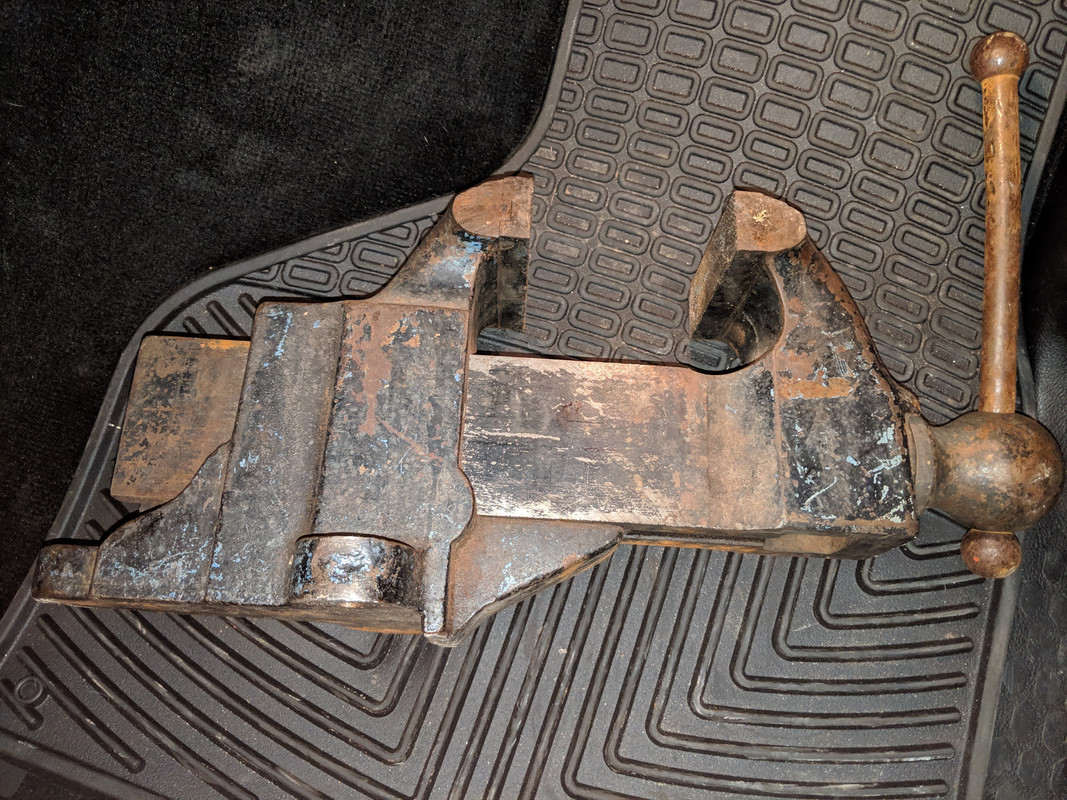
Picked up a nice Rock Island/Craftsman 5152 this evening. Rush hour traffic from Dallas to Fort Worth and back sucked pretty bad, but it's in nice shape!
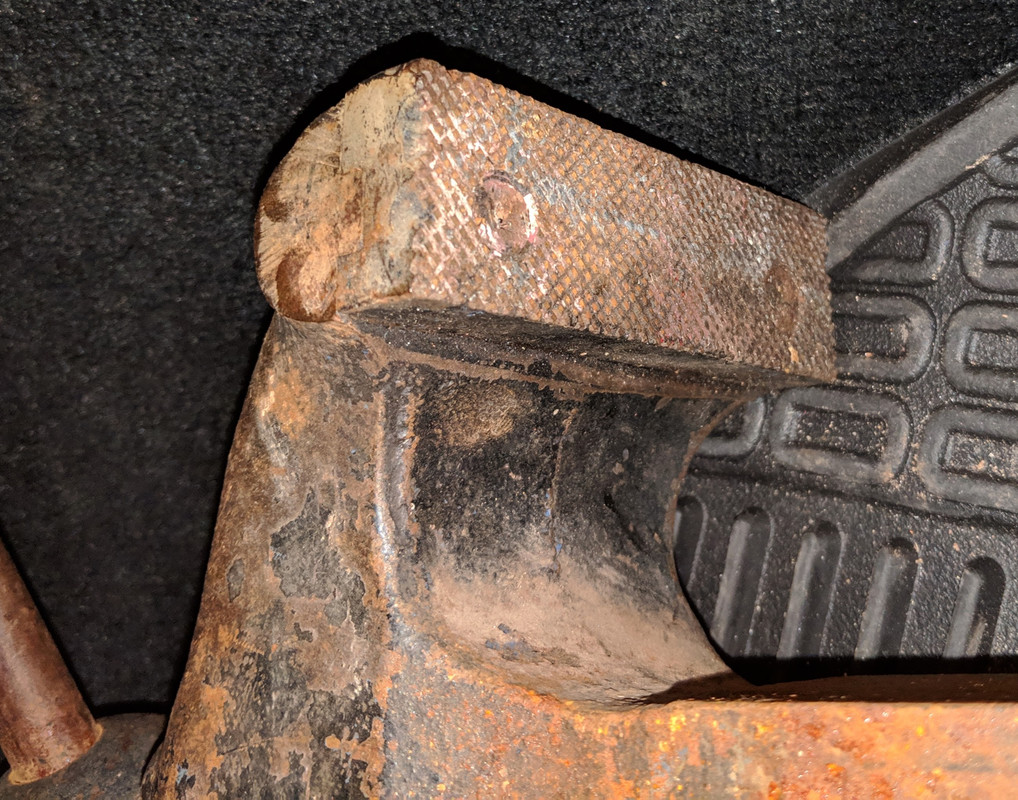
Jaws appear to be in nice condition as well:
Hmmm...I noticed that you put it on the floor in the front seat for the ride home. I guess I’m not the only one. I’m guessing that you hit the flashlight feature on your phone more than once on the way home to check it out. Nice pickup, it looks like it’s in great shape.
Dr ScottI'll give this topic a shot. The reason Powdered Metal Molds are built is to save on material (Tool Steel) and cutting those pesky serrations. Cutting serrations are very time consuming, if you could build a mold and kick a set of jaws out in 45 seconds then you have found a way to make jaws cheap. I am not a expert on material in Powder Metal but have built metal molds in the late 90's. Powdered metal is a some kind of metal material mixed with a binder. The molds can have multiple cavities. The mold is big and can weight up to 1500 lbs. The reason for the mass is when the material is injected into the cavity it is under extreme pressure where the mass will keep the mold from bowing due to injection pressure.
Molds for metal injection have a high shrink rate, most plastic injection molds are around .006/inch. Metal Molds are up to .02 to .024 per inch. So a 6 x 1 set of jaws will have a cavity size around 6.135 x 1.023 or so. The core will have the serrations and screw holes and the cavity will be flat. The runners which is a channel where the material flows into the mold is around 3/16 round or a 6 degree flat channel. The Gate is the final opening into the cavity and much smaller in size since the material starts to cool as it travels to the cavity and under extreme pressure heats up as it is pushed into the cavity. Maybe a second or two is all the time it takes to fill all the cavities. The Mold has water all around the cavities to cool the blanks.
The jaws come out pretty close to the size of the cavity and very fragile. Then they go into a oven and baked where the binder dissolves and the jaws shrink to 6 x 1. I took a few pic's of a set of broken jaws and noted how they built this set. Sharp corners are a no no in mold making, a very high stress area that will crack under pressure, that is why these jaws broke. The jaws after shrinking are not flat but kind of wavy, the hardness is as high as the ones I build but can not take any stress unlike toolsteel. The screw holes in this broken set of jaws are built with a taper where the screw tighten up on, this area should be flat. Why they built it this way is a question I would ask if I seen this on a part design. The Asian's built this mold very cheap, the cavity and coring still has the cutter marks from a end mill. The metal molds I built were ground or EDM'd. The last picture shows a jaw where the serrations were pressed on, I do not think these Asian jaws were powder metal. This was my experience with powdered molds back in the late 90's. I am sure the material has changed some. Kind of long winded answer.







 nice, real nice!