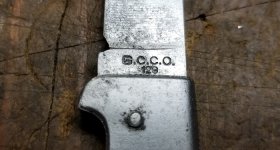
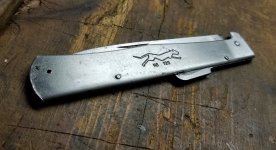
I've been doing some reading myself, and I saw that. Mine had traces of black paint on the scale, which I stripped. Seeing it made me re-check mine, and sure enough, the 'JAPAN' was buried in the recess.
Also tracked it to a thread on All About Pocket Knives. I don't know why my knife has a period after the 'C' (as in 'G.C.C.O.'), but according to the guys on AAPK, it stands for Gutmann Cutlery Co., Mt. Vernon, NY. They were in business for fifty years, from 1947-1997, importing knives and swords from Germany, Italy, and Japan. I suspect the 'G.C.C.O.' stands for Gutmann Cutlery Company Outfitters, or something like that. Or it was just a mistake.
But what is the Otter Mercator Black Cat connection?
That third piece of the puzzle came from Heinne-Haynes, an outfitter in the UK, which provides this tidy little history lesson in its Otter knives section:
"The Otter Mercator Black Cat is by far the most popular knife from Otter. The history of this model goes back to 1867 when the India Works of Heinrich Kaufmann & Sons developed and manufactured the Mercator knife and registered it as D.R.G.M. (Deutsches Reich Gebrauchs Muster). Only the India Works were allowed to use the Mercator brand.
Otter has owned the trademarks since 1995. During World War I, the knife was known far beyond the borders of Germany, when it was issued to the soldiers of the German Army under Emperor Wilhelm II. The end of the Second World War brought about a breakthrough, with the knife becoming a cult object abroad. For American GIs returning home from Germany, the Mercator knife was one of the most popular souvenirs.
Even today, the famous cat with the characters K55K - from Kaufmann's address at 55 High Street, Katze (cat) - is applied by hand in genuine gold paint. The metal box construction of the handle (powder-coated steel) means the knife is stable, flat, light and handy. The finely ground carbon blade is made from the finest Solingen steel and locked securely with the back lock. A metal eyelet on the handle end enables the attachment of your favourite lanyard."
I am guessing that Gutmann was importing the original Heinrich Kaufmann & Sons version and also a version (the No. 129) that Kaufmann was making in Japan, similar to the way they had a shop in India.
It's hard to say how old it is, but I am guessing early. I like the bit about American GI's loving the knife and returning from WWII with them as souvenirs. And they really captured what I was trying to describe about it upthread with this bit: "the knife is stable, flat, light and handy." I could not have said it better!


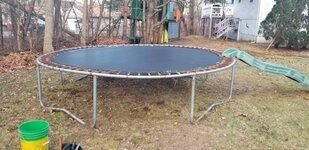






 I hope no one comes a knockin. Dig a pit and put in in the ground like the Kardashians have, that way do one will see it in your yard!