
To avoid these ads, REGISTER NOW!

Difficult to Determine but is it worth it?

Griff79

Well-known member
Joined
Jun 9, 2018
Messages
584
Location
Denver
I have almost and unanswerable question, but here goes.

I am just getting into auto restoration/customization for my own fun. I have been building a tool collection over the last 40 years. Previously I did woodworking.

My auto tools consist of a CM set that I purchased in 1978, 1/4, 3/8, 1/2 sockets, deep and shallow. Combination wrenches and ratchets in both SAE and metric. Eklund hex keys, a full complement of cutters, Cresent wrenches, pliers-needle nose and slip joint, Channel locks, punches, old Nicholson files, cold chisels, screwdrivers from tiny jewelers to extra large sizes, phillips and slot, small set of torx, , rules, squares, combination squares, tapes, plumb bobs.

Just picked up a DeWalt 3/8 20v impact wrench, I have most hand-power tools and a drill press, that's about it for mechanics tools.

I try to live by the mantra buy quality cry once buy junk cry often. I like to patronize the USA, I realize that is not always possible. I'm not made of money either.

Here are the questions: What other tools will I need to round out my start?

And for a shade tree mechanic like myself is it worth it to buy SK X frame ratcheting wrenches and some impact sockets, maybe a torque wrench at 30% off sale now or will a brand like Tekton, Gearwrench, Carlyle, suffice at a much cheaper price point. Possibly used truck brands might be an option as well in the future but retail truck prices are too high for me right now.

Thanks,
Griff
 
Last edited:
To avoid these ads, REGISTER NOW!

DGersic

Well-known member
Joined
Mar 12, 2017
Messages
6,349
Location
DeKalb, IL
How rusty is the stuff you’re working on? 1/2” drive, impact, and other air tools help deal with rusty parts.

Are you doing mechanical work? Engine work? Body and paint? Interior? Electrical? Each has its own tool requirements.


Sent from my iPad using The Garage Journal mobile app
 

unslow1

Well-known member
Joined
Mar 3, 2012
Messages
7,880
Location
Illinois
It just depends what you are working on. I've been involved with several restorations. Most work doesn't involve lots of specialty tools. My Grandfather did restorations right up until he passed and had minimal tools. I'd say just buy regular ratcheting wrenches. No point in spending a lot. You can get decent tools for a lot less than SK unless you insist on USA. I'd be more inclined to worry about air compressor, lighting, engine stand and hoist. To get more specific answer you will need to state what you are working on. Probably best just to buy what you need as you go. I've done a bit of everything from my 1912 to my two blown pro streeters.
 

Tonyuk

Well-known member
Joined
Jun 9, 2017
Messages
1,539
Location
Scotland
What brand of car are you working on and what do you plan to do?

The brand (more correctly nationality) of a car usually decides what specific kind of tools you'll need. German manufacturers for example love torx and spline head fasteners, where as brands from japan use them much less often.

However as a minimum i would recommend;

Good socket set, 1/4" chrome, 3/8" chrome + impact since you have one and 1/2" impact.

Good ratchets for the above, i like Gearwrench, by look into harbor freight pro.

Good screwdrivers, Wera for me. Good pliers, tekton are good. Set of pry bars. Pocket screwdriver.

Good set of basic combo spanners, mine are Facom by tekton do a good set, unless your working on anything old i would only get metric, same goes for the sockets. If you changing out brake calipers etc.. then a set of flare spanners will be required. Mine are facom, Toptul do a good set for little money.

Oil filter tool, good catch can (i'd say min 15L) Shop towels + rags, box of disposable gloves, plus some general fabric backed building gloves. Safety glasses.

Set of extensions in mixed sizes and lengths. Set of torx bits, and maybe a set of spline and e-torx bits/sockets.

Decent ball-pein hammer, a medium sized rubber deadblow. A small air compressor (the kind for tyres only, unless you already have larger) Tyre pressure gauge. Good torque wrench, 1/2" drive, around 50-200nm range.

Good jack and jackstands. Wheel chocks. One of those retractable pickup magnets. Good flashlight. Tape measure, different coloured paint markers.

Brakeclean and consumables. Bit of multi-purpose grease. Spray grease. Wire brush, small file.

There's always more that you think you need, my box at work is full of tools i never thought i would have to get, yet end up needing them anyway. I would start out by treating each job individually and thinking what will you need to get it done, make sure you have that then if you find yourself needing other kit for a different job just add it on.
 

Steiger9

Well-known member
Joined
Jul 23, 2017
Messages
109
The one automotive tool I'm most thankful that it exists when I need it are these hose clamp pliers.

https://www.amazon.com/dp/B003D3N7YW/?tag=atomicindus08-20

Older stuff isn't much of an issue but modern vehicles have very tight access and while it's possible to get spring clamps off with pliers I generally scraped myself up good prior to getting these.

A distant second (although far more frequently used by me) is a roto-ratchet. I have Genius brand in 1/4 and 3/8 but while amazing in the roto execution, not so great ratcheting. (My 1/4 skips teeth a lot. Would recommend the Snappy version). Again, with modern vehicles having tight engine bays, the ability to ratchet away from a straight 90 degrees is almost a necessity.
 

speed bump

Well-known member
Joined
May 28, 2008
Messages
6,317
Location
Butte Montana
It really depends on how deep you want to go. If it's all basic mechanic work then you might as well spend some money on basic mechanics tools. If you need to do more things I would skip spending a bunch of money on basic hand tools and focus on getting the specialty tools you will need eventually.
 

bczygan

Well-known member
Joined
Nov 4, 2009
Messages
22,002
Location
DETROIT! Arsenal of Scrappers
I have almost and unanswerable question, but here goes.

I am just getting into auto restoration/customization for my own fun. I have been building a tool collection over the last 40 years. Previously I did woodworking.

My auto tools consist of a CM set that I purchased in 1978, 1/4, 3/8, 1/2 sockets, deep and shallow. Combination wrenches and ratchets in both SAE and metric. Eklund hex keys, a full complement of cutters, Cresent wrenches, pliers-needle nose and slip joint, Channel locks, punches, old Nicholson files, cold chisels, screwdrivers from tiny jewelers to extra large sizes, phillips and slot, small set of torx, , rules, squares, combination squares, tapes, plumb bobs.

Just picked up a DeWalt 3/8 20v impact wrench, I have most hand-power tools and a drill press, that's about it for mechanics tools.

I try to live by the mantra buy quality cry once buy junk cry often. I like to patronize the USA, I realize that is not always possible. I'm not made of money either.

Here are the questions: What other tools will I need to round out my start?

And for a shade tree mechanic like myself is it worth it to buy SK X frame ratcheting wrenches and some impact sockets, maybe a torque wrench at 30% off sale now or will a brand like Tekton, Gearwrench, Carlyle, suffice at a much cheaper price point. Possibly used truck brands might be an option as well in the future but retail truck prices are too high for me right now.

Thanks,
Griff

The more you do, the more you need. Check my list linked below.

Bill
 

trackwelder

Well-known member
Joined
Jun 22, 2005
Messages
2,608
Location
n.y
Good air hammer with an assortment of bits. A good set of HSS drill bits
Oxy ace torch set
Air die grinder with burrs, stones,wire brushes, rolacs
A blast cabinet for stripping parts to be refinished
Parts cleaner
Impact and chrome swivel sockets
Mig welder
 

finn

Well-known member
Joined
Mar 27, 2005
Messages
16,317
Location
The UP, God's country
I recommend that you pick a project and dig into it with the tools you have before running out and outfitting a complete restoration shop with tens of thousands of dollars worth of tools. Once you start on a project, you’ll find out quick enough where your existing tool kit is lacking, Adding to the kit only takes a few minutes on the internet and a visit from the brown truck in a few days.

If you are serious about restoration, blasting equipment, compressors, lifts, and rotisserie’s are more important than ratcheting box wrenches.

If your plans are less intensive, digital volt meters trim tools, cleaning supplies, and shop vacs rise to the top.

There’s a wide gap separating working shops from tool polishing exhibits.
 

joe_padavano

Well-known member
Joined
Feb 26, 2011
Messages
1,788
Location
Northern VA
I don't see a torque wrench on your list.

Over the last half century, I've accumulated three triple-stack rollaways full of automotove tools (plus all the ones that don't fit in the boxes). The monster air compressor, a real pneumatic impact, and other air tools are a must. I've also accumulated a large number of specialty tools over the years. I primarily work on GM cars and trucks from the 1950s-1980s, so when all the dealerships closed about ten years ago, I snagged all the applicable Kent-Moore tools I could find, as most of then ended up on ebay. I also buy specialty tools at swap meets and on line. Things like the special shock absorber stud tool, special carb rebuild and gauge tools, etc.

Oh, and don't forget a torch.

Finally, the most important "tool" you can get for your car is a factory service manual. Don't waste your time with Chiltons/Haynes/Motors. Get a real one. And don't cheap out and try to get a free PDF version. Spend the money and buy a real, original, paper copy. You'll be glad you did.
 
To avoid these ads, REGISTER NOW!

Professional Tool User

Well-known member
Joined
Apr 9, 2018
Messages
1,835
Location
BC
If you use your tools once every few weeks vs every day, don't spend the money on expensive tools unless you can get them used for dirt cheap. Try to figure out what tools you need to tackle future projects, set aside the money, and buy the tools as needed. I'd prioritize getting air or cordless tools over expensive ratcheting wrenches.
 
OP
G

Griff79

Well-known member
Joined
Jun 9, 2018
Messages
584
Location
Denver
How rusty is the stuff you’re working on? 1/2” drive, impact, and other air tools help deal with rusty parts.

Are you doing mechanical work? Engine work? Body and paint? Interior? Electrical? Each has its own tool requirements.


Sent from my iPad using The Garage Journal mobile app

I will be doing, mechanical, Interior and electrical, needs tons more experience to do engine work and not yet on body and paint. I'll leave the last two to the experts for now.

The Jaguar I am working on now has very little rust, so I am pretty lucky with that.

Thanks,
Griff
 

danielbuck

Well-known member
Joined
Apr 15, 2014
Messages
925
angle grinder and welder, not sure how you can do auto restoration without them.

Pry bars, 4lb short handle sledge, rivet punches (and punches in general, including roll-pin punches). Air hammer and die grinders always come in handy.

snap ring pliers

I always find uses for small bottle jacks as well, either to help straighten things, or to simply lift something.

You'll probably make use of your woodworking clamps at times as well, to hold things when you need an extra hand. Though you may want to have a few of them on hand just for the auto work, as they will get greasy and banged up. I like the ones that are reversible, so they can act as a mild spreader as well.

I also like keeping a set of cheap open/closed end wrenches around, so that I can bend, cut/weld or whatever I need to do to get access to an odd bolt or two, and not worry about hacking up your nicer wrenches.

10mm sockets.... for some reason they always run away. buy a few of them :lol_hitti
 
Last edited:
OP
G

Griff79

Well-known member
Joined
Jun 9, 2018
Messages
584
Location
Denver
If you use your tools once every few weeks vs every day, don't spend the money on expensive tools unless you can get them used for dirt cheap. Try to figure out what tools you need to tackle future projects, set aside the money, and buy the tools as needed. I'd prioritize getting air or cordless tools over expensive ratcheting wrenches.

Thanks, even though my ego really wants the purdy SK x frames, your advice on acquiring items slowly as needed is what I should heed. :beer:
 
OP
G

Griff79

Well-known member
Joined
Jun 9, 2018
Messages
584
Location
Denver
I recommend that you pick a project and dig into it with the tools you have before running out and outfitting a complete restoration shop with tens of thousands of dollars worth of tools. Once you start on a project, you’ll find out quick enough where your existing tool kit is lacking, Adding to the kit only takes a few minutes on the internet and a visit from the brown truck in a few days.

If you are serious about restoration, blasting equipment, compressors, lifts, and rotisserie’s are more important than ratcheting box wrenches.

If your plans are less intensive, digital volt meters trim tools, cleaning supplies, and shop vacs rise to the top.

There’s a wide gap separating working shops from tool polishing exhibits.

Thanks Finn,

I am looking at a smaller blast cabinet. I do have to be realistic on what my capabilities are even if I have the tools. I'm in the process of making a master plan.
 
OP
G

Griff79

Well-known member
Joined
Jun 9, 2018
Messages
584
Location
Denver
I don't see a torque wrench on your list.

Over the last half century, I've accumulated three triple-stack rollaways full of automotove tools (plus all the ones that don't fit in the boxes). The monster air compressor, a real pneumatic impact, and other air tools are a must. I've also accumulated a large number of specialty tools over the years. I primarily work on GM cars and trucks from the 1950s-1980s, so when all the dealerships closed about ten years ago, I snagged all the applicable Kent-Moore tools I could find, as most of then ended up on ebay. I also buy specialty tools at swap meets and on line. Things like the special shock absorber stud tool, special carb rebuild and gauge tools, etc.

Oh, and don't forget a torch.

Finally, the most important "tool" you can get for your car is a factory service manual. Don't waste your time with Chiltons/Haynes/Motors. Get a real one. And don't cheap out and try to get a free PDF version. Spend the money and buy a real, original, paper copy. You'll be glad you did.

Joe,

What torque wrench settings should I look at picking up? I am sure you need a couple to cover the wide range of setting found on a vehicle.
Griff
 

danielbuck

Well-known member
Joined
Apr 15, 2014
Messages
925
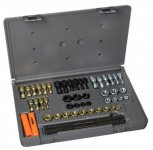
even if for not "restoring" damaged threads, those thread-restorer kits work great to just help clean out threads and remove rust. Just remember to use some sort of oil to keep it lubed. Probably doesn't matter what you use, though I imagine most folks suggest a penetrating oil (if the hardware is rusty).

I picked up a set a long time ago, thinking I'd probably use it here and there. I end up using it on darn near any project where I'm tearing down something old and want to re-use some of the hardware. Eventually you'll replace some of the more used thread nuts. but they do last a good while.

I wouldn't use actual cutting taps and dies to clean out threads, if you have to, do it very gingerly and with alot of oil. Taps/Dies are made for cutting new threads, on clean material. Way to easy to cross thread and damage old threads if you put a nice sharp tap/die on them, especially if the hardware isn't clean. It can be difficult to tell if you're hitting a rusty spot or a bent thread, or if you're cross threading. Thread restorers, chasers, or "forming" taps are looser and duller (the ones I have anyway), and probably aren't hardened as much as cutting taps/dies. So they don't damage existing threads as easily by removing material. To restore, you don't want to cut, you want to simply "bend back" the threads, if that makes sense.

You can also make thread restorers from regular nuts and bolts by grinding or cutting a few grooves in them. At this point, I probably WOULD run a tap/die through that new nut/bolt that you ground, to make sure there aren't any burs to catch. Do it gingerly though.
 
Last edited:
To avoid these ads, REGISTER NOW!
Top Bottom