To avoid these ads, REGISTER NOW!

Physics of a torque multiplier

nmantas

Well-known member
Joined
Sep 18, 2010
Messages
828
Location
Downriver Detroit
A buddy at work and I were trying to figure out the physics of a torque multiplier, not how they work in regards to gear reduction but how the forces add up. We pretty much thought that the amplitudes of the input torque + reactive force = output torque (less any loss to friction etc). So basically with a 4:1 multiplier in order to create 1000ft*lbs, 250ft*lbs is coming from the input breaker bar or torque wrench and the reaction bar is supplying the other 750ft*lbs by having its movement restricted (again assuming no loses).

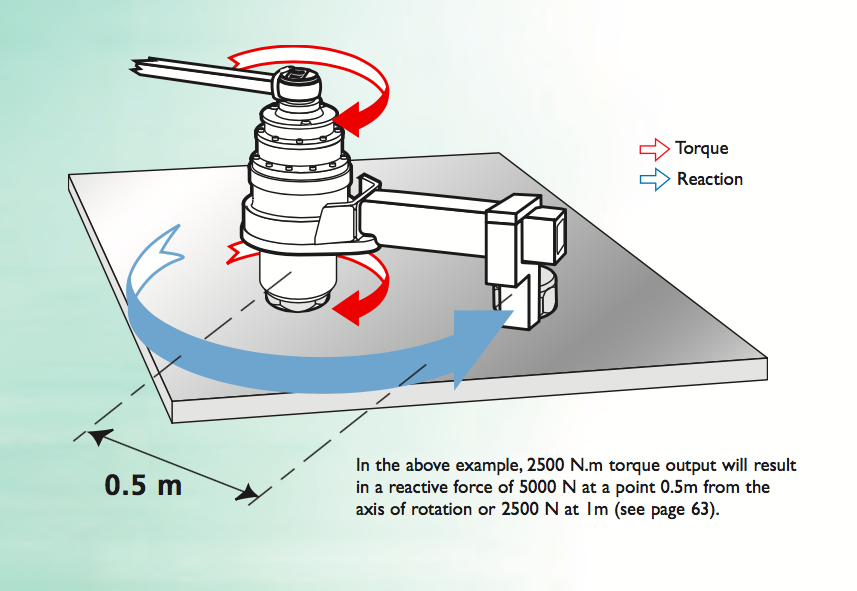
But then I found several references online that say the output torque is equal but opposite to the reactive force and the image below from norbar seems to back that up (torque on faster is the opposite as the reactive force at 1 meter).....but if that is the case what happened to the original input torque?


Screen-Shot-2018-12-19-at-8-59-51-PM.png
 
To avoid these ads, REGISTER NOW!

dsaabm

Well-known member
Joined
Jan 6, 2009
Messages
308
Location
USA
The gearset is how they work you can't ignore that, the reaction arm holds the gear case which allows the gearset to work which is why it sees the output torque in the opposite direction (reaction force).

The gearset converts the 250 ftlbs input to 1000 ftlbs output but the tradeoff is the output now 1/4 the rotational speed of the input.

To clarify, the arm does not input any torque. It holds the reaction torque allowing input torque to become output torque.
 
Last edited:
OP
N

nmantas

Well-known member
Joined
Sep 18, 2010
Messages
828
Location
Downriver Detroit
Your answer: Each action has an EQUAL and OPPOSITE reaction.

Exactly.....so what happened to the initial input torque if we are saying the reactive force is equal but opposite of the torque of the output. I know I'm missing something but just like energy and force can't be created it also can't be destroyed with conservations of Newtonian mechanics.

To clarify, the arm does not input any torque. It holds the reaction torque allowing input torque to become output torque.
Yes, and I understand the gearing vis-à-vis making it go slower which raises the torque but I've never really had to deal with gear ratios and a normal force of the reaction being restricted against an unmovable object. Definitely not as straight forward, for me at least, as gear ratios in regards to a drill press setting, fishing reel, car transmission.
 
Last edited:

Citation

Well-known member
Joined
Jan 20, 2016
Messages
3,268
Location
Indy
My quick read of the picture says it has to be wrong but probably not wrong to the point that matters.

There are three input torques to the system, the wrench, the nut that doesn't want to turn and the lever arm (force*distance). All three must add to be zero or the system spins out of control. The torque applied by the nut to the system is said to be 4x that of the torque applied by the wrench. The two torques are in opposite directions (I'm assuming the wrench is still turned in the same direction as if you had a longer wrench). That means the lever arm must provide the difference and that difference would be in the same direction as the torque applied by the wrench. So the reaction arm torque should be, assuming a 4x multiplier, 3x the torque applied by the wrench.

So yeah, my thinking is you are correct.

That said, if the intent is to get people to be aware of just how hard the reaction arm is going to push back on what ever is used to provide counter torque then it's probably best to have people overestimate by assuming 100% of the reaction torque is applied via the arm vs 75% (assuming a 4x multiplier)
 

TwoInch

Well-known member
Joined
Mar 29, 2012
Messages
2,828
Location
NW INDIANA
My quick read of the picture says it has to be wrong but probably not wrong to the point that matters.

There are three input torques to the system, the wrench, the nut that doesn't want to turn and the lever arm (force*distance). All three must add to be zero or the system spins out of control. The torque applied by the nut to the system is said to be 4x that of the torque applied by the wrench. The two torques are in opposite directions (I'm assuming the wrench is still turned in the same direction as if you had a longer wrench). That means the lever arm must provide the difference and that difference would be in the same direction as the torque applied by the wrench. So the reaction arm torque should be, assuming a 4x multiplier, 3x the torque applied by the wrench.

So yeah, my thinking is you are correct.

That said, if the intent is to get people to be aware of just how hard the reaction arm is going to push back on what ever is used to provide counter torque then it's probably best to have people overestimate by assuming 100% of the reaction torque is applied via the arm vs 75% (assuming a 4x multiplier)
I believe this is correct, and the picture is wrong. If 1000 lbs is going to the nut, 1000lbs must be resisted. So that static arm would be under full nut load...

Maybe minus input torque? That part is not immediately clear to me.. I wouldn't think that would be the case..

Think of a drill, not an impact. Essentially an electric torque multiplier. Your hand is that static arm. The motor the input torque... You must resist the full torque applied to the screw. The gearing in the drill can not change that. It only changes how fast its applied, and how much the motor can input.

I think that makes sense.

Sent from my LGLS676 using Tapatalk
 

TwoInch

Well-known member
Joined
Mar 29, 2012
Messages
2,828
Location
NW INDIANA
I think, depending on the direction the input torque is applied, possibly the static arm may need to resist the output torque plus the input. So 1000 lbs and the 250.

Ill have to think a bit more on this....

Sent from my LGLS676 using Tapatalk
 

u3b3rg33k

Well-known member
Joined
Dec 18, 2017
Messages
4,078
Exactly.....so what happened to the initial input torque if we are saying the reactive force is equal but opposite of the torque of the output. I know I'm missing something but just like energy and force can't be created it also can't be destroyed with conservations of Newtonian mechanics.


Yes, and I understand the gearing vis-à-vis making it go slower which raises the torque but I've never really had to deal with gear ratios and a normal force of the reaction being restricted against an unmovable object. Definitely not as straight forward, for me at least, as gear ratios in regards to a drill press setting, fishing reel, car transmission.

you mean like your car tire against the immovable road? :)
 

Provincial

Well-known member
Joined
Sep 21, 2011
Messages
6,883
Location
Near Salem, OR
All torque output has to react to the gear case, and to the reaction bar.

The input torque reacts against the gear case, and hence to the reaction bar, and passes through to the output. Hence, it is absorbed into the output, less any friction losses.
 

Provincial

Well-known member
Joined
Sep 21, 2011
Messages
6,883
Location
Near Salem, OR
u3, instead of a car, a better analogy would be a railroad handcar. The motive force applied to the handcar where the wheel meets the rail is what moves the car, and is not directly reacting to the force applied to the operating lever and gearing.
 

Jim c

Banned
Joined
Dec 19, 2017
Messages
200
This is not exactly the easiest problem to solve. So here it is as I understand it from my engineering and physics classes: there are only two directions for torque: 1) clockwise ( positive) torque and 2) counterclockwise (negative) torque. And the total of the two torques added together or summed up is always going to be equal to zero. Written out as a math equation: the sum of the torques = (+)F*d (-)F*d=0 ok, so all of the torques cranking to the clockwise direction added together are going to be exactly equal to all of the torques cranking in the counterclockwise direction added together.
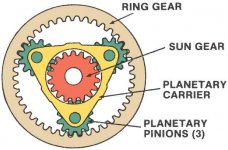
So, let’s put this multiplier on a truck lug nut: if the instructions say that it multiplies torque by 4 and they read “ set your torque wrench on one fourth of the desired final torque” let’s say, you want to tighten the nut to 400, so you set your wrench to 100,correct? Now, you push down on your wrench creating 100 and your wrench goes click and you know from your instructions that the nut is at 400, correct? Ok, your torque and the the torque created through the planetary gear set of the multiplier equals 400, correct? This means that the gears in the multiplier have a three to one ratio and your 100 plus the 300 from the output added together produce a total of 400, right? Ok, it really is that simple. And, the torque in the counterclockwise direction also known as the reactive force is exactly equal to 400 as well. I hope that this helps you to make sense of this. If you would like a little additional insight in to these very cool and interesting torque multipliers: your wrench is turning the sun gear at the center of the planetary set. As you rotate the sun and planetaries would just sit there and spin in place and the outer casing of the multiplier ( aka the ring gear) would just spin in the opposite direction of your wrench. But, you anchor it against another lug nut freezing it in place so that the planetaries must walk around the internal diameter of the ring gear; please keep in mind that the planetaries are attached to a carrier which moves with them as they rotate around the ring and that carrier is the output on the front of the multiplier which your socket is attached to.
 
Last edited:

Jim c

Banned
Joined
Dec 19, 2017
Messages
200
Two inch you are exactly correct: the input plus the output are equal to the total torque applied to the nut, and the reactive torque is exactly equal to and opposite in direction as the sum of the input and output.
 

Citation

Well-known member
Joined
Jan 20, 2016
Messages
3,268
Location
Indy
Two inch you are exactly correct: the input plus the output are equal to the total torque applied to the nut, and the reactive torque is exactly equal to and opposite in direction as the sum of the input and output.

No, the torques should be:
Wrench + Arm = Nut

The the wrench and arm are in the same direction.
 

Citation

Well-known member
Joined
Jan 20, 2016
Messages
3,268
Location
Indy
Assuming the direction you turn the wrench is the same as the direction you turn the nut the reaction arm will provide torque in the same direction as the wrench and the torque applied to the nut is wrench+reaction arm=nut.

Something that is confusing in the picture is the wrench and nut should apply torque in opposite directions. This is intuitive if you think about the wrench acting directly on the nut. The wrench applies clockwise torque. The nut resists with equal but opposite torque (ie counter-clockwise).

With the torque multiplier the nut still provides the counter torque. If we are talking about tightening a nut then the nut is "applying" a counter-clockwise torque (ie the socket that's driving the nut feels a counter clockwise resistance). The wrench handle is applying clockwise torque to the input. Since all the torques have to balance the arm must apply torque to the mechanism in the same direction as the wrench and be equal to the difference between the wrench and nut applied torques.

The descriptions of drills and rail cars don't really work as those are internal forces. What I mean by that is a hand powered rail car still just has wheels (internal to the system) and rails (external) as all the interactions. The torque multiplier interacts at three points (wrench, arm, nut).
 

Spacey_G

Well-known member
Joined
Dec 31, 2015
Messages
492
The most reliable approach to this type of problem is to consider each component separately and analyze the forces and torques acting it. Don't try to wrap your head around the system all at once—it gets too confusing in all but the most basic cases.

Because none of the components are accelerating, Newton's First Law tells us that the sum of all forces and the sum of all torques on each component are zero. Further, Newton's Third Law tells us that a force or torque acting on one body produces an equal and opposite force or torque on it's mating body.

With these basic concepts in mind, you can draw diagrams of each component that indicate the direction and location of each force and torque acting on that component, and then write a system of equations that relate those forces and torques to one another. With the system set up correctly, you can assign whatever value you like to the input force (yes, the input is a force, not a torque) and solve for the forces and torques everywhere else.

A disciplined approach like that will help to unravel the web of confusion.
 
Last edited:

scubadoober

Well-known member
Joined
Aug 15, 2017
Messages
511
Force would equal zero when the torque wrench clicks (aka stops turning)? Would the force still equal zero when the wrench, gearset, and bolt are moving?
 

Evan(CA)

Banned
Joined
Mar 3, 2013
Messages
996
So that static arm would be under full nut load...


Sent from my LGLS676 using Tapatalk


I'm laughing so hard right now at this, picturing a guy describing his mom walking in on him jerkin it. I didn't sleep last night so maybe I'm just getting loopy.
 

Jbullfrog

ALLIANCE MEMBER
Joined
Jan 9, 2007
Messages
2,348
Location
Avoca, Iowa
The drive tool turn the planetary carrier. This causes the planetary pinions to walk around the ring gear, and also turn the sun gear. The ratio of teeth between the ring and sun determine the amplification of from the input to the output. The force needed to hold the planetary carrier is opposite of the output force from the sun gear, attached to the socket.
 

Attachments

  • planetary.jpg
    planetary.jpg
    40.3 KB · Views: 24
Last edited:
To avoid these ads, REGISTER NOW!

Jim c

Banned
Joined
Dec 19, 2017
Messages
200
I have read all of the posts and everybody on here is right in your analysis’ . And , amazingly, even though some of those who are posting think that they disagreeing with others, really when I read this everybody is agreeing with each other.

Two torques going clockwise to tighten the nut to 400 1) your 100 and 2) the 300 from the multiplier. One torque going counterclockwise from the brace arm and it is (-400).

You. Mult. Total. ............ You+mult. Brace
100 +300= (+400) And (+400) + (-400) = 0


What is confusing is the advertising: it says that your torque gets multiplied by 4. An accurate engineering analysis is: your torque gets multiplied by 3 and that 300 plus your original 100 sum up to 400. So, they are both really saying the same thing. The part that confuses everybody is their claim that the “ output” is 400. Actually, the total output is 400, but you are still part of the output because you are standing there pushing down on the wrench and producing your own 100 ft lb of torque. So, why don’t they advertise that it really multiplies torque by 3? Easy answer: because some other manufacturer would make the same product and advertise that it multiplies by 4 and they would get more of the sales! So every body advertises that it multiplies by 4 when it really only multiplies by 3 and nobody is incorrect because the total output is 4 times what you put in to it because your 100 does not get lost or evaporated. Nope, your 100 is still there and gets put in to tightening the nut in addition to what the multiplier gives.
 
Last edited:

Jim c

Banned
Joined
Dec 19, 2017
Messages
200
Nmantas. I wanted to provide an answer to your exact original question: in order to tighten something to 1000 you would turn your torque wrench to 250. So you are applying 250 clockwise and the multiplier is applying 750 clockwise for a grand total of 1000 clockwise. The brace arm is applying 1000 counterclockwise.

You....multi. Total............you +multi.....brace
250 + 750 =. 1000. And. (+1000). +(-1000). =. 0

Your multiplier does indeed provide you with 4 times multiplication but it is important to note that it does so with an internal planetary gear set with a 3 to 1 mechanical advantage: so it multiplies your torque 3 times but you are still there pushing on the wrench producing 250 torque AND you torque does not get evaporated or disappear.
Also, whatever item is bracing against the brace arm is producing a torque of 1000 and ( this is kind of off the topic) usually those brace arms are pretty short so you can calculate the force that is crushing against that brace arm by using your knowledge that there is a torque of 1000 counterclockwise on the brace arm. For example: say the brace arm crushes against another lugnut at 3 inches from the center of rotation, then the crushing force on that arm at that distance would be 4000! If the crushing force was located at a distance of 4 inches from the center of rotation then the crushing force would be 3000!
 

TwoInch

Well-known member
Joined
Mar 29, 2012
Messages
2,828
Location
NW INDIANA
I'm laughing so hard right now at this, picturing a guy describing his mom walking in on him jerkin it. I didn't sleep last night so maybe I'm just getting loopy.
In glad someone caught that...

Sent from my LGLS676 using Tapatalk
 

TwoInch

Well-known member
Joined
Mar 29, 2012
Messages
2,828
Location
NW INDIANA
I have read all of the posts and everybody on here is right in your analysis’ . And , amazingly, even though some of those who are posting think that they disagreeing with others, really when I read this everybody is agreeing with each other.

Two torques going clockwise to tighten the nut to 400 1) your 100 and 2) the 300 from the multiplier. One torque going counterclockwise from the brace arm and it is (-400).

You. Mult. Total. ............ You+mult. Brace
100 +300= (+400) And (+400) + (-400) = 0


What is confusing is the advertising: it says that your torque gets multiplied by 4. An accurate engineering analysis is: your torque gets multiplied by 3 and that 300 plus your original 100 sum up to 400. So, they are both really saying the same thing. The part that confuses everybody is their claim that the “ output” is 400. Actually, the total output is 400, but you are still part of the output because you are standing there pushing down on the wrench and producing your own 100 ft lb of torque. So, why don’t they advertise that it really multiplies torque by 3? Easy answer: because some other manufacturer would make the same product and advertise that it multiplies by 4 and they would get more of the sales! So every body advertises that it multiplies by 4 when it really only multiplies by 3 and nobody is incorrect because the total output is 4 times what you put in to it because your 100 does not get lost or evaporated. Nope, your 100 is still there and gets put in to tightening the nut in addition to what the multiplier gives.

Multiplying 100 by 3 is 300... That's why they advertise it as X4, because an input of 100 multiplied by 4 would be 400.

I understand what you are saying, but math only works one way. You just don't add your input into a multiplication equation. You are mixing addition and multiplication.

I think its confusion between ratios and multiplication that is messing it up. 3 to 1 and 4 to 1 are not the same as 3x1 and 4x1..

All that said, to the poster saying the drill is not a good example is wrong. It is exactly the same principle, same gear set type, in practice.

Drill motor is the input, attached to the case. This is the "wrench" on the above scenario. Always and only inputs 100 inlbs

Human hand is the static arm, immovable object in the scenario. Resists the full force applied by the multiplication effect.

Screw is the output. The nut in the scenario. Receives 400inlbs

Your hand(immovable) resists the full and equal force applied to the screw. You can change the drill gearing for a higher multiplied output by puting the drill in gear 2, thus multiplying the motors input through a planetary gear set, slowing the output and increasing the output forve, applying 400 to the screw. Your hand will then resist the full amount of output, whether its twice as much or more. The motor input(100inlbs) is the same no matter what happens.

It is a good example if you can envision these processes. It puts the force into your hand, instead of an adjacent lug nut.. For me, that makes it all come together in my mind. When the drill stalls, I can input just a hair more force with my hand, and turn the screw more.. So in effect, 100% of force is applied to both the immovable object and the output nut or screw. 100%, equals out to zero, balanced, whatever your wording.


Sent from my LGLS676 using Tapatalk
 
OP
N

nmantas

Well-known member
Joined
Sep 18, 2010
Messages
828
Location
Downriver Detroit
I'll be honest I didn't know if this thread was going to gain traction but I'm glad it got legs and got a lot of people thinking. I think we are now in agreement that the total torque on the fastener must be the opposite but equal to the normal force coming from the reaction bar against an immovable object....I feel kind of foolish that I didn't see it that way from the beginning but the foolishness was worth it for the discussion.
 

Jim c

Banned
Joined
Dec 19, 2017
Messages
200
Two inch, the drill with its planetary gear set is a great example, for sure! But I am gonna have to stew on it for a little while to get my head straight. You are right that you are the brace arm... but , wow, I am going to have to think about how the electric motor ...yeah, it seems like the electric motor is the same as the guy pushing on the torque wrench.

Btw... if you have an old black and decker cordless drill, before you toss it out, take it apart and you can have a very nice set of planetary gears to work with.. the whole chuck and gear set stays together and is helpful to use as a model. The one that I have is from an old orange b&d with the hi low slider on top , it actually has two planetary sets in a white plastic housing attached to the chuck. Also, it really helps to get an idea of automatic transmissions and visualizing what is actually moving inside and how.
 

Jim c

Banned
Joined
Dec 19, 2017
Messages
200
Nmantas. It is also pretty easy to see how people snap the “band” on their automatic transmission. That “band” is usually tightened by a hydraulic servo when changing gears and it grabs the ring gear and provides the brace arm of the torque multiplier.
 

Provincial

Well-known member
Joined
Sep 21, 2011
Messages
6,883
Location
Near Salem, OR
The only thing I will add to Jim_c's comments is that the input force on the multiplier must be a little larger than the theoretical amount because of friction losses. Many of the torque multipliers I have seen have a correction factor marked on them.

In the case of 250 ft. lbs. input and 1,000 ft. lbs. output, the input would have to be around (I am fudging here) 275 ft. lbs. if there was a 10% friction loss. I think 2% is more likely, but each design can have a different friction loss.
 

Fcvapor05

Well-known member
Joined
May 4, 2014
Messages
1,079
The posturing about how gear multiplication works is completely wrong.

A multiplier with a 4:1 ratio has a gearset with a motion ratio of... 4:1.

The input torque doesn't 'disappear'- it is balanced with the higher output torque at a lower speed.

Power in and out of the gearset is balanced across the reduction.
 

TwoInch

Well-known member
Joined
Mar 29, 2012
Messages
2,828
Location
NW INDIANA
Two inch, the drill with its planetary gear set is a great example, for sure! But I am gonna have to stew on it for a little while to get my head straight. You are right that you are the brace arm... but , wow, I am going to have to think about how the electric motor ...yeah, it seems like the electric motor is the same as the guy pushing on the torque wrench.

Btw... if you have an old black and decker cordless drill, before you toss it out, take it apart and you can have a very nice set of planetary gears to work with.. the whole chuck and gear set stays together and is helpful to use as a model. The one that I have is from an old orange b&d with the hi low slider on top , it actually has two planetary sets in a white plastic housing attached to the chuck. Also, it really helps to get an idea of automatic transmissions and visualizing what is actually moving inside and how.

Once you switch yourself for the static or brace arm, it becomes very clear. But getting that switch to nice with your head takes a moment..

Yea the electric motors is attached or braced to the housing. Which proves that it all must be equal. If it can only input 100ftlbs(unrealistically high), as the torque wrench, your hand can absorb whatever total can be generated by gear reduction(multiplication) by acting as the immovable object. But your hand can never, and will never be subjected to more, or less force than the output into the fastener.. Only equal.

And yes, gear sets out of junk drills are cool. I have a few somewhere in boxes... With some fandangled plan loosely attached to them... One day.

Sent from my LGLS676 using Tapatalk
 
Last edited:

Citation

Well-known member
Joined
Jan 20, 2016
Messages
3,268
Location
Indy
Multiplying 100 by 3 is 300... That's why they advertise it as X4, because an input of 100 multiplied by 4 would be 400.

I understand what you are saying, but math only works one way. You just don't add your input into a multiplication equation. You are mixing addition and multiplication.

I think its confusion between ratios and multiplication that is messing it up. 3 to 1 and 4 to 1 are not the same as 3x1 and 4x1..

All that said, to the poster saying the drill is not a good example is wrong. It is exactly the same principle, same gear set type, in practice.

Drill motor is the input, attached to the case. This is the "wrench" on the above scenario. Always and only inputs 100 inlbs

Human hand is the static arm, immovable object in the scenario. Resists the full force applied by the multiplication effect.

Screw is the output. The nut in the scenario. Receives 400inlbs

Your hand(immovable) resists the full and equal force applied to the screw. You can change the drill gearing for a higher multiplied output by puting the drill in gear 2, thus multiplying the motors input through a planetary gear set, slowing the output and increasing the output forve, applying 400 to the screw. Your hand will then resist the full amount of output, whether its twice as much or more. The motor input(100inlbs) is the same no matter what happens.

It is a good example if you can envision these processes. It puts the force into your hand, instead of an adjacent lug nut.. For me, that makes it all come together in my mind. When the drill stalls, I can input just a hair more force with my hand, and turn the screw more.. So in effect, 100% of force is applied to both the immovable object and the output nut or screw. 100%, equals out to zero, balanced, whatever your wording.


Sent from my LGLS676 using Tapatalk

No, I'm correct about the drill motor not being a good example. It is a similar grear train but unless you consider the person holding the wrench and the ground they are standing on to be part of "the system", the problem with the drill is it only has two torques acting on it. One is the reaction from the screw. The other is your hand. So the torque applied to the screw is equal to that of your hand. It doesn't matter how much torque the drill motor sees it applies. It doesn't matter if the drill gear ratio is 10:1, 1:1 or 1000000:1. The counter torque applied by your hands equals the torque applied to the screw.

In the case of the multiplier we have three torques and none are equal to another though they sum to zero.

BTW, I'm not implying that the internals of the drill aren't mechanically similar, just that when we are looking at the input and output torques they are not analogous systems.
 

Citation

Well-known member
Joined
Jan 20, 2016
Messages
3,268
Location
Indy
I'll be honest I didn't know if this thread was going to gain traction but I'm glad it got legs and got a lot of people thinking. I think we are now in agreement that the total torque on the fastener must be the opposite but equal to the normal force coming from the reaction bar against an immovable object....I feel kind of foolish that I didn't see it that way from the beginning but the foolishness was worth it for the discussion.

Not quite. It's equal to the sum of the reaction bar plus the wrench torques.
 

Jim c

Banned
Joined
Dec 19, 2017
Messages
200
Fcvapor. Your statement is completely correct. Also, you think that you are disagreeing with me about ratios, but really you are not: sometimes, there are forces applied from outside of the system which get added to the internal forces of the system. With the torque multiplier, you will always have to add the external force of you standing there pushing down on the torque wrench. The concept of external vs. internal is hard, but I have a really good example that I think you will like: when you are pushing a car by hand you push on the bumper and the car is pretty hard to push ( you wife is steering). So, you put your hands on the top of the rear tires and you push and, wow, the car is so much easier to push! You can push it so easily, you could push it all day! What gives with this example??

Here is what is happening: when you push on the bumper there is just one force and it you ( an external force) pushing on the bumper.

When you push on the top of the rear tire, you produce a rotational force( aka, a torque) and that torque rotates the tire, pushing the car forward. But that doesn’t explain why it is so easy to push the car. There is a second force acting to push the car forward and it is you pushing the car forward from the top of the tire and it is an external force.

So, there are two forces produced by your one hand pushing forward on the top of the tire: the one is a torque which propels the car just as the engine does. The second, and other force is an external force of you pushing forward on the car via the tire.

Now, go outside and try it and see for yourself and use it as a tool when you need it.

Here is a brain buster which will help solidify these concepts: instead of placing your hand on top of the tire and pushing forward as in the above example, place yOur hand on the bottom portion of the sidewall and push to rotate the tire in a forward direction ( please note, this means pushing toward the rear of the car on the bottom sidewall) producing a torque which would correspond with moving the car forward. You will note that the car does not move. Why? Answer is because even though you have produced a torque to rotate the tire and car forward, you are also pushing rearward on the car with your hand and this second force is an external force which is cancelling out the force to move the car forward from the torque.

The above example is an engineering problem which, after thinking about it, really made clear for me the idea of internal and external forces because it is such a hands on practical example that we all get to do at one time or another.

Two inch, I still cannot figure out, for the life of me, if your drill example the electric motor is an internal or external force!
 

bczygan

Well-known member
Joined
Nov 4, 2009
Messages
22,002
Location
DETROIT! Arsenal of Scrappers
I'm still confused!

But it's late and I'm tired.

When I was a younger man, I would've stayed up until I understood.

But I'm old and can happily go to sleep in blissful ignorance.

Bill
 

Citation

Well-known member
Joined
Jan 20, 2016
Messages
3,268
Location
Indy
Fcvapor. Your statement is completely correct. Also, you think that you are disagreeing with me about ratios, but really you are not: sometimes, there are forces applied from outside of the system which get added to the internal forces of the system. With the torque multiplier, you will always have to add the external force of you standing there pushing down on the torque wrench. The concept of external vs. internal is hard, but I have a really good example that I think you will like: when you are pushing a car by hand you push on the bumper and the car is pretty hard to push ( you wife is steering). So, you put your hands on the top of the rear tires and you push and, wow, the car is so much easier to push! You can push it so easily, you could push it all day! What gives with this example??

Here is what is happening: when you push on the bumper there is just one force and it you ( an external force) pushing on the bumper.

When you push on the top of the rear tire, you produce a rotational force( aka, a torque) and that torque rotates the tire, pushing the car forward. But that doesn’t explain why it is so easy to push the car. There is a second force acting to push the car forward and it is you pushing the car forward from the top of the tire and it is an external force.

So, there are two forces produced by your one hand pushing forward on the top of the tire: the one is a torque which propels the car just as the engine does. The second, and other force is an external force of you pushing forward on the car via the tire.

Now, go outside and try it and see for yourself and use it as a tool when you need it.

Here is a brain buster which will help solidify these concepts: instead of placing your hand on top of the tire and pushing forward as in the above example, place yOur hand on the bottom portion of the sidewall and push to rotate the tire in a forward direction ( please note, this means pushing toward the rear of the car on the bottom sidewall) producing a torque which would correspond with moving the car forward. You will note that the car does not move. Why? Answer is because even though you have produced a torque to rotate the tire and car forward, you are also pushing rearward on the car with your hand and this second force is an external force which is cancelling out the force to move the car forward from the torque.

The above example is an engineering problem which, after thinking about it, really made clear for me the idea of internal and external forces because it is such a hands on practical example that we all get to do at one time or another.

Two inch, I still cannot figure out, for the life of me, if your drill example the electric motor is an internal or external force!

I'm not sure I totally agree with your description of the internal forces here but we would probably be at the point where we would agree after drawing out some free body diagrams. Anyway, it's not really related but your description reminded me of this excellent film so I figured I would post it
 

Jim c

Banned
Joined
Dec 19, 2017
Messages
200
Citation. That really was an awesome film! Best differential explanation ever.
 

TwoInch

Well-known member
Joined
Mar 29, 2012
Messages
2,828
Location
NW INDIANA
Two inch, I still cannot figure out, for the life of me, if your drill example the electric motor is an internal or external force!

Technically? Its internal to the drill. But I can't come up with a reason why that would matter. Its just an input force.

We are looking at the drill gearbox and the inputs and outputs... Not the whole drill.

The motor is the input. The wrench. Braced against the case inside the drill, this is where the confusion is... It doesn't matter WHERE it's braced, it matters THAT its braced and inputing force. Imagine your holding the motor with your right hand, it's only touching the gearset and your hand. That's it.

The drill case handle, the static bracing arm, bracing the gearset from turning, is held in your other hand, or by other immovable object.

The output is the nut.

Its really that simple.

A drill is a torque multiplier, period. It's just Braced internally instead of externally. The concepts are the same, because it is the same thing. Its just harder to visualize the different forces apparently because its braced internally and the torque is coming from an electric motor.

If you stood there next to a nut, put the torque multiplier on the nut, put the bracing arm against your leg, pit the wrench in your hand, on the nut, and turned the nut, you are applying the input force, and resisting the other input(bracing arm).

Hopefully you got grippy shoes on.

Mr. Citation. Its all perspective. A torque multiplier or planetary gear set requires the same three input/outputs, you can stick the three different points wherever you want them. Two move, one doesn't.

The drill example shows that you can ignore the wrench input in the example, and focus only on the bracing force, and the output force.... Which are equal.

Or better yet...... Rip the motor out of the drill... Stick a ratchet/extension through the drill case and turn the gear set with the ratchet....

The force applied the the drill handle(brace) will equal the output to the screw.

Or... Even better yet... Attach a powerful electric motor to the input square drive of the OPs torque multiplier. Attach the motor too a bar that is braced to an immovable utility pole. Put the torque multipliers bracing arm on the opposite side of the same utility pole. This would be a drill.

Remove the above motor, put the torque wrench back on the multiplier, put right hand on the utility pole, put the torque wrench in your left hand, pull with left hand(TW), push with right hand(utility pole)

With the torque wrench and torque muliplier, through your feet, and the bracing arm, are on the same immovable object, the earth, opposing each other.


Those are the best attempted visualizations I can come up with. Maybe I'm too sleep deprived.

Carry on.... Lol

Sent from my LGLS676 using Tapatalk
 

Jim c

Banned
Joined
Dec 19, 2017
Messages
200
Two inch ... LMAO at standing there with torque multiplier brace arm against leg and pulling on torque wrench at same time! I think that you helped get my head straight on the drill. I agree with you completely; the drill IS a torque multiplier. Drill handle and your arm is brace arm. Output is chuck. And input is the drill motor. So, I think you would add the drill motors torque and the multipliers effect together to get the total output and the brace arm would be equal to and opposite of the total output and it is braced against your arm.

MERRY CHRISTMAS TO ALL!
 
To avoid these ads, REGISTER NOW!
Top Bottom