To avoid these ads, REGISTER NOW!

Building a Mezzanine Step By Step

OP
A

AMCguy

Well-known member
Joined
Dec 23, 2009
Messages
2,022
Location
Sunshine Coast, BC Canada
Progress;

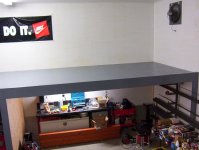
Sorry. I've been away from posting on this project for a few days. I spent a lot of that time stressing over the stair design. Once I finally decided on what to do, I cut and sanded all the pieces and then pre-drilled them for the necessary brackets. I got to the painting on the weekend. What you see is the floor, posts, beam and all the stair pieces painted with two heavy coats of high gloss, oil based porch and floor paint. The underside and the supporting wall will get sprayed with white semigloss latex.

I did all the stair pieces separately for two reasons. I wanted paint on all the stair surfaces including the ends of all the boards. And I didn't want to get paint all over the shiny and expensive stair brackets and hardware. Plus I'm **** as hell and I had the time and this is MY project. OK that's three more reasons.

I listened to all the advice on the stairs and decided on twelve rises of 7 11/16''. The stair case will run with eleven treads of 11 1/4''.

It was a little cool these last few days. To speed up drying time (so I could re-coat in 24 hrs) I arranged my construction heater and my good old circulating fan to blow warm air on and under the smaller pieces on the floor. It was nice and warm up on the mezzanine, so it dried a little quicker.

It's all dry as I type this so, I'm heading out to the shop to assemble the stairs. It should go quick. I'll find out in a few minutes if all my figuring was correct. I'll post a picture of them in place later.
 

Attachments

  • 100_2254.jpg
    100_2254.jpg
    141.8 KB · Views: 659
To avoid these ads, REGISTER NOW!

cj7jeep81

Well-known member
Joined
Jul 11, 2006
Messages
463
Location
S.E. Indiana
Just to make sure, you are using 2x8 floor joists on 16" centers to span the 8' width? And your beam is a doubled up 2x10 that runs 32' supported with the wall in the center and each end?

I'm planning on a similar loft when I build my shop, so looking for ideas/what works for other people.
 
OP
A

AMCguy

Well-known member
Joined
Dec 23, 2009
Messages
2,022
Location
Sunshine Coast, BC Canada
Yes, that's what I did. There is actually a 2x8'' rim joist at the front as well. Then the two ply 2x10''. The whole works is glued and screwed together. It's very sturdy.
 
OP
A

AMCguy

Well-known member
Joined
Dec 23, 2009
Messages
2,022
Location
Sunshine Coast, BC Canada
Well the stairs went together perfectly. I went to great lengths with measuring, marking and pre-drilling all the pieces. It's kind of weird how at the beginning of this project I had never in my life built a flight of stars. In the end, it all went together like a piece of IKEA furniture. I'm feeling a little cocky right now.

The only thing I have left to do is paint the underside and build a railing. The railing will be steel but my shop is all messed up from this carpentry work. I have to reorganize everything before I can do any welding. I'll post again when I've got that done.
 

Attachments

  • 100_2256.jpg
    100_2256.jpg
    142 KB · Views: 726
  • 100_2259.jpg
    100_2259.jpg
    149.3 KB · Views: 635
  • 100_2262.jpg
    100_2262.jpg
    142.8 KB · Views: 654
  • 100_2260.jpg
    100_2260.jpg
    153.3 KB · Views: 615
  • 100_2258.jpg
    100_2258.jpg
    140.8 KB · Views: 606
  • 100_2257.jpg
    100_2257.jpg
    142.2 KB · Views: 619

OccupantRJ

Well-known member
Joined
May 15, 2009
Messages
11,074
Location
Eastern North Carolina
Very nice job, especially if that is your first set. If you feel a little side "quiver" as you use them, you can insert a wood block spacer between the stairs and wall, then lag into a wall stud. One or more of these will laterally stiffen up the stairs quite a bit. Good place under those stairs for an air compressor.
 
Last edited:

bczygan

Well-known member
Joined
Nov 4, 2009
Messages
22,002
Location
DETROIT! Arsenal of Scrappers
Just to make sure, you are using 2x8 floor joists on 16" centers to span the 8' width? And your beam is a doubled up 2x10 that runs 32' supported with the wall in the center and each end?

I'm planning on a similar loft when I build my shop, so looking for ideas/what works for other people.


You don't want to blindly copy what someone else does. Their uses may be different.

For instance, the size and spacing of the joists for this mezzanine allow for pretty large loads. You may not need or want to load your mezzanine that heavily, so it would be a waste of money to specify that size and spacing of joists.

In this case, let's look at what is there.

First, you have to determine the lumber being used, because there is a big difference in the strength of different species of wood.

Most lumberyards and big box stores sell hem-fir. But some, especially in the Pacific northwest, also have doug-fir. This is a much stronger material.

Let us assume that this mezzanine was made of hem-fir, the less strong option.

2x8 hem-fir joists at 16"o.c. with an 8' span will support a 60 pound live load and a 20 pound dead load. In fact, they will actually span 10'-6". Even spaced at 24"o.c., they span 9'-2". Typical bedroom floor design is 40 pounds live load and 10 pound dead load, so this is a floor system designed for much higher loads. If you just have office space on your mezzanine, this design would be very wasteful. In that case, 2x6's at 16"o.c. would span 9'-1". This would have matched his beam sizing below and saved $2 per joist, for a savings of $50.

Also important to know is the deflection. 1/360 is good for a finished drywall ceiling below, while 1/240 of span is OK for no finished ceiling.

The things you need to know to size structural members includes the properties of the wood you select, and span tables for wood with those properties.

In the case above I chose #2 and better hem-fir joists with an E of 1.3. This is a commonly available material.

Joist Span Tables:
http://www.awc.org/pdf/STJR_2005.pdf

Wood Properties:
http://www.wclib.org/pdfs/AP-1.pdf

All the above said, I like to go a little stronger when specifying joists for longer spans, to limit the perceived bounce in these floor systems.

After you find the joist size and spacing, you need to match the beam sizes to the joist loading. To undersize the beams, means you are wasting money in the joists. To over size the beams, means you are wasting money on the beams and maybe cutting headroom under them unnecessarily.

First, you need to figure the contributing area.
Here, the contributing are for the beam is half the distance from the beam to the back wall times the total load per square foot. So 4x80=320 pounds per lineal foot of beam.

Looking at the beam load table, we see no dimensional lumber used for 16' spans. In fact, I don't like to use dimensional lumber for anything over 12', especially for beams. It becomes more economical to use engineered lumber such as LVL's for these spans and loads.

Beam Load Table (Up to 13' span):
http://www.awc.org/pdf/wsdd/c2b.pdf

The span tables here below, are extended and DO show up to 16' spans, but look at the loads. A 2x10 at 16' supports 72 pounds per lineal foot. and a 2x8 only 44. So the beams in this thread (If properly connected together to form one assembly) are capable of supporting 188 pounds per lineal foot. Far less than the joists. Either the joists are oversized and not only wasteful, but add their excess dead load, or the beams are undersized, and need reinforcing. Another solution is cutting the beam spans by adding supports to increase the allowable load.

I might do the look-ups for the OP to reinforce his beams, if he wants. What he will surely need is to add an LVL to the face of the existing beams. But he will only need that if he plans storage of heavy items in the space. If not, he just has an overbuilt joist system.

WSDD:
http://www.awc.org/pdf/WSDD/wsdd.pdf

So the lesson is to NOT just copy what someone else has done. You need to decide on your own use and calculate joists and beams to match.

This is even more important when you have mixed uses in a space, such as a mezzanine with both office space and heavy storage spaces. And if your spans for beams and joists are different, you MUST do your own calculations.
 
Last edited:

cj7jeep81

Well-known member
Joined
Jul 11, 2006
Messages
463
Location
S.E. Indiana
Thanks for the info. I've been looking at the calculators (the awc one specifically) for determining my needs. I just wanted to compare real world experiences to what the calculator spit out. IE, calculator shows it as good, but he builds it and says it feels spongy, I'd want to upsize a bit from what the calculator said. Conversely, if he built and said he felt confident parking a tank up there, I'd know to trust the calculator more.

You don't want to blindly copy what someone else does. Their uses may be different.

For instance, the size and spacing of the joists for this mezzanine allow for pretty large loads. You may not need or want to load your mezzanine that heavily, so it would be a waste of money to specify that size and spacing of joists.

In this case, let's look at what is there.

First, you have to determine the lumber being used, because there is a big difference in the strength of different species of wood.

Most lumberyards and big box stores sell hem-fir. But some, especially in the Pacific northwest, also have doug-fir. This is a much stronger material.

Let us assume that this mezzanine was made of hem-fir, the less strong option.

2x8 hem-fir joists at 16"o.c. with an 8' span will support a 60 pound live load and a 20 pound dead load. In fact, they will actually span 10'-6". Even spaced at 24"o.c., they span 9'-2". Typical bedroom floor design is 40 pounds live load and 10 pound dead load, so this is a floor system designed for much higher loads. If you just have office space on your mezzanine, this design would be very wasteful. In that case, 2x6's at 16"o.c. would span 9'-1".

Also important to know is the deflection. 1/360 is good for a finished drywall ceiling below, while 1/240 of span is OK for no finished ceiling.

The things you need to know to size structural members includes the properties of the wood you select, and span tables for wood with those properties.

In the case above I chose #2 and better hem-fir joists with an E of 1.3. This is a commonly available material.

Joist Span Tables:
http://www.awc.org/pdf/STJR_2005.pdf

Wood Properties:
http://www.wclib.org/pdfs/AP-1.pdf

All the above said, I like to go a little stronger when specifying joists for longer spans, to limit the perceived bounce in these floor systems.

After you find the joist size and spacing, you need to match the beam sizes to the joist loading. To undersize the beams, means you are wasting money in the joists. To over size the beams, means you are wasting money on the beams and maybe cutting headroom under them unnecessarily.

First, you need to figure the contributing area.
Here, the contributing are for the beam is half the distance from the beam to the back wall times the total load per square foot. So 4x80=320 pounds per lineal foot of beam.

Looking at the beam load table, we see no dimensional lumber used for 16' spans. In fact, I don't like to use dimensional lumber for anything over 12', especially for beams. It becomes more economical to use engineered lumber such as LVL's for these spans and loads.

Beam Load Table (Up to 13' span):
http://www.awc.org/pdf/wsdd/c2b.pdf

The span tables here below, are extended and DO show up to 16' spans, but look at the loads. A 2x10 at 16' supports 72 pounds per lineal foot. and a 2x8 only 44. So the beams in this thread (If properly connected together to form one assembly) are capable of supporting 188 pounds per lineal foot. Far less than the joists. Either the joists are oversized and not only wasteful, but add their excess dead load, or the beams are undersized, and need reinforcing. Another solution is cutting the beam spans by adding supports to increase the allowable load.

I might do the look-ups for the OP to reinforce his beams, if he wants. What he will surely need is to add an LVL to the face of the existing beams. But he will only need that if he plans storage of heavy items in the space. If not, he just has an overbuilt joist system.

WSDD:
http://www.awc.org/pdf/WSDD/wsdd.pdf

So the lesson is to NOT just copy what someone else has done. You need to decide on your own use and calculate joists and beams to match.

This is even more important when you have mixed uses in a space, such as a mezzanine with both office space and heavy storage spaces. And if your spans for beams and joists are different, you MUST do your own calculations.
 

bczygan

Well-known member
Joined
Nov 4, 2009
Messages
22,002
Location
DETROIT! Arsenal of Scrappers
Thanks for the info. I've been looking at the calculators (the awc one specifically) for determining my needs. I just wanted to compare real world experiences to what the calculator spit out. IE, calculator shows it as good, but he builds it and says it feels spongy, I'd want to up-size a bit from what the calculator said. Conversely, if he built and said he felt confident parking a tank up there, I'd know to trust the calculator more.

Yeah, I tend to oversize myself. ESPECIALLY with long spans. I like what he did here with the oversize joists and also putting the 2x10's higher to form a toe kick. I would have used LVL's for the beams to simplify, and the 2x8 rim joist at the beam is an unneeded complication then too. Just hang the joist hangers on the beam.

I understand peoples reluctance to use engineered lumber, such as LVL's. They just aren't as familiar with them as they are with dimensional lumber. But for longer beams, they are really the only choice. You choose a strength such as 1.5 or 2.0 and just use the span tables, as you would for dimensional lumber.

Here's a link to one manufacturer:
(Note that this manufacturer makes the widths such that 2 ply's equal the width of a 2x4 wall.)

http://www.google.com/url?sa=t&rct=j&q=&esrc=s&source=web&cd=1&ved=0CCkQFjAA&url=http%3A%2F%2Fwww.buildgp.com%2FDocumentViewer.aspx%3Frepository%3DBP%26elementid%3D9548&ei=-437Ut7POJP02wXVxYGQDA&usg=AFQjCNGtccm_bwMH66BX83QMcHN3PuUOXg&sig2=ysFYK9TPtqnt4SVh8A938g&bvm=bv.61190604,d.b2I

The replacement for his beam, to make the beam match the joists, would have been a 2.0 LVL. A doubled 1 3/4 x 11 1/4 would give a 428 pound per lineal foot capacity at 1/240.
Of course, this improvement in strength comes at a cost. Each beam made up of 2 2x10's and the 2x8 cost $50. A double LVL would be $140.

His connection of the ledger to the back was was great. If there had been nothing to connect to in the middle, such as the situation with a pole barn, that ledger becomes a beam, and must be sized as such.

A lot of this is in the details.
 
Last edited:
OP
A

AMCguy

Well-known member
Joined
Dec 23, 2009
Messages
2,022
Location
Sunshine Coast, BC Canada
I added some lights to the underside. There are five 4 foot long two lamp fixtures under each side. They tucked up nicely between the joists. It's like an operating room under there now.
 

Attachments

  • 100_2267.jpg
    100_2267.jpg
    135.6 KB · Views: 541
To avoid these ads, REGISTER NOW!

HAY YOU

Well-known member
Joined
Nov 19, 2012
Messages
585
Can't tell for sure from your pics. It looks like the deck flooring is below the back to back 2 x 8 the stairs are attached to. If so watch out for the tripping hazard.
 
OP
A

AMCguy

Well-known member
Joined
Dec 23, 2009
Messages
2,022
Location
Sunshine Coast, BC Canada
Can't tell for sure from your pics. It looks like the deck flooring is below the back to back 2 x 8 the stairs are attached to. If so watch out for the tripping hazard.

It is. Good observation. There is a 1 1/4'' difference. I plan to make a raised area of the floor with a high visibility boarder around it.

Thanks.
 

mrobins297aaa

Well-known member
Joined
Sep 20, 2010
Messages
3,283
Location
south east michigan
very nice job, I want to do something similar in the back of my barn. i have pretty close to the same height as you 14'1". its funny everytime i start thinking about doing it i think "why don't you just get rid of some of this ****, thats what you really need to do".............lol
I wouldn't be afraid of using the pickup on the car lift to lift things up there. just put 4 undercar jack stands under the truck after you get it to the height you need.
 

mrobins297aaa

Well-known member
Joined
Sep 20, 2010
Messages
3,283
Location
south east michigan
You don't want to blindly copy what someone else does. Their uses may be different.

For instance, the size and spacing of the joists for this mezzanine allow for pretty large loads. You may not need or want to load your mezzanine that heavily, so it would be a waste of money to specify that size and spacing of joists.

In this case, let's look at what is there.

First, you have to determine the lumber being used, because there is a big difference in the strength of different species of wood.

Most lumberyards and big box stores sell hem-fir. But some, especially in the Pacific northwest, also have doug-fir. This is a much stronger material.

Let us assume that this mezzanine was made of hem-fir, the less strong option.

2x8 hem-fir joists at 16"o.c. with an 8' span will support a 60 pound live load and a 20 pound dead load. In fact, they will actually span 10'-6". Even spaced at 24"o.c., they span 9'-2". Typical bedroom floor design is 40 pounds live load and 10 pound dead load, so this is a floor system designed for much higher loads. If you just have office space on your mezzanine, this design would be very wasteful. In that case, 2x6's at 16"o.c. would span 9'-1". This would have matched his beam sizing below and saved $2 per joist, for a savings of $50.

Also important to know is the deflection. 1/360 is good for a finished drywall ceiling below, while 1/240 of span is OK for no finished ceiling.

The things you need to know to size structural members includes the properties of the wood you select, and span tables for wood with those properties.

In the case above I chose #2 and better hem-fir joists with an E of 1.3. This is a commonly available material.

Joist Span Tables:
http://www.awc.org/pdf/STJR_2005.pdf

Wood Properties:
http://www.wclib.org/pdfs/AP-1.pdf

All the above said, I like to go a little stronger when specifying joists for longer spans, to limit the perceived bounce in these floor systems.

After you find the joist size and spacing, you need to match the beam sizes to the joist loading. To undersize the beams, means you are wasting money in the joists. To over size the beams, means you are wasting money on the beams and maybe cutting headroom under them unnecessarily.

First, you need to figure the contributing area.
Here, the contributing are for the beam is half the distance from the beam to the back wall times the total load per square foot. So 4x80=320 pounds per lineal foot of beam.

Looking at the beam load table, we see no dimensional lumber used for 16' spans. In fact, I don't like to use dimensional lumber for anything over 12', especially for beams. It becomes more economical to use engineered lumber such as LVL's for these spans and loads.

Beam Load Table (Up to 13' span):
http://www.awc.org/pdf/wsdd/c2b.pdf

The span tables here below, are extended and DO show up to 16' spans, but look at the loads. A 2x10 at 16' supports 72 pounds per lineal foot. and a 2x8 only 44. So the beams in this thread (If properly connected together to form one assembly) are capable of supporting 188 pounds per lineal foot. Far less than the joists. Either the joists are oversized and not only wasteful, but add their excess dead load, or the beams are undersized, and need reinforcing. Another solution is cutting the beam spans by adding supports to increase the allowable load.

I might do the look-ups for the OP to reinforce his beams, if he wants. What he will surely need is to add an LVL to the face of the existing beams. But he will only need that if he plans storage of heavy items in the space. If not, he just has an overbuilt joist system.

WSDD:
http://www.awc.org/pdf/WSDD/wsdd.pdf

So the lesson is to NOT just copy what someone else has done. You need to decide on your own use and calculate joists and beams to match.

This is even more important when you have mixed uses in a space, such as a mezzanine with both office space and heavy storage spaces. And if your spans for beams and joists are different, you MUST do your own calculations.

excellent post Bill
 

Fisherguy

Well-known member
Joined
Oct 31, 2011
Messages
191
Location
150 Mile House BC
Where were you able to find 32 ft long 2x10's?
Thinking of 2 or 3 2x12's screwed and glued to make a beam to span my 24 ft wide shop for my mezzanine but not sure how easy it is to find 25 ft 2x12's let alone the 32's you used...?
 

bobj49f2

Banned
Joined
Nov 13, 2009
Messages
430
Location
SE Wisconsin
This is an old post but I've just went through something similar.

My son just installed a 30' wide mezzanine in my 50'x30' pole building. He bought three 30' long, I think 2"x18", LVL from Menards. He had them custom made and took, I think, about 2 weeks. He used one on the backside against the wall and glued and screwed two together for the front beam.

View media item 89674
 

theoldwizard1

Well-known member
Joined
Feb 22, 2011
Messages
43,166
Location
SE MI
This is an old post but I've just went through something similar.

My son just installed a 30' wide mezzanine in my 50'x30' pole building. He bought three 30' long, I think 2"x18", LVL from Menards. He had them custom made and took, I think, about 2 weeks. He used one on the backside against the wall and glued and screwed two together for the front beam.
Glue and screw not necessary. A few nails would have been fine.

I would be more concerned about the posts at each end of that 30' LVL. There should probably be 4x6 post under each end and those posts should rest on a PT "pad" (raw wood should not touch concrete). Even the one attached to the back wall should really have "posts" (2x6 flat) because the studs were never design to carry that extra load.
 

bobj49f2

Banned
Joined
Nov 13, 2009
Messages
430
Location
SE Wisconsin
He's got plenty of support on each end. He has three 2"x6" bolted through the three 2"x6" sixes that go all the way up the wall. He also had a 8"x8" in the center of the double LVL, resting on a metal plate on the cement floor. On the back LVL he has it bolted to the four sets of three 2"x6". He's going to add a some 2"x6" under the back LVL for added support. He knows what he's doing so I'm standing back and letting him go. I just cut the wood as he calls out the measurements.
 
To avoid these ads, REGISTER NOW!
Top Bottom