To avoid these ads, REGISTER NOW!

Any Machinists Out There? What Am I Doing Wrong?

freudianfloyd

Well-known member
Joined
Feb 12, 2015
Messages
3,432
Location
Nowhere
I have posted in the past about the Tormach mill we have in out R&D lab, and how I could never get it to cut very well, even though I have seen these machines fly through hardened steel without any issue on Tormach's website, and NYCNC videos. The machine we had seemed to struggle with aluminum. Well we recently upgraded....

Here is our new to us HAAS TM-1
View media item 89999
It spent it's life in our fabrication shop, and when they upgraded, I had the machine put in our lab. Before we even began using it, we went through the machine and replaced any worn parts, and then had a HAAS service tech come out and go through the machine, level it, check all the specs and tolerances, and lube the machine up. According to him, this machine which really doesn't have many hours on it, should be in great working condition.

Anyway, yesterday we tried making our first part. We are cutting a shape from a 3/8" thick 316SS plate. The end mill we are using is this 1/2" carbide 4 flute reduced vibration style...
View media item 89998
The tool is in a collet style CAT 40 toolholder and has less than 1" stickout.
View media item 90001
And the raw material is held in this Kurt vise, with 1-2-3 blocks underneath for additional support.
View media item 90000
The speeds and feeds we have tried are the following:

Running at 1% according to GWizard
View media item 90003
and 100%
View media item 90002
Anything obviously wrong yet?

When running the program which is cutting this part out of the center of this plate, the machine shakes violently on the plunge, and then proceeds to squeal like crazy during the entire cut. We have tried bumping the speeds and feeds up and down 10% at a time and it really makes no difference. The chips looked decent, not that I am an expert on them, but it was obvious that the machine was cutting, and not tearing or chewing away at the material. Also, the surface finish looked pretty good for the most part.

The only way we were able to get the machine to run quietly, was to run carbide endmills at the speeds and feeds of HSS tooling. I know this isn't right, but our lab is next to offices, and we cannot let it scream like it was.

Sorry for the long post, but I know if anybody can help, it's the members of this board. If you see anything wrong with what I am doing, please let me know. And yes, we have asked our fab shop guys, but they are button pushers, not machinists, and have been no help.

Thanks in advance.
 
To avoid these ads, REGISTER NOW!

bugnut

ALLIANCE MEMBER
Joined
Jul 14, 2012
Messages
4,013
Location
Central Ohio
couple things come to mind-start at the top.
plunge cut requires a center cutting endmill I did not look up what you are using so insure center cutting endmill
tool over hang-the distance between the cutter and the vise should be as short as possible, this keeps a more rigid setup.
at the speeds/feeds shown at 1% chip load per tooth is way to light (use an online calculator)
at 100 percent chip load looks much better.

a huge clue is stiffer carbide runs quieter

a lot of times you need to increase the feedrate to load the machine tool to reduce vibrations

chip load and endmill selector online-lots of them this is one

http://www.endmill.com/pages/training/spdfeed.html
 
OP
F

freudianfloyd

Well-known member
Joined
Feb 12, 2015
Messages
3,432
Location
Nowhere
couple things come to mind-start at the top.
plunge cut requires a center cutting endmill I did not look up what you are using so insure center cutting endmill
tool over hang-the distance between the cutter and the vise should be as short as possible, this keeps a more rigid setup.
at the speeds/feeds shown at 1% chip load per tooth is way to light (use an online calculator)
at 100 percent chip load looks much better.

a huge clue is stiffer carbide runs quieter

a lot of times you need to increase the feedrate to load the machine tool to reduce vibrations

chip load and endmill selector online-lots of them this is one

http://www.endmill.com/pages/training/spdfeed.html

Thank you for your input. But I do have a few questions....

We have tried running the machine at 100% and it still had the same problems. The endmill is center cutting, I double checked.

Also, here is the recommended SFM and Chipload and we are at the high end of the range, but not outside of the recommended range. Am I missing something?
View media item 90010
 

BuffettFan

Well-known member
Joined
Jul 11, 2017
Messages
10,928
Location
Central Illinois
I can't see all of your parameters, but my calculations are 1150 RPM and 9.2 IPM.
Your setup looks pretty rigid, the only thing I would change if possible would be a shorter collet holder.
Stainless never sounds happy when it's cutting in my experience.
You could try a center drill to the final depth at the plunge location. I've done it many times, it does help.
Always remember, the specs the tool mfg's give you are if everything is perfect, no deflection in the machine or set up, etc.
As much of an upgrade as the Haas is, it's still not the most rigid machine tool on the market.
That being said, you're going to love the Haas. No comparison the the Tormach.
Good luck!
 

dr_clyde

Well-known member
Joined
Jan 7, 2009
Messages
6,471
Location
Holland, MI
You are using flood coolant correct?

Stainless machines different than other metals. You want to make sure you're taking a chip, not rubbing. You will work harden the metal if you're not pulling enough of a chip and all hell breaks loose when that happens.

DO NOT use cutting oil, you want COOLANT with emulsified oil, I use TRIM E206 by Master Chemical.

Compared to steel, aluminum and the red metals, stainless will act different. You want a lower SFM than the rest. Carbide likes feed pressure, and NEEDS to be kept cool. I would try lowering your RPM while keeping the feed constant, when it starts to behave, then you can increase both in tandem, up to the SFM recommendations of the cutter.

That machine should be able to take a decent cut in stainless. It shouldn't squeal, holler or carry on. It should just cut.

Yeah, HAAS isn't the best, but they are MILES ahead of a Tormach.

How are you programming this? Are you using a HSM toolpath or regular? You are climb milling everything?
 
OP
F

freudianfloyd

Well-known member
Joined
Feb 12, 2015
Messages
3,432
Location
Nowhere
Is it turning backwards?

Are you referring to conventional vs climbing, or are you asking if the end mill is turning counter-clockwise?

In either case, the end mill is turning clockwise, as for whether it is conventional or climbing, it is milling the slot out of the center of a plate, so isn't it technically doing climbing on one side of the end mill and conventional on the other?
 

matt_i

Well-known member
Joined
Mar 14, 2008
Messages
10,758
Location
SE Michigan
You could try a center drill to the final depth at the plunge location. I've done it many times, it does help.

I would recommend same. The SFM at the center of the tool is ZERO despite it being "center cutting" and that's basically asking the Z-axis to provide the thrust to bull that material out of the way.

You may also be able to X-Z or Y-Z interpolate and ramp the cutter down to full depth instead of straight Z axis plunge.

There's always the tried and true "reduce cutter diameter" to reduce cutting loads...which is the direction I'd go when trying to reduce chatter.

I would run a 3/8" solid carbide EM in my Fadal at 4000 rpms, which is my path to make the spindle last a long time. It would run all day at 7000 rpms I just don't know how many days. The 1100-ish seems very slow for a solid carbide tool even in stainless steel. Use the flood coolant to keep the heat down.

Make sure you are climb milling with CNC whenever possible, its not equivalent to a conventional/hog cut like you'd use on a Bridgeport.
 
Last edited:
OP
F

freudianfloyd

Well-known member
Joined
Feb 12, 2015
Messages
3,432
Location
Nowhere
You are using flood coolant correct?

Stainless machines different than other metals. You want to make sure you're taking a chip, not rubbing. You will work harden the metal if you're not pulling enough of a chip and all hell breaks loose when that happens.

DO NOT use cutting oil, you want COOLANT with emulsified oil, I use TRIM E206 by Master Chemical.

Compared to steel, aluminum and the red metals, stainless will act different. You want a lower SFM than the rest. Carbide likes feed pressure, and NEEDS to be kept cool. I would try lowering your RPM while keeping the feed constant, when it starts to behave, then you can increase both in tandem, up to the SFM recommendations of the cutter.

That machine should be able to take a decent cut in stainless. It shouldn't squeal, holler or carry on. It should just cut.

Yeah, HAAS isn't the best, but they are MILES ahead of a Tormach.

How are you programming this? Are you using a HSM toolpath or regular? You are climb milling everything?

It was programmed with Sprutcam. I did not program this with HSM toolpaths. And again, pardon my ignorance, which I really am ignorant in this subject, but when cutting a part out of the middle of a plate, isn't it technically climbing on one side of the end mill and conventional milling on the other?

We have tried several different coolants, but it is possible that they are all wrong. Again, we are engineers not machinists. Here are the three we have currently.
View media item 90011The machine is currently running flood coolant, with the Mobil.

View media item 90012
View media item 90013
We have not tried the HAAS with the Xtreme Cut or Koolmist, but we have tried all three with the Tormach, and none of them seemed to make any difference.

Again guys, I appreciate the help.
 

glend123

Well-known member
Joined
Mar 3, 2014
Messages
279
Location
SE Wisconsin
cutting SS on my Haas machine I run a 1/2 carbide 4 flute at 3000 rpm, 24 ipm with flood coolant. .030 dp or so and 2 degree ramp into the part.
 

dr_clyde

Well-known member
Joined
Jan 7, 2009
Messages
6,471
Location
Holland, MI
What's your depth of cut? Are you trying to profile the shape in one pass? You're probably going to have to take more than one pass on this.

Technically, yes, cutting an on slot is both climbing and conventionally milling.

I think you're gonna struggle a little bit with running on size slots. Meaning using a 3/8" slot with a 3/8" end mill at full depth at one shot. I would undersize the slot, in a couple passes and then interpolate the finish slot with climb milling once you get to depth.

If you're gonna profile a shape, I would recommend holding the shape in such a way that you can run around it in one or two setups allowing you to climb around the part.

Use a sub-plate or something instead of a vise.

If you must cut a slot on size in one pass, a two or three flute end mill will give better finishes.

Honestly, your part geometry plays a huge part in how the work is held and how the toolpath is generated.

It all boils down to speeds, feeds, and cut geometry.
 
OP
F

freudianfloyd

Well-known member
Joined
Feb 12, 2015
Messages
3,432
Location
Nowhere
What's your depth of cut? Are you trying to profile the shape in one pass? You're probably going to have to take more than one pass on this.

Technically, yes, cutting an on slot is both climbing and conventionally milling.

I think you're gonna struggle a little bit with running on size slots. Meaning using a 3/8" slot with a 3/8" end mill at full depth at one shot. I would undersize the slot, in a couple passes and then interpolate the finish slot with climb milling once you get to depth.

If you're gonna profile a shape, I would recommend holding the shape in such a way that you can run around it in one or two setups allowing you to climb around the part.

Use a sub-plate or something instead of a vise.

If you must cut a slot on size in one pass, a two or three flute end mill will give better finishes.

Honestly, your part geometry plays a huge part in how the work is held and how the toolpath is generated.

It all boils down to speeds, feeds, and cut geometry.

My depth of cut is .125" and the plate is 3/8" thick. I have the plate in a vise, but with the workpiece firmly against 1-2-3 blocks which are underneath. We have in the past tried using toe clamps and bolting the workpiece directly to a plate sitting on the bed, and did not have much of an improvement, of course that was on the Tormach.
 

matt_i

Well-known member
Joined
Mar 14, 2008
Messages
10,758
Location
SE Michigan
My depth of cut is .125" and the plate is 3/8" thick. I have the plate in a vise, but with the workpiece firmly against 1-2-3 blocks which are underneath. We have in the past tried using toe clamps and bolting the workpiece directly to a plate sitting on the bed, and did not have much of an improvement, of course that was on the Tormach.

I would cut that all the way thru...full 3/8" depth, after drilling a pilot as above. The "corners" of the endmill are a receptor for heat that are going to break down. Let the robust spiral edge do the work.

If you go to a smaller dia, you just interpolate the ends of the slots. A couple of G01s and G03s will get it done. I write text messages to my VMC via Notepad in windows :shocking:
 
OP
F

freudianfloyd

Well-known member
Joined
Feb 12, 2015
Messages
3,432
Location
Nowhere
I would cut that all the way thru...full 3/8" depth, after drilling a pilot as above. The "corners" of the endmill are a receptor for heat that are going to break down. Let the robust spiral edge do the work.

If you go to a smaller dia, you just interpolate the ends of the slots. A couple of G01s and G03s will get it done. I write text messages to my VMC via Notepad in windows :shocking:

I will give what you suggest a try, but for future reference, what if you do not need to cut completely through a part where full depth of cut isn't possible, and cannot go with a pilot hole? I have a part like that currently that I will be working on soon.
 

matt_i

Well-known member
Joined
Mar 14, 2008
Messages
10,758
Location
SE Michigan
I will give what you suggest a try, but for future reference, what if you do not need to cut completely through a part where full depth of cut isn't possible, and cannot go with a pilot hole? I have a part like that currently that I will be working on soon.

In this case I'd X-Z or Y-Z interpolate the cutter down on a ramp instead of straight Z-plunge.

Need a strong flow of coolant or compressed air to blast all of the chips out of there and create clearance for the cutter and then you can pocket. But as above a bunch of little steps down just creates heat at the bottom of the .cutter. Use the robust spiral edge to do most of the work.

There are also 45 degree "clipped corner" endmills...there's a better term for it that I'm forgetting but it makes the EM last considerably longer in a case where you don't really need a sharp inside bottom corner.

Some caveats for extreme depth skinny pockets....I don't know your exact geometry or material and I'm just chucking out generalities.
 

Kevin54

MEMBER EMERITUS
Joined
Jan 12, 2005
Messages
29,341
Location
Urbana, Ohio
Instead of running everything with a 4 flute, rough things out with a 6 flute corncob at slow feed, and slower speed. Then use a 4 flute to clean up.
 

kazlx

Well-known member
Joined
Oct 30, 2012
Messages
2,851
Location
Tustin, CA
I ran 5 fluters from Maritool with good results in 304. You should up your chipload from 0.0004 to 0.001-0.002. If you aren't taking a bit enough bite, the tool is going to rub and material will eat the edge. Edit: looks like parameters on the second shot are better. Might want to try and helical in, not straight plunge.

https://www.maritool.com/Cutting-To...30-Radius-with-Chip-Breaker/product_info.html

This should help you get started.


31510253127_96bc92ac23_c.jpg
 
Last edited:
OP
F

freudianfloyd

Well-known member
Joined
Feb 12, 2015
Messages
3,432
Location
Nowhere
I ran 5 fluters from Maritool with good results in 304. You should up your chipload from 0.0004 to 0.001-0.002. If you aren't taking a bit enough bite, the tool is going to rub and material will eat the edge. Edit: looks like parameters on the second shot are better. Might want to try and helical in, not straight plunge.

https://www.maritool.com/Cutting-To...30-Radius-with-Chip-Breaker/product_info.html

This should help you get started.


31510253127_96bc92ac23_c.jpg

Its funny you post that video link. In the past I went through that video, ordered the exact tools he shows, and set my parameters to the exact feeds and speeds, helix angle, etc, and I still could not reproduce the results on the same Tormach he uses. I contacted Tormach, and they sent me a new spindle, and that still did not fix the problem. We have also tried 5 flute carbide end-mills without success.

I promise I am not trying to be difficult, I will try anything suggested, I just have not figured it out yet. I'm starting to think that it is me, and not the machines as they both sound exactly the same when cutting.
 
OP
F

freudianfloyd

Well-known member
Joined
Feb 12, 2015
Messages
3,432
Location
Nowhere
cutting SS on my Haas machine I run a 1/2 carbide 4 flute at 3000 rpm, 24 ipm with flood coolant. .030 dp or so and 2 degree ramp into the part.

Again, pardon my ignorance, but when you say .030 dp, are you referring to the depth of cut at .030 inches?
 

66cj225

Well-known member
Joined
Nov 4, 2011
Messages
332
Location
NH
Old school with a Cincinnati, would have been low and slow, lots of coolant and you'd feel each cutter in the shop floor. The condition of the machine would determine the surface finish. 1/2 in at 2.5 inch is kind of flexible for SS
 
To avoid these ads, REGISTER NOW!

glend123

Well-known member
Joined
Mar 3, 2014
Messages
279
Location
SE Wisconsin
Again, pardon my ignorance, but when you say .030 dp, are you referring to the depth of cut at .030 inches?

Yes. Going too slow will give you problems also. Try my feed and speed recommendations, I've been using that for a general starting point for years.
 
Last edited:

laser3kw

Well-known member
Joined
Nov 17, 2012
Messages
7,276
Location
northen IL
I never advise to cut a slot to size with a tool of the same size. One side of the cut climb mills and the other size conventional mills. Slot size is hard to hold. I recommend undersize tool and profile mill to final size. This is in steel holding slot sizes +/- .001"
 

bugnut

ALLIANCE MEMBER
Joined
Jul 14, 2012
Messages
4,013
Location
Central Ohio
Lots of help here from the responders.
Ramping to get to depth will help, smaller cutter with g01/g03 at radius for ends will help. If you can't use a center drill a spot drill will work.
If your machine has a load meter look at the load meter during the cut and try to load up the machine, either slow the rpm or increase the feed.

When setting the Haas in place did you perchance set it on rubber isolation mounts?
 

66cj225

Well-known member
Joined
Nov 4, 2011
Messages
332
Location
NH
Here's a way to use the machine differently to see if there's a problem. Reorient the work piece in the vise 90* leaving the vise where it is; you may have to dress the cut ends of the work piece square to get it clamp up properly. The parallels should be tight underneath when it's seated. Then work in and out rather than across. Maybe there's a lock function in that fancy computer for the unused axis? In its day, a slitting saw in a horizontal would be the most rigid setup.
 

MattT

Well-known member
Joined
Feb 20, 2010
Messages
3,201
And the raw material is held in this Kurt vise, with 1-2-3 blocks underneath for additional support.

That set up looks wrong to me. Try a pair of parallels against the vise jaws and knock the plate down onto them tight with a deadblow. Moderate blows with a 1 pound deadblow should do it.
 

kazlx

Well-known member
Joined
Oct 30, 2012
Messages
2,851
Location
Tustin, CA
That set up looks wrong to me. Try a pair of parallels against the vise jaws and knock the plate down onto them tight with a deadblow. Moderate blows with a 1 pound deadblow should do it.

I was going to mention that as well. I'm not sure what the final part is, but op1 for me is pretty much always in Talons. I'm guessing the material is moving around or vibrating against the blocks. He may have to square the ends before using a vise like that. I would set the part higher on parallels.

Get yourself some Mitee Bite talons.

https://www.miteebite.com/products/talongrip/
 

Bigblue&Goldie

Well-known member
Joined
Mar 12, 2009
Messages
10,745
Location
AZ
I agree, the setup is less than ideal.

You mentioned you guys are all engineers; have you brought in a machinist for consulting? It seems you would be money and time ahead to get an experts opinion on your machinery, setup, tooling selection, program, etc.
 
OP
F

freudianfloyd

Well-known member
Joined
Feb 12, 2015
Messages
3,432
Location
Nowhere
FINALLY!!!! Thank you all for your help, I made some major progress today, and on the Tormach of all things. I know I have tried alot of what has been suggested in the past, but never really had much success. I think my biggest problem was that I was trying to be gentle, even though I know the end mill rubbing is terrible for it, I was still being too cautious.

On this part, I was cutting a 1/2" thick plate of 316SS. I oriented the part so that it was not in the center of the plate, and put it on the edge. I also started my cuts on the outside of the workpiece eliminating the straight plunge into the part. I added a helix into the program, but I am not sure of the angle. My parameters were as follows:

3/8" 4 flute carbide end mill
.1" DOC
1846 RPM
9.47 IPM
Plunge @ 3 IPM
Flood Coolant

And we happened to have some Mitee-Bite vise jaws, so I gave those a try too. The machine purred like a kitten, and left a good finish considering I didn't do a cleanup pass.

Here is the final part still in the vise, I left the final depth slightly less than .5" to keep the part from binding or flying out on the final pass.
View media item 90055
Thank you all for your suggestions. We almost exclusively use 316SS and now that I have a proven feed and speed, it will speed up programming quite a bit.
 

kazlx

Well-known member
Joined
Oct 30, 2012
Messages
2,851
Location
Tustin, CA
Right on. Is that part complete or are there other features that need to get added? One way to do it is add in tabs. The machine will cut through but leave a few tabs holding the part. The part can then be broken out and tabs removed in another op or by hand with a quick deburr knife and/or grinder or another op in the mill.
 
OP
F

freudianfloyd

Well-known member
Joined
Feb 12, 2015
Messages
3,432
Location
Nowhere
Right on. Is that part complete or are there other features that need to get added? One way to do it is add in tabs. The machine will cut through but leave a few tabs holding the part. The part can then be broken out and tabs removed in another op or by hand with a quick deburr knife and/or grinder or another op in the mill.

The triangular piece is the actual part. It will get a secondary operation done on it, but will be broken out of the plate and stood up on end. I like the idea of tabs, and have struggled with ways to hold down the actual part that you are cutting out. In this case, I brought the final cut down to .496" from a .5" plate. It left enough material to keep the part in place bit remained easy to remove.

I would like to try tabs, but I'm not sure how I would do that with my CAM program.
 

KerryH

Well-known member
Joined
Jun 23, 2013
Messages
113
Location
Ga
I would make the jump to fusion 360 and take advantage of the HSM toolpaths, the toolpaths created from it are the same that autodesk’s hsmworks and inventor generate. A HSM toolpaths that takes advantage of a larger depth of cut but a shallower width of cut works a lot better than a shallow depth of cut and a full width of cut especially on lower power machines. Check out videos on YouTube by nyc cnc to help with learning the software. I’ve been using it for a few years now working with plastics, aluminum, mild steels, stainless steels and tool steels and have never had a single issue with a toolpaths not working as intended.
 
OP
F

freudianfloyd

Well-known member
Joined
Feb 12, 2015
Messages
3,432
Location
Nowhere
I would make the jump to fusion 360 and take advantage of the HSM toolpaths, the toolpaths created from it are the same that autodesk’s hsmworks and inventor generate. A HSM toolpaths that takes advantage of a larger depth of cut but a shallower width of cut works a lot better than a shallow depth of cut and a full width of cut especially on lower power machines. Check out videos on YouTube by nyc cnc to help with learning the software. I’ve been using it for a few years now working with plastics, aluminum, mild steels, stainless steels and tool steels and have never had a single issue with a toolpaths not working as intended.

Sprutcam has the ability to do HSM, but since I could never get the machine to run good at slows feeds and speeds, I was afraid to try pushing it even harder with HSM. Now that I have a good starting point that the machine is capable of running, I may give it another try.
 

kazlx

Well-known member
Joined
Oct 30, 2012
Messages
2,851
Location
Tustin, CA
Glad you fixed your issues, it can definitely be frustrating. Slotting is slotting on any setup and it ***** on harder materials. Your solution was ideal to move the part sideways to be able to enter from the side instead of plunging. The other option if the part allows, is you can drill an entry point outside of your part so you don't have to plunge with the endmill.
 
OP
F

freudianfloyd

Well-known member
Joined
Feb 12, 2015
Messages
3,432
Location
Nowhere
So can one of you answer this question for me? When milling a full width of cutter slot. The end mill is turning clockwise, and the spindle is travelling from left to right during the cut. Is that considered climbing, or conventional? Does climbing and conventional only refer to the sides of the end mill, or the face also? It seems to me the face is doing a climbing operation (as in, it is pulling the material into the cutter), but maybe I am thinking about it all wrong.
 

kazlx

Well-known member
Joined
Oct 30, 2012
Messages
2,851
Location
Tustin, CA
So can one of you answer this question for me? When milling a full width of cutter slot. The end mill is turning clockwise, and the spindle is travelling from left to right during the cut. Is that considered climbing, or conventional? Does climbing and conventional only refer to the sides of the end mill, or the face also? It seems to me the face is doing a climbing operation (as in, it is pulling the material into the cutter), but maybe I am thinking about it all wrong.

That’s always referred to as slotting, just for that reason. You’ll se cutter manufacturers give specs specifically for that operation. It’s way harder on the cutter.
 
OP
F

freudianfloyd

Well-known member
Joined
Feb 12, 2015
Messages
3,432
Location
Nowhere
That’s always referred to as slotting, just for that reason. You’ll se cutter manufacturers give specs specifically for that operation. It’s way harder on the cutter.

So it isn't climbing or conventional? The reason I ask, is a few people suggested making the cut using climb milling, but one of the other guys here when seeing the part run said that was conventional milling. To me, when slotting, the end mill is pulling the material into it, which would make it a climb mill process. Who is right? Or are we both wrong?
 

kazlx

Well-known member
Joined
Oct 30, 2012
Messages
2,851
Location
Tustin, CA
It's both and neither. Look at how the cutter engages the material. Climb or conventional is determined by which side of the cutter axis you are on and the rotation of the spindle. It will be the same cut regardless of which direction you travel. There is no 'side'. That is only for a full width slot. If you make a 1/2" slot with a 3/8" endmill, then you could initially slot and then you would have a choice to finish the walls either climb or conventional milling.
 
OP
F

freudianfloyd

Well-known member
Joined
Feb 12, 2015
Messages
3,432
Location
Nowhere
It's both and neither. Look at how the cutter engages the material. Climb or conventional is determined by which side of the cutter axis you are on and the rotation of the spindle. It will be the same cut regardless of which direction you travel. There is no 'side'. That is only for a full width slot. If you make a 1/2" slot with a 3/8" endmill, then you could initially slot and then you would have a choice to finish the walls either climb or conventional milling.

Sorry to keep harping on this...

So if making a 1/2" slot with a 1/2" end mill rotating clockwise, with workpiece travelling from right to left, is that considered climbing, conventional, or neither?
 

kazlx

Well-known member
Joined
Oct 30, 2012
Messages
2,851
Location
Tustin, CA
Neither. It's the same no matter which way you go with 100% engagement. It changes through the cut, because technically as the tooth enters the cut, it's starting as conventional, with zero engagement and making a thicker chip until it crosses the axis of the tool and then the chip starts to thin again until it exits, which is a climb cut....
 
Last edited:

kazlx

Well-known member
Joined
Oct 30, 2012
Messages
2,851
Location
Tustin, CA
You could also try tricking it into using an adaptive. Going full depth in one shot will give you better cutter life in the stainless. And you could use like a 1/4 or 3/8 instead of 1/2.
 

Attachments

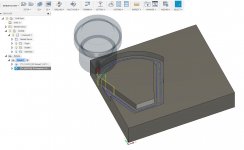
  • adaptive.JPG
    adaptive.JPG
    95.5 KB · Views: 24
To avoid these ads, REGISTER NOW!
Top Bottom