To avoid these ads, REGISTER NOW!

Upstairs radiators not heating

jeepwm69

Member
Joined
Aug 11, 2016
Messages
23
My house was built by my grandparents right after WWII (started in 47, finished in 48). House had radiators that we are using for heat, and I can't get the upstairs radiators to get warm.

So let's start with what I know.

Single pipe system, which has one hot water pipe (copper) going throughout the house, with lines coming off of it going to and from radiators. I honestly expected to see separate lines but apparently this is common.

Downstairs radiators all get hot without issue. Boiler has about 20PSI.

Upstairs had water line in, valve is open. Two radiators are connected to each other, sitting side by side. Air has been bled out of them.

Expansion tank is metal and in the basement rafters above the boiler.

The two lines going to the upstair radiators are at the very end of the system, about 6-8 feet from the circulation pump. I suspect this might be part of the problem.

Radiators are ice cold. I went to the basement and felt the lines, and the inlet line is warm, other line is not.

The lines run through a closet on the ground floor. Both lines are cold in the closet.

Yesterday I went upstairs and started bleeding water. After I bled out a couple of gallons I checked the inlet on the first radiator and it was hot. I bled out more water and the top pipe running between the radiators was warm, but the pipe going between radiators at the bottom was still cold. This tells me the inlet is clear and will allow hot water in.

This leads me to believe one of the following might be the issue.

A) This circuit is at the end of the system so there's not enough pressure to force water through the circuit. I don't THINK this is the issue as the pump would be pulling water and is close to the pipes going to these radiators.

B) The return line going from radiators back to main line is clogged

C) The way these two radiators are hooked together is somehow not allowing flow

The upstairs bedroom has been uninhabited until recently when my teenaged daughter decided to move up there. According to my mom (who grew up in the house) the upstairs radiators never worked very well at all.

My grandfather paneled and finished the upstairs bedroom some time in the 50's, doing the work himself, so I'm wondering if the way he has the radiators hooked together might be creating the issue.

Anyone have any ideas? I'd like to get heat up there so my kid isn't running electric heaters that might be a fire hazard.

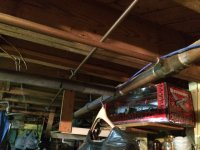
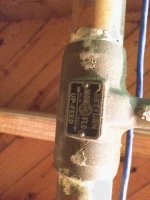
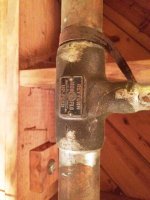
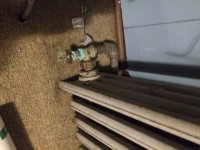
To explain pictures
First is inlet going into radiators
Second is how the two radiators are connected to one another (top to top, bottom to bottom). It's hard to see the top connection, but there is a pipe connecting the two rads at the top just like the one visible at the bottom.
Third shows the lines coming off the main line. Closest is return line, further away (wrapped in foam) is inlet line. Flow direction is towards camera
Fourth shows the pump, with line coming into top of the pump from where pic three was taken. About 4-5 feet of line between rad lines and the elbow doing down into the pump.
 

Attachments
  • inlet valve.jpg
    inlet valve.jpg
    118.5 KB · Views: 79
  • connectionrads.jpg
    connectionrads.jpg
    106 KB · Views: 73
  • water lines.jpg
    water lines.jpg
    121.8 KB · Views: 81
  • pump.jpg
    pump.jpg
    120.5 KB · Views: 75
Last edited:
To avoid these ads, REGISTER NOW!

Kaizen

Well-known member
Joined
Jan 9, 2015
Messages
6,948
Location
New England
location location location
If you are in the crazy cold vortex i'd guess some part of the return is frozen. Could be clogged but not usual with that size pipes and steam pressure. The return in a steam system is just like a drain. Is the cellar cold? Where it goes through the closet?
 

Dave in Mass

Well-known member
Joined
Jan 29, 2013
Messages
635
Location
Massachusetts
My house was having similar issues in the fall at the start of heating season. Hot water with baseboards (not radiators).

Furnace guy came out and bled the system just using gravity. Still no upstairs heat.

He used a pump to really cycle through and get all the air out of the system and we have been good since.

I know you said you bled but just my story on why it took a bit more than just a normal bleed.
 
OP
J

jeepwm69

Member
Joined
Aug 11, 2016
Messages
23
location location location
If you are in the crazy cold vortex i'd guess some part of the return is frozen. Could be clogged but not usual with that size pipes and steam pressure. The return in a steam system is just like a drain. Is the cellar cold? Where it goes through the closet?

Nah I'm in Arkansas. It's cold here but that "Southern cold".

Lines are all in areas that are warm. Right in the middle of the house.

Basement is warm as well, and the system is hot water, not steam.
 
OP
J

jeepwm69

Member
Joined
Aug 11, 2016
Messages
23
My house was having similar issues in the fall at the start of heating season. Hot water with baseboards (not radiators).

Furnace guy came out and bled the system just using gravity. Still no upstairs heat.

He used a pump to really cycle through and get all the air out of the system and we have been good since.

I know you said you bled but just my story on why it took a bit more than just a normal bleed.

I bled a couple of gallons of water out of it last night, and the inlet and first rad started getting warm. I'm wondering if having them connected together top and bottom in the middle is correct, or if that might not allow the proper flow.

You might also have a point in that I might have an airlock somewhere that allows water past to the bleeder but doesn't necessarily allow flow.

Perhaps I should turn off the downstairs radiators, which should put higher pressure on the upstairs lines/circuit, right? See if that forces anything through those upstairs radiators?

Thanks for the replies so far! Very frustrating
 

Kaizen

Well-known member
Joined
Jan 9, 2015
Messages
6,948
Location
New England
This is running as a steam boiler correct? Have you checked the water level site glass? Possible if low there isn’t enough steam to get up to the top of the column. Are you familiar with how steam works? There shouldn’t be much water in those rads if it’s working correctly. Do you have those air things in each ? They sound like a pressure cooker releasing steam.


Sent from my iPhone using Tapatalk
 

Kaizen

Well-known member
Joined
Jan 9, 2015
Messages
6,948
Location
New England
Forget my previous post. I see the circulator. Ok yes close the bottom floor ones, well really just the first one as they are all connected. Problem is with a circulating system it’s usually 3/4 inch pipe. He still has the old steam pipes from the look of it. So too much volume to get the hot water upstairs. If closing the valve works try opening it a little so the pressure is even between floors. If closing it does not work you might have air so opening the water supply and attaching a hose to the boiler will blow any air bubbles out. You might be able to put stop valves downstairs at those T’s to balance the flow. I’d start thinking about taking it all out and putting in baseboards. Those rads are great for steam but take some fiddling for hot water


Sent from my iPhone using Tapatalk
 

brewchief

Well-known member
Joined
Sep 20, 2008
Messages
2,370
Location
Michigan
That's a monoflow system, it has a large main line and the uses special monoflow tees to divert part of the flow to the radiator. They airlock pretty easy and can be a pain to bleed.

There are arrows on the tees, make sure both are going in the proper direction.

I've added a ball valve in the main between the tees in the past, closing it forces full flow through the radiators and can help bleed them.

If the branch lines are long you may find no matter what you do you can't get much flow, if that's the case there is always the option of addind a circulator to that loop to increase the flow.

Sent from my SM-G965U using Tapatalk
 

danski0224

Well-known member
Joined
Jan 29, 2005
Messages
13,411
Location
Near Naperville, IL
That looks like a B&G 100 circulator. Those are made for high volume, low head systems. Not what you have.

You need to figure out the head loss for your system, the proper GPM, and install a correctly sized circulator. If the system is one loop, then the boiler size will dictate GPM. Hopefully (probably not, in most cases) the main pipe will be properly sized.

The circulator is also installed wrong (based upon your written flow description)- it should be "pumping away", but that may not readily addressable due to the Monoflo tees. It's also unknown whether or not the Monoflo tees are installed properly.

I do not see an air removal device. Nor is there the air removal device that is supposed to be used with a compression tank.

Compression tanks are not nearly as good as expansion tanks, which were not readily available when the system was built. That can be changed.

In essence, like many systems, it fails at the basic installation level.
 
Last edited:

LS6 Tommy

Well-known member
Joined
Dec 27, 2013
Messages
26,162
Location
Northern NJ
That's a monoflow system, it has a large main line and the uses special monoflow tees to divert part of the flow to the radiator. They airlock pretty easy and can be a pain to bleed.

There are arrows on the tees, make sure both are going in the proper direction.

I've added a ball valve in the main between the tees in the past, closing it forces full flow through the radiators and can help bleed them.

If the branch lines are long you may find no matter what you do you can't get much flow, if that's the case there is always the option of addind a circulator to that loop to increase the flow.

Sent from my SM-G965U using Tapatalk


^^This^^

Monoflow systems can be a pain in the *** to bleed at the highest parts of the system. I finally made my second floor a separate zone and eliminated the monoflow tee completely.

Tommy
 
To avoid these ads, REGISTER NOW!

LS6 Tommy

Well-known member
Joined
Dec 27, 2013
Messages
26,162
Location
Northern NJ
That looks like a B&G 100 circulator. Those are made for high volume, low head systems. Not what you have.

You need to figure out the head loss for your system, the proper GPM, and install a correctly sized circulator. If the system is one loop, then the boiler size will dictate GPM.

The circulator is also installed wrong (based upon your written flow description)- it should be "pumping away", but that may not be fixable due to the Monoflo tees. It's also unknown whether or not the Monoflo tees are installed properly.

I do not see an air removal device. Nor is there the air removal device that is supposed to be used with a compression tank.

Compression tanks are not nearly as good as expansion tanks, which were not readily available when the system was built. That can be changed.

In essence, like many systems, it fails at the basic installation level.


There is nothing "wrong" with his setup. The pump is often on the return with diverter tees whether the diverter tee is on the supply or return side of the emitter. His design was very common in the period his house was built, but diverter tees can be installed a few different ways, and not all diverter tees are unidirectional. I agree that upgrading to an expansion tank when possible is a good idea.

Tommy
 
Last edited:

yeldogt

Well-known member
Joined
Jan 2, 2012
Messages
18,184
I agree this was a common system -- big single pump on the return. Simple tank

They don't like air.

Frankly -- you would do well to call a local company and have it looked at. As thing age --- multi marginal components can case problems. If the system worked before it will work again -- they need to be properly bled and have no leaks. Proper boiler temps -- expansion tank properly filled.
 

danski0224

Well-known member
Joined
Jan 29, 2005
Messages
13,411
Location
Near Naperville, IL
In the OP there is mention of "grandma said the upstairs didn't work" or something along those lines. It's a PITA to quote stuff and reply on a phone.

Even though that style circulator always seems to be used, it isn't really the proper choice once the pump curve is looked at. Lots of GPM, not so much head.

And the location of the compression or expansion tank relative to the boiler and circulator locations will influence what is happening with air in the system and pump head.

Bleeding water out of the system is forcing water to go places that the circulator can't push it.

It doesn't look like there is any modern air removal device like a Spirovent, nor do I see the type of fitting that's supposed to go on the boiler to work with a compression tank and Air Trol valve that goes in the compression tank.
 
OP
J

jeepwm69

Member
Joined
Aug 11, 2016
Messages
23
Thanks for the replies. There is an expansion tank in the rafters of the basement next to the boiler.

I did nose around a bit last night, and discovered that the lines going to the upstairs rads are 1/2", while the lines going to the downstairs rads are 3/4".

I found this thread, and wonder if the simple explanation offered as

"this whole thread started because the radiator was brought down from 1 inch piping to 1/2 inch copper pipe and cutting the gpm of circulation to four times less...

since 1/2 inch pipe will let 4 times less gpm of flow when compared to a one inch pipe gpm flow..that means you need four 1/2 inch pipes to get the gpm flow of a 1 inch pipe.
the Icesailor explained all this"


.https://forum.heatinghelp.com/discu...s-radiators-at-end-of-run-causing-problems/p2

I closed off the bottom radiators last night, and the line coming off the main hot water line did get hot further along than it did before, but still not enough to push water into the upstairs radiators.

I'll have to look at those T's in the line and see if they're marked. I have a feeling this part of the system was added years after the rest of the system was in place, so it might have been someone who didn't know what they were doing who didn't use the right monoflow T's or used undersized pipe going to the radiators.

Thank you for the responses so far. It doesn't get cold here often, but now that I have a kid living up there I'd like to make it at least tolerable when have cold snaps like we're having now.
 

yeldogt

Well-known member
Joined
Jan 2, 2012
Messages
18,184
Are you sure the supply is 1/2 or are the takeoff to each 1/2 ... My memory is 1.5 gpm for 1/2 -- so under ideal conditions w/170/80 water you can get a max 15k btu. That's ideal conditions.

3/4 gets you 4 and 40k -- so huge difference in capacity. Most modern boilers are piped with 1 1/4 and 1" .... old days larger because of oversizing. less insulation.

I run 1/2 pex to to my panel radiators -- two or three with one pipe diverters. I keep each loop around 10-11k max loss.

How many radiators are you trying to run ... and are you sure it's only 1/2 cu ??
 
OP
J

jeepwm69

Member
Joined
Aug 11, 2016
Messages
23
I looked at what was easily visible from the basement. The rest of the stuff is in the crawl space.

Ground floor radiator in the study has 3/4" copper pipe supply and return lines for that radiator. So does the one in the kitchen. The rest are up under the house but given that the ground floor system was put in all at once and the upstairs was added later I figure the downstairs units all have 3/4"

The lines going to the upstairs radiators are 1/2" copper line. Would do you mean by "takeoff"? Only two radiators upstairs, which are joined to one another at top and bottom, to make what I guess would effectively be one big radiator.

Main line appears to be 2".

Let's see, I have 14 rads running on the system on the ground floor. They are all different sizes though.

Boiler is on about 20psi when hot. Drops to about 15 when cold.
 
OP
J

jeepwm69

Member
Joined
Aug 11, 2016
Messages
23
Upon further inspection, there are diverter tees on the radiator return side marked "Mon Flo", which apparently is standard placement for monoflow systems.

That said, the upstairs circuit, which has lines run from the basement all the way to the 2nd floor, utilizes 1/2" copper line, where the shorter, ground floor circuits use 3/4" line.

Am I correct that given the length of the lines going upstairs that the lines should be bigger, not smaller, than the ground floor units in order to facilitate flow?
 

Attachments

  • upstairs.jpg
    upstairs.jpg
    114 KB · Views: 25
  • kitchen.jpg
    kitchen.jpg
    112.5 KB · Views: 19

yeldogt

Well-known member
Joined
Jan 2, 2012
Messages
18,184
How big of a space up stairs -- how large the radiators?

Typically you would have a larger line going to the second floor and the diverter tee's would come off of that line closer to radiators.

1/2 pipe will cary around 15k BTU's --

My guess is the layout is out of specification for the Tee's -- look up how far the Tee can be from the radiator. -- friction through 1/2 pipe to second floor stops almost all of the flow.

Short of ripping out the pipe ........You could get the smallest circulator pump and wire it into a Tstat - set up as a slave so it can only operate when the lower is running.
 
OP
J

jeepwm69

Member
Joined
Aug 11, 2016
Messages
23
Space upstairs is probably only about 200-250 square feet. One bedroom and a bathroom.

Right now I have two radiators hooked together, probably 6 feet long in total, 3 feet tall or so (I can measure and get definite dimensions)

I think this was added on after the fact, and don't know that the people who installed it really knew what they were doing.

I wondered about hooking up a small circulation pump as opposed to replumbing the whole thing.
 

yeldogt

Well-known member
Joined
Jan 2, 2012
Messages
18,184
Space upstairs is probably only about 200-250 square feet. One bedroom and a bathroom.

Right now I have two radiators hooked together, probably 6 feet long in total, 3 feet tall or so (I can measure and get definite dimensions)

I think this was added on after the fact, and don't know that the people who installed it really knew what they were doing.

I wondered about hooking up a small circulation pump as opposed to replumbing the whole thing.


The bypass tee's are not designed for long runs ... they work by diverting a small amount ....
 
To avoid these ads, REGISTER NOW!
Top Bottom