To avoid these ads, REGISTER NOW!

M18 Mid Torque or M12 Stubby for suspension work ?

visionguru

Well-known member
Joined
Jan 2, 2017
Messages
1,233
Location
Chicago
Where you getting these numbers from, or whats this revelation with their marketing gimmicks. Got any sources?

Those numbers are from Milwaukee's own specification sheets. Milwaukee specifies both real torque and nut busting torque for Mid-torque, High-torque impacts, but only nut busting torque for stubby.

Its impressive because of what it undid, did you watch the video?
It's impressive because of its power/size. Any M18 guns can beat that easily. The M18 compact is only 1" longer, but more powerful.

This $25 12v HF tool maybe bigger, @150 ft-lb, it's likely will do the similar as what the stubby can do.
https://www.harborfreight.com/12-volt-1-2-half-inch-emergency-impact-wrench-92349.html

I'm not saying it's not a good tool, just not a tool that has enough power to get suspension work done and far-from being the one tool that can get most done in a DIY.
 
Last edited:
To avoid these ads, REGISTER NOW!

Yarpo

Well-known member
Joined
Feb 11, 2017
Messages
1,356
Location
Minnesota
Those numbers are from Milwaukee's own specification sheets. Milwaukee specifies both real torque and nut busting torque

Care to share the differences in those terms or got a link? I was under the impression nut busting torque refers to maximum, reverse torque.

Never seen the anyone claim them to be different I guess
 

Yarpo

Well-known member
Joined
Feb 11, 2017
Messages
1,356
Location
Minnesota

DFB

Well-known member
Joined
Sep 7, 2016
Messages
5,765
Location
Southern VT/Western Mass
The reasons RTR present in his tests is why in this video the stubby seems to show even higher than rated torque values but only after numerous times removing and retightening the exact same fastener.

"When a nut/bolt is hot, it takes LESS TORQUE to remove it than it took to install it!"


Note how it took a full 16 seconds of pounding on the lug nut at 180 ft lbs cold, but after removing it several times and heating it up it could do it easier in approx half the time , (8 sec) after being tightened to a higher torque

Even at 80 ftlbs higher it took only 12 seconds

and with an a torque loss adapter and battery wear down :rolleyes:
 

WittHay

Well-known member
Joined
Jan 6, 2016
Messages
2,157
Location
Surrey, BC Canada
There is a big difference in ergonomics between the M18 and M12 tools, The M12 have fatter handles and the handles are set at different angles. A M18 compact or Mac 20V 3/8 actually feels lighter and less awkward than a M12 and the M12 stubby is worse.

I have 5 M18 Fuel impacts from 3/8 to 3/4 and am pleased with them. Even though I have some M12 tools I dont have any M12 impacts because I dont care much for the battery in the grip style. Totally a individual preference but as the OP has never used a impact before it should be pointed there are differences even amongst the same brand of tools.

For the OP the mid torque is a good all round impact and depending on the vehicle a impact driver, screwdriver or 1/4 impact and a 3/8 ratchet might be handier than a 3/8 or 1/2 stubby
 

Attachments

  • can-someone-post-a-photo-of-fuel-impact-1-4-3-8-2-all-side-by-archive-the-garage-journal-board-m.jpg
    can-someone-post-a-photo-of-fuel-impact-1-4-3-8-2-all-side-by-archive-the-garage-journal-board-m.jpg
    83.5 KB · Views: 39
  • IMG_20170209_084911136.jpg
    IMG_20170209_084911136.jpg
    157.8 KB · Views: 29
Last edited:

visionguru

Well-known member
Joined
Jan 2, 2017
Messages
1,233
Location
Chicago
Thanks! But I'm confused, max working torque he claims to be 1036, while Milwaukee claims 1100....I'll give them a little lee way. That's less than 10% embelesment on Milwaukee's part. Unless again I'm missing somthing. The testing methods by both parties may make up that difference.

Yeah, I agree with you that RTR's testing didn't make a good case to support his "big lie" claim. I'm sure the manufacturers' testing would be more accurate than RTR's. However, common sense tells us that there is no reason that the impact would magically generate more power when in reverse than forward.

Notice that in RTR's testing results:
Mode 1 Forward (Dynamic) = 161 ft-lbs
Mode 2 Forward (Dynamic) = 422 ft-lbs
Mode 1 Reverse (Dynamic) = 161 ft-lbs
Mode 2 Reverse (Dynamic) = 421 ft-lbs

The dynamic torque of "forward" and "reverse" are exactly the same. The "nut busting torque" is not the actual torque generated by the tool, but rather the maximum torque value of a bolt the tool can remove, which is often 30% higher.

It's fair to compare "nut busting" against "nut busting". It's not fair to compare "nut busting" againt "real torque". On Milwaukee's specifications, the stubby is conveniently missing the real torque specs, only the 250 ft-lb nut busting torque, obviously a marketing gimmick to make the stubby to appear more powerful than it really is.

Milwaukee makes quality tools, but their marketing people are full of B.S., always put bragging on every packaging of their tools.
 
Last edited:
To avoid these ads, REGISTER NOW!

Eric29

Well-known member
Joined
Apr 18, 2008
Messages
499
Location
Western NY
My 1/2" IR sometimes has a tough time with suspension parts that have seen several winters of snow and salt even when I crank up the air pressure. I guess it depends on what you're working on and where the vehicle has been.


I'm with this guy, I have the 1/2" IR and even that not always up to suspension/chassis work . I got work in timely fashion and when in shop I got airline right at the bay so use it as gives me a tool smaller than the battery stubby yet hits harder than the battery mid 1/2" .
I wouldn't go stubby battery for your initial post intended use and more so if working on older rusty type stuff .You want the hardest hitting compact gun you can get and also will want decent extension range and swivel sockets to get most use out of a battery impact as even a mid torque is a lot of cocking about to get socket on fastener good, seeing lot of cammed out fastener heads these days where tech just gunning it half cocked till socket cams out and just call it good, not great for customer as sometimes too loose and not great for next tech as if tight seized the cammed head won't hold any torque when trying remove it, getting this a lot on caliper bracket bolts and hub bearing bolts from sloppy work these days .
 

Shehzada

Well-known member
Joined
Oct 14, 2008
Messages
246
There is a big difference in ergonomics between the M18 and M12 tools, The M12 have fatter handles and the handles are set at different angles. A M18 compact or Mac 20V 3/8 actually feels lighter and less awkward than a M12 and the M12 stubby is worse.

I have 5 M18 Fuel impacts from 3/8 to 3/4 and am pleased with them. Even though I have some M12 tools I dont have any M12 impacts because I dont care much for the battery in the grip style. Totally a individual preference but as the OP has never used a impact before it should be pointed there are differences even amongst the same brand of tools.

For the OP the mid torque is a good all round impact and depending on the vehicle a impact driver, screwdriver or 1/4 impact and a 3/8 ratchet might be handier than a 3/8 or 1/2 stubby
Those 5 photos, can u please point out which one is which gun. Thanks

Sent from my mobile device
 

WittHay

Well-known member
Joined
Jan 6, 2016
Messages
2,157
Location
Surrey, BC Canada
Those 5 photos, can u please point out which one is which gun. Thanks

Sent from my mobile device

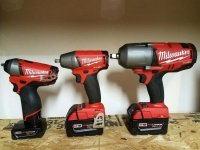
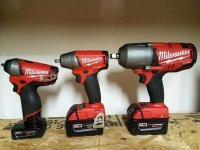
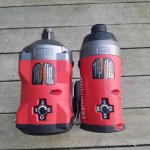
  • 1st group is a M12 1/4 , M18 3/8, older M18 1/2 high torque
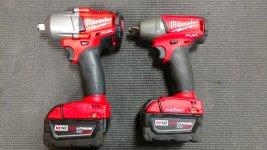
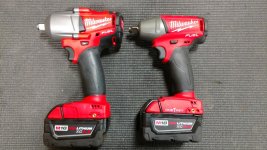
  • 2nd group is M18 1/2 mid torque, M18 1/2 compact
  • 3rd group is M12 3/8 stubby, M12 impact driver

Usually I use a compact M18 battery with the smaller M18 impacts vs. the large battery packs shown in the pictures
 

Attachments

  • can-someone-post-a-photo-of-fuel-impact-1-4-3-8-2-all-side-by-archive-the-garage-journal-board-m.jpg
    can-someone-post-a-photo-of-fuel-impact-1-4-3-8-2-all-side-by-archive-the-garage-journal-board-m.jpg
    83.5 KB · Views: 15
  • IMG_20170209_084911136.jpg
    IMG_20170209_084911136.jpg
    157.8 KB · Views: 19
  • 42068894_284610205708409_675377040690164975_n.jpg
    42068894_284610205708409_675377040690164975_n.jpg
    99.8 KB · Views: 21

Shehzada

Well-known member
Joined
Oct 14, 2008
Messages
246
  • 1st group is a M12 1/4 , M18 3/8, older M18 1/2 high torque
  • 2nd group is M18 1/2 mid torque, M18 1/2 compact
  • 3rd group is M12 3/8 stubby, M12 impact driver

Usually I use a compact M18 battery with the smaller M18 impacts vs. the large battery packs shown in the pictures
Thank you so much. I have the 2763 1/2 M18 that I love but always wanted to buy a smaller all rounder in 3/8 size since I have set of short impact sockets.

According to the photos, I like the 3/8 M18 and M18 1/2 compact. The M12 stubby (though it has a shorter nose) seems too fat.

What would you recommend?

Sent from my mobile device
 

DFB

Well-known member
Joined
Sep 7, 2016
Messages
5,765
Location
Southern VT/Western Mass
According to the photos, I like the 3/8 M18 and M18 1/2 compact.

Sent from my mobile device


I posted these numbers once in another thread once before. Mode RPM and IPM do vary between the 3/8" and 1/2" compact models which factor out to different maximum attainable torque values in the respective ranges.

So that's something to note when deciding on the anvil drive.

Overall the 2 compacts are the same size body and many people chose based on the impact socket drive size they most often use. And of course any of the tools can be run with different size adapters...


2754-20
Mode#1 900
Mode#2 1600
Mode#3 2500 (210ftlbs max rating)
Mode #4 1600 - tool will shut off after about one second of impacting ††

2755-20 pin
2755B-20 ring
Mode#1 1700
Mode#2 2000
Mode#3 2500 (220ftlbs max rating)
Mode#4 2000 - tool will shut off after about one second of impacting †††

No IPM are given anymore in the Operators Manual for current compacts


And just for a general comparison I have added the specs that came with the older Gen 1 series tools.

Milwaukee once did have torque values attached to the various rpm/ipm's combinations of the different ranges. For whatever their reasons Milwaukee has decided not to relate those various numbers with the tools anymore.

Take it for what it's worth values may relate very similar to the current models


2654-20 ring
Mode#1 900RPM/1100 IPM 30ft.lbs
Mode#2 1600RPM/2400IPM 75ft.lbs
Mode#3 2400RPM/3100IPM 200ftlbs

2655-20 pin
2655B-20 ball pin

Mode#1 1700RPM / 2000IPM 80ft.lbs
Mode#2 2000RPM / 3000IPM 120ft.lbs
Mode#3 2400RPM / 3100IPM 210ft.lbs
 

Shehzada

Well-known member
Joined
Oct 14, 2008
Messages
246
I posted these numbers once in another thread once before. Mode RPM and IPM do vary between the 3/8" and 1/2" compact models which factor out to different maximum attainable torque values in the respective ranges.

So that's something to note when deciding on the anvil drive.

Overall the 2 compacts are the same size body and many people chose based on the impact socket drive size they most often use. And of course any of the tools can be run with different size adapters...


2754-20
Mode#1 900
Mode#2 1600
Mode#3 2500 (210ftlbs max rating)
Mode #4 1600 - tool will shut off after about one second of impacting ††

2755-20 pin
2755B-20 ring
Mode#1 1700
Mode#2 2000
Mode#3 2500 (220ftlbs max rating)
Mode#4 2000 - tool will shut off after about one second of impacting †††

No IPM are given anymore in the Operators Manual for current compacts


And just for a general comparison I have added the specs that came with the older Gen 1 series tools.

Milwaukee once did have torque values attached to the various rpm/ipm's combinations of the different ranges. For whatever their reasons Milwaukee has decided not to relate those various numbers with the tools anymore.

Take it for what it's worth values may relate very similar to the current models


2654-20 ring
Mode#1 900RPM/1100 IPM 30ft.lbs
Mode#2 1600RPM/2400IPM 75ft.lbs
Mode#3 2400RPM/3100IPM 200ftlbs

2655-20 pin
2655B-20 ball pin

Mode#1 1700RPM / 2000IPM 80ft.lbs
Mode#2 2000RPM / 3000IPM 120ft.lbs
Mode#3 2400RPM / 3100IPM 210ft.lbs
Thank you

Sent from my mobile device
 
To avoid these ads, REGISTER NOW!
Top Bottom